

- Market Size (2026)
- USD 866.0 Mn
- Forecast (2036)
- USD 1580.4 Mn
- CAGR (2026 to 2036)
- 6.2%
How big is Wrinkle Smoothing Patches Market in 2026?
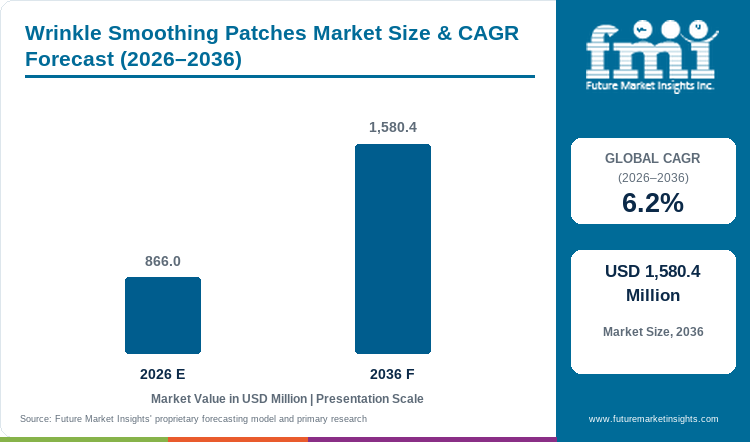
USD 866.0 Million in 2026 and USD 1,580.4 Million by 2036 at a 6.2% CAGR.
Demand for wrinkle smoothing patches is projected to expand at 6.2% CAGR between 2026 and 2036, increasing market value from USD 866.0 Million in 2026 to USD 1,580.4 Million by 2036. Consumers can evaluate a targeted treatment at home without booking a procedure, so repeat demand depends on whether the visible effect is clear enough to justify routine use.
The U.S. Census Bureau reported in June 2025 that the population age 65 and older reached 61.2 million in 2024 and represented 18.0% of the population. That expands the population managing age-related skin concerns, although demographic change does not create a sale by itself. Buyers still compare tolerability, application effort and evidence behind the stated cosmetic effect before a product becomes part of a repeat routine.
Key Takeaways
- At-home wrinkle care gains repeat demand when the visible result is easy to judge and the application fits an established skin-care routine.
- Core / classic lines are projected to account for 36.0% of Product Type demand in 2026.
- Conventional products are estimated at 53.0% of Nature demand in 2026.
- Cream & balm is forecast to hold 34.0% of Format demand in 2026.
- Wrinkle claims face different evidence and product-control requirements across the EU, Great Britain, South Korea and Gulf markets.
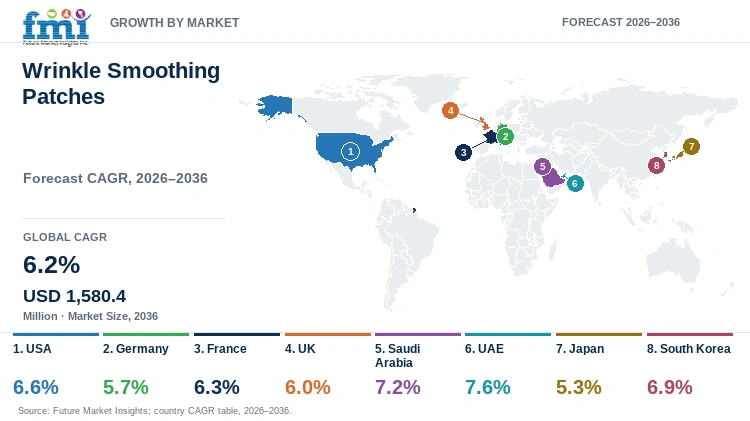
- UAE records the highest country CAGR shown at 7.6% from 2026 to 2036, followed by Saudi Arabia at 7.2% and South Korea at 6.9%.
- Unilever, The Estée Lauder Companies, L'Oréal Groupe, Coty, Shiseido, Kao Corporation, Procter & Gamble, Amorepacific, e.l.f. Beauty and Beiersdorf form the named competitive set.
Analyst Perspective
"Wrinkle-smoothing products earn repeat purchase when the result is easy to evaluate and the routine is easy to maintain. Brands should align claim wording with the evidence before scaling promotion, then make the format fit how consumers already buy and use treatment-led skin care."
- Rahul Pandita, Principal Consultant, Future Market Insights
How is the Wrinkle Smoothing Patches Market segmented?
The wrinkle smoothing patches market is segmented by Product Type, Nature, Format, Price Positioning, Sales Channel and Region.
Product Type separates broad core ranges from targeted, sensitive, premium and kit-based treatment offers. Nature distinguishes conventional formulas from vegan, natural, dermocosmetic and fragrance-free positions. Format captures how the treatment is delivered, while Price Positioning reflects the spending threshold attached to the claim and sensorial experience. Sales Channel shows where discovery, advice and replenishment occur. Region captures the local evidence and product-control requirements that shape launch timing.
Why do Core / classic lines lead the Product Type category?
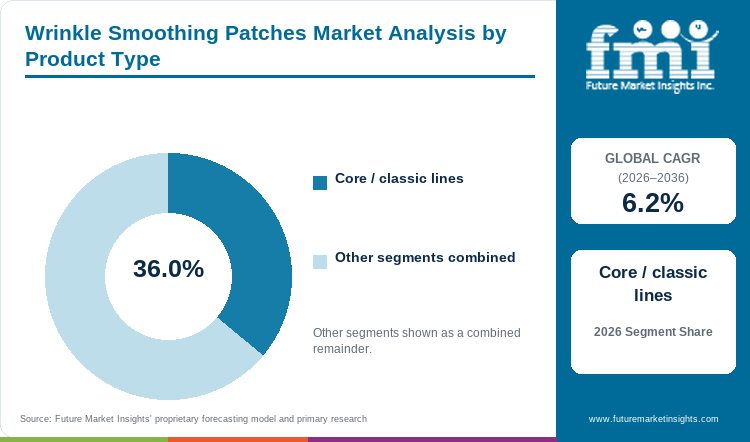
Core / classic lines reduce trial friction because consumers can compare a familiar wrinkle-care promise with products already used in a daily routine. A broad core range also gives brands room to serve several age groups without narrowing the offer to one facial zone. This positioning overlaps with the wider anti-aging skincare market, where proof of visible benefit and routine fit influence repeat purchase.
- Core / classic lines account for 36.0% of Product Type demand in 2026 because familiar benefit framing can lower the barrier to trial and repeat use.
- In August 2025, Beiersdorf introduced NIVEA Cellular Epigenetics Rejuvenating Serum to the mass market with EPICELLINE after first introducing the ingredient under Eucerin in 2024. The move shows how a research-led anti-aging concept can migrate from dermocosmetic positioning into a wider consumer price tier.
Why does Conventional lead the Nature category?
Conventional formulations give brands wide latitude to balance efficacy with stability and price. Vegan or natural positioning can matter to specific buyers, while dermocosmetic and fragrance-free offers address sensitivity or evidence expectations. The segment remains commercially relevant when consumers judge the treatment primarily on visible performance and tolerability, a pattern also seen across the broader skincare products market.
- Conventional products hold 53.0% of Nature demand in 2026 because formulation flexibility supports performance and price targets across several consumer tiers.
- In August 2025, Shiseido announced a renewed ELIXIR wrinkle cream for launch in Japan on September 21. The product uses pure retinol as an approved wrinkle-improvement active, strengthening the evidence threshold for localized wrinkle-treatment positioning in Japan.
Why does Cream & balm lead the Format category?
Cream & balm formats fit familiar leave-on routines and can be positioned for localized dryness or line-softening care. Consumers already understand dosage and frequency, which reduces the education burden compared with a less familiar delivery system. Serums offer a lighter treatment experience, while sheets and patches provide more localized application. The same format logic appears in the anti-aging creams and serums market.
- Cream & balm represents 34.0% of Format demand in 2026 because leave-on textures fit familiar wrinkle-care routines.
- In August 2024, Amorepacific renewed Sulwhasoo's Concentrated Ginseng Rejuvenating line with cream and rich-cream textures positioned around elasticity, wrinkles and hydration.
How does Price Positioning shape purchase in the Wrinkle Smoothing Patches Market?
Price Positioning changes the level of proof and sensorial differentiation a buyer expects. Mass offers lower the cost of trial, while masstige and premium products can support higher prices through stronger ingredient stories or a more distinctive experience. Professional positioning carries a higher evidence and service threshold. The commercial issue is whether the perceived benefit supports the intended repeat-purchase price.
- Beiersdorf stated in August 2025 that NIVEA brought EPICELLINE from a derma-brand launch into the mass market, illustrating how science-led concepts can move across price tiers.
How does Sales Channel shape purchase in the Wrinkle Smoothing Patches Market?
Sales Channel affects how much explanation a wrinkle treatment receives before purchase and how easily it can be replenished. Digital channels can show application steps and comparison content, while specialty beauty and pharmacy routes can add advice or credibility. Supermarkets widen access and salons can support professional recommendation. Channel economics depend on converting first-time trial into repeat use without relying on continuous discounting.
- In May 2025, e.l.f. Beauty agreed to acquire skin-focused rhode after the brand built a strong direct-to-consumer business, with Sephora expansion planned in North America and the UK.
What are the drivers, restraints and opportunities in the Wrinkle Smoothing Patches Market?
At-home wrinkle care supports demand, while claims evidence and country product controls raise launch friction, and accessible science-led routines create room for wider repeat use.
- Driver: Consumers are seeking visible wrinkle-smoothing benefits that can be added to a home routine without a professional procedure.
- Restraint: Wrinkle claims require evidence and can face different regulatory treatment across countries, which increases launch work and limits reusable global copy.
- Opportunity: Brands can widen repeat purchase by connecting accessible prices with clearer proof and low-friction replenishment.
The main demand mechanism is convenience around a visible cosmetic concern. A consumer can apply a targeted product at home and decide whether the smoothing effect earns a place in the routine. The U.S. population age 65 and older reached 61.2 million in 2024, according to the Census Bureau, but age alone is not the commercial trigger. Purchase depends on a legible use case and a benefit that remains worth repeating.
Claims create the clearest launch constraint because the same wording can carry different evidence obligations across markets. Commission Regulation (EU) No 655/2013 requires cosmetic claims in the European Union to meet common criteria and align with supporting documentation. Great Britain requires a Responsible Person to keep a Product Information File and be able to prove marketing claims. South Korea has a formal evaluation route for functional cosmetics, including products that require evidence of function. These requirements can extend launch timelines when one product needs market-specific substantiation or labeling.
The commercial opportunity is to move credible treatment science into routines that do not require premium-only pricing. Beiersdorf demonstrated this direction in August 2025 by moving EPICELLINE from Eucerin into a NIVEA mass-market serum. Digital channels can then explain usage and support replenishment. The wider skincare market shows the same pressure toward routine-based active care, but repeat purchase still depends on evidence that matches the claim and tolerability that supports frequent use.
Which country CAGRs are compared in the Wrinkle Smoothing Patches Market?
| Country | CAGR |
|---|---|
| USA | 6.6% |
| Germany | 5.7% |
| France | 6.3% |
| UK | 6.0% |
| Saudi Arabia | 7.2% |
| UAE | 7.6% |
| Japan | 5.3% |
| South Korea | 6.9% |
How do country-level CAGRs compare in the Wrinkle Smoothing Patches Market?
The country growth rates shown span 2.3 percentage points from UAE at 7.6% to Japan at 5.3%. UAE and Saudi Arabia form the fastest-growth Gulf band. South Korea, USA and France range from 6.9% to 6.3%. UK, Germany and Japan range from 6.0% to 5.3%. These rates compare forecast pace rather than absolute market size.
- UAE at 7.6% is 0.4 percentage points above Saudi Arabia at 7.2%. Both markets require disciplined product documentation before promotion scales.
- Saudi Arabia at 7.2% is 0.3 percentage points above South Korea at 6.9%. Gulf conversion depends heavily on channel expansion, while South Korea places more weight on the functional-cosmetics route for stronger wrinkle claims.
- South Korea at 6.9%, USA at 6.6% and France at 6.3% form a close band where claims credibility and repeat-purchase economics matter more than small CAGR differences.
- UK at 6.0%, Germany at 5.7% and Japan at 5.3% form the lower band among the countries shown. Established routines and formal evidence expectations raise the conversion threshold for new offers.
CAGR should be used to compare pace, not market size. A slower-growing country can still support substantial revenue if the buyer base and retail reach are large. Price tolerance and claims requirements also affect the addressable opportunity, as does the cost of customer acquisition.
Country-wise Analysis
- USA: Consumers buy wrinkle care across mass retail, specialty beauty and direct channels. Demand for Wrinkle Smoothing Patches in USA is forecast to expand at 6.6% CAGR from 2026 to 2036. The U.S. Census Bureau reported that people age 65 and older represented 18.0% of the population in 2024. e.l.f. Beauty's 2025 agreement to acquire rhode also shows continued investment in skin-focused digital brands. Suppliers need clear instructions and credible proof that can survive comparison across a crowded channel set.
- Germany: Buyers combine drugstore familiarity with a mature online shopping habit. Demand for Wrinkle Smoothing Patches in Germany is forecast to expand at 5.7% CAGR from 2026 to 2036. Destatis reported that 23% of people aged 16 to 74 bought everyday goods such as food, detergent or cosmetics online during the prior three months in 2023. Suppliers need concise substantiation and channel execution that works across drugstore and e-commerce settings.
- France: Consumers move between perfumery, specialty beauty and online retail. Demand for Wrinkle Smoothing Patches in France is forecast to expand at 6.3% CAGR from 2026 to 2036. Insee reported that 63% of people aged 15 or older bought products or services online during the prior three months in 2024. Dense brand choice raises the cost of weak differentiation, so suppliers need a defensible claim and consistent positioning across channels.
- UK: Buyers have broad access to mass, specialty and pharmacy channels. Demand for Wrinkle Smoothing Patches in UK is forecast to expand at 6.0% CAGR from 2026 to 2036. Government guidance requires a GB Responsible Person, a Product Information File and notification before a cosmetic product is made available. The Responsible Person must also be able to prove marketing claims. Suppliers should complete the compliance file before scaling campaign language.
- Saudi Arabia: Consumers encounter wrinkle care through pharmacies, malls and digital channels. Demand for Wrinkle Smoothing Patches in Saudi Arabia is forecast to expand at 7.2% CAGR from 2026 to 2036. The Saudi Food and Drug Authority maintains a list of cosmetic products for which importers or manufacturers have submitted marketing notification, and the notifier assumes responsibility under applicable rules. Suppliers need a capable local route to market and completed notification before broad promotion.
- UAE: Buyers have dense exposure to prestige retail and marketplaces. Demand for Wrinkle Smoothing Patches in UAE is forecast to expand at 7.6% CAGR from 2026 to 2036. Dubai Municipality reported in October 2024 that its beauty-product oversight uses an integrated laboratory system with more than 5,000 advanced testing techniques. Suppliers need disciplined product documentation and local replenishment that can support fast-moving imported assortments.
- Japan: Buyers are accustomed to detailed skin-care routines and precise benefit categories. Demand for Wrinkle Smoothing Patches in Japan is forecast to expand at 5.3% CAGR from 2026 to 2036. In August 2025, Shiseido announced a renewed ELIXIR wrinkle cream for a September 21 launch using pure retinol as an approved wrinkle-improvement active. New entrants need precise benefit language and a format that fits established repeat-use habits.
- South Korea: Consumers are highly exposed to treatment-led skin care and digital product education. Demand for Wrinkle Smoothing Patches in South Korea is forecast to expand at 6.9% CAGR from 2026 to 2036. The Ministry of Food and Drug Safety lists a 60-day review period for functional-cosmetics evaluation where examination is required. Suppliers should align substantiation with the intended wrinkle claim before translating the proof into mobile-first content.
Who are the notable companies in the Wrinkle Smoothing Patches Market?
Unilever, The Estée Lauder Companies, L'Oréal Groupe, Coty, Shiseido, Kao Corporation, Procter & Gamble, Amorepacific, e.l.f. Beauty and Beiersdorf are the notable companies covered in this market.
Competition spans scaled consumer groups, prestige skin-care specialists and digital-led brands. Large portfolios can place wrinkle care across several price tiers, while specialist treatment brands compete on a narrower efficacy story. Recent acquisitions and product launches also show continued investment in treatment-led skin care. The same company set appears across the wider beauty and personal care product market, although this report counts only products within the defined wrinkle-smoothing scope.
- Unilever, L'Oréal Groupe, Procter & Gamble and Beiersdorf bring broad consumer reach and multi-price skin-care portfolios.
- The Estée Lauder Companies, Shiseido, Kao Corporation and Amorepacific compete through prestige or research-led skin care with treatment-focused product platforms.
- Coty and e.l.f. Beauty add portfolio flexibility and digital activation, with e.l.f. expanding its skin-care position through the rhode transaction.
Competitive Benchmarking: Wrinkle Smoothing Patches Market
| Company | Current public evidence | Treatment focus | Route to market | Geographic signal |
|---|---|---|---|---|
| The Estée Lauder Companies | Serpin Pharma collaboration announced in February 2025 | Skin longevity and anti-inflammatory ingredient research | Prestige skin care and digital retail | Global beauty markets |
| L'Oréal Groupe | Agreement to acquire a majority stake in Medik8 announced in June 2025 | Premium retinal-led treatment skin care | Online and offline omnichannel retail | Europe with growing U.S. presence |
| Shiseido | Renewed ELIXIR wrinkle cream announced in August 2025 | Regulated wrinkle-improvement treatment in Japan | Consumer skin-care channels | Japan with wider international skin-care reach |
| Kao Corporation | Curél Netherlands launch announced in June 2026 | Sensitive-skin and derma-oriented skin care | Etos Derma launch in the Netherlands | Japan and expanding EMEA presence |
| Amorepacific | Sulwhasoo Concentrated Ginseng Rejuvenating line renewed in August 2024 | Prestige anti-aging creams and related treatments | Brand stores and online brand channels | South Korea with international prestige reach |
| e.l.f. Beauty | rhode acquisition agreement announced in May 2025 | Skin-focused digital brand expansion | DTC with planned Sephora expansion | North America and UK expansion |
| Beiersdorf | NIVEA EPICELLINE serum launched to mass market in August 2025 | Science-led mass and dermocosmetic anti-aging | Mass retail plus derma-brand channels | Europe with broader international rollout |
The benchmark summarizes recent public product or portfolio evidence relevant to treatment-led skin care. It does not assign company market share, and companies without comparable recent evidence are retained in the wider company list rather than scored.
Key Developments in the Wrinkle Smoothing Patches Market
- In February 2025, The Estée Lauder Companies announced a collaboration with Serpin Pharma to explore how anti-inflammatory biotechnology could be applied to cosmetic skin-care ingredients for skin longevity. The commercial relevance is future differentiation in evidence-led treatment products if the research converts into finished products.
- In June 2025, L'Oréal Groupe signed an agreement to acquire a majority stake in British premium skin-care brand Medik8. L'Oréal described Medik8 as an ingredient-led brand known for Crystal Retinal and an omnichannel mix across Europe with growing U.S. presence.
- In August 2025, Shiseido announced a renewed ELIXIR wrinkle cream for launch in Japan on September 21. The targeted cream uses pure retinol as an approved quasi-drug active for wrinkle improvement and applies Shiseido Retinol TripleLock Technology to protect the ingredient. The launch raises the proof standard for localized wrinkle treatments in Japan and reinforces the commercial value of regulated efficacy language where consumers already understand treatment-led routines.
- In August 2025, Beiersdorf introduced NIVEA Cellular Epigenetics Rejuvenating Serum to the mass market with EPICELLINE. The company had first introduced the ingredient under Eucerin in 2024 and said the NIVEA rollout would extend the technology across more countries. The move shows how science-led anti-aging propositions can migrate from dermocosmetic positioning toward accessible price points, increasing competitive pressure on mass wrinkle-care products to pair affordability with stronger evidence.
Key Players in the Wrinkle Smoothing Patches Market
Scaled Multi-Channel Skin-Care Platforms
- Unilever
- L'Oréal Groupe
- Procter & Gamble
- Beiersdorf
Prestige and Research-Led Treatment Specialists
- The Estée Lauder Companies
- Shiseido
- Kao Corporation
- Amorepacific
Agile Portfolio and Channel Expanders
- Coty
- e.l.f. Beauty, Inc.
Wrinkle Smoothing Patches Market - Report Scope
| Coverage field | Report scope |
|---|---|
| Market breakdown | Product Type, Nature, Format, Price Positioning, Sales Channel and Region |
| Quantitative Units | USD Million |
| Market Definition | Revenue from wrinkle-smoothing patches and companion topical formats positioned for visible cosmetic smoothing within the stated Product Type, Nature, Format, Price Positioning and Sales Channel categories. Professional aesthetic procedures, prescription treatments and devices are excluded. |
| Regions Covered | North America; Latin America; Western Europe; Eastern Europe; East Asia; South Asia and Pacific; Middle East and Africa |
| Countries Covered | USA; Germany; France; UK; Saudi Arabia; UAE; Japan; South Korea; more than twenty-five additional countries in the full report |
| Key Companies Covered | Unilever; The Estée Lauder Companies; L'Oréal Groupe; Coty; Shiseido; Kao Corporation; Procter & Gamble; Amorepacific; e.l.f. Beauty, Inc.; Beiersdorf |
| Forecast Period | 2026 to 2036 |
| Approach | Primary and secondary research with market triangulation. |
Wrinkle Smoothing Patches Market - Research Methodology
| Method | Approach |
|---|---|
| Primary Research | FMI analysts gather input from beauty brands, retailers, distributors, category teams and subject-matter specialists. Interviews examine purchase triggers, price positioning, channel behavior and the evidence buyers expect before repeat use. |
| Desk Research | Desk research covers regulator guidance, official statistics, company filings, product information and corporate announcements relevant to wrinkle-smoothing products, claims and route-to-market conditions. |
| Market Sizing and Forecasting | Market sizing combines the 2025 base year with the 2026 forecast start and 2036 forecast end. Forecast assumptions consider segment structure, country growth, channel access, price positioning, product innovation and compliance requirements. |
| Data Validation | Estimates are compared across independent public indicators and primary interviews. Products and revenues are checked against the market definition to reduce overlap with adjacent skin-care categories. |
Wrinkle Smoothing Patches Market by Segments
Wrinkle Smoothing Patches Market segmented by Product Type:
- Core / classic lines
- Targeted treatment lines
- Sensitive & gentle lines
- Premium & clinical lines
- Kits & sets
Wrinkle Smoothing Patches Market segmented by Nature:
- Conventional
- Vegan & cruelty-free
- Natural & organic
- Dermocosmetic / clinical
- Fragrance-free & sensitive
Wrinkle Smoothing Patches Market segmented by Format:
- Cream & balm
- Liquid & serum
- Stick & solid
- Spray & mist
- Sheet & patch
- Powder
Wrinkle Smoothing Patches Market segmented by Price Positioning:
- Mass
- Masstige
- Premium
- Professional
Wrinkle Smoothing Patches Market segmented by Sales Channel:
- E-commerce & DTC
- Specialty beauty retail
- Pharmacies & drugstores
- Supermarkets & hypermarkets
- Salons & spas
Wrinkle Smoothing Patches Market by Region:
- North America
- United States
- Canada
- Latin America
- Brazil
- Mexico
- Argentina
- Chile
- Western Europe
- Germany
- France
- United Kingdom
- Italy
- Spain
- Benelux
- Nordics
- Eastern Europe
- Poland
- Czech Republic
- Romania
- Hungary
- East Asia
- China
- Japan
- South Korea
- South Asia and Pacific
- India
- ASEAN
- Australia and New Zealand
- Middle East and Africa
- GCC Countries
- South Africa
- Türkiye
- Israel
Research Sources and Bibliography
- USA Census Bureau (2025, June 26). Older Adults Outnumber Children in 11 States and Nearly Half of U.S. Counties.
- Statistisches Bundesamt (2024, February 27). 23% der 16- bis 74-Jährigen kaufen Lebensmittel oder Kosmetika online.
- Insee (2025, October 14). Achats de produits et de services en ligne.
- Department for Business and Trade and Office for Product Safety and Standards. Making cosmetic products available to consumers in Great Britain.
- European Commission (2013, July 10). Commission Regulation (EU) No 655/2013 on common criteria for cosmetic claims.
- Saudi Food and Drug Authority. List of Notification of Marketing for Cosmetic Products (Listed Products).
- Dubai Municipality (2024, October 28). Raising Cosmetics Standards at Beauty World.
- Ministry of Food and Drug Safety, Republic of Korea. Approval Process: Functional Cosmetics.
- L'Oréal Groupe (2025, June 9). L'Oréal Groupe to acquire a majority stake in Medik8.
- The Estée Lauder Companies (2025, February 26). The Estée Lauder Companies Partners with Serpin Pharma, Inc. to Develop Breakthrough Skin Care Ingredients to Advance Longevity.
- Shiseido Company (2025, August 4). ELIXIR renewed wrinkle cream with pure retinol for September 21 launch.
- Beiersdorf (2025, August 13). Beiersdorf brings epigenetic innovation to the mass market: NIVEA serum featuring EPICELLINE.
- e.l.f. Beauty (2025, May 28). e.l.f. Beauty Announces Definitive Agreement to Acquire rhode.
- Kao Corporation (2026, June 2). Kao Accelerates Skin Care Growth in EMEA with Curél Launch in the Netherlands.
- Amorepacific (2024, August 5). Sulwhasoo Launches Renewed Concentrated Ginseng Rejuvenating Anti-Aging Line.
This bibliography is provided for reader reference and is not exhaustive. The full report contains the complete reference list and detailed citations.
This Report Answers
- What is the Wrinkle Smoothing Patches Market size in 2026 and what is it forecast to reach by 2036?
- Which consumer and industry pressures support demand for at-home wrinkle-smoothing routines?
- Why do Core / classic lines hold the leading position in Product Type?
- How does Conventional positioning influence formulation flexibility and downstream demand?
- Why does Cream & balm hold the leading position in Format?
- How do growth rates differ across USA, Germany, France, UK, Saudi Arabia, UAE, Japan, and South Korea?
- Which roles do Unilever, The Estée Lauder Companies, L'Oréal Groupe, Coty, Shiseido, Kao Corporation, Procter & Gamble, Amorepacific, e.l.f. Beauty and Beiersdorf play in the competitive landscape?
- How do claims substantiation and country-specific product controls limit adoption?
- What should brand, category, and channel decision-makers evaluate before investing in wrinkle-smoothing products?
Frequently Asked Questions
What is driving growth in the Wrinkle Smoothing Patches Market?
Growth is tied to demand for visible wrinkle-smoothing benefits that fit a home skin-care routine. Digital discovery can shorten the path to trial, but repeat purchase depends on whether the effect remains worth the price and application effort.
Who are the key players in the Wrinkle Smoothing Patches Market?
Key companies include Unilever, The Estée Lauder Companies, L'Oréal Groupe, Coty, Shiseido, Kao Corporation, Procter & Gamble, Amorepacific, e.l.f. Beauty and Beiersdorf. Their positions differ across mass reach, treatment-led skin care and digital channel execution.
What is a notable restraint in the Wrinkle Smoothing Patches Market?
Claims substantiation is a material restraint because wrinkle language can trigger different evidence or regulatory requirements across countries. Launch timing can lengthen when testing, documentation or local promotional wording must change.
Why should executives track the Wrinkle Smoothing Patches Market?
The category shows how anti-aging treatment concepts are moving across price tiers while digital channels shorten the path to trial. Executives should track whether stronger claims can be supported at the intended price and in each target market.
What business problem does the Wrinkle Smoothing Patches Market address?
The market addresses demand for a convenient cosmetic response to visible fine lines and wrinkles without an appointment or procedure. Products compete on whether targeted care is easy to apply and useful enough to repeat within an existing routine.
What should brand and category managers evaluate in the Wrinkle Smoothing Patches Market?
Managers should define the exact claim and target facial area before committing launch spend. Format and price tier should fit the intended channel, and the product should demonstrate enough benefit and tolerability to convert first-time trial into repeat use.
What limits return on investment in the Wrinkle Smoothing Patches Market?
Return can weaken when customer-acquisition spending exceeds repeat purchase or when evidence work must be repeated across jurisdictions. Heavy discounting also reduces economics if buyers purchase only during promotions.
What supports long-term commercial confidence in the Wrinkle Smoothing Patches Market?
Long-term demand is supported by persistent consumer interest in visible aging concerns and continued investment in skin-care science. The stronger commercial signal is whether treatment concepts can move across price tiers while retaining credible evidence. Key Players
Preview the report firsthand - request a free sample
Get SampleGet the brochure for pricing and purchase details.
Get PDFTable of Content
- Key Takeaways
- Market Size and CAGR
- Top Growth Driver
- Fastest Growing Segment
- Leading Region
- Key Companies
- Emerging Opportunities
- Executive Summary
- Global Market Outlook
- Demand-side Trends
- Supply-side Trends
- Technology Roadmap Analysis
- Analysis and Recommendations
- Analyst Perspective (What is happening? Why now? What should investors know?)
- Key Questions Answered
- How large is the market?
- What is the CAGR?
- What are key trends?
- Which region dominates?
- Who are the leaders?
- Market Overview
- Market Coverage / Taxonomy
- Market Definition / Scope / Limitations
- Research Methodology
- Chapter Orientation
- Analytical Lens and Working Hypotheses
- Market Structure, Signals, and Trend Drivers
- Benchmarking and Cross-market Comparability
- Market Sizing, Forecasting, and Opportunity Mapping
- Research Design and Evidence Framework
- Desk Research Programme (Secondary Evidence)
- Expert Input and Fieldwork (Primary Evidence)
- Tooling, Models, and Reference Databases
- Data Engineering and Model Build
- Quality Assurance and Audit Trail
- Market Background
- Market Dynamics (Drivers, Restraints, Opportunity, Trends)
- Scenario Forecast (Optimistic, Likely, Conservative)
- Impact Analysis
- AI Impact
- Sustainability Impact
- Regulatory Impact
- Technology Impact
- Consumer / Buyer Analysis
- Purchase Drivers
- Adoption Barriers
- Buyer Journey
- Opportunity Map Analysis
- Product Life Cycle Analysis
- Supply Chain Analysis
- Investment Feasibility Matrix
- Value Chain Analysis
- PESTLE and Porter's Analysis
- Regulatory Landscape
- Regional Parent Market Outlook
- Production and Consumption Statistics
- Import and Export Statistics
- Global Market Analysis and Forecast, 2021 to 2036
- Historical Market Size Value (USD Million) Analysis, 2021 to 2025
- Current and Future Market Size Value (USD Million) Projections, 2026 to 2036
- Y-o-Y Growth Trend Analysis
- Absolute $ Opportunity Analysis
- Global Market Pricing Analysis, 2021 to 2036
- Global Market Analysis and Forecast, By Product Type, 2021 to 2036
- Introduction / Key Findings
- Historical Market Size Value (USD Million) Analysis By Product Type, 2021 to 2025
- Current and Future Market Size Value (USD Million) Analysis and Forecast By Product Type, 2026 to 2036
- Core / classic lines
- Targeted treatment lines
- Sensitive & gentle lines
- Premium & clinical lines
- Kits & sets
- Y-o-Y Growth Trend Analysis By Product Type, 2021 to 2025
- Absolute $ Opportunity Analysis By Product Type, 2026 to 2036
- Global Market Analysis and Forecast, By Nature, 2021 to 2036
- Introduction / Key Findings
- Historical Market Size Value (USD Million) Analysis By Nature, 2021 to 2025
- Current and Future Market Size Value (USD Million) Analysis and Forecast By Nature, 2026 to 2036
- Conventional
- Vegan & cruelty-free
- Natural & organic
- Dermocosmetic / clinical
- Fragrance-free & sensitive
- Y-o-Y Growth Trend Analysis By Nature, 2021 to 2025
- Absolute $ Opportunity Analysis By Nature, 2026 to 2036
- Global Market Analysis and Forecast, By Format, 2021 to 2036
- Introduction / Key Findings
- Historical Market Size Value (USD Million) Analysis By Format, 2021 to 2025
- Current and Future Market Size Value (USD Million) Analysis and Forecast By Format, 2026 to 2036
- Cream & balm
- Liquid & serum
- Stick & solid
- Spray & mist
- Sheet & patch
- Powder
- Y-o-Y Growth Trend Analysis By Format, 2021 to 2025
- Absolute $ Opportunity Analysis By Format, 2026 to 2036
- Global Market Analysis and Forecast, By Price Positioning, 2021 to 2036
- Introduction / Key Findings
- Historical Market Size Value (USD Million) Analysis By Price Positioning, 2021 to 2025
- Current and Future Market Size Value (USD Million) Analysis and Forecast By Price Positioning, 2026 to 2036
- Mass
- Masstige
- Premium
- Professional
- Y-o-Y Growth Trend Analysis By Price Positioning, 2021 to 2025
- Absolute $ Opportunity Analysis By Price Positioning, 2026 to 2036
- Global Market Analysis and Forecast, By Sales Channel, 2021 to 2036
- Introduction / Key Findings
- Historical Market Size Value (USD Million) Analysis By Sales Channel, 2021 to 2025
- Current and Future Market Size Value (USD Million) Analysis and Forecast By Sales Channel, 2026 to 2036
- E-commerce & DTC
- Specialty beauty retail
- Pharmacies & drugstores
- Supermarkets & hypermarkets
- Salons & spas
- Y-o-Y Growth Trend Analysis By Sales Channel, 2021 to 2025
- Absolute $ Opportunity Analysis By Sales Channel, 2026 to 2036
- Global Market Analysis and Forecast, By Region, 2021 to 2036
- Introduction
- Historical Market Size Value (USD Million) Analysis By Region, 2021 to 2025
- Current Market Size Value (USD Million) Analysis and Forecast By Region, 2026 to 2036
- North America
- Latin America
- Western Europe
- Eastern Europe
- East Asia
- South Asia and Pacific
- Middle East and Africa
- Market Attractiveness Analysis By Region
- North America Market Analysis and Forecast, By Country, 2021 to 2036
- Historical Market Size Value (USD Million) Trend Analysis By Market Taxonomy, 2021 to 2025
- Market Size Value (USD Million) Forecast By Market Taxonomy, 2026 to 2036
- By Country
- United States
- Canada
- By Product Type
- By Nature
- By Format
- By Price Positioning
- By Sales Channel
- By Country
- Market Attractiveness Analysis
- By Country
- By Product Type
- By Nature
- By Format
- By Price Positioning
- By Sales Channel
- Key Takeaways
- Latin America Market Analysis and Forecast, By Country
- Historical Market Size Value (USD Million) Trend Analysis By Market Taxonomy, 2021 to 2025
- Market Size Value (USD Million) Forecast By Market Taxonomy, 2026 to 2036
- By Country
- Brazil
- Mexico
- Argentina
- Chile
- By Product Type
- By Nature
- By Format
- By Price Positioning
- By Sales Channel
- By Country
- Market Attractiveness Analysis
- By Country
- By Product Type
- By Nature
- By Format
- By Price Positioning
- By Sales Channel
- Key Takeaways
- Western Europe Market Analysis and Forecast, By Country
- Historical Market Size Value (USD Million) Trend Analysis By Market Taxonomy, 2021 to 2025
- Market Size Value (USD Million) Forecast By Market Taxonomy, 2026 to 2036
- By Country
- Germany
- France
- United Kingdom
- Italy
- Spain
- Benelux
- Nordics
- By Product Type
- By Nature
- By Format
- By Price Positioning
- By Sales Channel
- By Country
- Market Attractiveness Analysis
- By Country
- By Product Type
- By Nature
- By Format
- By Price Positioning
- By Sales Channel
- Key Takeaways
- Eastern Europe Market Analysis and Forecast, By Country
- Historical Market Size Value (USD Million) Trend Analysis By Market Taxonomy, 2021 to 2025
- Market Size Value (USD Million) Forecast By Market Taxonomy, 2026 to 2036
- By Country
- Poland
- Czech Republic
- Romania
- Hungary
- By Product Type
- By Nature
- By Format
- By Price Positioning
- By Sales Channel
- By Country
- Market Attractiveness Analysis
- By Country
- By Product Type
- By Nature
- By Format
- By Price Positioning
- By Sales Channel
- Key Takeaways
- East Asia Market Analysis and Forecast, By Country
- Historical Market Size Value (USD Million) Trend Analysis By Market Taxonomy, 2021 to 2025
- Market Size Value (USD Million) Forecast By Market Taxonomy, 2026 to 2036
- By Country
- China
- Japan
- South Korea
- By Product Type
- By Nature
- By Format
- By Price Positioning
- By Sales Channel
- By Country
- Market Attractiveness Analysis
- By Country
- By Product Type
- By Nature
- By Format
- By Price Positioning
- By Sales Channel
- Key Takeaways
- South Asia and Pacific Market Analysis and Forecast, By Country
- Historical Market Size Value (USD Million) Trend Analysis By Market Taxonomy, 2021 to 2025
- Market Size Value (USD Million) Forecast By Market Taxonomy, 2026 to 2036
- By Country
- India
- ASEAN
- Australia and New Zealand
- By Product Type
- By Nature
- By Format
- By Price Positioning
- By Sales Channel
- By Country
- Market Attractiveness Analysis
- By Country
- By Product Type
- By Nature
- By Format
- By Price Positioning
- By Sales Channel
- Key Takeaways
- Middle East and Africa Market Analysis and Forecast, By Country
- Historical Market Size Value (USD Million) Trend Analysis By Market Taxonomy, 2021 to 2025
- Market Size Value (USD Million) Forecast By Market Taxonomy, 2026 to 2036
- By Country
- GCC Countries
- South Africa
- Türkiye
- Israel
- By Product Type
- By Nature
- By Format
- By Price Positioning
- By Sales Channel
- By Country
- Market Attractiveness Analysis
- By Country
- By Product Type
- By Nature
- By Format
- By Price Positioning
- By Sales Channel
- Key Takeaways
- Key Countries Market Analysis
- United States
- Pricing Analysis
- Market Share Analysis, 2025
- By Product Type
- By Nature
- By Format
- By Price Positioning
- By Sales Channel
- Canada
- Pricing Analysis
- Market Share Analysis, 2025
- By Product Type
- By Nature
- By Format
- By Price Positioning
- By Sales Channel
- Mexico
- Pricing Analysis
- Market Share Analysis, 2025
- By Product Type
- By Nature
- By Format
- By Price Positioning
- By Sales Channel
- Brazil
- Pricing Analysis
- Market Share Analysis, 2025
- By Product Type
- By Nature
- By Format
- By Price Positioning
- By Sales Channel
- Chile
- Pricing Analysis
- Market Share Analysis, 2025
- By Product Type
- By Nature
- By Format
- By Price Positioning
- By Sales Channel
- Germany
- Pricing Analysis
- Market Share Analysis, 2025
- By Product Type
- By Nature
- By Format
- By Price Positioning
- By Sales Channel
- United Kingdom
- Pricing Analysis
- Market Share Analysis, 2025
- By Product Type
- By Nature
- By Format
- By Price Positioning
- By Sales Channel
- Italy
- Pricing Analysis
- Market Share Analysis, 2025
- By Product Type
- By Nature
- By Format
- By Price Positioning
- By Sales Channel
- Spain
- Pricing Analysis
- Market Share Analysis, 2025
- By Product Type
- By Nature
- By Format
- By Price Positioning
- By Sales Channel
- France
- Pricing Analysis
- Market Share Analysis, 2025
- By Product Type
- By Nature
- By Format
- By Price Positioning
- By Sales Channel
- India
- Pricing Analysis
- Market Share Analysis, 2025
- By Product Type
- By Nature
- By Format
- By Price Positioning
- By Sales Channel
- ASEAN
- Pricing Analysis
- Market Share Analysis, 2025
- By Product Type
- By Nature
- By Format
- By Price Positioning
- By Sales Channel
- Australia and New Zealand
- Pricing Analysis
- Market Share Analysis, 2025
- By Product Type
- By Nature
- By Format
- By Price Positioning
- By Sales Channel
- China
- Pricing Analysis
- Market Share Analysis, 2025
- By Product Type
- By Nature
- By Format
- By Price Positioning
- By Sales Channel
- Japan
- Pricing Analysis
- Market Share Analysis, 2025
- By Product Type
- By Nature
- By Format
- By Price Positioning
- By Sales Channel
- South Korea
- Pricing Analysis
- Market Share Analysis, 2025
- By Product Type
- By Nature
- By Format
- By Price Positioning
- By Sales Channel
- Poland
- Pricing Analysis
- Market Share Analysis, 2025
- By Product Type
- By Nature
- By Format
- By Price Positioning
- By Sales Channel
- Hungary
- Pricing Analysis
- Market Share Analysis, 2025
- By Product Type
- By Nature
- By Format
- By Price Positioning
- By Sales Channel
- Türkiye
- Pricing Analysis
- Market Share Analysis, 2025
- By Product Type
- By Nature
- By Format
- By Price Positioning
- By Sales Channel
- South Africa
- Pricing Analysis
- Market Share Analysis, 2025
- By Product Type
- By Nature
- By Format
- By Price Positioning
- By Sales Channel
- Saudi Arabia
- Pricing Analysis
- Market Share Analysis, 2025
- By Product Type
- By Nature
- By Format
- By Price Positioning
- By Sales Channel
- UAE
- Pricing Analysis
- Market Share Analysis, 2025
- By Product Type
- By Nature
- By Format
- By Price Positioning
- By Sales Channel
- United States
- Market Structure Analysis
- Competition Dashboard
- Competition Benchmarking
- Market Share Analysis of Top Players
- By Regional
- By Product Type
- By Nature
- By Format
- By Price Positioning
- By Sales Channel
- Emerging Startups
- Innovation Benchmarking
- Competition Analysis
- Competition Deep Dive
- The Estée Lauder Companies
- Overview
- Product Portfolio
- Profitability by Market Segments
- Sales Footprint
- Strategy Overview
- Marketing Strategy
- Product Strategy
- Channel Strategy
- L'Oréal Groupe
- Shiseido
- Kao Corporation
- Amorepacific
- e.l.f. Beauty
- Beiersdorf
- Unilever
- Procter & Gamble
- Coty
- e.l.f. Beauty, Inc.
- The Estée Lauder Companies
- Case Studies
- Success Stories
- Recent Developments
- Competition Deep Dive
- Assumptions & Acronyms Used


