

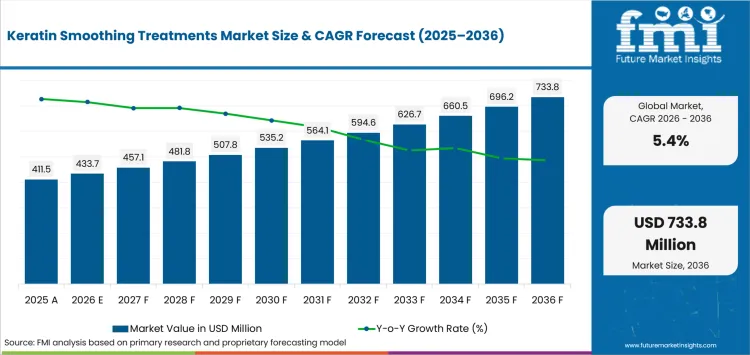
- Market Size (2026)
- USD 433.7 Mn
- Forecast (2036)
- USD 733.8 Mn
- CAGR (2026 to 2036)
- 5.4%
How big is Keratin Smoothing Treatments Market in 2026?
USD 433.7 million in 2026 and USD 733.8 million by 2036 at a 5.4% CAGR.
Demand for keratin smoothing treatments is projected to expand at 5.4% CAGR between 2026 and 2036, increasing valuation from USD 433.7 million to USD 733.8 million. Salon operators pay for longer control once treatment duration fits chair economics and clients can maintain the result between appointments. Wella Professionals introduced SmoothFiller in October 2025 as an under-two-hour smoothing service with results lasting up to three months. The service benchmark raises expectations for professional hair care products competing for the same frizz-control appointment.
Country conversion diverges where market surveillance turns formulation failure into immediate inventory risk instead of routine administrative work. The UK Office for Product Safety and Standards recalled Nov'Max Anti Volume Keratin Hair Treatment in March 2026 for prohibited formaldehyde. That action makes ingredient control a direct listing issue for salons and retailers. Brands serving salon services in several jurisdictions need records that can withstand post-market review ahead of local distribution expansion.
Key Takeaways of Keratin Smoothing Treatments Market
- Repeat purchasing rises if a smoothing service lowers frizz for long enough to justify salon chair time and planned home maintenance.
- By product type, core - classic lines are estimated to hold 32.0% in 2026 because familiar service protocols reduce consultation and training friction.
- The conventional segment is likely to capture 55.0% share in 2026 attributable to salon familiarity with its treatment sequence and performance range.
- Cream & balm formats are projected to hold 37.0% share in 2026 owing to controlled placement during section-by-section application.
- Ingredient scrutiny and heat-related exposure concerns lengthen qualification for formulations that lack clear documentation or safe professional-use instructions.
- Some of the key players in this market include Keratin Complex, Wella Company, GK Hair, ALFAPARF Milano Professional, Brasil Cacau, Kativa, Brazilian Blowout, and Keratherapy.
Analyst Perspective
"Salon accounts should compare keratin systems by how long the smoothing result holds against chair time, heat exposure and retraining effort. Strong programs protect service margin by pairing repeatable results with ingredient records and application guidance that stylists can use without slowing the appointment."
- Rahul Pandita, Principal Consultant, Future Market Insights
How is the Keratin Smoothing Treatments Market segmented?
The market is segmented by Product Type, Nature, Format, Price Positioning and Sales Channel.
The keratin smoothing treatments market is segmented by product type, nature, format, price positioning and sales channel. Product types include core - classic lines, targeted treatment lines, sensitive & gentle lines, premium & clinical lines and kits & sets. Nature covers conventional, vegan & cruelty-free, natural & organic, dermocosmetic / clinical and fragrance-free & sensitive. Formats include cream & balm, liquid & serum, stick & solid, spray & mist, sheet & patch and powder. Price positioning covers mass, masstige, premium and professional, while sales channels include e-commerce & DTC, specialty beauty retail, pharmacies & drugstores, supermarkets & hypermarkets and salons & spas.
What makes Core - Classic Lines central to the Product Type category?
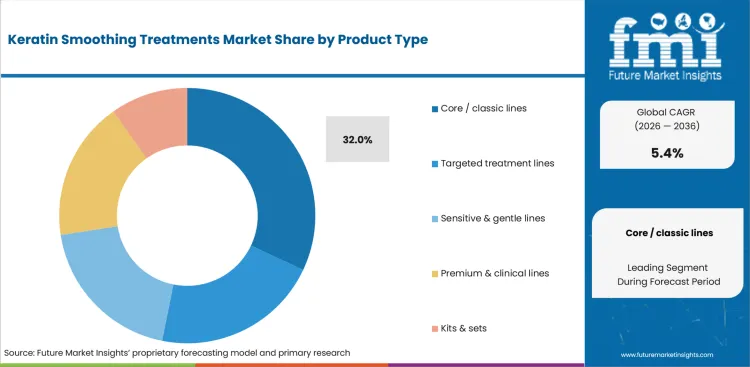
Core - classic lines remain the reference service for salons that need predictable smoothing without narrowing treatment to one hair concern. Familiar consultation steps also make these regimens easier to position beside established hair styling products during routine salon planning.
- By product type, core - classic lines are estimated to hold 32.0% in 2026 owing to broad use cases and a treatment sequence familiar to professional stylists.
- Keratin Complex announced Express Color & Smoothing in August 2025 as a two-in-one permanent-color and smoothing service, showing how familiar keratin protocols can be packaged around existing salon appointments.
Why does Conventional lead the Nature category?
Conventional formulations serve the widest installed base of salon expectations since operators already know how to evaluate smoothing strength and aftercare. Alternative nature claims compete more effectively once safety credentials and treatment performance are clear, a distinction also shaping adjacent natural cosmetic color categories.
- The conventional segment is likely to capture 55.0% share in 2026 attributable to familiar formulas and protocols that reduce retraining during routine professional service delivery.
- ANVISA warned in July 2025 that irregular straighteners can contain prohibited formaldehyde or non-permitted glyoxylic acid, making ingredient compliance a direct qualification issue regardless of nature positioning.
How does Cream & Balm influence selection within the Format category?
Cream & balm formats suit full smoothing services that require visible placement along controlled hair sections during application and thermal finishing. Their handling advantage differs from lighter liquid or solid hair styling formats that emphasize faster distribution or finishing without full-service saturation.
- In 2026, cream & balm is expected to lead format demand with 37.0% share because denser textures support measured application and controlled section coverage.
- ALFAPARF Milano Professional issued a July 2025 Lisse Design technical guide for a new Biomimetic Plastia method with fewer salon steps, linking section control to faster service execution.
What drives E-commerce & DTC within the Sales Channel category?
Direct digital channels fit treatments that need detailed application guidance ahead of purchase and repeat replenishment following the initial service. Brands can place preparation instructions and aftercare beside checkout, which gives the channel a different role from broader hair care market retail exposure.
- E-commerce & DTC is set to lead the sales channel with 25.0% share in 2026 due to direct education and repeat purchasing for defined treatment regimens.
- Kativa published a September 2025 step-by-step Brazilian straightening tutorial with results positioned for up to twelve weeks, showing how branded digital instruction can reduce uncertainty around at-home application routines.
What are the drivers, restraints and opportunities in the Keratin Smoothing Treatments Market?
Longer-wear frizz control supports repeat treatment demand, ingredient and exposure concerns restrict acceptable formulations, and documented lower-fume protocols offer a practical route to differentiated professional adoption.
- Driver: Clients reorder treatments or maintenance products once smoother hair reduces daily styling effort for a commercially meaningful period.
- Restraint: Formaldehyde risk and incomplete compliance records can remove products from credible salon and retail consideration.
- Opportunity: Professional education around documented formulations can shorten stylist qualification and support repeat service execution.
Professional service demand strengthens if salons can sell a result that lasts beyond ordinary wash-off care and fits a predictable appointment cycle. GK Hair scheduled a live demonstration of The Best Treatment on June 30 2025 inside its online certification program for smoothing professionals. Training matters because durable results must be reproduced by stylists before the service earns repeat chair time beside the hair serum market.
Safety documentation can block adoption despite strong treatment performance since professional accounts carry workplace and client exposure responsibility. FDA rules updated in February 2026 require covered cosmetic facilities to renew registration every two years and responsible persons to maintain product listings annually. Those recurring records raise the cost of weak compliance, so brands competing with beauty and personal care products need disciplined ingredient files ahead of distribution expansion.
Professional education offers a practical revenue route for brands that pair safe-use instructions with a repeatable smoothing outcome. GK Hair scheduled a live Nanoplastia demonstration on May 19 2025 inside its online certification program for smoothing professionals. Remote technical support reduces training distance and helps distributors standardize service execution for salons that also sell no-water hair conditioners and other maintenance formats.
Which country CAGRs are profiled in the Keratin Smoothing Treatments Market?
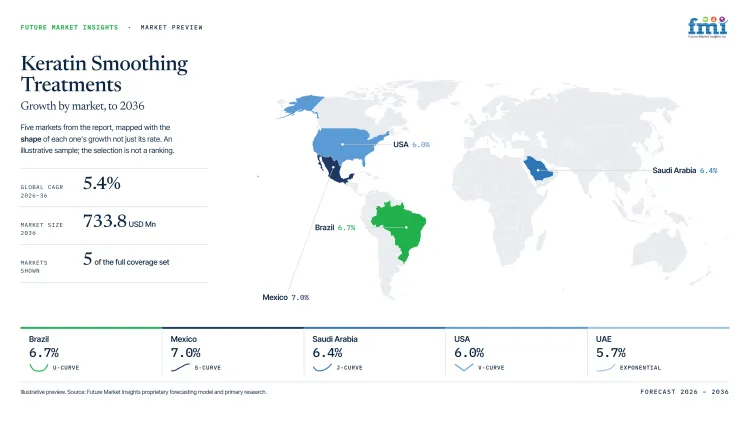
| Country | CAGR |
|---|---|
| Mexico | 7.0% |
| Brazil | 6.7% |
| Saudi Arabia | 6.4% |
| USA | 6.0% |
| UAE | 5.7% |
How do country-level CAGRs compare in the Keratin Smoothing Treatments Market?
The five forecasts span 1.3 percentage points. Mexico and Brazil make up the upper pair. Saudi Arabia occupies the middle. USA and UAE form the lower pair. Registration burden, digital administration and professional-channel structure explain the spread more clearly than current market size. Similar growth rates therefore conceal distinct entry work in each country.
- Mexico gains from DIGIPRIS filing efficiency for brands carrying complete Spanish-language claims and importer records.
- Brazil pairs deep salon familiarity with active ANVISA enforcement of straightener registration and manufacturing compliance.
- Saudi Arabia places notification discipline and localized cosmetic claims ahead of salon and retail distribution.
- USA combines broad professional demand with recurring federal cosmetic registration and annual product-listing duties.
- UAE uses Dubai import infrastructure alongside Montaji+ registration and active post-market cosmetic surveillance.
Comparable CAGRs therefore produce different channel costs and qualification requirements for new entrants.
The full report provides country-level CAGR analysis across North America, Latin America, Europe, East Asia, South Asia, Oceania and the Middle East and Africa.
Country-wise Analysis
- Mexico: Beauty retailers and professional salons increasingly manage cosmetic claims through digital administrative channels while importers remain responsible for compliant product information. COFEPRIS announced in July 2026 that DIGIPRIS allows one cosmetic advertising notice per brand to cover multiple media formats. Adoption of keratin smoothing treatments in Mexico is estimated to expand at 7.0% CAGR through 2036 owing to accessible salon and online routes. Spanish-language instructions and organized importer records support conversion, yet inconsistent claims or incomplete documentation can still interrupt listing. Companies that coordinate digital advertising records with retail education can test new offers faster without treating digitization as a substitute for product compliance.
- Brazil: Professional straightening is familiar to salon operators, yet current enforcement makes product regularity the first commercial gate for professional channels. Keratin smoothing treatment demand in Brazil is forecast to rise at 6.7% CAGR over the forecast period because salon familiarity sustains the service occasion. ANVISA inspected seven straightener establishments during June 2025 and reported that five were interdicted during its Safe Straightening operation. Registered products and Portuguese technical education give brands a workable path into professional channels with less commercial uncertainty. Enforcement against irregular formulations limits informal supply, so faster growth remains constrained by traceable registration and salon assurance requirements.
- Saudi Arabia: Importers must prepare cosmetic labels and claims for a formal notification environment ahead of salon or retail distribution. The Saudi Food and Drug Authority adopted updated Gulf regulations for cosmetic safety and claims in June 2025. Arabic-ready packaging and an experienced local distributor reduce avoidable filing errors during notification and downstream salon onboarding. The Saudi Arabian keratin smoothing treatments sector is projected to record 6.4% CAGR during the assessment period given continuing professional beauty demand. Claim wording and product safety records must remain aligned with the updated rules, so brands with complete technical files enter professional channels with less corrective paperwork.
- USA: Salon operators assess smoothing durability beside ingredient disclosure and workplace exposure controls, while national cosmetic rules require regular facility and product records. Sales of keratin smoothing treatments in USA are forecast to expand at 6.0% CAGR by 2036 reflecting broad professional and home-maintenance demand. FDA data current to June 30 2026 recorded 1,298,361 active cosmetic product listings under MoCRA nationwide. Detailed ingredient information and professional safety instructions improve acceptance by salons with formal workplace procedures. The compliance base raises entry work for brands that lack disciplined annual product-listing updates or clear responsible-person records during routine portfolio maintenance cycles.
- UAE: Dubai gives imported beauty brands concentrated access through a trade hub that also applies active registration and post-market controls to cosmetics. Montaji+ registration and capable local importers help brands reach salons efficiently while preserving traceable product records. UAE is estimated to post 5.7% CAGR over the forecast period tied to imported beauty choice and dense professional channels. Dubai Municipality stated in October 2025 that its product-safety system handles nearly 40,000 imported-product shipments annually. Municipal laboratories test cosmetics for harmful substances including carcinogenic formaldehyde, so sustained salon and digital distribution depends on importer traceability following registration within Dubai's surveillance system.
Who are the notable companies in the Keratin Smoothing Treatments Market?
Keratin Complex, Wella Company, GK Hair, ALFAPARF Milano Professional, Brasil Cacau, Kativa, Brazilian Blowout, and Keratherapy are the notable companies serving this market.
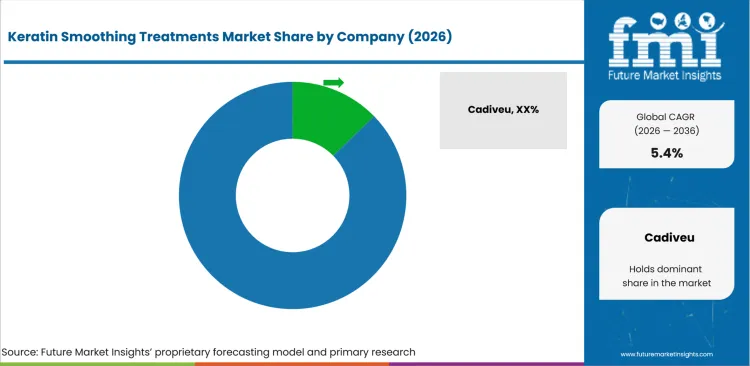
Competition is concentrated around professional treatment credibility because salons compare smoothing strength and service time with training support and safety documentation. Keratin specialists defend narrow expertise, while global salon groups use broader education networks and premium cosmetics relationships to reach professional accounts.
- Keratin Complex, GK Hair and Keratherapy compete through multi-treatment professional portfolios with education resources supporting stylist application and service selection.
- Wella Company and ALFAPARF Milano Professional bring larger professional salon networks, while Brasil Cacau and Brazilian Blowout emphasize dedicated smoothing identities.
- Kativa extends the competitive set into accessible home-oriented straightening routines that still depend on detailed application guidance and channel trust.
Competitive Benchmarking: Keratin Smoothing Treatments Market
| Company | Dedicated Keratin Smoothing Portfolio | Professional Protocol & Education | Consumer & Digital Access | Geographic Reach |
|---|---|---|---|---|
| Keratin Complex | High | High | High | North America and international distributor markets |
| Wella Company | Medium | High | Medium | Global professional salon markets |
| GK Hair | High | High | High | North America, Europe, Middle East and international DTC |
| ALFAPARF Milano Professional | Medium | High | Medium | Europe and international professional markets |
| Brasil Cacau | High | Medium | Medium | Latin America and international professional distributors |
| Kativa | Medium | Medium | High | Latin America, Europe and international consumer retail |
| Brazilian Blowout | High | High | Low | North America and selected international salon markets |
| Keratherapy | High | High | Medium | USA, Canada and international distributor markets |
Scoring basis: High portfolio breadth requires at least three documented smoothing treatments, Medium requires two and Low identifies one. High professional support requires structured certification or multiple education resources, Medium requires one documented protocol and Low reflects limited published support. High consumer access requires direct availability plus supporting education, Medium reflects narrower consumer access and Low identifies documented professional-only distribution.
Key Developments in the Keratin Smoothing Treatments Market
- In August 2026, Brazilian Blowout expanded in-person professional smoothing education with a licensed-stylist training session in Flower Mound, Texas.
- In February 2025, Brasil Cacau held active registrations in Uruguay for Brazilian Thermal Reconstruction, Brazilian Eco Keratin, and Smoothing Protein under the national hair straightener register.
- In February 2025, Kativa held an active registration in Uruguay for Keratin Alisado Sin Plancha Xtreme Care under the national hair straightener register.
Key Players in the Keratin Smoothing Treatments Market
Professional Keratin Treatment Specialists
- Keratin Complex
- GK Hair
- Brasil Cacau
- Brazilian Blowout
- Keratherapy
Global Professional Salon Platforms
- Wella Company
- ALFAPARF Milano Professional
Consumer Straightening and Maintenance Access
- Kativa
Keratin Smoothing Treatments Market - Report Scope
| Coverage field | Report scope |
|---|---|
| Market breakdown | By product type, nature, format, price positioning, sales channel and region. |
| Quantitative Units | USD Million. |
| Market Definition | Commercial keratin-positioned smoothing formulations and treatment kits sold for professional salon or defined at-home use. |
| Regions Covered | North America, Latin America, Europe, East Asia, South Asia and Pacific, and Middle East and Africa. |
| Countries Covered | Mexico, Brazil, Saudi Arabia, USA, UAE, and 20+ countries included in the full report. |
| Key Companies Profiled | Keratin Complex, Wella Company, GK Hair, ALFAPARF Milano Professional, Brasil Cacau, Kativa, Brazilian Blowout, and Keratherapy. |
| Forecast Period | 2026 to 2036. |
| Approach | Primary and secondary research with market triangulation. |
Keratin Smoothing Treatments Market - Research Methodology
| Method | Approach |
|---|---|
| Primary Research | FMI analysts gathered input from manufacturers, service providers, technology developers, distributors, end users, procurement teams, and subject-matter experts. Interviews examined purchasing decisions, product or service evaluation, adoption barriers, approval requirements, pricing considerations, and expectations for technical or commercial support. Respondents were also asked what evidence is required before a trial, pilot, or initial order develops into regular purchasing. |
| Desk Research | Desk research covered government statistics, regulatory publications, trade data, industry associations, technical literature, standards, company filings, product information, and official corporate announcements. Sources were reviewed for relevance, publication date, geographic coverage, and consistency with the defined market scope. Claims relating to performance, applications, approvals, capacity, investment, and commercial activity were retained only when supported by credible public evidence. |
| Market Sizing and Forecasting | The market model combined the baseline value with historical performance, segment structure, pricing and volume indicators, adoption levels, company participation, and country-level demand conditions. Forecast assumptions considered economic activity, investment trends, regulatory developments, technology adoption, purchasing cycles, supply availability, and barriers to wider market use. Segment and regional estimates were reconciled before the final market total was calculated. |
| Data Validation | Estimates were checked against multiple independent indicators, including public data, company activity, trade patterns, industry developments, and findings from primary interviews. Validation also tested whether products, services, applications, and company revenues fell within the defined market boundaries. Adjacent categories, unsupported claims, overlapping revenues, and activities without direct market relevance were excluded to reduce double counting and maintain consistency across segments and countries. |
Keratin Smoothing Treatments Market by Segments
Keratin Smoothing Treatments Market segmented by Product Type:
- Core - classic lines
- Targeted treatment lines
- Sensitive & gentle lines
- Premium & clinical lines
- Kits & sets
Keratin Smoothing Treatments Market segmented by Nature:
- Conventional
- Vegan & cruelty-free
- Natural & organic
- Dermocosmetic / clinical
- Fragrance-free & sensitive
Keratin Smoothing Treatments Market segmented by Format:
- Cream & balm
- Liquid & serum
- Stick & solid
- Spray & mist
- Sheet & patch
- Powder
Keratin Smoothing Treatments Market segmented by Price Positioning:
- Mass
- Masstige
- Premium
- Professional
Keratin Smoothing Treatments Market segmented by Sales Channel:
- E-commerce & DTC
- Specialty beauty retail
- Pharmacies & drugstores
- Supermarkets & hypermarkets
- Salons & spas
Keratin Smoothing Treatments Market by Region:
- North America
- United States
- Canada
- Latin America
- Brazil
- Mexico
- Argentina
- Chile
- Western Europe
- Germany
- France
- United Kingdom
- Italy
- Spain
- Benelux
- Nordics
- Eastern Europe
- Poland
- Czech Republic
- Romania
- Hungary
- East Asia
- China
- Japan
- South Korea
- South Asia and Pacific
- India
- ASEAN
- Australia and New Zealand
- Middle East and Africa
- GCC Countries
- South Africa
- Türkiye
- Israel
Research Sources and Bibliography
- Wella Professionals. (2025, October 1). Introducing SmoothFiller™: A New Era of Keratin Treatments.
- Office for Product Safety and Standards. (2026, March 19). Product Recall: Nov'Max Anti Volume Keratin Hair Treatment (2602-0256).
- Keratin Complex. (2025, August 29). KERATIN COMPLEX LAUNCHES THE PERFECT COLOR SERVICE: EXPRESS COLOR & SMOOTHING SYSTEM.
- Agência Nacional de Vigilância Sanitária. (2025, July 7). Anvisa alerta para riscos à saúde associados ao uso de alisantes capilares irregulares.
- ALFAPARF Milano Professional. (2025, July). Lisse Design Keratin Therapy - Technical Guide.
- Kativa. (2025, September 19). Step-by-step to perfect, pin-straight hair.
- GK Hair. (2025, June 30). GK Hair Virtual Courses | Online Haircare Classes.
- USA Food and Drug Administration. (2026, February 11). Registration & Listing of Cosmetic Product Facilities and Products.
- Comisión Federal para la Protección contra Riesgos Sanitarios. (2026, July 15). Cofepris mejora la gestión y digitalización del Aviso de Publicidad de Productos Cosméticos.
- Agência Nacional de Vigilância Sanitária. (2025, July 7). Alisamento seguro: operação fiscaliza fabricantes de alisantes irregulares.
- Saudi Food and Drug Authority. (2025, June 24). SFDA Adopts Updates to Gulf Technical Regulations for Cosmetics.
- Dubai Municipality. (2025, October 27). Product safety at Beautyworld Middle East 2025.
- Ministerio de Salud Pública de Uruguay. (2025, February 14). Acceso 3 878 2025 - registro de los alisados capilares habilitados por el Ministerio de Salud Pública.
- Brazilian Blowout. (2026, August 16). Free In-Person Training.
- Brazilian Blowout. (2026, February). Brazilian Blowout FREE Instructions.
- Keratin Complex. (Retrieved August 20, 2026). Keratin Complex Resource Center.
- Keratherapy. (Retrieved August 20, 2026). About Keratherapy.
- Keratin Complex. (2026, February 2). Our Boldest Evolution Yet: KCRIO Restorative Keratin System.
- GK Hair. (2026, August 12). Introducing Nanoplastia: The Future of Hair Smoothing.
- Henkel. (2026, July 7). Henkel successfully closes acquisition of premium hair care brand OLAPLEX.
- Unilever. (2026, July 9). TRESemmé Professional: science-led, salon-quality haircare.
- Cezanne Hair Professional. (2025, March 10). Cezanne Classic Keratin Smoothing Treatment: What to Expect & Who It’s For.
- Goldwell. (2025, Fall). Hair Stories: Glimpse into Fall 2025.
- Farouk Systems. (2025, March). 2025 Schools Catalog.
This bibliography is provided for reader reference and is not exhaustive. The full report contains the complete reference list and detailed citations
This Report Answers
- How large is the keratin smoothing treatments market in 2026 and what value is forecast by 2036?
- Which operating conditions turn longer-wear smoothing into repeat professional or home-maintenance purchasing?
- Why do core - classic lines hold the leading position within product type in 2026?
- How do conventional formulations and cream & balm formats shape current segment leadership?
- How do Mexico, Brazil, Saudi Arabia, USA and UAE differ in forecast growth and market-access conditions?
- Which companies compete through specialist keratin systems and professional salon platforms?
- How do ingredient scrutiny and formaldehyde-related enforcement affect product qualification for salons and retailers?
- Which commercial actions can improve stylist adoption without weakening documentation or application control?
- How do company portfolios differ in professional education, consumer access and geographic coverage?
Frequently Asked Questions
How big is the keratin smoothing treatments market in 2026?
The keratin smoothing treatments market is valued at USD 433.7 million in 2026 and is projected to reach USD 733.8 million by 2036. Growth is supported by repeat salon treatments and at-home maintenance that preserve longer-wear frizz control between professional appointments.
What is the CAGR of the keratin smoothing treatments market from 2026 to 2036?
The keratin smoothing treatments market is projected to grow at a CAGR of 5.4% between 2026 and 2036. Expansion is supported by durable smoothing results that justify repeat professional services and defined maintenance purchases.
Which product type leads the keratin smoothing treatments market?
The core - classic lines segment is expected to hold 32.0% of the keratin smoothing treatments market in 2026, attributable to familiar salon protocols and broad treatment use. Salon operators can fit these regimens into established consultation and application routines without redesigning the full service sequence.
Which countries are projected to record the highest growth in the keratin smoothing treatments market?
Mexico is projected to grow at 7.0% CAGR, followed by Brazil at 6.7% and Saudi Arabia at 6.4% through 2036. Their growth paths depend on salon demand alongside distinct registration and cosmetic-claims requirements that shape local product entry and channel execution.
Which companies are active in the keratin smoothing treatments market?
Key companies operating in the keratin smoothing treatments market include Keratin Complex, Wella Company, GK Hair, ALFAPARF Milano Professional, Brasil Cacau, Kativa, Brazilian Blowout, and Keratherapy. They compete through treatment breadth and stylist education while using different professional and consumer channels to reach smoothing customers.
Preview the report firsthand - request a free sample
Get SampleGet the brochure for pricing and purchase details.
Get PDFTable of Content
- Key Takeaways
- Market Size and CAGR
- Top Growth Driver
- Fastest Growing Segment
- Leading Region
- Key Companies
- Emerging Opportunities
- Executive Summary
- Global Market Outlook
- Demand-side Trends
- Supply-side Trends
- Technology Roadmap Analysis
- Analysis and Recommendations
- Analyst Perspective (What is happening? Why now? What should investors know?)
- Key Questions Answered
- How large is the market?
- What is the CAGR?
- What are key trends?
- Which region dominates?
- Who are the leaders?
- Market Overview
- Market Coverage / Taxonomy
- Market Definition / Scope / Limitations
- Research Methodology
- Chapter Orientation
- Analytical Lens and Working Hypotheses
- Market Structure, Signals, and Trend Drivers
- Benchmarking and Cross-market Comparability
- Market Sizing, Forecasting, and Opportunity Mapping
- Research Design and Evidence Framework
- Desk Research Programme (Secondary Evidence)
- Expert Input and Fieldwork (Primary Evidence)
- Tooling, Models, and Reference Databases
- Data Engineering and Model Build
- Quality Assurance and Audit Trail
- Market Background
- Market Dynamics (Drivers, Restraints, Opportunity, Trends)
- Scenario Forecast (Optimistic, Likely, Conservative)
- Impact Analysis
- AI Impact
- Sustainability Impact
- Regulatory Impact
- Technology Impact
- Consumer / Buyer Analysis
- Purchase Drivers
- Adoption Barriers
- Buyer Journey
- Opportunity Map Analysis
- Product Life Cycle Analysis
- Supply Chain Analysis
- Investment Feasibility Matrix
- Value Chain Analysis
- PESTLE and Porter's Analysis
- Regulatory Landscape
- Regional Parent Market Outlook
- Production and Consumption Statistics
- Import and Export Statistics
- Global Market Analysis and Forecast, 2021 to 2036
- Historical Market Size Value (USD Million) Analysis, 2021 to 2025
- Current and Future Market Size Value (USD Million) Projections, 2026 to 2036
- Y-o-Y Growth Trend Analysis
- Absolute $ Opportunity Analysis
- Global Market Pricing Analysis, 2021 to 2036
- Global Market Analysis and Forecast, By Product Type, 2021 to 2036
- Introduction / Key Findings
- Historical Market Size Value (USD Million) Analysis By Product Type, 2021 to 2025
- Current and Future Market Size Value (USD Million) Analysis and Forecast By Product Type, 2026 to 2036
- Core / classic lines
- Targeted treatment lines
- Sensitive & gentle lines
- Premium & clinical lines
- Kits & sets
- Core / classic lines
- Y-o-Y Growth Trend Analysis By Product Type, 2021 to 2025
- Absolute $ Opportunity Analysis By Product Type, 2026 to 2036
- Global Market Analysis and Forecast, By Nature, 2021 to 2036
- Introduction / Key Findings
- Historical Market Size Value (USD Million) Analysis By Nature, 2021 to 2025
- Current and Future Market Size Value (USD Million) Analysis and Forecast By Nature, 2026 to 2036
- Conventional
- Vegan & cruelty-free
- Natural & organic
- Dermocosmetic / clinical
- Fragrance-free & sensitive
- Conventional
- Y-o-Y Growth Trend Analysis By Nature, 2021 to 2025
- Absolute $ Opportunity Analysis By Nature, 2026 to 2036
- Global Market Analysis and Forecast, By Format, 2021 to 2036
- Introduction / Key Findings
- Historical Market Size Value (USD Million) Analysis By Format, 2021 to 2025
- Current and Future Market Size Value (USD Million) Analysis and Forecast By Format, 2026 to 2036
- Cream & balm
- Liquid & serum
- Stick & solid
- Spray & mist
- Sheet & patch
- Powder
- Cream & balm
- Y-o-Y Growth Trend Analysis By Format, 2021 to 2025
- Absolute $ Opportunity Analysis By Format, 2026 to 2036
- Global Market Analysis and Forecast, By Price Positioning, 2021 to 2036
- Introduction / Key Findings
- Historical Market Size Value (USD Million) Analysis By Price Positioning, 2021 to 2025
- Current and Future Market Size Value (USD Million) Analysis and Forecast By Price Positioning, 2026 to 2036
- Mass
- Masstige
- Premium
- Professional
- Mass
- Y-o-Y Growth Trend Analysis By Price Positioning, 2021 to 2025
- Absolute $ Opportunity Analysis By Price Positioning, 2026 to 2036
- Global Market Analysis and Forecast, By Sales Channel, 2021 to 2036
- Introduction / Key Findings
- Historical Market Size Value (USD Million) Analysis By Sales Channel, 2021 to 2025
- Current and Future Market Size Value (USD Million) Analysis and Forecast By Sales Channel, 2026 to 2036
- E-commerce & DTC
- Specialty beauty retail
- Pharmacies & drugstores
- Supermarkets & hypermarkets
- Salons & spas
- E-commerce & DTC
- Y-o-Y Growth Trend Analysis By Sales Channel, 2021 to 2025
- Absolute $ Opportunity Analysis By Sales Channel, 2026 to 2036
- Global Market Analysis and Forecast, By Region, 2021 to 2036
- Introduction
- Historical Market Size Value (USD Million) Analysis By Region, 2021 to 2025
- Current Market Size Value (USD Million) Analysis and Forecast By Region, 2026 to 2036
- North America
- Latin America
- Western Europe
- Eastern Europe
- East Asia
- South Asia and Pacific
- Middle East & Africa
- Market Attractiveness Analysis By Region
- North America Market Analysis and Forecast, By Country, 2021 to 2036
- Historical Market Size Value (USD Million) Trend Analysis By Market Taxonomy, 2021 to 2025
- Market Size Value (USD Million) Forecast By Market Taxonomy, 2026 to 2036
- By Country
- USA
- Canada
- By Product Type
- By Nature
- By Format
- By Price Positioning
- By Sales Channel
- By Country
- Market Attractiveness Analysis
- By Country
- By Product Type
- By Nature
- By Format
- By Price Positioning
- By Sales Channel
- Key Takeaways
- Latin America Market Analysis and Forecast, By Country
- Historical Market Size Value (USD Million) Trend Analysis By Market Taxonomy, 2021 to 2025
- Market Size Value (USD Million) Forecast By Market Taxonomy, 2026 to 2036
- By Country
- Brazil
- Mexico
- Chile
- Rest of Latin America
- By Product Type
- By Nature
- By Format
- By Price Positioning
- By Sales Channel
- By Country
- Market Attractiveness Analysis
- By Country
- By Product Type
- By Nature
- By Format
- By Price Positioning
- By Sales Channel
- Key Takeaways
- Western Europe Market Analysis and Forecast, By Country
- Historical Market Size Value (USD Million) Trend Analysis By Market Taxonomy, 2021 to 2025
- Market Size Value (USD Million) Forecast By Market Taxonomy, 2026 to 2036
- By Country
- Germany
- UK
- Italy
- Spain
- France
- Nordic
- BENELUX
- Rest of Western Europe
- By Product Type
- By Nature
- By Format
- By Price Positioning
- By Sales Channel
- By Country
- Market Attractiveness Analysis
- By Country
- By Product Type
- By Nature
- By Format
- By Price Positioning
- By Sales Channel
- Key Takeaways
- Eastern Europe Market Analysis and Forecast, By Country
- Historical Market Size Value (USD Million) Trend Analysis By Market Taxonomy, 2021 to 2025
- Market Size Value (USD Million) Forecast By Market Taxonomy, 2026 to 2036
- By Country
- Russia
- Poland
- Hungary
- Balkan & Baltic
- Rest of Eastern Europe
- By Product Type
- By Nature
- By Format
- By Price Positioning
- By Sales Channel
- By Country
- Market Attractiveness Analysis
- By Country
- By Product Type
- By Nature
- By Format
- By Price Positioning
- By Sales Channel
- Key Takeaways
- East Asia Market Analysis and Forecast, By Country
- Historical Market Size Value (USD Million) Trend Analysis By Market Taxonomy, 2021 to 2025
- Market Size Value (USD Million) Forecast By Market Taxonomy, 2026 to 2036
- By Country
- China
- Japan
- South Korea
- By Product Type
- By Nature
- By Format
- By Price Positioning
- By Sales Channel
- By Country
- Market Attractiveness Analysis
- By Country
- By Product Type
- By Nature
- By Format
- By Price Positioning
- By Sales Channel
- Key Takeaways
- South Asia and Pacific Market Analysis and Forecast, By Country
- Historical Market Size Value (USD Million) Trend Analysis By Market Taxonomy, 2021 to 2025
- Market Size Value (USD Million) Forecast By Market Taxonomy, 2026 to 2036
- By Country
- India
- ASEAN
- Australia & New Zealand
- Rest of South Asia and Pacific
- By Product Type
- By Nature
- By Format
- By Price Positioning
- By Sales Channel
- By Country
- Market Attractiveness Analysis
- By Country
- By Product Type
- By Nature
- By Format
- By Price Positioning
- By Sales Channel
- Key Takeaways
- Middle East & Africa Market Analysis and Forecast, By Country
- Historical Market Size Value (USD Million) Trend Analysis By Market Taxonomy, 2021 to 2025
- Market Size Value (USD Million) Forecast By Market Taxonomy, 2026 to 2036
- By Country
- Kingdom of Saudi Arabia
- Other GCC Countries
- Türkiye
- South Africa
- Other African Union
- Rest of Middle East & Africa
- By Product Type
- By Nature
- By Format
- By Price Positioning
- By Sales Channel
- By Country
- Market Attractiveness Analysis
- By Country
- By Product Type
- By Nature
- By Format
- By Price Positioning
- By Sales Channel
- Key Takeaways
- Key Countries Market Analysis
- USA
- Pricing Analysis
- Market Share Analysis, 2025
- By Product Type
- By Nature
- By Format
- By Price Positioning
- By Sales Channel
- Canada
- Pricing Analysis
- Market Share Analysis, 2025
- By Product Type
- By Nature
- By Format
- By Price Positioning
- By Sales Channel
- Mexico
- Pricing Analysis
- Market Share Analysis, 2025
- By Product Type
- By Nature
- By Format
- By Price Positioning
- By Sales Channel
- Brazil
- Pricing Analysis
- Market Share Analysis, 2025
- By Product Type
- By Nature
- By Format
- By Price Positioning
- By Sales Channel
- Chile
- Pricing Analysis
- Market Share Analysis, 2025
- By Product Type
- By Nature
- By Format
- By Price Positioning
- By Sales Channel
- Germany
- Pricing Analysis
- Market Share Analysis, 2025
- By Product Type
- By Nature
- By Format
- By Price Positioning
- By Sales Channel
- UK
- Pricing Analysis
- Market Share Analysis, 2025
- By Product Type
- By Nature
- By Format
- By Price Positioning
- By Sales Channel
- Italy
- Pricing Analysis
- Market Share Analysis, 2025
- By Product Type
- By Nature
- By Format
- By Price Positioning
- By Sales Channel
- Spain
- Pricing Analysis
- Market Share Analysis, 2025
- By Product Type
- By Nature
- By Format
- By Price Positioning
- By Sales Channel
- France
- Pricing Analysis
- Market Share Analysis, 2025
- By Product Type
- By Nature
- By Format
- By Price Positioning
- By Sales Channel
- India
- Pricing Analysis
- Market Share Analysis, 2025
- By Product Type
- By Nature
- By Format
- By Price Positioning
- By Sales Channel
- ASEAN
- Pricing Analysis
- Market Share Analysis, 2025
- By Product Type
- By Nature
- By Format
- By Price Positioning
- By Sales Channel
- Australia & New Zealand
- Pricing Analysis
- Market Share Analysis, 2025
- By Product Type
- By Nature
- By Format
- By Price Positioning
- By Sales Channel
- China
- Pricing Analysis
- Market Share Analysis, 2025
- By Product Type
- By Nature
- By Format
- By Price Positioning
- By Sales Channel
- Japan
- Pricing Analysis
- Market Share Analysis, 2025
- By Product Type
- By Nature
- By Format
- By Price Positioning
- By Sales Channel
- South Korea
- Pricing Analysis
- Market Share Analysis, 2025
- By Product Type
- By Nature
- By Format
- By Price Positioning
- By Sales Channel
- Russia
- Pricing Analysis
- Market Share Analysis, 2025
- By Product Type
- By Nature
- By Format
- By Price Positioning
- By Sales Channel
- Poland
- Pricing Analysis
- Market Share Analysis, 2025
- By Product Type
- By Nature
- By Format
- By Price Positioning
- By Sales Channel
- Hungary
- Pricing Analysis
- Market Share Analysis, 2025
- By Product Type
- By Nature
- By Format
- By Price Positioning
- By Sales Channel
- Kingdom of Saudi Arabia
- Pricing Analysis
- Market Share Analysis, 2025
- By Product Type
- By Nature
- By Format
- By Price Positioning
- By Sales Channel
- Türkiye
- Pricing Analysis
- Market Share Analysis, 2025
- By Product Type
- By Nature
- By Format
- By Price Positioning
- By Sales Channel
- South Africa
- Pricing Analysis
- Market Share Analysis, 2025
- By Product Type
- By Nature
- By Format
- By Price Positioning
- By Sales Channel
- USA
- Market Structure Analysis
- Competition Dashboard
- Competition Benchmarking
- Market Share Analysis of Top Players
- By Regional
- By Product Type
- By Nature
- By Format
- By Price Positioning
- By Sales Channel
- Emerging Startups
- Innovation Benchmarking
- Competition Analysis
- Competition Deep Dive
- Cadiveu
- Overview
- Product Portfolio
- Profitability by Market Segments
- Sales Footprint
- Strategy Overview
- Marketing Strategy
- Product Strategy
- Channel Strategy
- Brasil Cacau
- GK Hair
- Wella Company
- Kao Corporation
- Henkel
- Olaplex
- Church & Dwight
- Amorepacific
- Unilever
- Cadiveu
- Case Studies
- Success Stories
- Recent Developments
- Competition Deep Dive
- Assumptions & Acronyms Used


