

- Market Size (2026)
- USD 348.9 Mn
- Forecast (2036)
- USD 1143.1 Mn
- CAGR (2026 to 2036)
- 12.6%
How big is X-Linked Retinitis Pigmentosa Market in 2026?
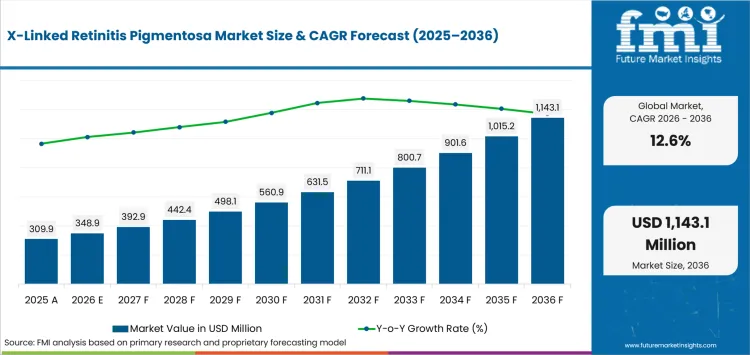
USD 348.9 million in 2026 and USD 1,143.1 million by 2036 at a 12.6% CAGR.
Demand for X-linked retinitis pigmentosa therapies is projected to expand at 12.6% CAGR between 2026 and 2036, increasing valuation from USD 348.9 million in 2026 to USD 1,143.1 million by 2036. Established inherited retinal therapies support referral pathways that connect genetic testing with specialist retinal care.
Late-stage programs require coordinated testing across genetically confirmed participants and international specialist retinal surgical centers. In March 2026, ClinicalTrials.gov recorded 95 participants in the completed international phase 3 bota-vec trial. The enrollment scale requires sponsors developing retinal biologics to align imaging endpoints with vector supply and multiyear safety monitoring.
Key Takeaways of X-Linked Retinitis Pigmentosa Market
- Genetic confirmation and specialist retinal delivery support therapy demand among patients with progressive RPGR-associated vision loss.
- Gene therapy is projected to represent 82.0% of therapy-type demand in 2026 through direct RPGR alignment.
- Sub-retinal delivery is estimated to account for 83.0% of administration-route demand in 2026 across specialist retinal procedures.
- RPGR gene replacement is forecast to capture 58.0% of treatment-approach demand in 2026 through mutation-specific development.
- Patient eligibility and specialist surgery requirements restrain access across geographically concentrated treatment networks and referral pathways.
- Beacon Therapeutics, MeiraGTx, Frontera Therapeutics, 4D Molecular Therapeutics, Ocugen, Inc., SparingVision, Nacuity Pharmaceuticals and BlueRock Therapeutics / Bayer are profiled competitors.
Analyst Perspective
"The commercial contest in XLRP depends on how early retinal centers identify RPGR-positive patients with viable photoreceptors. A program gains durable value through consistent vector supply, sub-retinal technique and functional endpoints across every treatment site."
- Anurag Sharma, Principal Consultant, Future Market Insights
How is the X-Linked Retinitis Pigmentosa Market segmented?
The X-linked retinitis pigmentosa industry is segmented by therapy type, stage of development, route of administration, end user, treatment approach and region.
The market is segmented by therapy type, stage of development, route of administration, end user, treatment approach and region. Therapy type includes gene therapy with RPGR replacement or gene-agnostic therapy, pharmacological agents with antioxidant or neuroprotective agents, stem cell therapies with retinal progenitor or iPSC-derived photoreceptors, and optogenetics with optogenetic genes or light-sensitive proteins. Development stages currently include phase III late-stage clinical, phase I-II clinical, approved-commercial and discovery-preclinical programs. Routes include sub-retinal gene or cell delivery, intravitreal gene or vector delivery, oral-systemic treatment, combination administration and experimental delivery. End users include hospitals and eye-care chains, specialty clinics, academic institutes, government organizations and gene therapy centers. Treatment approaches cover RPGR ORF15 or AAV-mediated replacement, gene modifier therapy, neuroprotection, progenitor cells, iPSC photoreceptors, antioxidants and symptom management.
What makes gene therapy central to the therapy type category?
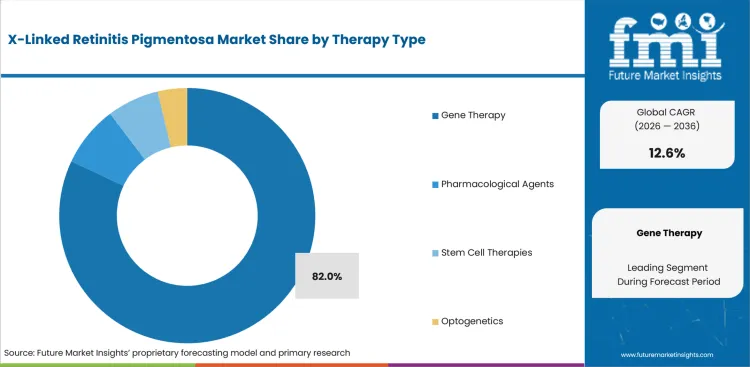
RPGR-associated XLRP gives gene therapy developers a defined payload target among genetically confirmed patients today. In July 2025, Beacon Therapeutics enrolled 85 participants in VISTA across North America, the United Kingdom and Australia. Multiregional enrollment makes site-level dosing and endpoint consistency central to the pivotal commercial evidence package.
- Gene therapy is set to lead the therapy type category with 82.0% share in 2026 due to direct alignment with the RPGR disease mechanism.
- Retinal centers require confirmed RPGR variants and preserved photoreceptors to plan sub-retinal administration safely and consistently. Manufacturing consistency and surgical training determine whether programs expand beyond clinical sites and reach eligible patients.
What supports phase III late-stage clinical programs within the stage of development category?
Late-stage programs must connect functional vision outcomes with durable safety evidence and reproducible vector quality. Small eligible populations make endpoint consistency and site preparation central to multicountry filing plans and regulatory review.
- By stage of development, phase III late-stage clinical is estimated to hold 39.0% in 2026 owing to filing preparation and confirmatory evidence needs.
- Pivotal programs need endpoints that remain comparable across surgical sites and regulatory pathways during multiyear follow-up. In April 2026, MeiraGTx entered an agreement to acquire bota-vec interests and stated that regulatory filings would begin. The filing plan concentrates manufacturing, clinical and regulatory work around a phase III evidence package.
How does sub-retinal delivery shape selection within the route of administration category?
Sub-retinal administration places gene or cell material beside photoreceptors through surgery that controls injection location and postoperative imaging. In July 2025, BlueRock Therapeutics announced the first CLARICO treatment with OpCT-001 for primary photoreceptor diseases. The multisite study makes reproducible surgical technique and retinal monitoring central to broader treatment-center participation.
- The sub-retinal route is likely to capture 83.0% share in 2026 attributable to direct placement beside viable photoreceptors.
- Treatment centers need vitreoretinal surgeons and imaging protocols that support accurate dosing with reliable postoperative monitoring. Specialized vitreoretinal surgery devices improve procedural control but limited surgical capacity restricts access outside major referral centers.
What role do hospitals and eye-care chains play within the end-user category?
Hospitals and eye-care chains combine genetic assessment with retinal imaging, surgery and extended follow-up inside one referral pathway. Their coordinated teams reduce handoffs between eligibility testing and long-term safety monitoring for each eligible patient.
- By end user, hospitals and eye-care chains are forecast to represent 46.0% in 2026 driven by integrated genetic testing, surgery, and follow-up.
- Specialist centers use ophthalmic diagnostic equipment to measure retinal structure and functional change across repeated visits. In December 2025, Beacon Therapeutics treated the first LANDSCAPE participant in a bilateral laru-zova study. The protocol requires coordinated dosing and eye testing equipment access within one experienced hospital network.
What are the drivers, restraints and opportunities in the X-Linked Retinitis Pigmentosa Market?
Driver: RPGR biology supports focused replacement design and measurable clinical intent. Restraint: Progressive retinal loss narrows eligibility as specialist delivery becomes more complex. Opportunity: Gene-agnostic neuroprotection and cell replacement extend treatment beyond one mutation-specific construct.
- Driver: Defined RPGR biology supports focused vector design and measurable clinical intent across mutation-confirmed patients.
- Restraint: Progressive retinal loss and specialist surgery requirements narrow eligibility and increase treatment-site preparation across regional care networks.
- Opportunity: Neuroprotection and photoreceptor replacement broaden treatment options beyond direct RPGR programs for genetically diverse patients.
RPGR-associated disease gives developers a defined payload target and measurable treatment objective for genetically confirmed patients. Commercial supply requires gene therapy manufacturing that reproduces vector potency and lot comparability across multicenter programs.
Photoreceptor loss narrows the treatment window and reduces the benefit that sub-retinal surgery can preserve for patients. In January 2025, 4D Molecular Therapeutics ended 4D-125 and redirected resources toward nearer regulatory milestones. The decision reflects how small cohorts and long follow-up can displace ocular drug delivery programs during portfolio review.
Broader treatment architectures address patients whose genotype or remaining retinal structure does not fit direct RPGR replacement. In October 2025, Nacuity Pharmaceuticals received FDA breakthrough therapy designation for NPI-001 in retinitis pigmentosa. The oral program adds a non-surgical option beside mutation-broad gene therapy and photoreceptor replacement for eligible patients.
Which country CAGRs are profiled in the X-Linked Retinitis Pigmentosa Market?
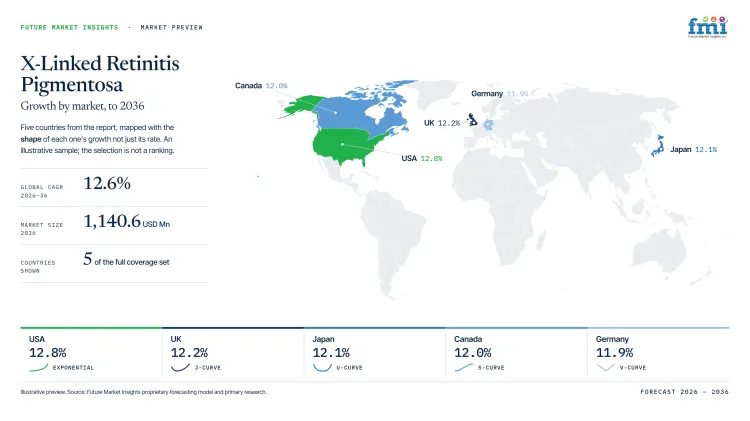
| Country | CAGR |
|---|---|
| USA | 12.8% |
| Canada | 12.0% |
| Australia | 12.3% |
| UK | 12.2% |
| Japan | 12.1% |
| Germany | 11.9% |
How do country-level CAGRs compare in the X-Linked Retinitis Pigmentosa Market?
The country comparison spans 0.9 percentage point and reveals three distinct growth groups across the X-Linked Retinitis Pigmentosa Market. The USA leads at 12.8%, while Australia, the UK and Japan form a closely aligned middle group spanning only 0.2 percentage point. Canada and Germany remain at the lower end with a 0.1-point difference between them.
- The USA leads the comparison at a 12.8% CAGR through 2036, supported by extensive multicenter trial experience, although travel requirements and payer authorization remain relevant for repeated specialist follow-up.
- Australia records a 12.3% CAGR, remaining 0.5 percentage points below the USA. A national trial pathway supports development, while concentrated metropolitan treatment capacity can create access challenges for regional families.
- The UK grows at a 12.2% CAGR, only 0.1 percentage point below Australia. Established advanced-therapy oversight supports market development, while health technology assessment can delay funded access after authorization.
- Japan records a 12.1% CAGR, remaining 0.1 percentage point below the UK. Country-specific evidence requirements and a limited specialist network concentrate surgery and repeated imaging in major cities.
- Canada records a 12.0% CAGR, 0.1 percentage point below Japan. Specialist availability, referral pathways and access to advanced treatment services influence market development across the country.
- Germany records an 11.9% CAGR, creating a 0.1-percentage-point gap from Canada. Genomic diagnosis and rare-disease centers support care, while data coordination and referral transfers remain uneven across institutions.
Comparable CAGRs can still produce different market conditions. Differences in clinical-trial infrastructure, specialist availability, payer authorization, advanced-therapy oversight, diagnostic networks and referral pathways influence market development across countries. The full report provides country-level CAGR analysis across North America, Latin America, Europe, East Asia, South Asia and Pacific, and the Middle East and Africa.
Country-wise Analysis
- USA access depends on inherited-retinal centers that combine accredited genetic confirmation with sub-retinal surgery and multiyear functional imaging, although travel costs and payer authorization remain difficult for families outside major referral regions. Adoption of XLRP therapy in the United States is estimated to expand at 12.8% CAGR through 2036, supported by pivotal-trial experience and established genetic counseling within retinal teams familiar with gene-therapy monitoring requirements. ClinicalTrials.gov listed 25 VISTA locations across four countries in April 2026, giving experienced retinal specialists a multicenter framework for common imaging and structured long-term safety follow-up across participating USA treatment sites.
- Australian XLRP programs rely on metropolitan inherited-retinal centers that combine genetic screening with specialist surgery and repeated imaging, yet long travel distances complicate treatment scheduling and follow-up for families living outside major cities. Australia is estimated to post 12.3% CAGR over the forecast period, supported by a formal national pathway that permits regulated clinical trials using unapproved therapeutic goods under defined sponsor and ethics responsibilities. The TGA stated in May 2025 that sponsors must use the Clinical Trial Notification or Clinical Trial Approval pathway, clarifying lawful study supply despite limited metropolitan capacity that restricts regional trial participation and patient access.
- United Kingdom treatment pathways depend on teaching hospitals that combine molecular diagnosis with sub-retinal surgery and extended functional testing, although national commissioning and health technology assessment can delay routine funded access once authorization is secured. The United Kingdom XLRP therapy sector is projected to record 12.2% CAGR during the assessment period, reinforced by inherited-retinal expertise and a national advanced-therapy oversight framework for clinical development. The MHRA consulted on updated gene therapy definitions in May 2026 and gave developers clearer classification, although delivery capacity and reimbursement decisions remain concentrated within a limited national specialist network for routine funded treatment access.
- Japanese XLRP studies require country-specific evidence through qualified national inherited-retinal centers that coordinate genetic confirmation with surgery and repeated imaging, while limited site availability complicates treatment participation for patients outside major metropolitan areas. XLRP therapy demand in Japan is forecast to rise at 12.1% CAGR over the forecast period, influenced by a defined clinical pathway and current specialist research capacity within established national ophthalmology institutions. ClinicalTrials.gov reported in June 2026 that the Japanese bota-vec phase III study enrolled four participants at one Tokyo site, illustrating how local evidence preparation and treatment experience remain concentrated within a narrow network.
- German access increasingly begins with genomic diagnosis through university hospitals and rare-disease centers that coordinate referrals for inherited retinal disorders, although digital data exchange and specialist transfers remain uneven across regional care institutions. XLRP therapy sales in Germany are forecast to expand at 11.9% CAGR by 2036, attributable to broader rare-disease identification and established ophthalmology pathways that can direct genetically confirmed patients toward specialist assessment. The Federal Ministry of Health reported in February 2026 that Germany had established more than 30 rare-disease centers, giving genomic referrals a national route while retinal expertise remains uneven across the national care system.
Who are the notable companies in the X-Linked Retinitis Pigmentosa Market?
Beacon Therapeutics, MeiraGTx, Frontera Therapeutics, 4D Molecular Therapeutics, Ocugen, Inc., SparingVision, Nacuity Pharmaceuticals and BlueRock Therapeutics / Bayer are the notable companies serving this market.
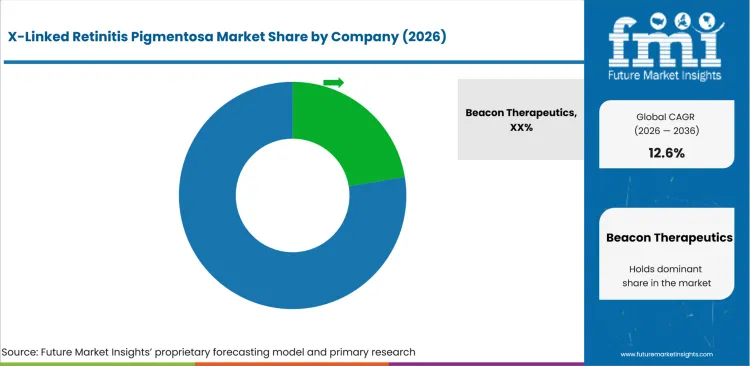
Competition remains concentrated as few developers combine RPGR-specific candidates with pivotal evidence and trained retinal-surgery sites. Broader retinal platforms widen treatment coverage, but small cohorts and multiyear follow-up increase financing needs without commercial revenue.
- Beacon Therapeutics, MeiraGTx and Frontera Therapeutics compete through active RPGR replacement programs spanning phase II through pivotal development.
- Ocugen and SparingVision pursue mutation-broad gene therapies, while Nacuity Pharmaceuticals advances an oral route for wider retinitis pigmentosa populations.
- 4D Molecular Therapeutics contributes historical XLRP evidence, while BlueRock Therapeutics / Bayer develops cell replacement for broader photoreceptor loss.
Competitive Benchmarking: X-Linked Retinitis Pigmentosa Market
| Company | Exact XLRP evidence | Clinical maturity | Filing and delivery readiness | Geographic Reach |
|---|---|---|---|---|
| Beacon Therapeutics | High | High | High | North America, UK and Australia |
| MeiraGTx | High | High | High | United States, Europe, UK and Japan |
| Frontera Therapeutics | High | Medium | Medium | China and United States |
| 4D Molecular Therapeutics | Medium | Medium | Low | United States and Europe, historical |
| Ocugen, Inc. | Low | High | Medium | United States, Canada and South Korea |
| SparingVision | Low | Medium | Medium | Europe and United States |
| Nacuity Pharmaceuticals | Low | Medium | Medium | United States and Australia |
| BlueRock Therapeutics / Bayer | Low | Medium | Medium | United States and Germany |
Key Developments in the X-Linked Retinitis Pigmentosa Market
- In May 2026, Frontera Therapeutics presented positive top-line phase II data for FT-002 in pediatric participants with RPGR-associated XLRP at the ARVO annual meeting.
- In May 2026, Beacon Therapeutics reported 12-month DAWN results for laru-zova and maintained its second-half 2026 schedule for pivotal VISTA top-line data.
- In February 2026, SparingVision completed dosing in the phase I/II PRODYGY trial of SPVN06 with 27 treated participants and six controls.
Key Players in the X-Linked Retinitis Pigmentosa Market
RPGR Gene Replacement Developers
- Beacon Therapeutics
- MeiraGTx
- Frontera Therapeutics
Gene-Agnostic and Genetic Medicine Platforms
- 4D Molecular Therapeutics
- Ocugen, Inc.
- SparingVision
Pharmacological and Cell Therapy Platforms
- Nacuity Pharmaceuticals
- BlueRock Therapeutics / Bayer
X-Linked Retinitis Pigmentosa Market - Report Scope
| Coverage field | Report scope |
|---|---|
| Market breakdown | By therapy type, stage of development, route of administration, end user, treatment approach and region. |
| Quantitative Units | Revenue in USD million and CAGR in %. |
| Market Definition | Therapies and clinical delivery pathways for X-linked retinitis pigmentosa across gene replacement, gene-agnostic, pharmacological and cell-based treatment architectures. |
| Regions Covered | North America, Latin America, Europe, East Asia, South Asia and Pacific and Middle East and Africa. |
| Countries Covered | USA, Australia, UK, Japan, Germany and 20+ countries included in the full report. |
| Key Companies Profiled | Beacon Therapeutics, MeiraGTx, Frontera Therapeutics, 4D Molecular Therapeutics, Ocugen, Inc., SparingVision, Nacuity Pharmaceuticals and BlueRock Therapeutics / Bayer |
| Forecast Period | 2026-2036. |
| Approach | Primary and secondary research with market triangulation. |
X-Linked Retinitis Pigmentosa Market - Research Methodology
| Method | Approach |
|---|---|
| Primary Research | FMI analysts gathered input from manufacturers, service providers, technology developers, distributors, end users, procurement teams, and subject-matter experts. Interviews examined purchasing decisions, product or service evaluation, adoption barriers, approval requirements, pricing considerations, and expectations for technical or commercial support. Respondents were also asked what evidence is required before a trial, pilot, or initial order develops into regular purchasing. |
| Desk Research | Desk research covered government statistics, regulatory publications, trade data, industry associations, technical literature, standards, company filings, product information, and official corporate announcements. Sources were reviewed for relevance, publication date, geographic coverage, and consistency with the defined market scope. Claims relating to performance, applications, approvals, capacity, investment, and commercial activity were retained only when supported by credible public evidence. |
| Market Sizing and Forecasting | The market model combined the baseline value with historical performance, segment structure, pricing and volume indicators, adoption levels, company participation, and country-level demand conditions. Forecast assumptions considered economic activity, investment trends, regulatory developments, technology adoption, purchasing cycles, supply availability, and barriers to wider market use. Segment and regional estimates were reconciled before the final market total was calculated. |
| Data Validation | Estimates were checked against multiple independent indicators, including public data, company activity, trade patterns, industry developments, and findings from primary interviews. Validation also tested whether products, services, applications, and company revenues fell within the defined market boundaries. Adjacent categories, unsupported claims, overlapping revenues, and activities without direct market relevance were excluded to reduce double counting and maintain consistency across segments and countries. |
X-Linked Retinitis Pigmentosa Market by Segments
X-Linked Retinitis Pigmentosa Market segmented by Therapy Type:
- Gene Therapy
- RPGR Gene Replacement Therapy
- Gene-Agnostic Gene Therapy
- Pharmacological Agents
- Antioxidant Therapy
- Retinal Neuroprotective Agents
- Stem Cell Therapies
- Retinal Progenitor Cell Therapy
- iPSC-Derived Photoreceptor Therapy
- Optogenetics
- Optogenetic Gene Therapy
- Light-Sensitive Protein Therapy
X-Linked Retinitis Pigmentosa Market segmented by Stage of Development:
- Phase III - Late-Stage Clinical
- Pivotal Gene Therapy Trials
- Late-Stage Confirmatory Studies
- Phase I-II Clinical
- First-in-Human Studies
- Dose-Finding Studies
- Approved - Commercial
- Approved Retinal Gene Therapies
- Expanded Access Programs
- Discovery & Preclinical
- Preclinical Gene Therapy
- Preclinical Cell Therapy
X-Linked Retinitis Pigmentosa Market segmented by Route of Administration:
- Sub-Retinal
- Sub-Retinal Gene Delivery
- Sub-Retinal Cell Delivery
- Intravitreal
- Intravitreal Gene Therapy
- Intravitreal Vector Delivery
- Oral - Systemic
- Oral Antioxidant Therapy
- Systemic Pharmacological Treatment
- Others
- Combination Administration
- Experimental Delivery Routes
X-Linked Retinitis Pigmentosa Market segmented by End User:
- Hospitals & Eye-Care Chains
- Ophthalmology Hospitals
- Retinal Specialty Centers
- Specialty Clinics
- Retina Clinics
- Genetic Eye Disease Clinics
- Academic & Research Institutes
- University Research Centers
- Clinical Research Institutes
- Others
- Government Research Organizations
- Specialized Gene Therapy Centers
X-Linked Retinitis Pigmentosa Market segmented by Treatment Approach:
- RPGR Gene Replacement
- RPGR ORF15 Gene Therapy
- AAV-Mediated Gene Replacement
- Gene-Agnostic Retinal Therapy
- Gene Modifier Therapy
- Retinal Neuroprotection
- Cell-Based Therapy
- Retinal Progenitor Cells
- iPSC-Derived Photoreceptors
- Pharmacological & Supportive Therapy
- Antioxidant Therapy
- Symptom Management
X-Linked Retinitis Pigmentosa Market by Region:
- North America
- United States
- Canada
- Latin America
- Brazil
- Chile
- Mexico
- Rest of Latin America
- Western Europe
- Germany
- United Kingdom
- Italy
- Spain
- France
- Nordics
- Benelux
- Rest of Western Europe
- Eastern Europe
- Russia
- Poland
- Hungary
- Balkan and Baltic States
- Rest of Eastern Europe
- East Asia
- China
- Japan
- South Korea
- South Asia and Pacific
- India
- ASEAN
- Australia and New Zealand
- Rest of South Asia and Pacific
- Middle East and Africa
- Kingdom of Saudi Arabia
- Other GCC Countries
- Türkiye
- South Africa
- Other African Union Countries
- Rest of Middle East and Africa
Research Sources and Bibliography
- National Library of Medicine. (2026, March 16). Gene Therapy Trial for the Treatment of X-linked Retinitis Pigmentosa Associated With Variants in the RPGR Gene.
- Beacon Therapeutics. (2025, July 8). Beacon Therapeutics completes enrollment in registrational Phase 2/3 VISTA trial of laru-zova for patients with XLRP.
- MeiraGTx Holdings plc. (2026, April 16). MeiraGTx Announces the Acquisition of Botaretigene Sparoparvovec (bota-vec) for the Treatment of X-linked Retinitis Pigmentosa (XLRP).
- BlueRock Therapeutics. (2025, July 8). BlueRock Therapeutics announces first patient receives investigational therapy in Phase 1/2a clinical trial of OpCT-001 for the treatment of primary photoreceptor diseases.
- Beacon Therapeutics. (2025, December 16). Beacon Therapeutics Treats First Patient in LANDSCAPE Trial of laru-zova in Patients with X-linked Retinitis Pigmentosa (XLRP).
- 4D Molecular Therapeutics, Inc. (2025, January 10). 4DMT Focuses Pipeline to Prioritize 4D-150 in Wet AMD & DME and 4D-710 in CF and Extends Cash Runway.
- Nacuity Pharmaceuticals. (2025, October 2). Nacuity Pharmaceuticals Granted USA FDA Breakthrough Therapy Designation for NPI-001 (N-acetylcysteine amide) Tablets for the Treatment of Retinitis Pigmentosa.
- National Library of Medicine. (2026, April 7). A Clinical Trial Evaluating the Safety and Efficacy of a Single Subretinal Injection of AGTC-501 in Participants With XLRP.
- Therapeutic Goods Administration. (2025, May 26). How we regulate Australian clinical trials that use unapproved therapeutic goods.
- Medicines and Healthcare products Regulatory Agency. (2026, May 11). Consultation on the regulation of Gene therapy medicinal products.
- National Library of Medicine. (2026, June 5). A Study of AAV5-hRKp.RPGR for the Treatment of Japanese Participants With X-linked Retinitis Pigmentosa.
- Bundesministerium für Gesundheit. (2026, February 27). Vier Millionen Betroffene: Präzise Diagnostik schneller in die Versorgung bringen.
- Frontera Therapeutics. (2026, May 11). Frontera Therapeutics Presents Positive Top-Line Phase II Data for FT-002 and FT-003 at ARVO 2026.
- Beacon Therapeutics. (2026, May 7). Beacon Therapeutics Announces Positive 12-Month Safety and Efficacy Update from Phase 2 DAWN Trial of laru-zova in Patients with X-linked Retinitis Pigmentosa (XLRP) at ARVO 2026 Annual Meeting.
- SparingVision. (2026, February 9). SparingVision Successfully Completes PRODYGY Trial Patient Dosing with SPVN06, its Novel Neuroprotective Gene Therapy.
- Ocugen, Inc. (2026, March 2). Ocugen Announces Phase 3 liMeliGhT Enrollment Completion for OCU400, a Novel Modifier Gene Therapy for Broad Retinitis Pigmentosa.
This bibliography is provided for reader reference and is not exhaustive. The full report contains the complete reference list and detailed citations.
This Report Answers
- How large is the X-linked retinitis pigmentosa market in 2026 and 2036?
- Which clinical conditions support demand for X-linked retinitis pigmentosa therapies?
- Why does gene therapy account for the largest therapy-type share in 2026?
- How does sub-retinal delivery shape treatment-center requirements and patient access?
- Why do country growth rates differ across major XLRP treatment systems?
- Which companies maintain exact RPGR programs or related retinal treatment platforms?
- What operational constraints limit wider XLRP therapy adoption across specialist centers?
- How do gene-agnostic and cell-based approaches broaden the treatment pathway?
Frequently Asked Questions
How big is the X-linked Retinitis Pigmentosa Market in 2026?
The global X-linked retinitis pigmentosa market is estimated at USD 348.9 million in 2026 and is projected to reach USD 1,143.1 million by 2036. Growth is supported by advances in genetic diagnosis, expanding retinal treatment capacity, and the development of targeted therapies.
What is the CAGR of the X-linked Retinitis Pigmentosa Market from 2026 to 2036?
The X-linked retinitis pigmentosa market is projected to grow at a CAGR of 12.6% between 2026 and 2036. Growth is driven by progress in RPGR-targeted therapies and increasing adoption of genetic testing in inherited retinal disorders.
Which therapy type leads the X-linked Retinitis Pigmentosa Market?
Gene therapy is projected to account for 82.0% of the market by therapy type in 2026. Its leadership reflects its ability to directly address the underlying genetic mutations responsible for the disease.
Which administration route leads the X-linked Retinitis Pigmentosa Market?
Sub-retinal delivery is projected to hold 83.0% of route-of-administration demand in 2026. The approach enables targeted treatment of retinal cells and remains the preferred delivery method for most gene therapy programs.
Who are the key companies in the X-linked Retinitis Pigmentosa Market?
Key companies in the X-linked retinitis pigmentosa market include Beacon Therapeutics, MeiraGTx, Frontera Therapeutics, 4D Molecular Therapeutics, Ocugen, SparingVision, Nacuity Pharmaceuticals, and BlueRock Therapeutics/Bayer. These companies are developing gene therapies, neuroprotective treatments, and regenerative approaches for inherited retinal diseases.
Preview the report firsthand - request a free sample
Get SampleGet the brochure for pricing and purchase details.
Get PDFTable of Content
- Key Takeaways
- Market Size and CAGR
- Top Growth Driver
- Fastest Growing Segment
- Leading Region
- Key Companies
- Emerging Opportunities
- Executive Summary
- Global Market Outlook
- Demand-side Trends
- Supply-side Trends
- Technology Roadmap Analysis
- Analysis and Recommendations
- Analyst Perspective (What is happening? Why now? What should investors know?)
- Key Questions Answered
- How large is the market?
- What is the CAGR?
- What are key trends?
- Which region dominates?
- Who are the leaders?
- Market Overview
- Market Coverage / Taxonomy
- Market Definition / Scope / Limitations
- Research Methodology
- Chapter Orientation
- Analytical Lens and Working Hypotheses
- Market Structure, Signals, and Trend Drivers
- Benchmarking and Cross-market Comparability
- Market Sizing, Forecasting, and Opportunity Mapping
- Research Design and Evidence Framework
- Desk Research Programme (Secondary Evidence)
- Expert Input and Fieldwork (Primary Evidence)
- Tooling, Models, and Reference Databases
- Data Engineering and Model Build
- Quality Assurance and Audit Trail
- Market Background
- Market Dynamics (Drivers, Restraints, Opportunity, Trends)
- Scenario Forecast (Optimistic, Likely, Conservative)
- Impact Analysis
- AI Impact
- Sustainability Impact
- Regulatory Impact
- Technology Impact
- Consumer / Buyer Analysis
- Purchase Drivers
- Adoption Barriers
- Buyer Journey
- Opportunity Map Analysis
- Product Life Cycle Analysis
- Supply Chain Analysis
- Investment Feasibility Matrix
- Value Chain Analysis
- PESTLE and Porter's Analysis
- Regulatory Landscape
- Regional Parent Market Outlook
- Production and Consumption Statistics
- Import and Export Statistics
- Global Market Analysis and Forecast, 2021 to 2036
- Historical Market Size Value (USD Million) Analysis, 2021 to 2025
- Current and Future Market Size Value (USD Million) Projections, 2026 to 2036
- Y-o-Y Growth Trend Analysis
- Absolute $ Opportunity Analysis
- Global Market Pricing Analysis, 2021 to 2036
- Global Market Analysis and Forecast, By Therapy Type, 2021 to 2036
- Introduction / Key Findings
- Historical Market Size Value (USD Million) Analysis By Therapy Type, 2021 to 2025
- Current and Future Market Size Value (USD Million) Analysis and Forecast By Therapy Type, 2026 to 2036
- Gene Therapy
- Gene Replacement Therapy
- Gene Modifier Therapy
- Pharmacological Agents
- Antioxidant Therapy
- Retinal Neuroprotective Agents
- Stem Cell Therapies
- Retinal Progenitor Cell Therapy
- iPSC-Derived Photoreceptor Therapy
- Optogenetics
- Optogenetic Gene Therapy
- Light-Sensitive Protein Therapy
- Gene Therapy
- Y-o-Y Growth Trend Analysis By Therapy Type, 2021 to 2025
- Absolute $ Opportunity Analysis By Therapy Type, 2026 to 2036
- Global Market Analysis and Forecast, By Stage of Development, 2021 to 2036
- Introduction / Key Findings
- Historical Market Size Value (USD Million) Analysis By Stage of Development, 2021 to 2025
- Current and Future Market Size Value (USD Million) Analysis and Forecast By Stage of Development, 2026 to 2036
- Phase III - Late-Stage Clinical
- Pivotal Gene Therapy Trials
- Late-Stage Confirmatory Studies
- Phase I-II Clinical
- First-in-Human Studies
- Dose-Finding Studies
- Approved - Commercial
- Approved Retinal Gene Therapies
- Expanded Access Programs
- Discovery & Preclinical
- Preclinical Gene Therapy
- Preclinical Cell Therapy
- Phase III - Late-Stage Clinical
- Y-o-Y Growth Trend Analysis By Stage of Development, 2021 to 2025
- Absolute $ Opportunity Analysis By Stage of Development, 2026 to 2036
- Global Market Analysis and Forecast, By Route of Administration, 2021 to 2036
- Introduction / Key Findings
- Historical Market Size Value (USD Million) Analysis By Route of Administration, 2021 to 2025
- Current and Future Market Size Value (USD Million) Analysis and Forecast By Route of Administration, 2026 to 2036
- Sub-Retinal
- Sub-Retinal Gene Delivery
- Sub-Retinal Cell Delivery
- Intravitreal
- Intravitreal Gene Therapy
- Intravitreal Vector Delivery
- Oral - Systemic
- Oral Antioxidant Therapy
- Systemic Pharmacological Treatment
- Others
- Combination Administration
- Experimental Delivery Routes
- Sub-Retinal
- Y-o-Y Growth Trend Analysis By Route of Administration, 2021 to 2025
- Absolute $ Opportunity Analysis By Route of Administration, 2026 to 2036
- Global Market Analysis and Forecast, By End User, 2021 to 2036
- Introduction / Key Findings
- Historical Market Size Value (USD Million) Analysis By End User, 2021 to 2025
- Current and Future Market Size Value (USD Million) Analysis and Forecast By End User, 2026 to 2036
- Hospitals & Eye-Care Chains
- Ophthalmology Hospitals
- Retinal Specialty Centers
- Specialty Clinics
- Retina Clinics
- Genetic Eye Disease Clinics
- Academic & Research Institutes
- University Research Centers
- Clinical Research Institutes
- Others
- Government Research Organizations
- Specialized Gene Therapy Centers
- Hospitals & Eye-Care Chains
- Y-o-Y Growth Trend Analysis By End User, 2021 to 2025
- Absolute $ Opportunity Analysis By End User, 2026 to 2036
- Global Market Analysis and Forecast, By Treatment Approach, 2021 to 2036
- Introduction / Key Findings
- Historical Market Size Value (USD Million) Analysis By Treatment Approach, 2021 to 2025
- Current and Future Market Size Value (USD Million) Analysis and Forecast By Treatment Approach, 2026 to 2036
- RPGR Gene Replacement
- RPGR ORF15 Gene Therapy
- AAV-Mediated Gene Replacement
- Gene-Agnostic Retinal Therapy
- Gene Modifier Therapy
- Retinal Neuroprotection
- Cell-Based Therapy
- Retinal Progenitor Cells
- iPSC-Derived Photoreceptors
- Pharmacological & Supportive Therapy
- Antioxidant Therapy
- Symptom Management
- RPGR Gene Replacement
- Y-o-Y Growth Trend Analysis By Treatment Approach, 2021 to 2025
- Absolute $ Opportunity Analysis By Treatment Approach, 2026 to 2036
- Global Market Analysis and Forecast, By Region, 2021 to 2036
- Introduction
- Historical Market Size Value (USD Million) Analysis By Region, 2021 to 2025
- Current Market Size Value (USD Million) Analysis and Forecast By Region, 2026 to 2036
- North America
- Latin America
- Western Europe
- Eastern Europe
- East Asia
- South Asia and Pacific
- Middle East & Africa
- Market Attractiveness Analysis By Region
- North America Market Analysis and Forecast, By Country, 2021 to 2036
- Historical Market Size Value (USD Million) Trend Analysis By Market Taxonomy, 2021 to 2025
- Market Size Value (USD Million) Forecast By Market Taxonomy, 2026 to 2036
- By Country
- USA
- Canada
- By Therapy Type
- By Stage of Development
- By Route of Administration
- By End User
- By Treatment Approach
- By Country
- Market Attractiveness Analysis
- By Country
- By Therapy Type
- By Stage of Development
- By Route of Administration
- By End User
- By Treatment Approach
- Key Takeaways
- Latin America Market Analysis and Forecast, By Country
- Historical Market Size Value (USD Million) Trend Analysis By Market Taxonomy, 2021 to 2025
- Market Size Value (USD Million) Forecast By Market Taxonomy, 2026 to 2036
- By Country
- Brazil
- Mexico
- Chile
- Rest of Latin America
- By Therapy Type
- By Stage of Development
- By Route of Administration
- By End User
- By Treatment Approach
- By Country
- Market Attractiveness Analysis
- By Country
- By Therapy Type
- By Stage of Development
- By Route of Administration
- By End User
- By Treatment Approach
- Key Takeaways
- Western Europe Market Analysis and Forecast, By Country
- Historical Market Size Value (USD Million) Trend Analysis By Market Taxonomy, 2021 to 2025
- Market Size Value (USD Million) Forecast By Market Taxonomy, 2026 to 2036
- By Country
- Germany
- UK
- Italy
- Spain
- France
- Nordic
- BENELUX
- Rest of Western Europe
- By Therapy Type
- By Stage of Development
- By Route of Administration
- By End User
- By Treatment Approach
- By Country
- Market Attractiveness Analysis
- By Country
- By Therapy Type
- By Stage of Development
- By Route of Administration
- By End User
- By Treatment Approach
- Key Takeaways
- Eastern Europe Market Analysis and Forecast, By Country
- Historical Market Size Value (USD Million) Trend Analysis By Market Taxonomy, 2021 to 2025
- Market Size Value (USD Million) Forecast By Market Taxonomy, 2026 to 2036
- By Country
- Russia
- Poland
- Hungary
- Balkan & Baltic
- Rest of Eastern Europe
- By Therapy Type
- By Stage of Development
- By Route of Administration
- By End User
- By Treatment Approach
- By Country
- Market Attractiveness Analysis
- By Country
- By Therapy Type
- By Stage of Development
- By Route of Administration
- By End User
- By Treatment Approach
- Key Takeaways
- East Asia Market Analysis and Forecast, By Country
- Historical Market Size Value (USD Million) Trend Analysis By Market Taxonomy, 2021 to 2025
- Market Size Value (USD Million) Forecast By Market Taxonomy, 2026 to 2036
- By Country
- China
- Japan
- South Korea
- By Therapy Type
- By Stage of Development
- By Route of Administration
- By End User
- By Treatment Approach
- By Country
- Market Attractiveness Analysis
- By Country
- By Therapy Type
- By Stage of Development
- By Route of Administration
- By End User
- By Treatment Approach
- Key Takeaways
- South Asia and Pacific Market Analysis and Forecast, By Country
- Historical Market Size Value (USD Million) Trend Analysis By Market Taxonomy, 2021 to 2025
- Market Size Value (USD Million) Forecast By Market Taxonomy, 2026 to 2036
- By Country
- India
- ASEAN
- Australia & New Zealand
- Rest of South Asia and Pacific
- By Therapy Type
- By Stage of Development
- By Route of Administration
- By End User
- By Treatment Approach
- By Country
- Market Attractiveness Analysis
- By Country
- By Therapy Type
- By Stage of Development
- By Route of Administration
- By End User
- By Treatment Approach
- Key Takeaways
- Middle East & Africa Market Analysis and Forecast, By Country
- Historical Market Size Value (USD Million) Trend Analysis By Market Taxonomy, 2021 to 2025
- Market Size Value (USD Million) Forecast By Market Taxonomy, 2026 to 2036
- By Country
- Kingdom of Saudi Arabia
- Other GCC Countries
- Türkiye
- South Africa
- Other African Union
- Rest of Middle East & Africa
- By Therapy Type
- By Stage of Development
- By Route of Administration
- By End User
- By Treatment Approach
- By Country
- Market Attractiveness Analysis
- By Country
- By Therapy Type
- By Stage of Development
- By Route of Administration
- By End User
- By Treatment Approach
- Key Takeaways
- Key Countries Market Analysis
- USA
- Pricing Analysis
- Market Share Analysis, 2025
- By Therapy Type
- By Stage of Development
- By Route of Administration
- By End User
- By Treatment Approach
- Canada
- Pricing Analysis
- Market Share Analysis, 2025
- By Therapy Type
- By Stage of Development
- By Route of Administration
- By End User
- By Treatment Approach
- Mexico
- Pricing Analysis
- Market Share Analysis, 2025
- By Therapy Type
- By Stage of Development
- By Route of Administration
- By End User
- By Treatment Approach
- Brazil
- Pricing Analysis
- Market Share Analysis, 2025
- By Therapy Type
- By Stage of Development
- By Route of Administration
- By End User
- By Treatment Approach
- Chile
- Pricing Analysis
- Market Share Analysis, 2025
- By Therapy Type
- By Stage of Development
- By Route of Administration
- By End User
- By Treatment Approach
- Germany
- Pricing Analysis
- Market Share Analysis, 2025
- By Therapy Type
- By Stage of Development
- By Route of Administration
- By End User
- By Treatment Approach
- UK
- Pricing Analysis
- Market Share Analysis, 2025
- By Therapy Type
- By Stage of Development
- By Route of Administration
- By End User
- By Treatment Approach
- Italy
- Pricing Analysis
- Market Share Analysis, 2025
- By Therapy Type
- By Stage of Development
- By Route of Administration
- By End User
- By Treatment Approach
- Spain
- Pricing Analysis
- Market Share Analysis, 2025
- By Therapy Type
- By Stage of Development
- By Route of Administration
- By End User
- By Treatment Approach
- France
- Pricing Analysis
- Market Share Analysis, 2025
- By Therapy Type
- By Stage of Development
- By Route of Administration
- By End User
- By Treatment Approach
- India
- Pricing Analysis
- Market Share Analysis, 2025
- By Therapy Type
- By Stage of Development
- By Route of Administration
- By End User
- By Treatment Approach
- ASEAN
- Pricing Analysis
- Market Share Analysis, 2025
- By Therapy Type
- By Stage of Development
- By Route of Administration
- By End User
- By Treatment Approach
- Australia & New Zealand
- Pricing Analysis
- Market Share Analysis, 2025
- By Therapy Type
- By Stage of Development
- By Route of Administration
- By End User
- By Treatment Approach
- China
- Pricing Analysis
- Market Share Analysis, 2025
- By Therapy Type
- By Stage of Development
- By Route of Administration
- By End User
- By Treatment Approach
- Japan
- Pricing Analysis
- Market Share Analysis, 2025
- By Therapy Type
- By Stage of Development
- By Route of Administration
- By End User
- By Treatment Approach
- South Korea
- Pricing Analysis
- Market Share Analysis, 2025
- By Therapy Type
- By Stage of Development
- By Route of Administration
- By End User
- By Treatment Approach
- Russia
- Pricing Analysis
- Market Share Analysis, 2025
- By Therapy Type
- By Stage of Development
- By Route of Administration
- By End User
- By Treatment Approach
- Poland
- Pricing Analysis
- Market Share Analysis, 2025
- By Therapy Type
- By Stage of Development
- By Route of Administration
- By End User
- By Treatment Approach
- Hungary
- Pricing Analysis
- Market Share Analysis, 2025
- By Therapy Type
- By Stage of Development
- By Route of Administration
- By End User
- By Treatment Approach
- Kingdom of Saudi Arabia
- Pricing Analysis
- Market Share Analysis, 2025
- By Therapy Type
- By Stage of Development
- By Route of Administration
- By End User
- By Treatment Approach
- Türkiye
- Pricing Analysis
- Market Share Analysis, 2025
- By Therapy Type
- By Stage of Development
- By Route of Administration
- By End User
- By Treatment Approach
- South Africa
- Pricing Analysis
- Market Share Analysis, 2025
- By Therapy Type
- By Stage of Development
- By Route of Administration
- By End User
- By Treatment Approach
- USA
- Market Structure Analysis
- Competition Dashboard
- Competition Benchmarking
- Market Share Analysis of Top Players
- By Regional
- By Therapy Type
- By Stage of Development
- By Route of Administration
- By End User
- By Treatment Approach
- Emerging Startups
- Innovation Benchmarking
- Competition Analysis
- Competition Deep Dive
- Beacon Therapeutics
- Overview
- Product Portfolio
- Profitability by Market Segments
- Sales Footprint
- Strategy Overview
- Marketing Strategy
- Product Strategy
- Channel Strategy
- Johnson & Johnson Innovative Medicine / MeiraGTx
- 4D Molecular Therapeutics
- Ocugen, Inc.
- Nacuity Pharmaceuticals
- SparingVision
- BlueRock Therapeutics
- Bayer AG
- Frontera Therapeutics
- Novartis AG
- Others
- Beacon Therapeutics
- Case Studies
- Success Stories
- Recent Developments
- Competition Deep Dive
- Assumptions & Acronyms Used


