

- Market Size (2026)
- USD 1314.6 Mn
- Forecast (2036)
- USD 3228.1 Mn
- CAGR (2026 to 2036)
- 9.4%
How big is Xenotransplantation Clinical Advancement Market in 2026?
USD 1,314.6 million in 2026 and USD 3,228.1 million by 2036 at a 9.4% CAGR.
Demand for xenotransplantation clinical advancement is projected to grow at 9.4% CAGR during the forecast period. The valuation is estimated at USD 1314.6 million in 2026 and is forecast to reach USD 3228.1 million by 2036. Commercial spending follows a coordinated pathway joining engineered donor animals with immunosuppression and infection surveillance across clinical programs. Surgical teams require graft monitoring systems that separate organ function from rejection signals during early clinical follow-up. HRSA reported in June 2026 that the United States had 250 transplant hospitals within the national network. Programs depend on transplant diagnostics that document compatibility and rejection risk across each recipient evaluation. Clinical pathways also require organ preservation systems that maintain donor-organ condition during transport and operating-room preparation. Investment therefore concentrates at institutions able to manage surgery and biosafety laboratories under one accountable long-term protocol.
National entry routes differ materially through regulatory authority and transplant-center concentration across the five profiled countries. United States programs can progress through FDA-authorized clinical studies inside a mature transplant network with rigorous sponsor oversight. ClinicalTrials.gov listed EGEN-5784 in May 2026 as a multicenter liver xenotransplant study planned across eight United States centers. British and German institutions have experienced transplant teams yet routine purchasing remains constrained by investigational status. South Korean developers face a distinct biosafety gate because national authorities require prior review for healthcare genetically modified organisms. Adjacent regenerative medicine programs provide cell and tissue engineering capacity without proving routine xenograft purchasing. Base editing platforms strengthen donor-organ design capability but do not replace clinical evidence for safety and durable function. Commercial entry therefore depends on national trial authorization and a service model that can sustain lifetime infection surveillance.
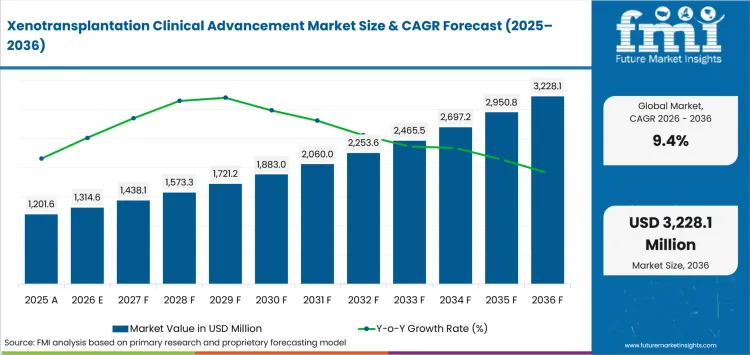
Key Takeaways of Xenotransplantation Clinical Advancement Market
- Organ scarcity shapes demand for xenotransplantation clinical advancement, with donor engineering, immunosuppression, pathogen surveillance, and long-term recipient monitoring forming connected requirements across clinical programs.
- By organ type, kidney transplantation holds 42.2% share in 2026, while preclinical studies account for 44.2% share in 2026 within clinical stage, reflecting measurable renal graft outcomes and the extensive compatibility and safety evidence required before human treatment.
- End-stage organ failure represents 31.3% share in 2026, while transplant centers hold 33.7% share in 2026 among end users, reflecting the focus on severe organ dysfunction and the specialist surgical and follow-up infrastructure required for xenotransplantation.
- South Korea records the highest country CAGR at 11.1% through 2036, followed by Germany at 9.4% and the United Kingdom at 8.2%, reflecting differences in biotechnology capacity, transplant infrastructure, clinical governance, and trial authorization.
- Competition centers on eGenesis, United Therapeutics, Revivicor, Makana Therapeutics, Qihan Bio, Eledon Pharmaceuticals, and Tonix Pharmaceuticals, with competitive positioning spanning gene-edited donor organs, clinical development programs, and immune-modulating therapies.
- Donor-organ consistency, infection surveillance, immunosuppression management, regulatory requirements, and long-term safety monitoring remain major barriers across xenotransplantation clinical programs.
Analyst Perspective
"The xenotransplantation clinical advancement market is being shaped by the balance between expanded organ availability and the long-term safety requirements of clinical use. Transplant programs are evaluating graft performance, immunological outcomes, infection surveillance, and patient follow-up as distinct development considerations. Companies that establish rigorous clinical monitoring, standardized manufacturing, and transparent risk management will be better positioned to advance xenotransplantation programs."
- Anurag Sharma, Principal Consultant at Future Market Insights
Source: FMI's proprietary forecasting model and primary research
How is the Xenotransplantation Clinical Advancement Market segmented?
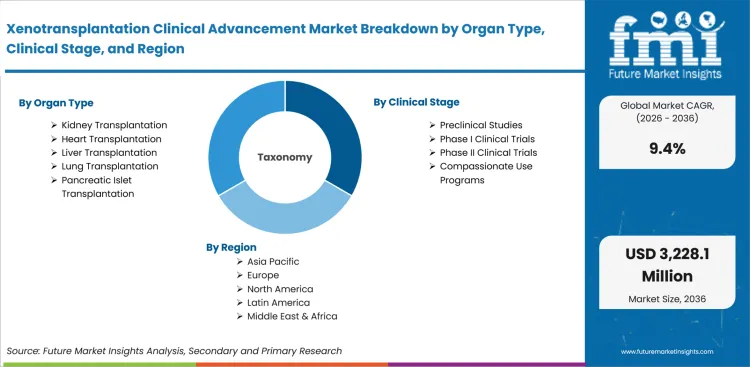
The xenotransplantation clinical advancement industry is segmented by organ type, clinical stage, application, end user, and region.
The segmentation framework separates transplanted organs from the evidence stage and clinical problem addressed by each program. Organ type distinguishes kidney and thoracic organs from liver and pancreatic islet approaches across clinically observable procedures. Clinical stage follows programs from preclinical studies through formal trials and compassionate use under defined regulatory protocols. Application separates end-stage failure from organ shortage management and regenerative medicine through the problem addressed by each program. End user identifies transplant centers and hospitals alongside biotechnology companies and research institutes responsible for development or delivery. Regional analysis compares regulatory routes and specialist capacity across national health systems with different clinical research infrastructure.
What supports kidney transplantation within the organ type category?
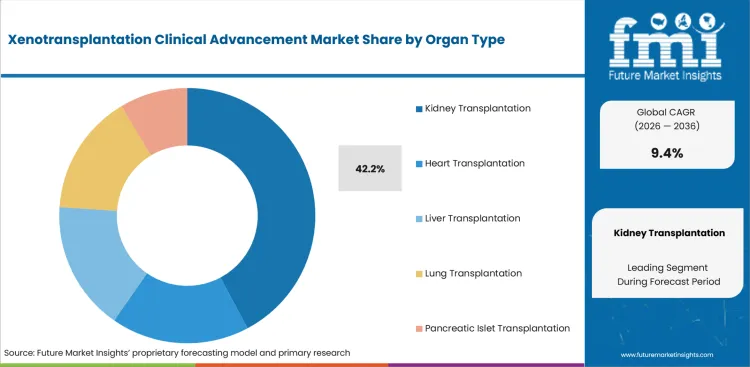
Kidney programs offer measurable filtration endpoints and an established surgical pathway for recipients facing long dialysis exposure. The International Xenotransplantation Association published a kidney position paper in April 2025 that defined clinical selection and monitoring priorities. Transplant teams can compare creatinine and filtration measures throughout recovery while maintaining protocol-specific infection surveillance. Related preservation solutions support operating-room timing but cannot resolve immune compatibility or long-term graft durability.
- Kidney transplantation is forecast to represent 42.2% of organ type in 2026, attributable to the clinical priority assigned to renal replacement and measurable graft function. The segment also benefits from established dialysis referral networks that identify eligible recipients and document baseline disease burden.
- Nephrologists and transplant surgeons evaluate kidney xenografts through survival and filtration outcomes that can be monitored repeatedly. Adoption depends on reliable crossmatching and defined rescue options that protect recipients during rejection or graft dysfunction throughout early clinical participation and extended follow-up.
How do preclinical studies shape the clinical stage category?
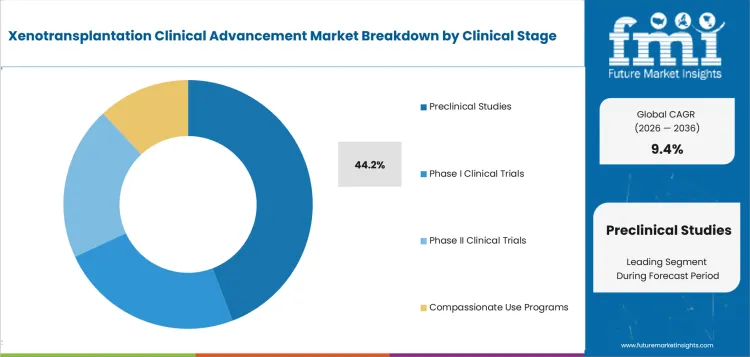
Preclinical studies test donor genetics and immunosuppression across animal models before a human protocol can establish acceptable risk. A March 2026 literature update reported continued nonhuman-primate work alongside the field’s transition into authorized trials. Program sponsors use these studies to refine graft survival endpoints and pathogen surveillance plans before regulatory submission. The evidence also informs manufacturing controls across donor herds and edited-cell lines throughout repeated preclinical production cycles.
- Preclinical studies are estimated to hold 44.2% share within clinical stage in 2026, driven by required donor-genetics and infection-control evidence. Regulators require a consistent package that links donor breeding and organ preparation with recipient monitoring and emergency management standards.
- Biotechnology developers use preclinical programs to identify rejection mechanisms and dosing schedules without exposing human recipients to an unbounded protocol. The same work supports cell and gene therapy manufacturing practices that control identity and contamination across edited biological materials under controlled production conditions.
What makes end-stage organ failure central to the application category?
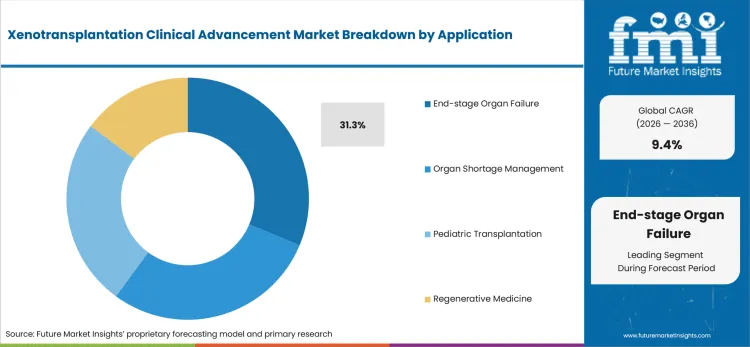
Patients with end-stage organ failure face a narrow set of options once conventional therapy no longer maintains adequate function. NHS Blood and Transplant reported nearly 4,600 transplants across the United Kingdom during the 2024/25 reporting year. The same official page estimated around 8100 people remained on the national transplant waiting list. The continuing gap creates a direct clinical rationale for investigational organs among carefully selected recipients with limited alternatives. Commercial programs must demonstrate that xenografts improve survival or treatment burden beyond dialysis and other supportive care.
- End-stage organ failure is likely to capture 31.3% share within application in 2026, supported by the absence of adequate human donor supply for many patients. The application concentrates spending on programs that can replace failing organ function rather than provide a temporary diagnostic or supportive service.
- Transplant physicians consider xenografts for patients facing prolonged waiting times or limited suitability for a human donor organ. Adjacent advanced therapy products may restore tissue function but cannot substitute for a complete organ during life-threatening clinical decline in specialist centers.
How do transplant centers influence the end user category?
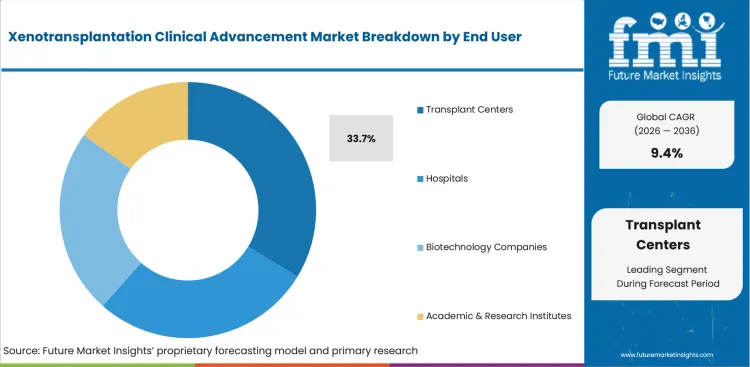
Transplant centers coordinate recipient selection and surgery with immunology laboratories and long-term infectious-disease surveillance across regulated protocols. ClinicalTrials.gov described the EXPAND UKidney study as a multicenter program with lifetime monitoring for graft function and zoonotic infections. The EXPAND protocol requires institutional capability beyond a conventional single-procedure surgical service and ordinary discharge planning. Each participating center must also manage crossmatching and data reporting under sponsor and regulator oversight.
- Transplant centers are forecast to represent 33.7% of end user in 2026, owing to their control over surgery and long-term graft surveillance. Their position reflects the need to combine intensive care and laboratory interpretation with surgical decision authority under one clinical governance structure.
- Hospital transplant institutes evaluate clinical programs through staffing depth and biosafety readiness across recipient selection and post-operative care. Investment in clinical diagnostics becomes necessary once routine laboratory pathways must distinguish rejection from infection and medication toxicity throughout long-term graft surveillance.
What are the drivers, restraints, and opportunities in the Xenotransplantation Clinical Advancement Market?
Persistent organ shortages support clinical development, while infection risk and long-term evidence requirements constrain adoption. Coordinated immune-management programs create the clearest commercial opening.
- Driver: Organ shortages create sustained clinical pressure for transplantable alternatives among patients who lack a timely allograft route.
- Restraint: Lifelong infection surveillance and uncertain immune durability increase clinical responsibility far beyond the implant procedure.
- Opportunity: Integrated donor-organ and immune-management programs can reduce coordination gaps across manufacturing and recipient care.
Organ scarcity creates the principal demand pressure because many candidates deteriorate during prolonged waiting periods. HRSA reported in December 2025 that another person joins the United States transplant waiting list every ten minutes. Xenotransplantation programs address that pressure through reproducible donor-organ production rather than dependence on unpredictable deceased donation. Transplant centers therefore evaluate clinical development as a controlled clinical capacity extension rather than a direct substitute for current donation programs.
Biosafety obligations create a material restraint across every clinical pathway involving living animal material and sustained recipient contact. FDA xenotransplantation guidance requires attention to infectious-agent screening and long-term recipient surveillance across source animals and human participants. Sponsors must fund data retention and rapid investigation of possible zoonotic events beyond ordinary surgical follow-up. Adoption remains limited until transplant centers can support those responsibilities without weakening existing allograft services under routine conditions.
Immune-management integration creates a credible opening for companies that can link donor genetics with a defined rejection-control regimen. Tonix Pharmaceuticals reported in May 2026 that its TNX-1500 Phase 1 study enrolled 26 healthy adults and demonstrated pharmacokinetics supporting monthly intravenous dosing in future use. A validated immune product can improve program design by separating organ manufacturing from pharmacologic responsibility during clinical evaluation. Commercial partnerships should connect dosing and monitoring with stem cell therapies expertise without treating adjacent evidence as proof of xenograft adoption.
Which country CAGRs are profiled in the Xenotransplantation Clinical Advancement Market?
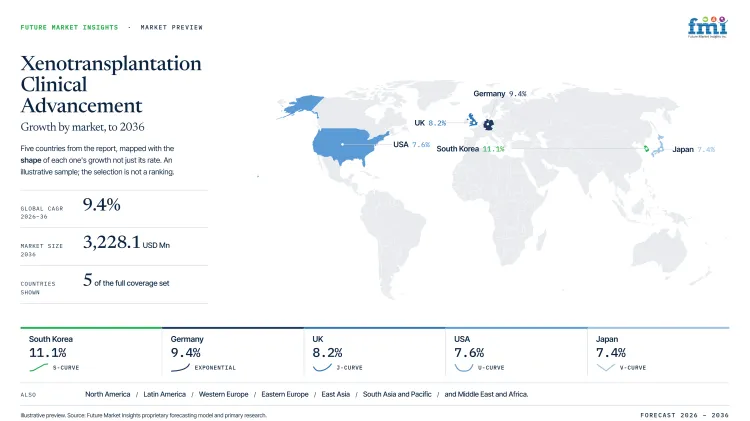
| Country | CAGR |
|---|---|
| USA | 7.6% |
| UK | 8.2% |
| Germany | 9.4% |
| Japan | 7.4% |
| South Korea | 11.1% |
How do country-level CAGRs compare in the Xenotransplantation Clinical Advancement Market?
The country comparison spans 3.7 percentage points between Japan at 7.4% and South Korea at 11.1%. The United States and Japan form a compressed pair separated by 0.2 percentage points within the lower cluster. The United Kingdom sits 0.6 points above the United States while Germany adds another 1.2 points. South Korea stands 1.7 points beyond Germany and therefore sits outside the central growth cluster. The spacing reflects different regulatory pathways and domestic development capacity rather than a direct measure of current market size.
- The United States and Japan show similar forecast rates despite materially different clinical development and regulatory routes. American programs rely on sponsor-led FDA trials while Japanese activity combines domestic donor-pig development with centralized transplant governance.
- The United Kingdom occupies the middle of the lower cluster through a revised clinical-trial framework and nationally coordinated transplant services.
- Germany sits above the United Kingdom through established transplant-center infrastructure and formal organ-allocation systems across the Eurotransplant network.
- South Korea is positioned outside the main cluster through biotechnology investment and rapid clinical-technology evaluation under strict biosafety controls.
Similar CAGRs can produce different entry conditions because trial approval and service coverage determine whether an investigational organ reaches a qualified center. Financing also changes the pace of donor-animal facilities and lifetime patient surveillance across health systems.
The full report provides country-level CAGR analysis across North America, Latin America, Europe, East Asia, South Asia, Oceania and the Middle East and Africa.
Country-wise Analysis
- United States clinical development operates through FDA-authorized protocols at transplant hospitals with extensive allograft experience. The United States xenotransplantation clinical advancement market is projected to grow at 7.6% CAGR by 2036, driven by sponsor-led kidney trials and specialist capacity. eGenesis reported in February 2025 that a second recipient received its engineered porcine kidney at Massachusetts General Hospital. The completed procedure supports an adoption route through experienced academic centers while the limited recipient count remains a material evidence constraint. Sponsors need site contracts that fund long-term surveillance and preserve clear responsibility for immunosuppression and graft removal.
- United Kingdom transplant services use national waiting-list coordination and centralized oversight across organ retrieval and clinical research. The United Kingdom outlook is anticipated to advance at 8.2% CAGR through 2036, supported by established transplant capacity and regulatory reform. MHRA guidance published in June 2025 established the approval route applying to new clinical trials from April 28, 2026. The framework enables a clearer sponsor pathway yet does not create routine legal sale for xenograft products. Developers must secure ethics review and specialist hospital participation before financing local donor-organ or surveillance infrastructure.
- Germany combines formal organ allocation with forty-three transplant centers that can support controlled clinical protocols. The German sector is estimated to post 9.4% CAGR over the assessment period, underpinned by specialist infrastructure and persistent organ scarcity. The German Organ Transplantation Foundation reported in January 2026 that 8,199 people remained on the waiting list at year-end 2025. The same release recorded 3,256 postmortem donor organs transplanted across German centers and the Eurotransplant network. Clinical entry requires sponsor-funded biosafety procedures because existing allograft capacity does not automatically cover xenograft surveillance.
- Japan maintains a centralized transplant registry and domestic programs developing genetically edited donor pigs for clinical research. Adoption in Japan is forecast to expand at 7.4% CAGR during the forecast period, influenced by national research capacity and conservative clinical governance. Japan Organ Transplant Network reported 14,983 registered kidney candidates across the national registry in June 2026. The waiting-list burden supports a direct enabler for kidney programs while limited deceased-donor transplantation creates strong ethical and regulatory scrutiny. Local developers need validated donor herds and hospital training that fit Japanese biosafety requirements before human enrollment.
- South Korea regulates healthcare genetically modified organisms through prior risk review covering import and clinical use. Demand for xenotransplantation clinical advancement in South Korea is predicted to rise at 11.1% CAGR through 2036, enabled by biotechnology capability and tertiary-care concentration. KDCA guidance updated in March 2025 confirmed that healthcare LMO use requires risk review and approval before import or production. The rule supports a defined biosafety route while adding documentation and facility requirements that can delay clinical programs. Companies need a domestic regulatory partner and trained hospital network before committing substantial donor-animal production capacity.
Who are the notable companies in the Xenotransplantation Clinical Advancement Market?
eGenesis, Revivicor, United Therapeutics, Makana Therapeutics, Qihan Bio, PorMedTec, Eledon Pharmaceuticals, and Tonix Pharmaceuticals are notable companies shaping this market.
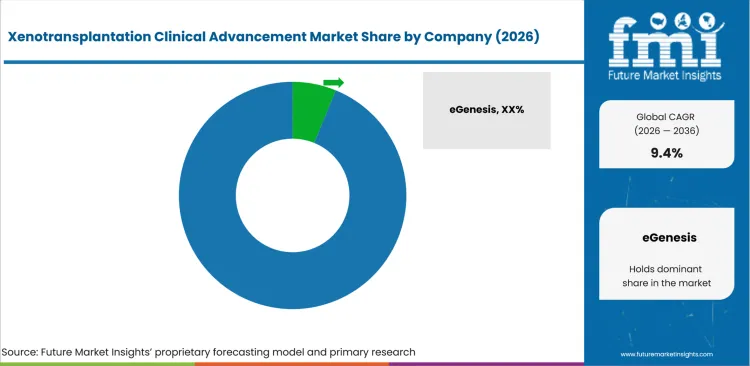
Competition spans donor-organ engineering and clinical sponsorship alongside immune products that support graft acceptance throughout long-term recipient care. Qihan Bio describes a multiplex genome-editing platform for human-compatible organs and cellular therapies within China. Donor-platform companies compete through edit design and animal-production controls while trial sponsors carry regulatory and patient-follow-up responsibility. Immune-support developers compete through dosing convenience and evidence that reduces rejection without unacceptable infection risk. Adjacent bioprinted organ research offers a different route to organ replacement and should not be treated as direct evidence of xenograft commercialization.
- eGenesis and Revivicor provide engineered donor-organ platforms linked to active United States kidney programs and regulated clinical pathways. United Therapeutics combines Revivicor organs with clinical sponsorship across kidney and heart indications under dedicated development programs.
- Makana Therapeutics and Qihan Bio develop edited donor animals for organ and cellular transplantation across research programs. PorMedTec supports Japan-focused donor-pig production and translational research through domestic institutional partnerships and controlled breeding infrastructure.
- Eledon Pharmaceuticals and Tonix Pharmaceuticals develop CD40L-directed immune therapies whose commercial relevance depends on trial inclusion and regulatory progress rather than donor-organ ownership.
Competitive Benchmarking: Xenotransplantation Clinical Advancement Market
| Company | Donor Organ Engineering | Clinical Translation | Immune Support | Geographic Reach |
|---|---|---|---|---|
| eGenesis | High | High | Medium | North America and Japan |
| Revivicor | High | High | Medium | United States |
| United Therapeutics | High | High | Medium | United States |
| Makana Therapeutics | High | Medium | High | North America |
| Qihan Bio | High | Medium | Low | China |
| PorMedTec | Medium | Medium | Low | Japan |
| Eledon Pharmaceuticals | Low | High | High | North America |
| Tonix Pharmaceuticals | Low | Medium | High | North America |
Key Developments in the Xenotransplantation Clinical Advancement Market
- In September 2025, eGenesis received FDA clearance for the EGEN-2784 investigational new drug application covering a Phase 1/2/3 kidney xenotransplant study in patients with end-stage kidney disease. The program uses genetically engineered porcine kidneys with defined compatibility edits and 24-week clinical endpoints. The clearance establishes a formal United States clinical pathway beyond individual expanded-access procedures and hospital-specific protocols.
- In November 2025, United Therapeutics announced the first UKidney transplant under its EXPAND clinical trial at NYU Langone Health. The study uses a ten-gene-edited porcine kidney with lifetime monitoring of graft function and zoonotic infection. The procedure places Revivicor-derived organs within a sponsor-led multicenter clinical pathway with predefined safety and efficacy endpoints.
- In April 2025, Tonix Pharmaceuticals announced a collaboration with Makana Therapeutics combining TNX-1500 with Makana's genetically engineered organs across kidney and heart xenotransplantation research. The collaboration also covers pancreatic islet research and crossmatch development across related transplant pathways. The agreement brings donor engineering and immune-control development into a coordinated preclinical and clinical research framework.
- In January 2026, Eledon Pharmaceuticals reported that tegoprubart had been used in three genetically modified pig kidney transplants at Massachusetts General Hospital. Eledon also outlined regulatory discussions concerning a defined development pathway for xenotransplantation applications in clinical protocols. The update highlights the role of dedicated immunosuppression alongside engineered donor organs and ongoing transplant-center monitoring.
Key Players in the Xenotransplantation Clinical Advancement Market
Donor Organ Platform Developers
- eGenesis
- Revivicor
- Makana Therapeutics
- Qihan Bio
- PorMedTec
Clinical and Immune-Support Developers
- United Therapeutics
- Eledon Pharmaceuticals
- Tonix Pharmaceuticals
Translational Infrastructure Providers
- Karius
- OrganOx
Xenotransplantation Clinical Advancement Market - Report Scope
| Coverage field | Report scope |
|---|---|
| Market breakdown | Organ type, clinical stage, application, end user, and region. |
| Quantitative Units | Revenue in USD Million, CAGR in %. |
| Market Definition | Products and services used directly to engineer, evaluate, transplant, and monitor animal-derived organs or cells within human clinical pathways. |
| Regions Covered | North America, Latin America, Western Europe, Eastern Europe, East Asia, South Asia and Pacific, and Middle East and Africa. |
| Countries Covered | USA, UK, Germany, Japan, and South Korea. |
| Key Companies Profiled | eGenesis, Revivicor, United Therapeutics, Makana Therapeutics, Qihan Bio, PorMedTec, Eledon Pharmaceuticals, and Tonix Pharmaceuticals. |
| Forecast Period | 2026 to 2036. |
| Approach | Hybrid bottom-up and top-down market sizing supported by primary interviews and official desk research. |
Xenotransplantation Clinical Advancement Market - Research Methodology
| Method | Approach |
|---|---|
| Primary Research | FMI analysts gathered input from manufacturers, service providers, technology developers, distributors, end users, sourcing teams, and subject-matter experts. Interviews examined purchasing decisions, product or service evaluation, adoption barriers, approval requirements, pricing considerations, and expectations for technical or commercial support. Respondents were also asked what evidence is required before a trial, pilot, or initial order develops into regular purchasing. |
| Desk Research | Desk research covered government statistics, regulatory publications, trade data, industry associations, technical literature, standards, company filings, product information, and official corporate announcements. Sources were reviewed for relevance, publication date, geographic coverage, and consistency with the defined market scope. Claims relating to performance, applications, approvals, capacity, investment, and commercial activity were retained only when supported by credible public evidence. |
| Market Sizing and Forecasting | The market model combined the baseline value with historical performance, segment structure, pricing and volume indicators, adoption levels, company participation, and country-level demand conditions. Forecast assumptions considered economic activity, investment trends, regulatory developments, technology adoption, purchasing cycles, supply availability, and barriers to wider market use. Segment and regional estimates were reconciled before the final market total was calculated. |
| Data Validation | Estimates were checked against multiple independent indicators, including public data, company activity, trade patterns, industry developments, and findings from primary interviews. Validation also tested whether products, services, applications, and company revenues fell within the defined market boundaries. Adjacent categories, unsupported claims, overlapping revenues, and activities without direct market relevance were excluded to reduce double counting and maintain consistency across segments and countries. |
Xenotransplantation Clinical Advancement Market by Segments
Xenotransplantation Clinical Advancement Market segmented by Organ Type:
- Kidney Transplantation
- Heart Transplantation
- Liver Transplantation
- Lung Transplantation
- Pancreatic Islet Transplantation
Xenotransplantation Clinical Advancement Market segmented by Clinical Stage:
- Preclinical Studies
- Phase I Clinical Trials
- Phase II Clinical Trials
- Compassionate Use Programs
Xenotransplantation Clinical Advancement Market segmented by Application:
- End-stage Organ Failure
- Organ Shortage Management
- Pediatric Transplantation
- Regenerative Medicine
Xenotransplantation Clinical Advancement Market segmented by End User:
- Transplant Centers
- Hospitals
- Biotechnology Companies
- Academic & Research Institutes
Xenotransplantation Clinical Advancement Market by Region
- North America
- United States
- Canada
- Latin America
- Brazil
- Mexico
- Argentina
- Chile
- Western Europe
- Germany
- France
- United Kingdom
- Italy
- Spain
- Benelux
- Nordics
- Eastern Europe
- Poland
- Czech Republic
- Romania
- Hungary
- East Asia
- China
- Japan
- South Korea
- South Asia and Pacific
- India
- ASEAN
- Australia and New Zealand
- Middle East and Africa
- GCC Countries
- South Africa
- Türkiye
- Israel
Research Sources and Bibliography
- Health Resources and Services Administration. (2026, June). About OPTN Membership.
- ClinicalTrials.gov. (2026, May 7). EGEN-5784 Porcine Liver With the Metra® ELC Device (NCT07429838).
- Meier, R. P. H., Pierson, R. N., III, Fishman, J. A., Buhler, L. H., Bottino, R., Ladowski, J. M., Ekser, B., Wolf, E., Brenner, P., Ierino, F., Mohiuddin, M., Cooper, D. K. C., & Hawthorne, W. J. (2025, April 8). International Xenotransplantation Association (IXA) Position Paper on Kidney Xenotransplantation.
- Shirini, K., Ladowski, J. M., Harsh, N., & Meier, R. P. H. (2026, March 30). Xenotransplantation Literature Update: July-December 2025.
- NHS Blood and Transplant. (n.d.). Organ donation and transplantation. .
- ClinicalTrials.gov. (2026, March 27). Study to Evaluate the Safety and Efficacy of the 10 GE Xenokidney in Patients With ESRD (EXPAND) (NCT06878560).
- Health Resources and Services Administration. (2025, December). How Organ Allocation Works.
- USA Food and Drug Administration. (n.d.). Xenotransplantation Guidances. .
- Tonix Pharmaceuticals Holding Corp. (2026, May 27). Tonix Pharmaceuticals Announces Publication of Phase 1 Clinical Data of TNX-1500, an Fc-Modified anti-CD40L (CD154) Monoclonal Antibody, in the Peer-Reviewed Journal of Clinical Immunology.
- eGenesis. (2025, February 7). eGenesis Announces Second Patient Successfully Transplanted with Genetically Engineered Porcine Kidney.
- Medicines and Healthcare products Regulatory Agency. (2025, June 25). Clinical trials for medicines: apply for approval in the UK.
- Deutsche Stiftung Organtransplantation. (2026, January 13). Organspendezahlen 2025 auf höchstem Stand seit 2012, dennoch weiterhin großer Bedarf [Organ donation figures for 2025 at their highest level since 2012, yet substantial need remains].
- Japan Organ Transplant Network. (2026, June 30). [Number of registered transplant candidates].
- Korea Disease Control and Prevention Agency. (2025, March 19). [Import, production, and use of living modified organisms for healthcare purposes].
- Qihan Biotech. (n.d.). Science. .
- eGenesis. (2025, September 8). eGenesis Announces IND Clearance for EGEN-2784 in Kidney Transplant and Landmark Patient Updates in Ongoing Expanded Access Study.
- United Therapeutics Corporation. (2025, November 3). United Therapeutics Corporation Announces First Transplant in EXPAND Clinical Trial of UKidney in Patients With End-Stage Renal Disease.
- Tonix Pharmaceuticals Holding Corp. (2025, April 9). Tonix Pharmaceuticals and Makana Therapeutics Announce Collaboration Combining Tonix’s Anti-CD40L Monoclonal Antibody (TNX-1500) with Makana’s Genetically Engineered Organs in Preclinical and Clinical Xenotransplantation Studies.
- Eledon Pharmaceuticals, Inc. (2026, January 8). Eledon Pharmaceuticals Highlights Recent Business Milestones and Provides 2026 Outlook.
- Makana Therapeutics. (n.d.). Xenotransplantation. .
- PorMedTec Co., Ltd. (n.d.). About Us. .
- United Therapeutics Corporation. (2025, February 3). United Therapeutics Corporation Announces FDA Clearance of its Investigational New Drug Application for the UKidney Xenotransplantation Clinical Trial.
- Eledon Pharmaceuticals, Inc. (2025, February 7). Eledon Pharmaceuticals Announces Use of Tegoprubart as Key Component of Immunosuppression Regimen in its Second Transplant of a Genetically Modified Pig Kidney into a Human.
The bibliography lists the original sources used for retained market evidence and independently assessed competitive capabilities.
This Report Answers
- How large is the xenotransplantation clinical advancement market in 2026 and 2036?
- Which clinical needs support investment in engineered donor-organ programs?
- Why does kidney transplantation hold the largest organ type share in 2026?
- How do preclinical studies influence regulatory and manufacturing decisions?
- Which local conditions shape growth across USA, UK, Germany, Japan, and South Korea?
- Which companies provide donor organs, clinical sponsorship, or immune-support products?
- What limits routine clinical adoption beyond early transplant procedures?
- How should transplant centers evaluate long-term surveillance responsibilities?
- What supports commercial confidence across donor engineering and immune management?
Frequently Asked Questions
How big is the Xenotransplantation Clinical Advancement Market in 2026?
Valued at USD 1,314.6 million in 2026, the xenotransplantation clinical advancement market is forecast to reach USD 3,228.1 million by 2036. Growth is driven by persistent organ shortages, coordinated donor-engineering programs, and expanding clinical trial activity across transplant centers managing long-term graft surveillance and immunosuppression.
What is the CAGR of the Xenotransplantation Clinical Advancement Market from 2026 to 2036?
The xenotransplantation clinical advancement market is projected to grow at a CAGR of 9.4% between 2026 and 2036, supported by persistent organ shortages driving investment in reproducible donor-organ production and integrated immune-management programs across transplant networks.
Which organ type segment leads the Xenotransplantation Clinical Advancement Market?
Kidney transplantation accounts for 42.2% of the xenotransplantation clinical advancement market by organ type in 2026, driven by measurable filtration endpoints, established surgical pathways, and dialysis referral networks identifying eligible recipients.
Which country is growing fastest in the Xenotransplantation Clinical Advancement Market?
South Korea is the fastest-growing country in the xenotransplantation clinical advancement market, expanding at an 11.1% CAGR through 2036, ahead of the market average of 9.4%, supported by strong biotechnology capabilities and a defined biosafety review pathway for healthcare genetically modified organisms.
Who are the leading companies in the Xenotransplantation Clinical Advancement Market?
Leading companies in the xenotransplantation clinical advancement market include eGenesis, Revivicor, United Therapeutics, Makana Therapeutics, Qihan Bio, PorMedTec, Eledon Pharmaceuticals, and Tonix Pharmaceuticals, spanning donor-organ engineering, clinical trial sponsorship, and immune-modulating therapies.
Preview the report firsthand - request a free sample
Get SampleGet the brochure for pricing and purchase details.
Get PDFTable of Content
- Key Takeaways
- Market Size and CAGR
- Top Growth Driver
- Fastest Growing Segment
- Leading Region
- Key Companies
- Emerging Opportunities
- Executive Summary
- Global Market Outlook
- Demand-side Trends
- Supply-side Trends
- Technology Roadmap Analysis
- Analysis and Recommendations
- Analyst Perspective (What is happening? Why now? What should investors know?)
- Key Questions Answered
- How large is the market?
- What is the CAGR?
- What are key trends?
- Which region dominates?
- Who are the leaders?
- Market Overview
- Market Coverage / Taxonomy
- Market Definition / Scope / Limitations
- Research Methodology
- Chapter Orientation
- Analytical Lens and Working Hypotheses
- Market Structure, Signals, and Trend Drivers
- Benchmarking and Cross-market Comparability
- Market Sizing, Forecasting, and Opportunity Mapping
- Research Design and Evidence Framework
- Desk Research Programme (Secondary Evidence)
- Expert Input and Fieldwork (Primary Evidence)
- Tooling, Models, and Reference Databases
- Data Engineering and Model Build
- Quality Assurance and Audit Trail
- Market Background
- Market Dynamics (Drivers, Restraints, Opportunity, Trends)
- Scenario Forecast (Optimistic, Likely, Conservative)
- Impact Analysis
- AI Impact
- Sustainability Impact
- Regulatory Impact
- Technology Impact
- Consumer / Buyer Analysis
- Purchase Drivers
- Adoption Barriers
- Buyer Journey
- Opportunity Map Analysis
- Product Life Cycle Analysis
- Supply Chain Analysis
- Investment Feasibility Matrix
- Value Chain Analysis
- PESTLE and Porter's Analysis
- Regulatory Landscape
- Regional Parent Market Outlook
- Production and Consumption Statistics
- Import and Export Statistics
- Global Market Analysis and Forecast, 2021 to 2036
- Historical Market Size Value (USD Million) Analysis, 2021 to 2025
- Current and Future Market Size Value (USD Million) Projections, 2026 to 2036
- Y-o-Y Growth Trend Analysis
- Absolute $ Opportunity Analysis
- Global Market Pricing Analysis, 2021 to 2036
- Global Market Analysis and Forecast, By Organ Type, 2021 to 2036
- Introduction / Key Findings
- Historical Market Size Value (USD Million) Analysis By Organ Type, 2021 to 2025
- Current and Future Market Size Value (USD Million) Analysis and Forecast By Organ Type, 2026 to 2036
- Kidney Transplantation
- Heart Transplantation
- Liver Transplantation
- Lung Transplantation
- Pancreatic Islet Transplantation
- Kidney Transplantation
- Y-o-Y Growth Trend Analysis By Organ Type, 2021 to 2025
- Absolute $ Opportunity Analysis By Organ Type, 2026 to 2036
- Global Market Analysis and Forecast, By Clinical Stage, 2021 to 2036
- Introduction / Key Findings
- Historical Market Size Value (USD Million) Analysis By Clinical Stage, 2021 to 2025
- Current and Future Market Size Value (USD Million) Analysis and Forecast By Clinical Stage, 2026 to 2036
- Preclinical Studies
- Phase I Clinical Trials
- Phase II Clinical Trials
- Compassionate Use Programs
- Preclinical Studies
- Y-o-Y Growth Trend Analysis By Clinical Stage, 2021 to 2025
- Absolute $ Opportunity Analysis By Clinical Stage, 2026 to 2036
- Global Market Analysis and Forecast, By Application, 2021 to 2036
- Introduction / Key Findings
- Historical Market Size Value (USD Million) Analysis By Application, 2021 to 2025
- Current and Future Market Size Value (USD Million) Analysis and Forecast By Application, 2026 to 2036
- End-stage Organ Failure
- Organ Shortage Management
- Pediatric Transplantation
- Regenerative Medicine
- End-stage Organ Failure
- Y-o-Y Growth Trend Analysis By Application, 2021 to 2025
- Absolute $ Opportunity Analysis By Application, 2026 to 2036
- Global Market Analysis and Forecast, By End User, 2021 to 2036
- Introduction / Key Findings
- Historical Market Size Value (USD Million) Analysis By End User, 2021 to 2025
- Current and Future Market Size Value (USD Million) Analysis and Forecast By End User, 2026 to 2036
- Transplant Centers
- Hospitals
- Biotechnology Companies
- Academic & Research Institutes
- Transplant Centers
- Y-o-Y Growth Trend Analysis By End User, 2021 to 2025
- Absolute $ Opportunity Analysis By End User, 2026 to 2036
- Global Market Analysis and Forecast, By Region, 2021 to 2036
- Introduction
- Historical Market Size Value (USD Million) Analysis By Region, 2021 to 2025
- Current Market Size Value (USD Million) Analysis and Forecast By Region, 2026 to 2036
- North America
- Latin America
- Western Europe
- Eastern Europe
- East Asia
- South Asia and Pacific
- Middle East & Africa
- Market Attractiveness Analysis By Region
- North America Market Analysis and Forecast, By Country, 2021 to 2036
- Historical Market Size Value (USD Million) Trend Analysis By Market Taxonomy, 2021 to 2025
- Market Size Value (USD Million) Forecast By Market Taxonomy, 2026 to 2036
- By Country
- USA
- Canada
- By Organ Type
- By Clinical Stage
- By Application
- By End User
- By Country
- Market Attractiveness Analysis
- By Country
- By Organ Type
- By Clinical Stage
- By Application
- By End User
- Key Takeaways
- Latin America Market Analysis and Forecast, By Country
- Historical Market Size Value (USD Million) Trend Analysis By Market Taxonomy, 2021 to 2025
- Market Size Value (USD Million) Forecast By Market Taxonomy, 2026 to 2036
- By Country
- Brazil
- Mexico
- Chile
- Rest of Latin America
- By Organ Type
- By Clinical Stage
- By Application
- By End User
- By Country
- Market Attractiveness Analysis
- By Country
- By Organ Type
- By Clinical Stage
- By Application
- By End User
- Key Takeaways
- Western Europe Market Analysis and Forecast, By Country
- Historical Market Size Value (USD Million) Trend Analysis By Market Taxonomy, 2021 to 2025
- Market Size Value (USD Million) Forecast By Market Taxonomy, 2026 to 2036
- By Country
- Germany
- UK
- Italy
- Spain
- France
- Nordic
- BENELUX
- Rest of Western Europe
- By Organ Type
- By Clinical Stage
- By Application
- By End User
- By Country
- Market Attractiveness Analysis
- By Country
- By Organ Type
- By Clinical Stage
- By Application
- By End User
- Key Takeaways
- Eastern Europe Market Analysis and Forecast, By Country
- Historical Market Size Value (USD Million) Trend Analysis By Market Taxonomy, 2021 to 2025
- Market Size Value (USD Million) Forecast By Market Taxonomy, 2026 to 2036
- By Country
- Russia
- Poland
- Hungary
- Balkan & Baltic
- Rest of Eastern Europe
- By Organ Type
- By Clinical Stage
- By Application
- By End User
- By Country
- Market Attractiveness Analysis
- By Country
- By Organ Type
- By Clinical Stage
- By Application
- By End User
- Key Takeaways
- East Asia Market Analysis and Forecast, By Country
- Historical Market Size Value (USD Million) Trend Analysis By Market Taxonomy, 2021 to 2025
- Market Size Value (USD Million) Forecast By Market Taxonomy, 2026 to 2036
- By Country
- China
- Japan
- South Korea
- By Organ Type
- By Clinical Stage
- By Application
- By End User
- By Country
- Market Attractiveness Analysis
- By Country
- By Organ Type
- By Clinical Stage
- By Application
- By End User
- Key Takeaways
- South Asia and Pacific Market Analysis and Forecast, By Country
- Historical Market Size Value (USD Million) Trend Analysis By Market Taxonomy, 2021 to 2025
- Market Size Value (USD Million) Forecast By Market Taxonomy, 2026 to 2036
- By Country
- India
- ASEAN
- Australia & New Zealand
- Rest of South Asia and Pacific
- By Organ Type
- By Clinical Stage
- By Application
- By End User
- By Country
- Market Attractiveness Analysis
- By Country
- By Organ Type
- By Clinical Stage
- By Application
- By End User
- Key Takeaways
- Middle East & Africa Market Analysis and Forecast, By Country
- Historical Market Size Value (USD Million) Trend Analysis By Market Taxonomy, 2021 to 2025
- Market Size Value (USD Million) Forecast By Market Taxonomy, 2026 to 2036
- By Country
- Kingdom of Saudi Arabia
- Other GCC Countries
- Türkiye
- South Africa
- Other African Union
- Rest of Middle East & Africa
- By Organ Type
- By Clinical Stage
- By Application
- By End User
- By Country
- Market Attractiveness Analysis
- By Country
- By Organ Type
- By Clinical Stage
- By Application
- By End User
- Key Takeaways
- Key Countries Market Analysis
- USA
- Pricing Analysis
- Market Share Analysis, 2025
- By Organ Type
- By Clinical Stage
- By Application
- By End User
- Canada
- Pricing Analysis
- Market Share Analysis, 2025
- By Organ Type
- By Clinical Stage
- By Application
- By End User
- Mexico
- Pricing Analysis
- Market Share Analysis, 2025
- By Organ Type
- By Clinical Stage
- By Application
- By End User
- Brazil
- Pricing Analysis
- Market Share Analysis, 2025
- By Organ Type
- By Clinical Stage
- By Application
- By End User
- Chile
- Pricing Analysis
- Market Share Analysis, 2025
- By Organ Type
- By Clinical Stage
- By Application
- By End User
- Germany
- Pricing Analysis
- Market Share Analysis, 2025
- By Organ Type
- By Clinical Stage
- By Application
- By End User
- UK
- Pricing Analysis
- Market Share Analysis, 2025
- By Organ Type
- By Clinical Stage
- By Application
- By End User
- Italy
- Pricing Analysis
- Market Share Analysis, 2025
- By Organ Type
- By Clinical Stage
- By Application
- By End User
- Spain
- Pricing Analysis
- Market Share Analysis, 2025
- By Organ Type
- By Clinical Stage
- By Application
- By End User
- France
- Pricing Analysis
- Market Share Analysis, 2025
- By Organ Type
- By Clinical Stage
- By Application
- By End User
- India
- Pricing Analysis
- Market Share Analysis, 2025
- By Organ Type
- By Clinical Stage
- By Application
- By End User
- ASEAN
- Pricing Analysis
- Market Share Analysis, 2025
- By Organ Type
- By Clinical Stage
- By Application
- By End User
- Australia & New Zealand
- Pricing Analysis
- Market Share Analysis, 2025
- By Organ Type
- By Clinical Stage
- By Application
- By End User
- China
- Pricing Analysis
- Market Share Analysis, 2025
- By Organ Type
- By Clinical Stage
- By Application
- By End User
- Japan
- Pricing Analysis
- Market Share Analysis, 2025
- By Organ Type
- By Clinical Stage
- By Application
- By End User
- South Korea
- Pricing Analysis
- Market Share Analysis, 2025
- By Organ Type
- By Clinical Stage
- By Application
- By End User
- Russia
- Pricing Analysis
- Market Share Analysis, 2025
- By Organ Type
- By Clinical Stage
- By Application
- By End User
- Poland
- Pricing Analysis
- Market Share Analysis, 2025
- By Organ Type
- By Clinical Stage
- By Application
- By End User
- Hungary
- Pricing Analysis
- Market Share Analysis, 2025
- By Organ Type
- By Clinical Stage
- By Application
- By End User
- Kingdom of Saudi Arabia
- Pricing Analysis
- Market Share Analysis, 2025
- By Organ Type
- By Clinical Stage
- By Application
- By End User
- Türkiye
- Pricing Analysis
- Market Share Analysis, 2025
- By Organ Type
- By Clinical Stage
- By Application
- By End User
- South Africa
- Pricing Analysis
- Market Share Analysis, 2025
- By Organ Type
- By Clinical Stage
- By Application
- By End User
- USA
- Market Structure Analysis
- Competition Dashboard
- Competition Benchmarking
- Market Share Analysis of Top Players
- By Regional
- By Organ Type
- By Clinical Stage
- By Application
- By End User
- Emerging Startups
- Innovation Benchmarking
- Competition Analysis
- Competition Deep Dive
- eGenesis
- Overview
- Product Portfolio
- Profitability by Market Segments
- Sales Footprint
- Strategy Overview
- Marketing Strategy
- Product Strategy
- Channel Strategy
- Revivicor
- United Therapeutics
- Makana Therapeutics
- XenoTherapeutics
- Qihan Bio
- Miromatrix Medical
- Recombinetics
- OrganOx
- IVIVA Medical
- eGenesis
- Case Studies
- Success Stories
- Recent Developments
- Competition Deep Dive
- Assumptions & Acronyms Used


