

- Industry Size (2026)
- USD 314.81 Mn
- Forecast (2036)
- USD 590.95 Mn
- CAGR (2026 to 2036)
- 6.50%
Organ Preservation & Perfusion Products Market Size, Market Forecast and Outlook By FMI
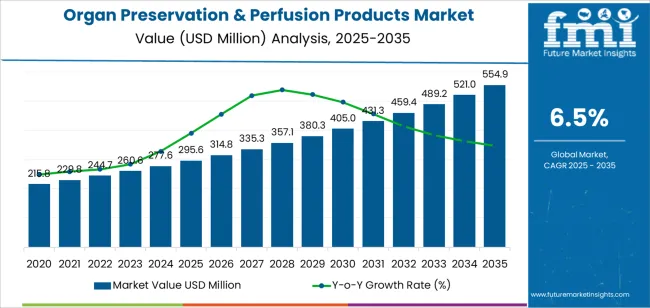
In 2025, the organ preservation & perfusion products market was valued at USD 295.60 million. Based on Future Market Insights' analysis, demand is estimated to grow to USD 314.81 million in 2026 and USD 590.95 million by 2036. FMI projects a CAGR of 6.50% during the forecast period.
Summary of Organ Preservation & Perfusion Products Market
- Organ Preservation & Perfusion Products Market Definition
- Organ preservation and perfusion products encompass machine perfusion systems (hypothermic and normothermic), static cold storage solutions (University of Wisconsin, HTK, Celsior), and disposable perfusion circuit consumables used to maintain organ viability between procurement from the donor and transplantation into the recipient across hospital transplant programs and research institutions.
- Demand Drivers in the Market
- Normothermic machine perfusion adoption for liver (OrganOx metra, CE and FDA cleared) and lung (XVIVO XPS, CE cleared) transplantation enables real-time organ viability assessment and extended preservation beyond the 6 to 12 hour static cold storage window, increasing the utilization rate of marginal donor organs.
- Transplant waiting list growth, with over 100,000 patients awaiting organ transplant in the USA alone per UNOS data, creates institutional pressure to maximize every available donor organ through perfusion-based assessment and reconditioning that static cold storage cannot provide.
- Hypothermic machine perfusion for kidney preservation has achieved standard-of-care status in multiple European transplant networks, with clinical evidence demonstrating reduced delayed graft function rates compared to static cold storage, driving hospital procurement of perfusion equipment and disposables.
- Key Segments Analyzed in the FMI Report
- Organ Perfusion System product type: 58.0% share in 2026, reflecting its structural position as the primary category across established procurement channels.
- Hospitals application: 65.0% share in 2026, reflecting its structural position as the primary category across established procurement channels.
- China: 8.80% compound growth through 2036, indicating concentrated demand acceleration.
- Analyst Opinion at FMI
- The organ preservation and perfusion products market is a transplant medicine category where machine perfusion is displacing static cold storage as the standard preservation modality. FMI analysts observe that organ perfusion systems command 58.0% product type share because the capital equipment and per-use disposable revenue model generates higher lifetime value than single-use preservation solution purchases. Hospital application at 65.0% share confirms that transplant centre operating suites are the primary installation point for perfusion equipment. China leads at 8.8% CAGR because the country's transplant programme expansion, supported by voluntary organ donation system maturation since 2015, is creating institutional perfusion equipment procurement demand from a low installed base.
- Strategic Implications / Executive Takeaways
- Transplant centres should evaluate normothermic liver perfusion systems to expand their usable donor liver pool by enabling viability assessment of extended criteria and donation-after-circulatory-death organs that would otherwise be declined under static cold storage protocols.
- Organ perfusion system manufacturers must develop portable normothermic perfusion platforms that enable continuous perfusion during organ transport, eliminating the cold storage gap between procurement site and transplant centre that currently limits preservation benefit.
- Research institutions should invest in ex-vivo organ perfusion platforms for drug toxicity testing and disease modeling applications, creating a non-transplant revenue stream for perfusion technology that diversifies the market beyond clinical transplantation.
The market is set to add approximately USD 276.14 million in absolute terms between 2026 and 2036. Machine perfusion adoption over static cold storage is the defining market transition, with normothermic perfusion enabling organ assessment, reconditioning, and extended preservation times that expand the usable donor organ pool. Regulatory clearances for normothermic liver perfusion (OrganOx metra) and lung perfusion (XVIVO XPS) are converting machine perfusion from a research technique into standard transplant centre protocol.
As per FMI, country-level growth rates through 2036 are projected as follows: China at 8.80%, India at 8.10%, Germany at 7.50%, Brazil at 6.80%, USA at 6.20%, UK at 5.50%, Japan at 4.90%. China records the fastest expansion driven by concentrated institutional investment.
Organ Preservation & Perfusion Products Market Key Takeaways
| Metric | Details |
|---|---|
| Industry Size (2026) | USD 314.81 Million |
| Industry Value (2036) | USD 590.95 Million |
| CAGR (2026 to 2036) | 6.50% |
Source: Future Market Insights, 2026
Organ Preservation & Perfusion Products Market Definition
The organ preservation and perfusion products market encompasses technologies maintaining organ viability during the interval between donor procurement and recipient transplantation. Product categories span normothermic machine perfusion systems (maintaining organs at physiological temperature with oxygenated blood or perfusate), hypothermic machine perfusion systems (continuous cold perfusion), static cold storage solutions (UW, HTK, Celsior), and single-use perfusion circuit disposables. As per FMI, the market is transitioning from static cold storage dominance to machine perfusion adoption, driven by clinical evidence demonstrating improved graft outcomes and expanded donor organ utilization rates.
Organ Preservation & Perfusion Products Market Inclusions
Market scope covers hypothermic and normothermic machine perfusion systems, static cold storage preservation solutions, perfusion circuit disposables, and organ transport containers used in kidney, liver, heart, and lung transplantation across hospital and research settings.
Organ Preservation & Perfusion Products Market Exclusions
Organ transplant surgical instruments, immunosuppressive drug therapies administered post-transplant, artificial organ devices (LVAD, dialysis machines), and tissue banking preservation systems for non-transplantable tissues are excluded.
Organ Preservation & Perfusion Products Market Research Methodology
- Primary Research: Analysts conducted structured interviews with procurement managers, product engineers, and distribution channel operators to map purchase decision triggers and specification requirements across key verticals.
- Desk Research: Data collection aggregated regulatory filings, industry standards documentation, patent registries, trade body publications, and company annual reports across all target geographies.
- Market-Sizing and Forecasting: Baseline values derive from a bottom-up aggregation of product shipment volumes and average selling prices, validated against publicly disclosed revenue figures from leading suppliers.
- Data Validation and Update Cycle: Projections are cross-referenced against quarterly earnings data, import-export trade statistics, and industry association production reports to maintain forecast integrity.
Why is the Organ Preservation & Perfusion Products Market Growing?
Market expansion rests on three fundamental shifts driving adoption across the transplant, surgical, and research sectors. First, transplant success enhancement demand creates compelling operational advantages through organ preservation and perfusion products that provide immediate viability extension and organ quality assessment without compromising transplant outcomes, enabling surgical teams to meet stringent success standards while maintaining operational productivity and reducing organ wastage rates. Second, transplant technology modernization accelerates as hospitals worldwide seek advanced perfusion systems that complement traditional preservation processes, enabling precise organ monitoring and viability assessment that align with surgical standards and transplant regulations.
Third, organ donation program enhancement drives adoption from transplant centers and healthcare facilities requiring effective preservation solutions that maximize organ utilization while maintaining operational productivity during procurement and transplantation operations. Growth faces headwinds from equipment cost challenges that vary across medical device suppliers regarding the sourcing of specialized components and perfusion technology, which may limit adoption in cost-sensitive environments. Technical limitations also persist regarding system complexity and specialized training requirements that may reduce effectiveness in resource-constrained facilities and developing market scenarios, which affect implementation performance and operational requirements.
Opportunity Pathways - Organ Preservation & Perfusion Products Market
The organ preservation and perfusion products market represents a specialized yet critical transplant technology opportunity driven by expanding global organ transplantation programs, surgical equipment modernization, and the need for superior organ viability in diverse medical applications. As transplant centers worldwide seek to achieve optimal organ preservation effectiveness, reduce wastage rates, and integrate advanced perfusion systems with automated platforms, organ preservation products are evolving from basic storage solutions to sophisticated viability management solutions ensuring transplant success and surgical leadership.
The market's growth trajectory from USD 295.6 million in 2025 to USD 555.0 million by 2035 at a 6.5% CAGR reflects fundamental shifts in transplant industry viability requirements and preservation equipment optimization. Geographic expansion opportunities are particularly pronounced in Asia Pacific markets, while the dominance of organ perfusion systems and hospital applications provides clear strategic focus areas.
Pathway A - Organ Perfusion System Leadership & Advanced Technology Optimization
Strengthening the dominant organ perfusion system segment through enhanced technology capabilities, superior viability monitoring, and automated perfusion protocols. This pathway focuses on optimizing perfusion parameters, improving organ assessment capabilities, extending operational effectiveness to advanced preservation rates, and developing specialized systems for diverse organ types. Market leadership consolidation through advanced perfusion engineering and automated monitoring integration enables premium positioning while defending competitive advantages against alternative preservation methods. Expected revenue pool: USD 38-52 million
Pathway B - Asia Pacific Transplant Center Expansion & System Localization
Rapid transplant program and healthcare facility growth across Asia Pacific creates substantial expansion opportunities through local system capabilities and technology transfer partnerships. Growing organ donation programs and government healthcare initiatives drive sustained demand for advanced preservation systems. Localization strategies reduce import costs, enable faster technical support, and position companies advantageously for procurement programs while accessing growing domestic markets. Expected revenue pool: USD 32-45 million
Pathway C - Hospital Market Dominance & Transplant Integration
Expansion within the dominant hospital segment (approximately 65% market share) through specialized preservation systems addressing transplant standards and high-volume procedure requirements. This pathway encompasses automated perfusion systems, quality monitoring integration, and compatibility with diverse surgical facility processes. Premium positioning reflects superior organ viability and comprehensive transplant compliance supporting modern hospital operations. Expected revenue pool: USD 28-38 million
Pathway D - Laboratory & Research Application Diversification
Strategic expansion into laboratory and research institute applications (approximately 30% market share) requires enhanced research capabilities and specialized preservation systems addressing experimental requirements. This pathway addresses organ study protocols, viability research enhancement, and advanced preservation configuration with specialized equipment engineering for demanding research standards. Premium pricing reflects specialized research requirements and extended preservation standards. Expected revenue pool: USD 22-32 million
Pathway E - Preservation Solution Innovation & Chemical Optimization
Development of specialized organ preservation and perfusion solutions addressing biochemical requirements and organ-specific needs. This pathway encompasses solution formulation optimization, temperature management integration, and cost-effective alternatives for emerging transplant segments. Technology differentiation through proprietary solution chemistry enables diversified revenue streams while reducing dependency on single equipment platforms. Expected revenue pool: USD 18-26 million
Pathway F - Normothermic Perfusion Development & Premium Positioning
Expansion of normothermic perfusion technology through enhanced organ functionality maintenance, real-time viability assessment, and specialized long-distance transport requirements. This pathway encompasses extended preservation applications, organ rehabilitation protocols, and specialty configurations requiring superior perfusion quality characteristics. Market development through advanced perfusion engineering enables differentiated positioning while accessing premium markets requiring highest-quality preservation solutions. Expected revenue pool: USD 15-22 million
Pathway G - Regulatory Compliance & Clinical Validation Development
Development of clinically validated preservation systems addressing regulatory compliance and transplant success requirements across hospital and research applications. This pathway encompasses clinical trial integration, outcome documentation processes, and comprehensive efficacy validation. Premium positioning reflects clinical evidence leadership and regulatory expertise while enabling access to evidence-focused procurement programs and quality-driven transplant center partnerships. Expected revenue pool: USD 12-18 million
What is the Segmental Analysis of the Organ Preservation & Perfusion Products Market?
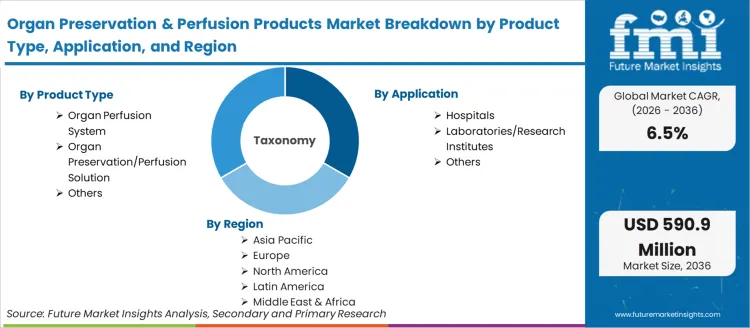
Primary Classification: The market segments by product type into Organ Perfusion System, Organ Preservation/Perfusion Solution, and Others categories, representing the evolution from basic preservation solutions to specialized perfusion systems for comprehensive organ viability optimization.
Secondary Classification: Application segmentation divides the market into Hospitals, Laboratories/Research Institutes, and Others sectors, reflecting distinct requirements for preservation capability, monitoring capacity, and transplant success standards.
Regional Classification: Geographic distribution covers Asia Pacific, Europe, North America, and other regions, with developed markets leading adoption while emerging economies show accelerating growth patterns driven by transplant program expansion initiatives.
The segmentation structure reveals technology progression from standard solution-based preservation toward specialized perfusion systems with enhanced viability and monitoring capabilities, while application diversity spans from hospital transplantation to specialized research and organ study applications requiring precise preservation solutions.
By Product Type, the Organ Perfusion System Segment Accounts for Dominant Market Share
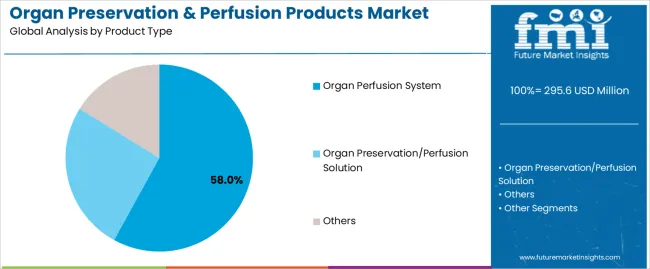
Market Position: Organ perfusion systems command the leading position in the Organ Preservation & Perfusion Products market with approximately 58% market share through advanced technology properties, including superior organ viability maintenance, real-time monitoring capability, and preservation optimization that enable transplant centers to achieve optimal transplant outcomes across diverse organ types and surgical environments.
Value Drivers: The segment benefits from transplant center preference for sophisticated preservation systems that provide consistent organ viability, enhanced assessment capabilities, and transplant success without requiring significant protocol modifications. Advanced perfusion features enable automated monitoring systems, viability consistency, and integration with existing surgical equipment, where system performance and preservation reliability represent critical transplant requirements.
Competitive Advantages: Organ perfusion systems differentiate through proven viability extension, consistent organ quality maintenance, and integration with automated transplant systems that enhance operational effectiveness while maintaining optimal organ preservation suitable for diverse transplant applications.
Key market characteristics:
- Advanced perfusion configurations with optimized flow parameters and monitoring capabilities
- Extended operational effectiveness, enabling superior organ viability with consistent preservation quality
- Surgical compatibility, including automated monitoring systems, quality assessment, and process integration for transplant operations
Organ Preservation/Perfusion Solution Shows Essential Market Presence
Organ preservation and perfusion solutions maintain essential material positioning in the Organ Preservation & Perfusion Products market due to their cost-effective preservation properties and universal application advantages. These solutions appeal to transplant centers requiring reliable chemical preservation with adequate performance for standard organ preservation and transport applications. Market adoption is driven by transplant volume expansion, emphasizing reliable preservation solutions and operational simplicity through optimized solution formulations while maintaining competitive pricing structures.
By Application, the Hospitals Segment Accounts for the Largest Market Share
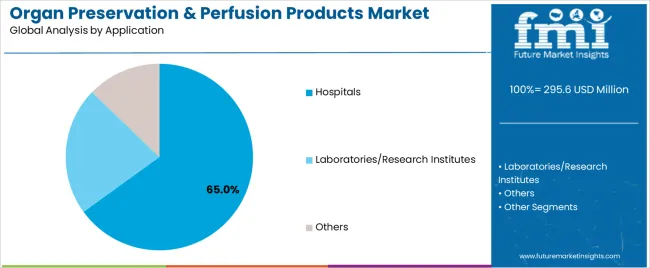
Market Context: Hospital applications dominate the Organ Preservation & Perfusion Products market with approximately 65% market share due to widespread adoption of transplant preservation equipment and increasing focus on organ viability extension, transplant success optimization, and organ utilization applications that minimize wastage risks while maintaining surgical standards.
Appeal Factors: Hospital transplant centers prioritize system reliability, viability consistency, and integration with existing surgical infrastructure that enables coordinated preservation application across multiple organ procurement programs. The segment benefits from substantial healthcare investment and transplant programs that emphasize the acquisition of preservation systems for transplant success and organ utilization applications.
Growth Drivers: Transplant program expansion initiatives incorporate organ preservation and perfusion products as standard equipment for surgical operations, while organ donation awareness campaigns increase demand for viability extension capabilities that comply with surgical standards and minimize organ rejection risks.
Market Challenges: Varying transplant protocols and surgical procedure differences may limit system standardization across different hospital facilities or operational scenarios.
Application dynamics include:
- Strong growth in transplant centers and surgical facilities requiring organ viability capabilities
- Increasing adoption in multi-organ transplant programs and complex surgical applications for transplant success
- Rising integration with automated monitoring systems for preservation optimization and quality assurance
Laboratory & Research Institute Applications Demonstrate Specialized Growth
Laboratory and research institute applications capture approximately 30% market share through specialized preservation requirements in organ research facilities, medical research laboratories, and experimental transplant applications. These facilities demand sophisticated preservation systems capable of extended viability maintenance while providing exceptional monitoring capabilities and research-grade preservation protocols.
Other Applications Show Diversified Demand
Other applications account for approximately 5% market share, including organ procurement organizations, specialty transplant facilities, and clinical trial applications requiring preservation and perfusion capabilities for specialized organ management and research validation.
What are the Drivers, Restraints, and Key Trends of the Organ Preservation & Perfusion Products Market?
Growth Accelerators: Transplant program expansion drives primary adoption as organ preservation and perfusion products provide superior viability extension capabilities that enable surgical teams to meet stringent transplant success standards without excessive equipment costs, supporting hospital operations and surgical excellence missions that require precise organ preservation applications. Transplant technology infrastructure demand accelerates market expansion as healthcare providers seek effective preservation systems that minimize organ wastage while maintaining operational effectiveness during procurement and transplantation scenarios. Healthcare spending increases worldwide, creating sustained demand for organ preservation systems that complement traditional cold storage processes and provide viability enhancement in competitive transplant environments.
Growth Inhibitors: Equipment cost challenges vary across medical device suppliers regarding the sourcing of specialized perfusion components and monitoring technology, which may limit operational flexibility and market penetration in regions with healthcare budget constraints or cost-sensitive transplant operations. Technical performance limitations persist regarding system complexity and specialized personnel training requirements that may reduce effectiveness in resource-limited facilities, developing healthcare markets, or emergency procurement conditions, affecting implementation reliability and operational requirements. Market fragmentation across multiple transplant protocols and preservation standards creates compatibility concerns between different system suppliers and existing surgical infrastructure.
Market Evolution Patterns: Adoption accelerates in established transplant centers and specialized surgical facilities where organ viability justifies preservation equipment costs, with geographic concentration in developed markets transitioning toward mainstream adoption in emerging economies driven by transplant program expansion and organ donation awareness. Technology development focuses on enhanced perfusion systems, improved viability monitoring integration, and compatibility with transplant management platforms that optimize organ preservation and transplant effectiveness. The market could face disruption if alternative preservation technologies or organ bioengineering innovations significantly limit the deployment of traditional perfusion-based preservation systems in transplant applications, though perfusion technology's unique combination of viability extension, real-time monitoring, and transplant success enhancement continues to make it preferred in surgical applications.
What is the Analysis of the Organ Preservation & Perfusion Products Market by Key Country?
The organ preservation & perfusion products market demonstrates varied regional dynamics with Growth Leaders including China (8.8% CAGR) and India (8.1% CAGR) driving expansion through transplant program capacity additions and healthcare system programs. Steady Performers encompass Germany (7.5% CAGR), Brazil (6.8% CAGR), United States (6.2% CAGR), and United Kingdom (5.5% CAGR), benefiting from established transplant industries and advanced surgical adoption. Mature Markets feature Japan (4.9% CAGR), where specialized transplant applications and premium preservation integration support consistent growth patterns.
.webp "Top Country Growth Comparison Organ Preservation & Perfusion Products Market Cagr (2026 2036)")
| Country | CAGR (2026-2036) |
|---|---|
| China | 8.8% |
| India | 8.1% |
| Germany | 7.5% |
| Brazil | 6.8% |
| United States | 6.2% |
| United Kingdom | 5.5% |
| Japan | 4.9% |
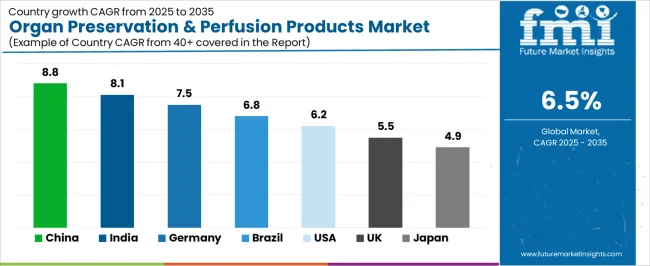
Regional synthesis reveals Asia Pacific markets leading adoption through transplant program expansion and healthcare infrastructure development, while European countries maintain steady expansion supported by preservation technology advancement and surgical standardization requirements. North American markets show moderate growth driven by transplant center applications and organ preservation integration trends.
Why is China Leading in Organ Preservation Technology Expansion?
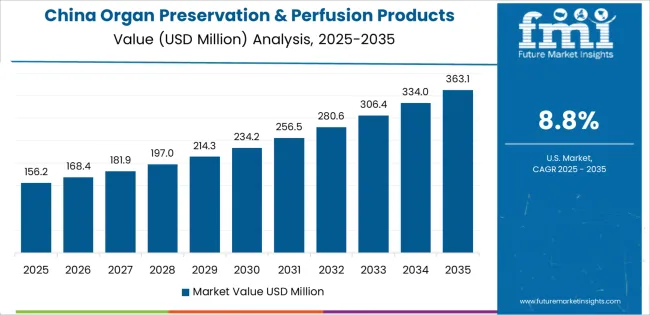
The Chinese market emphasizes advanced perfusion features, including precision viability control and integration with comprehensive transplant platforms that manage preservation quality, organ monitoring optimization, and surgical applications through unified management systems. The country demonstrates strong growth at 8.8% CAGR, driven by transplant program expansion, organ preservation initiatives, and emerging transplant center development that support perfusion system integration. Chinese healthcare providers prioritize operational effectiveness with organ preservation and perfusion products delivering consistent viability maintenance through advanced perfusion capabilities and system adaptation features.
Technology deployment channels include major transplant centers, specialized medical device suppliers, and hospital procurement programs that support professional applications for complex organ preservation and viability assessment applications. Transplant platform integration capabilities with established surgical systems expand market appeal across diverse operational requirements seeking organ viability and transplant success benefits. The expanding healthcare sector and accelerating transplant market create sustained demand, while innovative applications in organ donation programs and transplant research open new growth avenues.
Performance Metrics:
- Transplant centers in Shanghai, Guangzhou, and Beijing leading preservation system adoption for organ transplant operations
- Hospital partnerships maintaining significant market share for surgical equipment integration applications
- Transplant procurement programs supporting substantial system acquisitions across healthcare facilities
- Surgical platform compatibility with major transplant systems driving procurement selection criteria
How is Germany Maintaining Leadership in Organ Preservation Technology?
Germany's advanced healthcare market demonstrates sophisticated preservation system deployment with documented operational effectiveness in transplant applications and surgical facilities through integration with existing organ procurement systems and preservation infrastructure. The country leverages engineering expertise in medical technology and surgical systems integration to maintain strong growth at 7.5% CAGR. Industrial centers, including Frankfurt, Munich, and Hamburg, showcase premium installations where preservation systems integrate with comprehensive transplant platforms and surgical management systems to optimize organ viability and preservation effectiveness.
German medical device manufacturers prioritize system precision and EU compliance in preservation development, creating demand for premium perfusion systems with advanced features, including viability monitoring integration and automated perfusion protocols. The market benefits from established transplant infrastructure and a willingness to invest in preservation technologies that provide long-term transplant success benefits and compliance with international surgical and quality standards.
Market Intelligence Brief:
- Engineering focuses on EU transplant standards and premium quality compliance, driving surgical segment growth
- Transplant center partnerships providing faster technology development cycles
- Technology collaboration between German manufacturers and international medical device companies
- Surgical training programs expanding preservation system integration in transplant scenarios
What Drives Innovation in USA Organ Preservation Market?
USA organ preservation market demonstrates sophisticated deployment across hospital applications with documented effectiveness in transplant preservation and surgical facilities through integration with comprehensive transplant management systems and organ procurement infrastructure. The country leverages advanced manufacturing capabilities in medical innovation and surgical technologies to maintain moderate growth at 6.2% CAGR. Industrial centers, including major transplant centers and medical facilities, showcase premium installations where preservation systems integrate with comprehensive surgical platforms and transplant networks to optimize organ viability and preservation effectiveness.
American transplant centers prioritize system quality and surgical compliance in preservation development, creating demand for innovative perfusion systems with advanced features, including intelligent monitoring integration and automated viability assessment systems. The market benefits from established transplant infrastructure and willingness to invest in preservation technologies that provide long-term transplant success benefits and compliance with FDA and surgical standards.
Market Intelligence Brief:
- Transplant innovation focuses on surgical standards and premium quality compliance, driving hospital segment growth
- Medical device partnerships providing accelerated product development cycles
- Technology collaboration between American manufacturers and global transplant companies
- Clinical certification programs expanding preservation system integration in surgical scenarios
How is the United Kingdom Driving Transplant Quality Integration?
The UK organ preservation market demonstrates advanced quality deployment with documented operational effectiveness in transplant applications and surgical facilities through integration with existing organ procurement systems and preservation infrastructure. The country leverages regulatory expertise in transplant quality and surgical systems integration to maintain steady growth at 5.5% CAGR. Industrial centers, including London, Manchester, and Birmingham, showcase premium installations where preservation systems integrate with comprehensive quality platforms and transplant management systems to optimize organ viability and preservation effectiveness.
British transplant centers prioritize system quality and regulatory compliance in preservation development, creating demand for certified perfusion systems with advanced features, including outcome tracking and quality integration. The market benefits from established transplant infrastructure and commitment to invest in preservation technologies that provide long-term transplant success benefits and compliance with UK surgical standards. Hospital applications, transplant quality systems, and outcome-focused preservation programs drive diversified demand across multiple end-use segments.
Strategic Market Indicators:
- Quality compliance focuses on UK transplant standards and premium quality requirements, driving surgical segment growth
- Transplant center partnerships providing faster preservation technology development cycles
- Technology collaboration between British manufacturers and international medical device companies
- Surgical certification programs expanding preservation system integration in transplant scenarios
What Contributes to India’s Rapid Growth in Organ Preservation?
Organ preservation market in India demonstrates rapid expansion deployment with documented operational effectiveness in transplant applications and surgical facilities through integration with emerging healthcare systems and transplant infrastructure. The country leverages growing medical capabilities in transplant technology and surgical systems integration to achieve high growth at 8.1% CAGR. Industrial centers, including Mumbai, Delhi, and Bangalore, showcase expanding installations where preservation systems integrate with comprehensive transplant platforms and surgical networks to optimize market penetration and preservation effectiveness.
Indian transplant centers prioritize quality positioning and international standards in preservation development, creating demand for sophisticated perfusion systems with advanced features, including automated viability integration and quality monitoring systems. The market benefits from expanding transplant infrastructure and willingness to invest in international-standard preservation technologies that provide transplant success and compliance with global surgical standards.
Market Intelligence Brief:
- Healthcare focuses on international transplant standards and surgical positioning, driving hospital segment growth
- Medical device partnerships providing accelerated market entry cycles
- Technology collaboration between Indian manufacturers and international preservation companies
- Quality certification programs expanding preservation system integration in transplant scenarios
How is Brazil Expanding its Organ Preservation Market?
Brazil's organ preservation market demonstrates expanding deployment with documented operational effectiveness in transplant applications and surgical facilities through integration with healthcare systems and preservation infrastructure. The country leverages developing medical capabilities in transplant equipment and surgical systems integration to achieve strong growth at 6.8% CAGR. Industrial centers showcase growing installations where preservation systems integrate with transplant platforms and surgical networks to optimize preservation effectiveness.
Brazilian transplant centers prioritize system reliability and surgical standards in preservation development, creating demand for cost-effective perfusion systems with adequate features, including viability monitoring integration and organ assessment systems. The market benefits from expanding transplant infrastructure and healthcare development programs supporting preservation technology adoption.
Why is Japan Focusing on Precision in Organ Preservation Technology?
Japan's organ preservation market demonstrates precision deployment with documented operational effectiveness in transplant applications and surgical facilities through integration with advanced healthcare systems and quality infrastructure. The country leverages engineering excellence in precision medical technology and surgical systems integration to maintain steady growth at 4.9% CAGR. Industrial centers, including Tokyo, Osaka, and Yokohama, showcase premium installations where preservation systems integrate with comprehensive quality platforms and surgical systems to optimize transplant excellence and preservation effectiveness.
Japanese transplant centers prioritize system precision and surgical excellence in preservation development, creating demand for ultra-premium perfusion systems with advanced features, including micro-precision monitoring and quality integration systems. The market benefits from established transplant infrastructure and commitment to invest in highest-quality preservation technologies that provide superior transplant positioning and compliance with stringent Japanese surgical standards.
Strategic Market Indicators:
- Engineering focuses on precision quality standards and surgical excellence, driving premium segment growth
- Transplant center partnerships providing enhanced technology development cycles
- Technology collaboration between Japanese precision manufacturers and international medical device companies
- Precision surgical programs expanding preservation system integration in transplant scenarios
Europe Market Split by Country
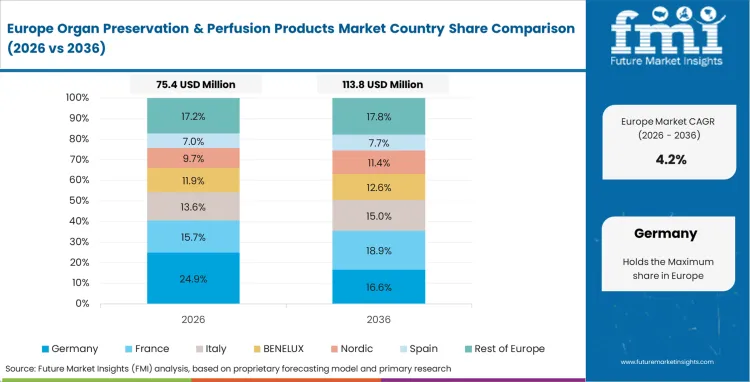
The Organ Preservation & Perfusion Products market in Europe is projected to grow substantially over the forecast period, with Germany expected to maintain its leadership position with a significant market share supported by its advanced transplant infrastructure and major surgical centers in Frankfurt and Munich. United Kingdom follows with strong market presence, driven by comprehensive organ donation programs and transplant quality initiatives. France holds substantial market share through specialized transplant activities, preservation equipment applications, and surgical facility operations.
Italy commands notable market presence through transplant programs and surgical preservation projects. Spain accounts for growing market share aided by organ donation expansion and transplant system adoption. The Netherlands maintains steady share driven by specialty transplant applications and preservation equipment demand. The Rest of Europe region is anticipated to show steady adoption, reflecting consistent growth in Nordic countries, transplant program expansion in Central European markets, and preservation equipment upgrades across Eastern European surgical facilities.
Organ Perfusion System Dominates Transplant Demand in Japan
In Japan, the Organ Preservation & Perfusion Products market prioritizes organ perfusion systems, which capture the dominant share of transplant center and surgical facility installations due to their advanced features, including precision viability monitoring optimization and seamless integration with existing surgical equipment infrastructure. Japanese transplant centers emphasize reliability, precision, and long-term transplant excellence, creating demand for perfusion systems that provide consistent organ preservation capabilities and superior technology performance based on surgical requirements and quality standards. Preservation solutions maintain secondary positions primarily in standard organ transport applications and cold storage installations where comprehensive preservation functionality meets operational requirements without compromising surgical efficiency.
Market Characteristics:
- Premium focus on perfusion systems with advanced viability monitoring capabilities and precision preservation properties
- Integration requirements with existing transplant platforms and specialty surgical systems
- Emphasis on operational reliability and long-term durability in transplant applications
Medical Device Manufacturers Lead Preservation Services in South Korea
In South Korea, the market structure favors international medical device manufacturers, including Organ Recovery Systems, Preservation Solutions Inc., and IGL Group, which maintain dominant positions through comprehensive product portfolios and established transplant center networks supporting both hospital preservation and research facility installations.
These providers offer integrated solutions combining advanced perfusion systems with professional technical services and ongoing clinical support that appeal to Korean transplant facilities seeking reliable organ preservation systems. Local medical device distributors and surgical equipment providers capture moderate market share by providing localized service capabilities and competitive pricing for standard transplant preservation installations, while domestic manufacturers focus on specialized applications and cost-effective solutions tailored to Korean transplant market characteristics.
Channel Insights:
- International medical device brands maintaining premium market positioning through advanced preservation offerings
- Local transplant center service networks expanding to support growing demand for professional installation and technical support
- Surgical integration capabilities becoming a key differentiator for facility-wide and transplant preservation applications
What is the Competitive Landscape of the Organ Preservation & Perfusion Products Market?
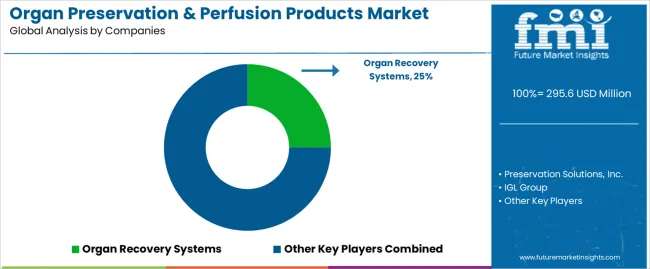
The organ preservation & perfusion products market operates with moderate concentration, featuring approximately 11-14 meaningful participants, where leading companies control roughly 55-60% of the global market share through established transplant center relationships and comprehensive preservation system portfolios. Competition emphasizes advanced viability capabilities, system reliability, and surgical integration rather than price-based rivalry. The leading companies maintain competitive positions through extensive organ preservation product lines and global transplant center presence.
Market Leaders encompass Organ Recovery Systems, Preservation Solutions Inc., and IGL Group, which maintain competitive advantages through extensive preservation technology expertise, global transplant networks, and comprehensive surgical integration capabilities that create customer loyalty and support premium pricing. These companies leverage decades of transplant technology experience and ongoing innovation investments to develop advanced organ preservation systems with precision viability control and monitoring features. Technology Innovators include Koehler, Bridge to Life, and regional specialists, which compete through specialized perfusion system technology focus and innovative preservation capabilities that appeal to transplant centers seeking advanced organ viability solutions and surgical differentiation.
These companies differentiate through rapid technology development cycles and specialized transplant application focus. Regional Specialists feature medical device manufacturers focusing on specific geographic markets and specialized applications, including normothermic perfusion systems and integrated transplant solutions. Market dynamics favor participants that combine reliable preservation systems with advanced viability capabilities, including precision monitoring control and automatic organ quality optimization features. Competitive pressure intensifies as traditional medical device suppliers expand into specialized transplant systems, while dedicated organ preservation companies challenge established players through innovative perfusion solutions and viability platforms targeting hospital and research segments.
Key Players in the Organ Preservation & Perfusion Products Market
- Organ Recovery Systems
- Preservation Solutions, Inc.
- IGL Group
- Koehler
- Bridge to Life
- OrganOx
- XVIVO
- Vivaly
- Paragonix Technologies
- SALF
- TX Innovations
- tranSnovo
Scope of the Report
| Metric | Value |
|---|---|
| Quantitative Units | USD 314.81 Million to USD 590.95 Million, at a CAGR of 6.50% |
| Market Definition | Organ preservation and perfusion products encompass machine perfusion systems (hypothermic and normothermic), static cold storage solutions (University of Wisconsin, HTK, Celsior), and disposable perfusion circuit consumables used to maintain organ viability between procurement from the donor and transplantation into the recipient across hospital transplant programs and research institutions. |
| Product Type Segmentation | Organ Perfusion System, Organ Preservation/Perfusion Solution, Others |
| Application Segmentation | Hospitals, Laboratories/Research Institutes, Others |
| Regions Covered | North America, Latin America, Europe, East Asia, South Asia, Oceania, Middle East & Africa |
| Countries Covered | China, India, Germany, Brazil, USA, UK, Japan, and 40 plus countries |
| Key Companies Profiled | Organ Recovery Systems, Preservation Solutions, Inc., IGL Group, Koehler, Bridge to Life, OrganOx, XVIVO, Vivaly, Paragonix Technologies, SALF, TX Innovations, tranSnovo |
| Forecast Period | 2026 to 2036 |
| Approach | Hybrid bottom-up and top-down modeling validated against primary research inputs and publicly available industry data. |
Organ Preservation & Perfusion Products Market by Segments
Product Type:
- Organ Perfusion System
- Organ Preservation/Perfusion Solution
- Others
Application:
- Hospitals
- Laboratories/Research Institutes
- Others
Region:
- Asia Pacific
- China
- India
- Japan
- South Korea
- ASEAN
- Australia & New Zealand
- Rest of Asia Pacific
- Europe
- Germany
- United Kingdom
- France
- Italy
- Spain
- Netherlands
- Nordic
- Rest of Europe
- North America
- United States
- Canada
- Mexico
- Latin America
- Brazil
- Argentina
- Rest of Latin America
- Middle East & Africa
- GCC Countries
- Turkey
- South Africa
- Rest of Middle East & Africa
Bibliography
- [1] United Network for Organ Sharing. (2024). UNOS Annual Data Report: Organ Transplant Waiting List and Procurement Statistics. UNOS.
- [2] OrganOx Ltd. (2024). metra Normothermic Machine Perfusion System: Clinical Evidence Summary. OrganOx.
- [3] XVIVO Perfusion AB. (2024). Annual Report 2024: Organ Perfusion Division. XVIVO.
- [4] European Commission. (2024). Directive 2010/53/EU: Standards of Quality and Safety of Human Organs Intended for Transplantation. European Commission.
- [5] World Health Organization. (2024). Global Observatory on Donation and Transplantation: Organ Procurement Statistics. WHO.
This bibliography is provided for reader reference. The full FMI report contains the complete reference list with primary research documentation.
Frequently Asked Questions
How large is the demand for Organ Preservation & Perfusion Products in the global market in 2026?
Demand for Organ Preservation & Perfusion Products in the global market is estimated to be valued at USD 314.81 million in 2026.
What will be the market size of Organ Preservation & Perfusion Products by 2036?
Market size for Organ Preservation & Perfusion Products is projected to reach USD 590.95 million by 2036.
What is the expected demand growth between 2026 and 2036?
Demand is expected to grow at a CAGR of 6.50% between 2026 and 2036.
Which Product Type is poised to lead by 2026?
Organ Perfusion System accounts for 58.0% in 2026.
How significant is Hospitals in driving adoption?
Hospitals represents 65.0% of segment share in 2026.
What country records the fastest growth?
China is projected to grow at a CAGR of 8.80% during 2026 to 2036.
What is the projected growth for India?
India is projected to expand at a CAGR of 8.10% during 2026 to 2036.
What is included in the scope of this report?
Market scope covers hypothermic and normothermic machine perfusion systems, static cold storage preservation solutions, perfusion circuit disposables, and organ transport containers used in kidney, liver, heart, and lung transplantation across hospital and research settings.
Preview the report firsthand - request a free sample
Get SampleGet the brochure for pricing and purchase details.
Get PDFTable of Content
- Executive Summary
- Global Market Outlook
- Demand-side Trends
- Supply-side Trends
- Technology Roadmap Analysis
- Analysis and Recommendations
- Market Overview
- Market Coverage / Taxonomy
- Market Definition / Scope / Limitations
- Research Methodology
- Chapter Orientation
- Analytical Lens and Working Hypotheses
- Market Structure, Signals, and Trend Drivers
- Company Annual and Sustainability Reports
- Peer-reviewed Journals and Academic Literature
- Corporate Websites, Product Literature, and Technical Notes
- Earnings Decks and Investor Briefings
- Statutory Filings and Regulatory Disclosures
- Technical White Papers and Standards Notes
- Trade Journals, Industry Magazines, and Analyst Briefs
- Conference Proceedings, Webinars, and Seminar Materials
- Government Statistics Portals and Public Data Releases
- Press Releases and Reputable Media Coverage
- Specialist Newsletters and Curated Briefings
- Sector Databases and Reference Repositories
- FMI Internal Proprietary Databases and Historical Market Datasets
- Subscription Datasets and Paid Sources
- Social Channels, Communities, and Digital Listening Inputs
- Additional Desk Sources
- Expert Input and Fieldwork (Primary Evidence)
- Primary Modes
- Qualitative Interviews and Expert Elicitation
- Quantitative Surveys and Structured Data Capture
- Blended Approach
- Why Primary Evidence is Used
- Field Techniques
- Interviews
- Surveys
- Focus Groups
- Observational and In-context Research
- Social and Community Interactions
- Stakeholder Universe Engaged
- C-suite Leaders
- Board Members
- Presidents and Vice Presidents
- R&D and Innovation Heads
- Technical Specialists
- Domain Subject-matter Experts
- Scientists
- Physicians and Other Healthcare Professionals
- Governance, Ethics, and Data Stewardship
- Research Ethics
- Data Integrity and Handling
- Primary Modes
- Tooling, Models, and Reference Databases
- Data Engineering and Model Build
- Data Acquisition and Ingestion
- Cleaning, Normalisation, and Verification
- Synthesis, Triangulation, and Analysis
- Quality Assurance and Audit Trail
- Market Background
- Market Dynamics
- Drivers
- Restraints
- Opportunity
- Trends
- Scenario Forecast
- Demand in Optimistic Scenario
- Demand in Likely Scenario
- Demand in Conservative Scenario
- Opportunity Map Analysis
- Product Life Cycle Analysis
- Supply Chain Analysis
- Investment Feasibility Matrix
- Value Chain Analysis
- PESTLE and Porter’s Analysis
- Regulatory Landscape
- Regional Parent Market Outlook
- Production and Consumption Statistics
- Import and Export Statistics
- Market Dynamics
- Global Market Analysis 2021 to 2025 and Forecast, 2026 to 2036
- Historical Market Size Value (USD Million) Analysis, 2021 to 2025
- Current and Future Market Size Value (USD Million) Projections, 2026 to 2036
- Y-o-Y Growth Trend Analysis
- Absolute $ Opportunity Analysis
- Global Market Pricing Analysis 2021 to 2025 and Forecast 2026 to 2036
- Global Market Analysis 2021 to 2025 and Forecast 2026 to 2036, By Product Type
- Introduction / Key Findings
- Historical Market Size Value (USD Million) Analysis By Product Type , 2021 to 2025
- Current and Future Market Size Value (USD Million) Analysis and Forecast By Product Type , 2026 to 2036
- Organ Perfusion System
- Organ Preservation/Perfusion Solution
- Others
- Organ Perfusion System
- Y-o-Y Growth Trend Analysis By Product Type , 2021 to 2025
- Absolute $ Opportunity Analysis By Product Type , 2026 to 2036
- Global Market Analysis 2021 to 2025 and Forecast 2026 to 2036, By Application
- Introduction / Key Findings
- Historical Market Size Value (USD Million) Analysis By Application, 2021 to 2025
- Current and Future Market Size Value (USD Million) Analysis and Forecast By Application, 2026 to 2036
- Hospitals
- Laboratories/Research Institutes
- Others
- Hospitals
- Y-o-Y Growth Trend Analysis By Application, 2021 to 2025
- Absolute $ Opportunity Analysis By Application, 2026 to 2036
- Global Market Analysis 2021 to 2025 and Forecast 2026 to 2036, By Region
- Introduction
- Historical Market Size Value (USD Million) Analysis By Region, 2021 to 2025
- Current Market Size Value (USD Million) Analysis and Forecast By Region, 2026 to 2036
- North America
- Latin America
- Western Europe
- Eastern Europe
- East Asia
- South Asia and Pacific
- Middle East & Africa
- Market Attractiveness Analysis By Region
- North America Market Analysis 2021 to 2025 and Forecast 2026 to 2036, By Country
- Historical Market Size Value (USD Million) Trend Analysis By Market Taxonomy, 2021 to 2025
- Market Size Value (USD Million) Forecast By Market Taxonomy, 2026 to 2036
- By Country
- USA
- Canada
- Mexico
- By Product Type
- By Application
- By Country
- Market Attractiveness Analysis
- By Country
- By Product Type
- By Application
- Key Takeaways
- Latin America Market Analysis 2021 to 2025 and Forecast 2026 to 2036, By Country
- Historical Market Size Value (USD Million) Trend Analysis By Market Taxonomy, 2021 to 2025
- Market Size Value (USD Million) Forecast By Market Taxonomy, 2026 to 2036
- By Country
- Brazil
- Chile
- Rest of Latin America
- By Product Type
- By Application
- By Country
- Market Attractiveness Analysis
- By Country
- By Product Type
- By Application
- Key Takeaways
- Western Europe Market Analysis 2021 to 2025 and Forecast 2026 to 2036, By Country
- Historical Market Size Value (USD Million) Trend Analysis By Market Taxonomy, 2021 to 2025
- Market Size Value (USD Million) Forecast By Market Taxonomy, 2026 to 2036
- By Country
- Germany
- UK
- Italy
- Spain
- France
- Nordic
- BENELUX
- Rest of Western Europe
- By Product Type
- By Application
- By Country
- Market Attractiveness Analysis
- By Country
- By Product Type
- By Application
- Key Takeaways
- Eastern Europe Market Analysis 2021 to 2025 and Forecast 2026 to 2036, By Country
- Historical Market Size Value (USD Million) Trend Analysis By Market Taxonomy, 2021 to 2025
- Market Size Value (USD Million) Forecast By Market Taxonomy, 2026 to 2036
- By Country
- Russia
- Poland
- Hungary
- Balkan & Baltic
- Rest of Eastern Europe
- By Product Type
- By Application
- By Country
- Market Attractiveness Analysis
- By Country
- By Product Type
- By Application
- Key Takeaways
- East Asia Market Analysis 2021 to 2025 and Forecast 2026 to 2036, By Country
- Historical Market Size Value (USD Million) Trend Analysis By Market Taxonomy, 2021 to 2025
- Market Size Value (USD Million) Forecast By Market Taxonomy, 2026 to 2036
- By Country
- China
- Japan
- South Korea
- By Product Type
- By Application
- By Country
- Market Attractiveness Analysis
- By Country
- By Product Type
- By Application
- Key Takeaways
- South Asia and Pacific Market Analysis 2021 to 2025 and Forecast 2026 to 2036, By Country
- Historical Market Size Value (USD Million) Trend Analysis By Market Taxonomy, 2021 to 2025
- Market Size Value (USD Million) Forecast By Market Taxonomy, 2026 to 2036
- By Country
- India
- ASEAN
- Australia & New Zealand
- Rest of South Asia and Pacific
- By Product Type
- By Application
- By Country
- Market Attractiveness Analysis
- By Country
- By Product Type
- By Application
- Key Takeaways
- Middle East & Africa Market Analysis 2021 to 2025 and Forecast 2026 to 2036, By Country
- Historical Market Size Value (USD Million) Trend Analysis By Market Taxonomy, 2021 to 2025
- Market Size Value (USD Million) Forecast By Market Taxonomy, 2026 to 2036
- By Country
- Kingdom of Saudi Arabia
- Other GCC Countries
- Turkiye
- South Africa
- Other African Union
- Rest of Middle East & Africa
- By Product Type
- By Application
- By Country
- Market Attractiveness Analysis
- By Country
- By Product Type
- By Application
- Key Takeaways
- Key Countries Market Analysis
- USA
- Pricing Analysis
- Market Share Analysis, 2025
- By Product Type
- By Application
- Canada
- Pricing Analysis
- Market Share Analysis, 2025
- By Product Type
- By Application
- Mexico
- Pricing Analysis
- Market Share Analysis, 2025
- By Product Type
- By Application
- Brazil
- Pricing Analysis
- Market Share Analysis, 2025
- By Product Type
- By Application
- Chile
- Pricing Analysis
- Market Share Analysis, 2025
- By Product Type
- By Application
- Germany
- Pricing Analysis
- Market Share Analysis, 2025
- By Product Type
- By Application
- UK
- Pricing Analysis
- Market Share Analysis, 2025
- By Product Type
- By Application
- Italy
- Pricing Analysis
- Market Share Analysis, 2025
- By Product Type
- By Application
- Spain
- Pricing Analysis
- Market Share Analysis, 2025
- By Product Type
- By Application
- France
- Pricing Analysis
- Market Share Analysis, 2025
- By Product Type
- By Application
- India
- Pricing Analysis
- Market Share Analysis, 2025
- By Product Type
- By Application
- ASEAN
- Pricing Analysis
- Market Share Analysis, 2025
- By Product Type
- By Application
- Australia & New Zealand
- Pricing Analysis
- Market Share Analysis, 2025
- By Product Type
- By Application
- China
- Pricing Analysis
- Market Share Analysis, 2025
- By Product Type
- By Application
- Japan
- Pricing Analysis
- Market Share Analysis, 2025
- By Product Type
- By Application
- South Korea
- Pricing Analysis
- Market Share Analysis, 2025
- By Product Type
- By Application
- Russia
- Pricing Analysis
- Market Share Analysis, 2025
- By Product Type
- By Application
- Poland
- Pricing Analysis
- Market Share Analysis, 2025
- By Product Type
- By Application
- Hungary
- Pricing Analysis
- Market Share Analysis, 2025
- By Product Type
- By Application
- Kingdom of Saudi Arabia
- Pricing Analysis
- Market Share Analysis, 2025
- By Product Type
- By Application
- Turkiye
- Pricing Analysis
- Market Share Analysis, 2025
- By Product Type
- By Application
- South Africa
- Pricing Analysis
- Market Share Analysis, 2025
- By Product Type
- By Application
- USA
- Market Structure Analysis
- Competition Dashboard
- Competition Benchmarking
- Market Share Analysis of Top Players
- By Regional
- By Product Type
- By Application
- Competition Analysis
- Competition Deep Dive
- Organ Recovery Systems
- Overview
- Product Portfolio
- Profitability by Market Segments (Product/Age /Sales Channel/Region)
- Sales Footprint
- Strategy Overview
- Marketing Strategy
- Product Strategy
- Channel Strategy
- Preservation Solutions, Inc.
- IGL Group
- Koehler
- Bridge to Life
- OrganOx
- XVIVO
- Vivaly
- Paragonix Technologies
- SALF
- TX Innovations
- tranSnovo
- Organ Recovery Systems
- Competition Deep Dive
- Assumptions & Acronyms Used


