

- Industry Size (2026)
- USD 2.28 Bn
- Forecast (2036)
- USD 2.28 Bn
- CAGR (2026 to 2036)
- 20.00%
3D Bioprinted Organ Transplants Market Size, Market Forecast and Outlook By FMI
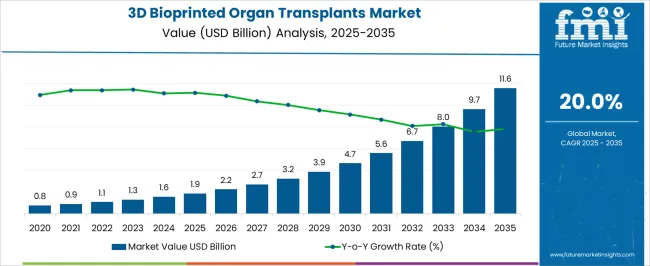
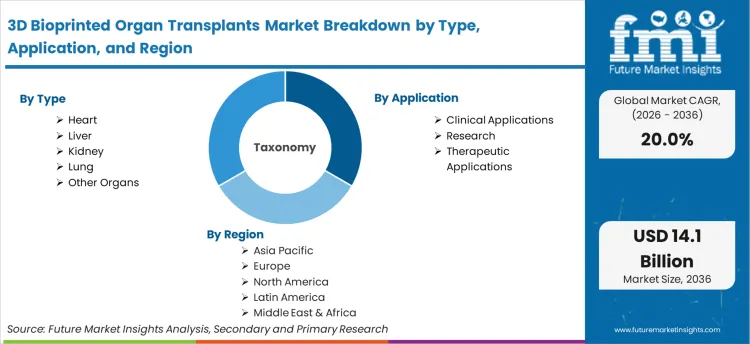
In 2025, the 3d bioprinted organ transplants market was valued at USD 1.90 billion. Based on Future Market Insights' analysis, demand is estimated to grow to USD 2.28 billion in 2026 and USD 14.12 billion by 2036. FMI projects a CAGR of 20.00% during the forecast period.
The market is set to add approximately USD 11.84 billion in absolute terms between 2026 and 2036. Chronic organ donor shortages, with over 100,000 patients on transplant waiting lists in the United States alone, are the fundamental demand driver for bioprinted organ development. While full-organ clinical transplantation remains pre-commercial for most organ types, bioprinted tissue constructs for pharmaceutical drug testing, disease modeling, and partial tissue repair are generating near-term revenue. Regulatory pathway development at the FDA (CBER tissue engineering framework) and EMA (ATMP classification) is providing the regulatory clarity required for clinical translation investment.
Summary of 3D Bioprinted Organ Transplants Market
- 3D Bioprinted Organ Transplants Market Definition
- 3D bioprinted organ transplants encompass bioprinting platforms, bioink materials, and tissue engineering services used to fabricate functional organ constructs (heart, liver, kidney, lung) from patient-derived or donor-derived cell sources for clinical transplantation, pharmaceutical drug testing, and therapeutic tissue replacement applications.
- Demand Drivers in the Market
- Global organ donor shortages exceeding 150,000 patients on active transplant waiting lists create a structural unmet medical need that conventional donor procurement cannot address, providing the clinical justification for bioprinted organ development investment across academic medical centers and biotech companies.
- Pharmaceutical companies are adopting bioprinted organ-on-chip and tissue construct models for preclinical drug toxicity screening, with bioprinted liver and kidney constructs replacing animal testing in early-stage drug safety evaluation workflows, generating near-term commercial revenue for bioprinting companies.
- FDA regenerative medicine advanced therapy (RMAT) designation and EMA advanced therapy medicinal product (ATMP) classification frameworks provide expedited regulatory pathways for bioprinted tissue products, reducing clinical translation timelines from over 15 years to 8 to 10 years for qualifying candidates.
- Key Segments Analyzed in the FMI Report
- Heart type: 26.4% share in 2026, reflecting its structural position as the primary category across established procurement channels.
- Clinical Applications application: 41.7% share in 2026, reflecting its structural position as the primary category across established procurement channels.
- China: 27.00% compound growth through 2036, indicating concentrated demand acceleration.
- Analyst Opinion at FMI
- The 3D bioprinted organ transplants market is a pre-commercial category where near-term revenue derives from pharmaceutical drug testing applications while long-term value creation depends on clinical transplantation milestones. FMI analysts observe that heart constructs command 26.4% type share because cardiac tissue engineering receives the largest research funding allocation driven by cardiovascular disease being the leading global cause of mortality. Clinical applications at 41.7% share reflects the investor and institutional focus on clinical translation pathways rather than research-only applications. The 20.0% CAGR reflects high growth from a small base, with revenue concentration in bioprinting hardware, bioink consumables, and contract tissue fabrication services rather than transplantation procedures. China leads at 27.0% CAGR because government bioeconomy investment programs and relaxed regulatory frameworks for tissue engineering clinical trials are accelerating development timelines.
- Strategic Implications / Executive Takeaways
- Bioprinting companies must prioritize bioprinted tissue construct applications for pharmaceutical drug testing and toxicity screening to generate near-term revenue while full-organ transplantation technology matures through multi-year clinical validation programs.
- Academic medical centers with regenerative medicine programs should establish GMP-grade bioprinting facilities to qualify for FDA RMAT and EMA ATMP regulatory pathways that require manufacturing compliance documentation from the earliest clinical development stages.
- Pharmaceutical companies should integrate bioprinted liver and kidney tissue models into preclinical drug safety workflows to reduce animal testing costs and improve human-relevant toxicity prediction accuracy in early-stage drug development pipelines.
3D Bioprinted Organ Transplants Market Key Takeaways
| Metric | Details |
|---|---|
| Industry Size (2026) | USD 2.28 Billion |
| Industry Value (2036) | USD 14.12 Billion |
| CAGR (2026 to 2036) | 20.00% |
Source: Future Market Insights, 2026
As per FMI, country-level growth rates through 2036 are projected as follows: China at 27.00%, India at 25.00%, Germany at 23.00%, France at 21.00%, UK at 19.00%, USA at 17.00%, Brazil at 15.00%. China records the fastest expansion, while mature markets sustain steady growth driven by institutional research investment and regulatory framework development.
3D Bioprinted Organ Transplants Market Definition
The 3D bioprinted organ transplants market represents the convergence of additive manufacturing technology, regenerative medicine, and tissue engineering applied to the fabrication of functional biological organ constructs. The market encompasses bioprinting hardware platforms capable of depositing cell-laden bioinks in anatomically precise geometries, bioink material formulations providing the extracellular matrix scaffolding required for cell viability and tissue maturation, and bioreactor systems supporting post-printing tissue development. FMI is of the opinion that the market is in a translational phase where pharmaceutical drug testing applications generate near-term commercial revenue while clinical transplantation of full organs remains a decade-horizon objective dependent on vascularization, innervation, and immune compatibility breakthroughs.
3D Bioprinted Organ Transplants Market Inclusions
Market scope covers 3D bioprinting hardware platforms, bioink formulations (hydrogels, decellularized ECM, cell-laden inks), organ scaffold fabrication services, and associated tissue maturation bioreactor systems used in heart, liver, kidney, and lung organ construct development for clinical, research, and therapeutic applications.
3D Bioprinted Organ Transplants Market Exclusions
Conventional organ transplantation from deceased or living donors, 3D-printed non-biological surgical models and implants (titanium, PEEK), and general-purpose 3D printers not configured for bioprinting are excluded.
3D Bioprinted Organ Transplants Market Research Methodology
- Primary Research: Analysts conducted structured interviews with procurement managers, product engineers, and distribution channel operators to map purchase decision triggers and specification requirements across key verticals.
- Desk Research: Data collection aggregated regulatory filings, industry standards documentation, patent registries, trade body publications, and company annual reports across all target geographies.
- Market-Sizing and Forecasting: Baseline values derive from a bottom-up aggregation of product shipment volumes and average selling prices, validated against publicly disclosed revenue figures from leading suppliers.
- Data Validation and Update Cycle: Projections are cross-referenced against quarterly earnings data, import-export trade statistics, and industry association production reports to maintain forecast integrity.
Why is the 3D Bioprinted Organ Transplants Market Growing?
The 3D Bioprinted Organ Transplants market is witnessing substantial growth, driven by the increasing demand for organ replacements and advanced regenerative medicine solutions. Rising incidences of organ failure and donor shortages are creating a critical need for alternative transplantation methods. Adoption is further supported by advancements in bioprinting technologies, including high-resolution printing, bioink formulation, and tissue engineering.
These technologies enable the creation of functional organ constructs that closely mimic natural tissue architecture. The integration of patient-specific data and AI-driven design approaches is improving precision and transplant success rates. Ongoing research collaborations, coupled with investments from both public and private sectors, are accelerating development and commercialization.
As regulatory pathways evolve and clinical acceptance increases, 3D bioprinted organs are expected to provide scalable solutions for critical healthcare needs The market is also benefiting from increased awareness among healthcare providers and patients regarding personalized and regenerative medical solutions, positioning it for sustained growth in the coming decade.
Segmental Analysis
The 3d bioprinted organ transplants market is segmented by type, application, and geographic regions. By type, 3d bioprinted organ transplants market is divided into Heart, Liver, Kidney, Lung, and Other Organs. In terms of application, 3d bioprinted organ transplants market is classified into Clinical Applications, Research, and Therapeutic Applications. Regionally, the 3d bioprinted organ transplants industry is classified into North America, Latin America, Western Europe, Eastern Europe, Balkan & Baltic Countries, Russia & Belarus, Central Asia, East Asia, South Asia & Pacific, and the Middle East & Africa.
Insights into the Heart Type Segment
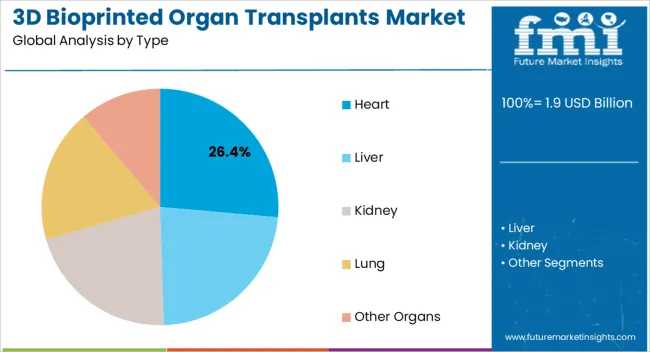
The heart segment is projected to hold 26.4% of the market revenue in 2025, establishing it as the leading organ type. Growth in this segment is being driven by the critical need for heart transplants due to rising cardiovascular disease prevalence and limited donor availability. 3D bioprinting enables the production of patient-specific cardiac tissues that reduce transplant rejection risk and improve post-operative outcomes.
Advanced bioink compositions and scaffold technologies allow for precise tissue architecture replication and functional integration with host tissue. The ability to customize organ constructs to match individual patient anatomy enhances clinical acceptance. Research advancements, including vascularization techniques and electrophysiological functionality, have strengthened the viability of bioprinted hearts for transplantation.
Increasing collaborations between biotechnology companies, hospitals, and research institutes have further accelerated adoption As demand for reliable and scalable cardiac transplant solutions rises, the heart segment is expected to maintain its market leadership, supported by technological innovation and growing clinical implementation.
Insights into the Clinical Applications Segment
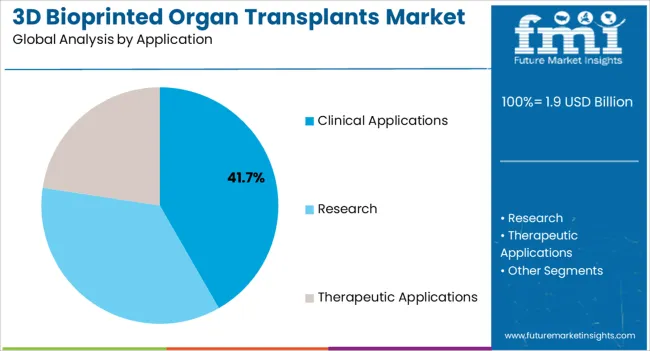
The clinical applications segment is anticipated to account for 41.7% of the market revenue in 2025, making it the leading application area. Its growth is being driven by the urgent need for functional organ replacements to address transplant shortages and improve patient survival rates. 3D bioprinted organs enable personalized therapies, reducing dependence on donor availability and minimizing immune rejection complications.
Advancements in tissue engineering, biofabrication, and biocompatible materials are enhancing the safety and efficacy of clinical applications. Hospitals and specialized clinics are increasingly adopting bioprinted organ solutions for preclinical studies, transplantation trials, and regenerative therapies. Regulatory approvals and clinical trial successes have improved confidence in integrating 3D bioprinted organs into routine healthcare.
The growing emphasis on patient-specific treatment planning and precision medicine is further supporting the adoption of clinical applications As healthcare providers and research institutions continue to explore bioprinting capabilities, the clinical applications segment is expected to remain the primary driver of market growth.
Market Overview
3D Bioprinted Organ Transplants Market Overview
Critical factors positively influencing the growth of the 3D bioprinted organ transplant market are:
- With the advancement in technology, there is increasing acceptance of 3D bioprinting organ transplant
- Increasing demand for organ transplants due to the global rise in chronic illnesses
- Nuanced application in orthopedic surgery for replacing broken or irreparable bones
- Application in the development of prosthetic limbs with high mobility
- Long wait time and steadily increasing wait list for organ donors
- Stringent laws and regulations surrounding organ donation
- Higher costs and technicalities associated with preserving and transplanting live organs
- These carry a lesser risk of rejection by the immune system as compared to traditional donor-donated organs
Analysis of 3D Bioprinted Organ Transplants Market By Key Countries
.webp "Top Country Growth Comparison 3d Bioprinted Organ Transplants Market Cagr (2026 2036)")
| Country | CAGR |
|---|---|
| China | 27.0% |
| India | 25.0% |
| Germany | 23.0% |
| France | 21.0% |
| UK | 19.0% |
| USA | 17.0% |
| Brazil | 15.0% |
Country-wise Analysis
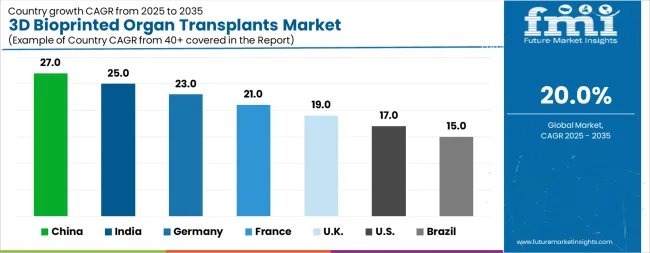
The 3D Bioprinted Organ Transplants Market is expected to register a CAGR of 20.0% during the forecast period, exhibiting varied country level momentum. China leads with the highest CAGR of 27.0%, followed by India at 25.0%. Developed markets such as Germany, France, and the UK continue to expand steadily, while the USA is likely to grow at consistent rates. Brazil posts the lowest CAGR at 15.0%, yet still underscores a broadly positive trajectory for the global 3D Bioprinted Organ Transplants Market. In 2024, Germany held a dominant revenue in the Western Europe market and is expected to grow with a CAGR of 23.0%. The USA 3D Bioprinted Organ Transplants Market is estimated to be valued at USD 678.2 million in 2036 and is anticipated to reach a valuation of USD 3.3 billion by 2036. Sales are projected to rise at a CAGR of 17.0% over the forecast period between 2036 and 2036. While Japan and South Korea markets are estimated to be valued at USD 88.1 million and USD 48.5 million respectively in 2036.
Key Players in the 3D Bioprinted Organ Transplants Market
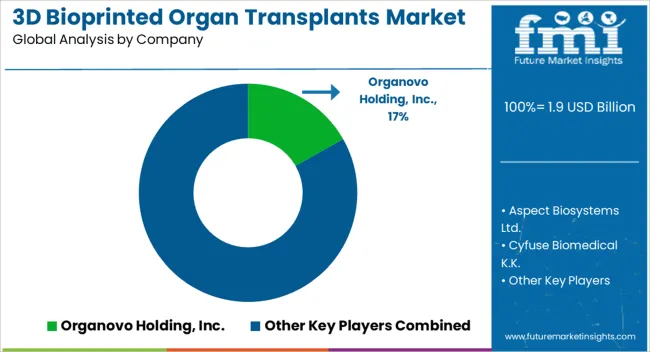
- Organovo Holding, Inc.
- Aspect Biosystems Ltd.
- Cyfuse Biomedical K.K.
- 3Dynamics Systems Ltd.
- Stratasys Ltd.
- Voxeljet A.G.
- Materialise N.V.
- Envision TECt
- Allevi
- Cellink
Scope of the Report
| Metric | Value |
|---|---|
| Quantitative Units | USD 2.28 Bn to USD 14.12 Bn, at a CAGR of 20.00% |
| Market Definition | 3D bioprinted organ transplants encompass bioprinting platforms, bioink materials, and tissue engineering services used to fabricate functional organ constructs (heart, liver, kidney, lung) from patient-derived or donor-derived cell sources for clinical transplantation, pharmaceutical drug testing, and therapeutic tissue replacement applications. |
| Type Segmentation | Heart, Liver, Kidney, Lung, Other Organs |
| Application Segmentation | Clinical Applications, Research, Therapeutic Applications |
| Regions Covered | North America, Latin America, Europe, East Asia, South Asia, Oceania, Middle East & Africa |
| Countries Covered | China, India, Germany, France, UK, USA, Brazil, and 40 plus countries |
| Key Companies Profiled | Organovo Holding, Inc., Aspect Biosystems Ltd., Cyfuse Biomedical K.K., 3Dynamics Systems Ltd., Stratasys Ltd., Voxeljet A.G., Materialise N.V., EnvisionTEC, Allevi, Cellink |
| Forecast Period | 2026 to 2036 |
| Approach | Hybrid bottom-up and top-down modeling validated against primary research inputs and publicly available industry data. |
3D Bioprinted Organ Transplants Market by Segments
Type:
- Heart
- Liver
- Kidney
- Lung
- Other Organs
Application:
- Clinical Applications
- Research
- Therapeutic Applications
Region:
- North America
- USA
- Canada
- Mexico
- Latin America
- Brazil
- Chile
- Rest of Latin America
- Western Europe
- Germany
- UK
- Italy
- Spain
- France
- Nordic
- BENELUX
- Rest of Western Europe
- Eastern Europe
- Russia
- Poland
- Hungary
- Balkan & Baltic
- Rest of Eastern Europe
- East Asia
- China
- Japan
- South Korea
- South Asia and Pacific
- India
- ASEAN
- Australia & New Zealand
- Rest of South Asia and Pacific
- Middle East & Africa
- Kingdom of Saudi Arabia
- Other GCC Countries
- Turkiye
- South Africa
- Other African Union
- Rest of Middle East & Africa
Bibliography
- [1] US Food and Drug Administration. (2024). CBER Guidance: Regulatory Considerations for Human Cells, Tissues, and Cellular and Tissue-Based Products. FDA.
- [2] European Medicines Agency. (2024). Advanced Therapy Medicinal Products (ATMP) Classification Framework. EMA.
- [3] National Institutes of Health. (2024). NIBIB Bioprinting Research Programme: Funding and Milestone Report. NIH.
- [4] Organovo Holdings Inc. (2024). Annual Report 2024: Bioprinted Tissue Platform Performance. Organovo.
- [5] World Health Organization. (2024). Global Observatory on Donation and Transplantation: Organ Shortage Statistics. WHO.
This bibliography is provided for reader reference. The full FMI report contains the complete reference list with primary research documentation.
Frequently Asked Questions
How large is the demand for 3D Bioprinted Organ Transplants in the global market in 2026?
Demand for 3D Bioprinted Organ Transplants in the global market is estimated to be valued at USD 2.28 billion in 2026.
What will be the market size of 3D Bioprinted Organ Transplants by 2036?
Market size for 3D Bioprinted Organ Transplants is projected to reach USD 14.12 billion by 2036.
What is the expected demand growth between 2026 and 2036?
Demand is expected to grow at a CAGR of 20.00% between 2026 and 2036.
Which Type is poised to lead by 2026?
Heart accounts for 26.4% in 2026, reflecting its established position across primary channels.
How significant is Clinical Applications in driving adoption?
Clinical Applications represents 41.7% of segment share in 2026.
What country records the fastest growth?
China is projected to grow at a CAGR of 27.00% during 2026 to 2036.
What is the projected growth for India?
India is projected to expand at a CAGR of 25.00% during 2026 to 2036.
What is included in the scope of this report?
Market scope covers 3D bioprinting hardware platforms, bioink formulations (hydrogels, decellularized ECM, cell-laden inks), organ scaffold fabrication services, and associated tissue maturation bioreactor systems used in heart, liver, kidney, and lung organ construct development for clinical, research, and therapeutic applications.
Preview the report firsthand - request a free sample
Get SampleGet the brochure for pricing and purchase details.
Get PDFTable of Content
- Executive Summary
- Global Market Outlook
- Demand-side Trends
- Supply-side Trends
- Technology Roadmap Analysis
- Analysis and Recommendations
- Market Overview
- Market Coverage / Taxonomy
- Market Definition / Scope / Limitations
- Research Methodology
- Chapter Orientation
- Analytical Lens and Working Hypotheses
- Market Structure, Signals, and Trend Drivers
- Company Annual and Sustainability Reports
- Peer-reviewed Journals and Academic Literature
- Corporate Websites, Product Literature, and Technical Notes
- Earnings Decks and Investor Briefings
- Statutory Filings and Regulatory Disclosures
- Technical White Papers and Standards Notes
- Trade Journals, Industry Magazines, and Analyst Briefs
- Conference Proceedings, Webinars, and Seminar Materials
- Government Statistics Portals and Public Data Releases
- Press Releases and Reputable Media Coverage
- Specialist Newsletters and Curated Briefings
- Sector Databases and Reference Repositories
- FMI Internal Proprietary Databases and Historical Market Datasets
- Subscription Datasets and Paid Sources
- Social Channels, Communities, and Digital Listening Inputs
- Additional Desk Sources
- Expert Input and Fieldwork (Primary Evidence)
- Primary Modes
- Qualitative Interviews and Expert Elicitation
- Quantitative Surveys and Structured Data Capture
- Blended Approach
- Why Primary Evidence is Used
- Field Techniques
- Interviews
- Surveys
- Focus Groups
- Observational and In-context Research
- Social and Community Interactions
- Stakeholder Universe Engaged
- C-suite Leaders
- Board Members
- Presidents and Vice Presidents
- R&D and Innovation Heads
- Technical Specialists
- Domain Subject-matter Experts
- Scientists
- Physicians and Other Healthcare Professionals
- Governance, Ethics, and Data Stewardship
- Research Ethics
- Data Integrity and Handling
- Primary Modes
- Tooling, Models, and Reference Databases
- Data Engineering and Model Build
- Data Acquisition and Ingestion
- Cleaning, Normalisation, and Verification
- Synthesis, Triangulation, and Analysis
- Quality Assurance and Audit Trail
- Market Background
- Market Dynamics
- Drivers
- Restraints
- Opportunity
- Trends
- Scenario Forecast
- Demand in Optimistic Scenario
- Demand in Likely Scenario
- Demand in Conservative Scenario
- Opportunity Map Analysis
- Product Life Cycle Analysis
- Supply Chain Analysis
- Investment Feasibility Matrix
- Value Chain Analysis
- PESTLE and Porter’s Analysis
- Regulatory Landscape
- Regional Parent Market Outlook
- Production and Consumption Statistics
- Import and Export Statistics
- Market Dynamics
- Global Market Analysis 2021 to 2025 and Forecast, 2026 to 2036
- Historical Market Size Value (USD Million) Analysis, 2021 to 2025
- Current and Future Market Size Value (USD Million) Projections, 2026 to 2036
- Y-o-Y Growth Trend Analysis
- Absolute $ Opportunity Analysis
- Global Market Pricing Analysis 2021 to 2025 and Forecast 2026 to 2036
- Global Market Analysis 2021 to 2025 and Forecast 2026 to 2036, By Type
- Introduction / Key Findings
- Historical Market Size Value (USD Million) Analysis By Type , 2021 to 2025
- Current and Future Market Size Value (USD Million) Analysis and Forecast By Type , 2026 to 2036
- Heart
- Liver
- Kidney
- Lung
- Other Organs
- Heart
- Y-o-Y Growth Trend Analysis By Type , 2021 to 2025
- Absolute $ Opportunity Analysis By Type , 2026 to 2036
- Global Market Analysis 2021 to 2025 and Forecast 2026 to 2036, By Application
- Introduction / Key Findings
- Historical Market Size Value (USD Million) Analysis By Application, 2021 to 2025
- Current and Future Market Size Value (USD Million) Analysis and Forecast By Application, 2026 to 2036
- Clinical Applications
- Research
- Therapeutic Applications
- Clinical Applications
- Y-o-Y Growth Trend Analysis By Application, 2021 to 2025
- Absolute $ Opportunity Analysis By Application, 2026 to 2036
- Global Market Analysis 2021 to 2025 and Forecast 2026 to 2036, By Region
- Introduction
- Historical Market Size Value (USD Million) Analysis By Region, 2021 to 2025
- Current Market Size Value (USD Million) Analysis and Forecast By Region, 2026 to 2036
- North America
- Latin America
- Western Europe
- Eastern Europe
- East Asia
- South Asia and Pacific
- Middle East & Africa
- Market Attractiveness Analysis By Region
- North America Market Analysis 2021 to 2025 and Forecast 2026 to 2036, By Country
- Historical Market Size Value (USD Million) Trend Analysis By Market Taxonomy, 2021 to 2025
- Market Size Value (USD Million) Forecast By Market Taxonomy, 2026 to 2036
- By Country
- USA
- Canada
- Mexico
- By Type
- By Application
- By Country
- Market Attractiveness Analysis
- By Country
- By Type
- By Application
- Key Takeaways
- Latin America Market Analysis 2021 to 2025 and Forecast 2026 to 2036, By Country
- Historical Market Size Value (USD Million) Trend Analysis By Market Taxonomy, 2021 to 2025
- Market Size Value (USD Million) Forecast By Market Taxonomy, 2026 to 2036
- By Country
- Brazil
- Chile
- Rest of Latin America
- By Type
- By Application
- By Country
- Market Attractiveness Analysis
- By Country
- By Type
- By Application
- Key Takeaways
- Western Europe Market Analysis 2021 to 2025 and Forecast 2026 to 2036, By Country
- Historical Market Size Value (USD Million) Trend Analysis By Market Taxonomy, 2021 to 2025
- Market Size Value (USD Million) Forecast By Market Taxonomy, 2026 to 2036
- By Country
- Germany
- UK
- Italy
- Spain
- France
- Nordic
- BENELUX
- Rest of Western Europe
- By Type
- By Application
- By Country
- Market Attractiveness Analysis
- By Country
- By Type
- By Application
- Key Takeaways
- Eastern Europe Market Analysis 2021 to 2025 and Forecast 2026 to 2036, By Country
- Historical Market Size Value (USD Million) Trend Analysis By Market Taxonomy, 2021 to 2025
- Market Size Value (USD Million) Forecast By Market Taxonomy, 2026 to 2036
- By Country
- Russia
- Poland
- Hungary
- Balkan & Baltic
- Rest of Eastern Europe
- By Type
- By Application
- By Country
- Market Attractiveness Analysis
- By Country
- By Type
- By Application
- Key Takeaways
- East Asia Market Analysis 2021 to 2025 and Forecast 2026 to 2036, By Country
- Historical Market Size Value (USD Million) Trend Analysis By Market Taxonomy, 2021 to 2025
- Market Size Value (USD Million) Forecast By Market Taxonomy, 2026 to 2036
- By Country
- China
- Japan
- South Korea
- By Type
- By Application
- By Country
- Market Attractiveness Analysis
- By Country
- By Type
- By Application
- Key Takeaways
- South Asia and Pacific Market Analysis 2021 to 2025 and Forecast 2026 to 2036, By Country
- Historical Market Size Value (USD Million) Trend Analysis By Market Taxonomy, 2021 to 2025
- Market Size Value (USD Million) Forecast By Market Taxonomy, 2026 to 2036
- By Country
- India
- ASEAN
- Australia & New Zealand
- Rest of South Asia and Pacific
- By Type
- By Application
- By Country
- Market Attractiveness Analysis
- By Country
- By Type
- By Application
- Key Takeaways
- Middle East & Africa Market Analysis 2021 to 2025 and Forecast 2026 to 2036, By Country
- Historical Market Size Value (USD Million) Trend Analysis By Market Taxonomy, 2021 to 2025
- Market Size Value (USD Million) Forecast By Market Taxonomy, 2026 to 2036
- By Country
- Kingdom of Saudi Arabia
- Other GCC Countries
- Turkiye
- South Africa
- Other African Union
- Rest of Middle East & Africa
- By Type
- By Application
- By Country
- Market Attractiveness Analysis
- By Country
- By Type
- By Application
- Key Takeaways
- Key Countries Market Analysis
- USA
- Pricing Analysis
- Market Share Analysis, 2025
- By Type
- By Application
- Canada
- Pricing Analysis
- Market Share Analysis, 2025
- By Type
- By Application
- Mexico
- Pricing Analysis
- Market Share Analysis, 2025
- By Type
- By Application
- Brazil
- Pricing Analysis
- Market Share Analysis, 2025
- By Type
- By Application
- Chile
- Pricing Analysis
- Market Share Analysis, 2025
- By Type
- By Application
- Germany
- Pricing Analysis
- Market Share Analysis, 2025
- By Type
- By Application
- UK
- Pricing Analysis
- Market Share Analysis, 2025
- By Type
- By Application
- Italy
- Pricing Analysis
- Market Share Analysis, 2025
- By Type
- By Application
- Spain
- Pricing Analysis
- Market Share Analysis, 2025
- By Type
- By Application
- France
- Pricing Analysis
- Market Share Analysis, 2025
- By Type
- By Application
- India
- Pricing Analysis
- Market Share Analysis, 2025
- By Type
- By Application
- ASEAN
- Pricing Analysis
- Market Share Analysis, 2025
- By Type
- By Application
- Australia & New Zealand
- Pricing Analysis
- Market Share Analysis, 2025
- By Type
- By Application
- China
- Pricing Analysis
- Market Share Analysis, 2025
- By Type
- By Application
- Japan
- Pricing Analysis
- Market Share Analysis, 2025
- By Type
- By Application
- South Korea
- Pricing Analysis
- Market Share Analysis, 2025
- By Type
- By Application
- Russia
- Pricing Analysis
- Market Share Analysis, 2025
- By Type
- By Application
- Poland
- Pricing Analysis
- Market Share Analysis, 2025
- By Type
- By Application
- Hungary
- Pricing Analysis
- Market Share Analysis, 2025
- By Type
- By Application
- Kingdom of Saudi Arabia
- Pricing Analysis
- Market Share Analysis, 2025
- By Type
- By Application
- Turkiye
- Pricing Analysis
- Market Share Analysis, 2025
- By Type
- By Application
- South Africa
- Pricing Analysis
- Market Share Analysis, 2025
- By Type
- By Application
- USA
- Market Structure Analysis
- Competition Dashboard
- Competition Benchmarking
- Market Share Analysis of Top Players
- By Regional
- By Type
- By Application
- Competition Analysis
- Competition Deep Dive
- Organovo Holding, Inc.
- Overview
- Product Portfolio
- Profitability by Market Segments (Product/Age /Sales Channel/Region)
- Sales Footprint
- Strategy Overview
- Marketing Strategy
- Product Strategy
- Channel Strategy
- Aspect Biosystems Ltd.
- Cyfuse Biomedical K.K.
- 3Dynamics Systems Ltd.
- Stratasys Ltd.
- Voxeljet A.G.
- Materialise N.V.
- Envision TECt
- Allevi
- Cellink
- Organovo Holding, Inc.
- Competition Deep Dive
- Assumptions & Acronyms Used


