

- Industry Size (2026)
- USD 10.0 Bn
- Forecast (2036)
- USD 45.4 Bn
- CAGR (2026 to 2036)
- 16.3%
BRIC Organic Baby Food Market Size, Market Forecast and Outlook By FMI
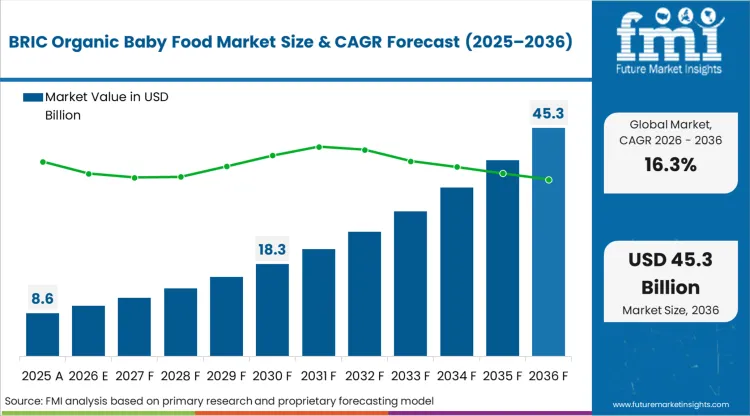
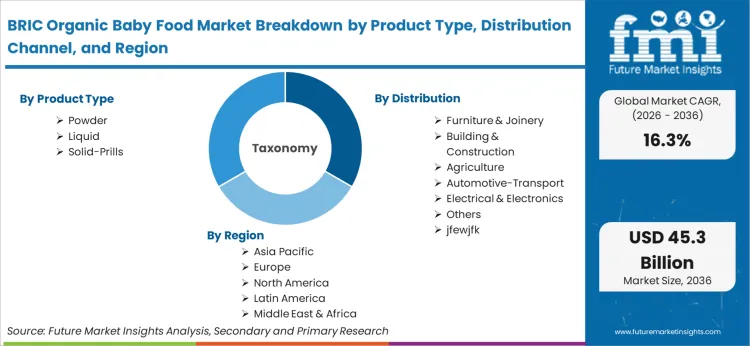
In 2025, the BRIC organic baby food market was valued at USD 8.6 billion. It is expected to reach USD 10.0 billion in 2026 and USD 45.4 billion by 2036, implying a CAGR of 16.3%. Absolute dollar growth of USD 36.8 billion over the decade signals a massive expansion rather than a simple recovery.
Future Market Insights analysis indicates that growth is shifting from simple volume expansion to a procurement specification shift, where the "entry ticket" for brands is no longer just calorie availability but verifiable safety and nutrient density. As parents in high-growth economies aggressively swap out conventional options for organic alternatives to mitigate pollutant risks, brands are forced to re-engineer supply chains for traceability rather than just cost. This pivot creates a "compliance moat" where only players capable of proving zero-residue supply chains can secure shelf space in modern retail formats, effectively locking out non-compliant low-cost incumbents.
Summary of BRIC Organic Baby Food Market
- BRIC Organic Baby Food Market Definition
- The industry covers certified organic infant nutrition products sold across Brazil, Russia, India, and China, prioritizing safety and clean-label compliance.
- Demand Drivers in the Market
- Rising "clean label" scrutiny due to safety incidents drives shift to organic.
- Expansion of modern retail and e-commerce broadens access to premium SKUs.
- Increasing disposable incomes in BRIC nations enable trading up to safer nutrition.
- Key Segments Analyzed in the FMI Report
- Product Type: Milk Formula holds 27% share; Prepared and Dried Food also vital.
- Distribution Channel: Online Retailing (18.5% share) is the fastest-growing route.
- Geography: China and India drive volume; US and Germany provide comparative benchmarks.
- Analyst Opinion at FMI
- Nandini Roy Choudhury, Client Partner for Food and Beverage, opines, "In the updated version of the BRIC Organic Baby Food Market Report for 2026 to 2036, CXOs will find that the 'trust deficit' in conventional food systems is the single largest value driver. Besides this, my findings point at supply chain integrity becoming the primary competitive moat, as parents in emerging markets increasingly reject mass-market incumbents in favor of brands that can prove source-to-shelf purity."
- Strategic Implications/Executive Takeaways
- Shift focus from mass distribution to "trust-based" marketing and certification.
- Treat supply chain transparency as a core product feature, not just backend compliance.
- Prioritize online channels to capture the digital-first generation of new parents.
- Methodology
- Validated through first-hand corporate production and capacity data.
- Zero reliance on speculative third-party market research reports.
- Based on verifiable industrial benchmarks and verified sources.
As Laura Modi, CEO & Co-Founder of Bobbie, noted regarding the industry's need for structural change, “When I founded Bobbie in 2018, I set out to change modern parenting culture with a high quality formula I wished existed.” [1]. This sentiment underscores a broader shift where manufacturers must move beyond basic nutrition to deliver emotional reassurance through radical transparency. For the 2026-2036 period, this implies that brands failing to provide "farm-to-bottle" visibility will face rapid de-listing as retailers align their categories with heightened parental scrutiny.
Growth tracks a robust trajectory across key markets, with China (16.5% CAGR), India (15.7% CAGR), Brazil (15.0% CAGR), Russia (14.6% CAGR), the United States (15.2% CAGR), and Germany (14.0% CAGR) all signaling double-digit expansion. This synchronized acceleration reflects a global upgrading of infant nutrition standards, where the premium paid for organic certification is increasingly viewed as non-negotiable insurance against health risks rather than a discretionary luxury.
BRIC Organic Baby Food Market Definition
The BRIC organic baby food market comprises the production, trade, and retail of infant nutrition products that are certified organic, meaning they are grown without synthetic pesticides, genetically modified organisms (GMOs), or artificial preservatives. This category strictly includes products explicitly labeled and certified as organic by relevant national or international bodies. The market definition encompasses all forms of infant nutrition, including formulas, prepared baby food, and dried snacks, designed specifically for children from birth to toddlerhood.
BRIC Organic Baby Food Market Inclusions
The report includes a comprehensive analysis of all certified organic nutritional products for infants, covering key categories such as milk formula, dried baby food (cereals, biscuits), and prepared baby food (purees, pouches). It also covers various distribution channels including modern trade (supermarkets/hypermarkets), specialty organic stores, and rapidly expanding online retailing platforms. The scope extends to both international multinational brands operating in the BRIC region and emerging domestic organic players.
BRIC Organic Baby Food Market Exclusions
The scope excludes conventional baby food products that lack organic certification, even if they claim "natural" or "preservative-free" status without official validation. It also omits non-food infant care products such as diapers, skincare, or accessories, focusing strictly on ingestible nutrition. Additionally, the report does not account for informal or homemade baby food markets that do not enter formal commercial retail channels.
BRIC Organic Baby Food Market Research Methodology
- Primary Research: Interviews were conducted with baby food manufacturers, organic ingredient suppliers, retail category managers, and regulatory consultants in Brazil, Russia, India, and China to validate demand trends and supply chain bottlenecks.
- Desk Research: Production data from organic trade associations, retail sales audits from major supermarket chains, and import/export data for infant formula supported the volume benchmarking.
- Market-Sizing and Forecasting: A hybrid top-down and bottom-up model was developed, reconstructing demand from birth rates and organic penetration levels while cross-referencing with corporate revenue disclosures.
- Data Validation and Update Cycle: Outputs undergo anomaly screening against FAO/WHO nutritional data and structured peer review by FMI’s food and beverage domain experts prior to release.
Segmental Analysis
BRIC Organic Baby Food Market Analysis by Product Type
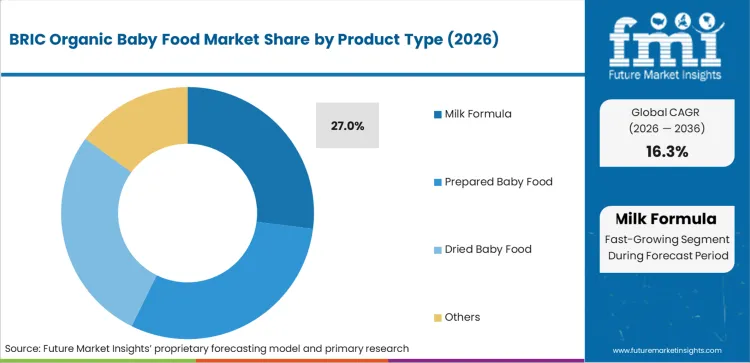
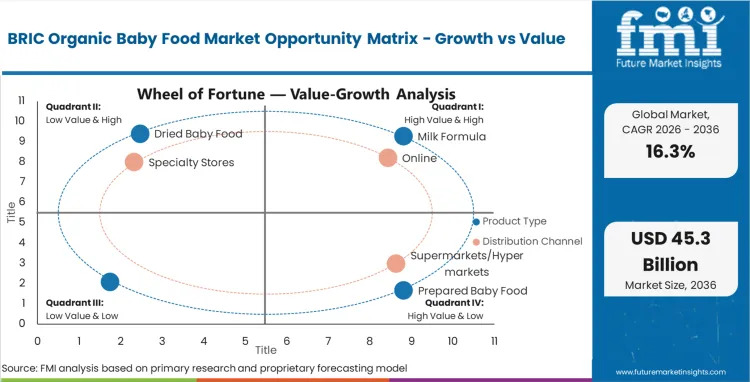
The milk formula segment leads the market with a dominant 27% share in 2026, driven by the critical nature of formula as a primary nutritional source and the high sensitivity parents have towards its safety profile. Growth in this segment is reinforced by the expansion of "clean label" options that mimic breast milk composition without synthetic additives. Meanwhile, prepared and dried baby food are gaining traction as convenient, safe weaning options for working parents.
- Safety trigger: Demand for organic milk formula is reinforced by recurrent safety scares in conventional supply chains, prompting parents to switch to certified brands to ensure zero exposure to contaminants like heavy metals or pesticide residues [2].
- Innovation shift: Procurement shifts because brands are introducing specialized formulations such as organic milk powder and plant-based blends, allowing them to capture value from parents seeking functional benefits beyond basic organic certification [3].
- Premiumisation move: Adoption accelerates where manufacturers like Danone and Nestlé renovate portfolios to include "no refined sugar" and "clean label" claims, helping them defend market share against agile D2C competitors [4].
BRIC Organic Baby Food Market Analysis by Distribution Channel
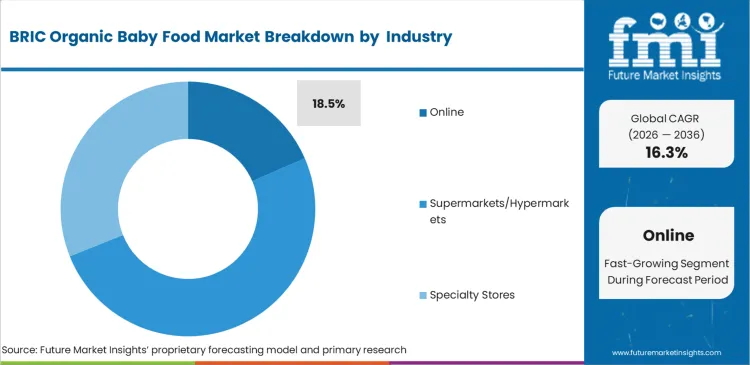
Online retailing is projected to hold an 18.5% market share in 2026 and represents the fastest-growing channel, fundamentally altering how brands reach young parents. This shift is powered by the digital-native behavior of millennial and Gen Z parents who rely on social proof, detailed product pages, and subscription convenience. The channel allows niche organic brands to bypass the slotting fee barriers of traditional retail, creating a direct feedback loop with consumers.
- Access mechanism: Growth is anchored in the rapid expansion of quick-commerce and e-grocery platforms in cities like Shanghai and Bengaluru, which allows parents to secure recurring deliveries of bulky formula tins without physical store visits [5].
- Trust building: Procurement shifts because online platforms offer extensive product information and peer reviews, enabling parents to verify certification claims and ingredient lists more thoroughly than is possible in a hurried in-store environment [6].
- Direct engagement: Adoption accelerates where brands leverage D2C models to offer subscription discounts and loyalty perks, locking in high-value customers for the entire 12-36 month infant feeding lifecycle [7].
BRIC Organic Baby Food Market Drivers, Restraints, and Opportunities
The primary engine for market acceleration is the intensifying parental demand for "clean label" safety and nutrition, catalyzed by widespread awareness of food system vulnerabilities. As reports on severe child food poverty highlight that 181 million children globally consume limited diets, parents with disposable income are aggressively pivoting to nutrient-dense, fortified organic options to ensure optimal development [8]. This behavior is not merely a preference but a risk-mitigation strategy, where the "organic" seal serves as a proxy for safety against industrial contaminants. This shift is directly reflected in the robust 16.3% CAGR, as families in emerging economies prioritize infant nutrition over other household expenditures, effectively recession-proofing the category.
A significant restraint remains the high cost and complexity of organic supply chains, which limits mass-market accessibility and creates vulnerability to raw material shortages. For instance, Danone’s move to stop sourcing soy from Brazil ahead of EU deforestation rules illustrates the logistical tightrope manufacturers must walk to maintain compliance and certification [9]. These stringent sourcing requirements often lead to higher shelf prices, which can alienate price-sensitive consumers in lower-income tiers of BRIC nations. To mitigate this, players are investing in localized organic farming clusters to reduce reliance on volatile imports, though the transition period continues to squeeze margins and restrict volume growth.
- Retail Expansion Opportunity: The expansion of premium organic brands into mass-market retailers like Walmart and Whole Foods allows niche players to tap into mainstream traffic, scaling volume significantly beyond specialty channels [10].
- Functional Innovation Opportunity: Launching value-added products like organic vitamin D drops and probiotic supplements enables brands to capture a larger share of the "infant wellness" wallet beyond just calories [11].
- Plant-Based Opportunity: Acquiring or developing plant-based organic nutritional formulas allows major players to address the growing segment of vegan and flexitarian parents seeking sustainable, allergen-free alternatives [12].
Regional Analysis
Based on the regional analysis, the BRIC organic baby food market is segmented into North America, Latin America, Europe, East Asia, South Asia, Oceania and Middle East & Africa across 40+ countries. The full report also offers market attractiveness analysis based on regional trends.
.webp "Top Country Growth Comparison Bric Organic Baby Food Market Cagr (2026 2036)")
| Country | CAGR (2026 to 2036) |
|---|---|
| Brazil | 15.0% |
| Russia | 14.6% |
| India | 15.7% |
| China | 16.5% |
| Germany | 14.0% |
| United States | 15.2% |
Source: Future Market Insights (FMI) analysis, based on proprietary forecasting model and primary research
Asia Pacific BRIC Organic Baby Food Market Analysis
Asia Pacific serves as the high-velocity growth engine for the global organic baby food sector, leveraging massive population bases and a rapidly expanding middle class that equates imported or certified nutrition with safety. The region's market is characterized by a "premiumisation at scale" dynamic, where urban parents in mega-cities drive demand for imported formulas and high-quality local organic brands. With China's retail sales of consumer goods reaching USD 6.8 trillion in 2025, the spending power available for premium infant nutrition is immense, supporting a shift from basic sustenance to functional, brain-boosting organic diets [13].
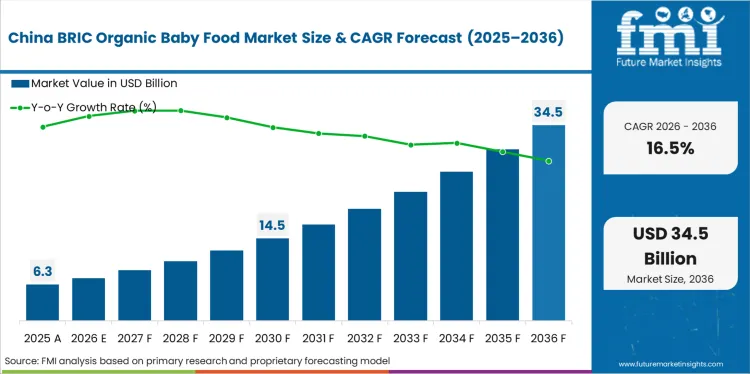
- China: Demand for organic baby food in China is set to grow at 16.5% CAGR through 2036, supported by a concentration of retail power where top retailers command over 66% of sales, allowing for rapid scaling of premium organic listings [13]. This trajectory is supported by the entry of global players like Yili launching Pro-Kido infant formula, which directly caters to the intense parental focus on cognitive development and safety [14].
- India: Growth in organic baby food across India is estimated at 15.7% CAGR through 2036, driven by the introduction of "no refined sugar" recipes by incumbents like Nestlé to align with stricter health consciousness among urban mothers [4]. This demand shift is reflected in the aggressive modernization of retail channels, where brands use clean-label certifications to differentiate in a crowded, price-sensitive market.
FMI’s report includes a detailed analysis of the growth in the Asia Pacific region, along with a country-wise assessment that includes Japan and South Korea. South Korea and Japan offer additional opportunities as mature markets where aging demographics drive value-over-volume strategies, focusing on ultra-premium, specialized organic formulations for a shrinking but highly affluent base of newborns. To capture this, manufacturers are emphasizing clinical validation and advanced a2 infant formula technologies to justify premium price points [15].
Latin America BRIC Organic Baby Food Market Analysis
Latin America is emerging as a critical growth frontier, where the modernization of retail infrastructure and increasing urbanization are making certified organic products more accessible to the middle class. The region faces a dual dynamic of high potential volume in Brazil contrasted with economic volatility, forcing brands to balance premium positioning with affordability. Key players are responding with localized production to hedge against currency fluctuations and import costs, treating the region as a strategic production hub as well as a consumer market.
- Brazil: The Brazil organic baby food sector is poised to expand at 15.0% CAGR during 2026 to 2036 because Nestlé has committed significant capex, increasing investment to 7 billion reais (USD 1.27 billion) to upgrade local production capabilities [16]. This trajectory translates into deeper market penetration as localized manufacturing lowers the cost barrier for organic adoption in secondary cities.
FMI’s report includes a detailed analysis of the growth in the Latin America region, along with a country-wise assessment that includes Mexico and Argentina. Mexico and Argentina present significant opportunities for baby snacks expansion, where rising female workforce participation is driving demand for convenient, safe, and nutritious ready-to-eat options. Brands entering these markets are focusing on navigating complex regulatory environments while leveraging digital channels to build brand trust directly with consumers [15].
Europe BRIC Organic Baby Food Market Analysis
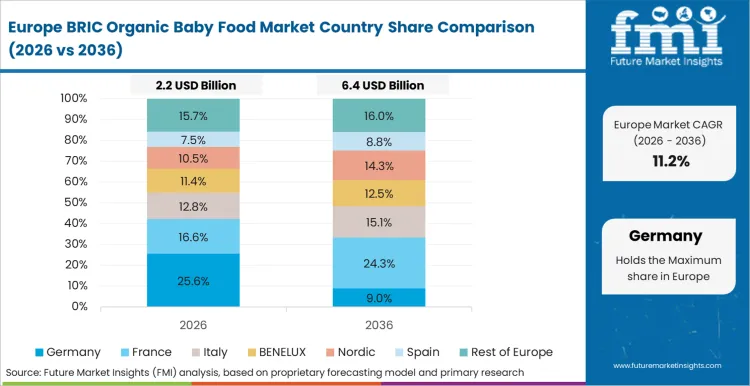
Europe acts as the global benchmark for organic standards, where the market is driven by sophisticated consumer preferences for sustainability and "beyond organic" attributes like biodynamic farming. The region's mature profile means growth comes from trading up to higher-value functional products rather than simple volume expansion. With EU organic market sales hitting USD 58.5 billion, the appetite for certified products is well-established, pushing brands to innovate with novel ingredients and eco-friendly packaging to maintain relevance [17].
- Russia: Russia is likely to see organic baby food revenues increase at 14.6% CAGR during 2026 to 2036, given the reliance on pharmacy and modern trade channels to distribute functional, clean-label SKUs amidst import constraints [15]. This expansion is linked to a resilience in demand for high-quality infant nutrition, which remains a priority spend for Russian families despite broader economic headwinds.
- Germany: The outlook for organic baby food in Germany indicates a 14.0% CAGR from 2026 to 2036 as the market rewards "proof-based" organic claims, favoring brands that can demonstrate rigorous traceability and sustainable sourcing [17]. This growth is underpinned by the restructuring of legacy players like Töpfer, ensuring that even established brands evolve to meet modern efficiency and quality standards [18].
FMI’s report includes a detailed analysis of the growth in the Europe region, along with a country-wise assessment that includes France and the UK. The UK and France remain vital markets for baby toddler bar, where innovation in healthy, sugar-free finger foods is driving category value. In these markets, retailers are aggressively expanding private-label organic ranges, forcing branded competitors to double down on unique formulations and sustainability credentials to defend market share [15].
North America BRIC Organic Baby Food Market Analysis
North America remains a powerhouse of innovation and value, characterized by a highly competitive landscape where startups and incumbents battle for the "share of trust." The market is defined by a "green recovery" in birth rates and a massive shift towards clean label projects, driven by high disposable incomes and a regulatory environment that increasingly scrutinizes infant food safety. With USA organic food sales reaching USD 65.4 billion, the ecosystem is ripe for premium infant nutrition products that align with the broader lifestyle shift towards wellness and non-toxic living [10].
- United States: The United States is expected to record 15.2% CAGR in organic baby food demand over 2026 to 2036 as recurrent safety concerns, such as botulism outbreaks, drive parents toward brands with impeccable safety records and transparent testing [2]. This demand momentum is further fueled by the aggressive retail expansion of challenger brands like ByHeart into major chains like Target and Whole Foods, making premium formula widely available [1].
FMI’s report includes a detailed analysis of the growth in the North America region, along with a country-wise assessment that includes Canada. Canada represents a stable growth opportunity for probiotic infant formula, supported by high regulatory standards and a consumer base willing to pay a premium for verified quality. Brands in this region are increasingly leveraging online subscriptions to serve a geographically dispersed population effectively [3].
Competitive Aligners for Market Players
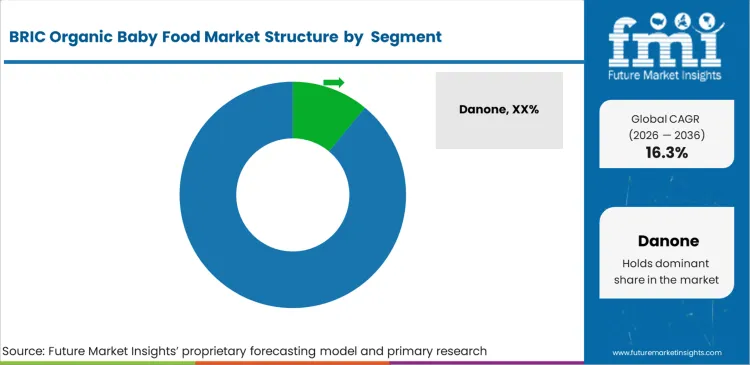
The market structure is increasingly defined by a "trust-based" competitive advantage, where the ability to prove safety and transparency is more valuable than price leadership. Roughly one-third of the market is controlled by integrated multinationals that can afford the heavy capex required for "clean room" manufacturing, while agile startups disrupt the status quo with digital-first transparency and direct-to-consumer models. The primary competitive variable is no longer just shelf presence but the ability to withstand scrutiny; brands that proactively adopt "Clean Label" certifications ahead of regulations win loyalty from anxious parents.
Producers with diversified, global supply chains are better positioned to absorb regional shocks, such as ingredient bans or crop failures, ensuring supply continuity during critical feeding windows. This resilience is a key differentiator, as stock-outs in the infant formula category can permanently lose a customer. Consequently, major players are vertically integrated or forming exclusive partnerships with organic farming cooperatives to secure a consistent flow of high-quality raw materials, insulating themselves from the volatility of the open commodities market.
Regulatory compliance further narrows the competitive field, acting as a filter that removes under-invested players from the shelf. The ability to meet stringent new standards for heavy metals and sugar content requires advanced testing infrastructure and formulation expertise, creating a natural attrition of lower-quality brands. Customer concentration in modern retail reinforces this, as major chains like Walmart and Tesco rationalize their assortments to feature fewer, deeper partnerships with suppliers who can guarantee both volume and strict safety compliance.
Recent Developments
The report includes full coverage of key trends from competitive benchmarking. Some of the recent developments covered in the reports:
- In May 2025, Danone acquired a majority stake in Kate Farms to expand its portfolio into plant-based organic nutritional formulas.[12]
- In February 2024, Bobbie launched Organic Vitamin D and Organic Probiotic Drops, marking its first strategic move beyond infant formula into the broader wellness category.[11]
Key Players in BRIC Organic Baby Food
- Danone
- Nestlé
- ByHeart
- Bobbie
- Kate Farms
- Töpfer
- Gerber
- Yili
- Bellamy’s
- Else Nutrition
Scope of the Report
| Metric | Value |
|---|---|
| Quantitative Units | USD 10.0 billion (2026) to USD 45.4 billion (2036), at a CAGR of 16.3% |
| Market Definition | The BRIC organic baby food market comprises the global production and trade of certified organic infant nutrition products, including milk formula, prepared foods, and dried snacks, utilized as a primary source of safe nutrition for infants and toddlers. |
| Product Type Segmentation | Milk Formula, Prepared Baby Food, Dried Baby Food, Others |
| Distribution Channel Segmentation | Supermarkets/Hypermarkets, Specialty Stores, Online Retailing, Others |
| Application Coverage | Infant Nutrition, Toddler Nutrition, Weaning Foods |
| Regions Covered | North America, Latin America, Europe, East Asia, South Asia, Oceania, Middle East and Africa |
| Countries Covered | Brazil, Russia, India, China, United States, Germany, and 40 plus countries |
| Key Companies Profiled | Danone, Nestlé, ByHeart, Bobbie, Kate Farms, Töpfer, Gerber, Yili, Bellamy’s, Else Nutrition |
| Forecast Period | 2026 to 2036 |
| Approach | Hybrid top down and bottom up market modeling validated through primary interviews with resin producers and panel manufacturers, supported by trade data benchmarking and plant level capacity verification |
BRIC Organic Baby Food Market Analysis by Segments
Product Type:
- Milk Formula
- Prepared Baby Food
- Dried Baby Food
- Others
Distribution Channel:
- Supermarkets/Hypermarkets
- Specialty Stores
- Online Retailing
- Others
Region:
- Asia Pacific
- India
- China
- Japan
- South Korea
- Indonesia
- Australia & New Zealand
- ASEAN
- Rest of Asia Pacific
- Europe
- Germany
- Italy
- France
- United Kingdom
- Spain
- Benelux
- Nordics
- Central & Eastern Europe
- Rest of Europe
- North America
- United States
- Canada
- Mexico
- Latin America
- Brazil
- Argentina
- Chile
- Rest of Latin America
- Middle East & Africa
- Kingdom of Saudi Arabia
- United Arab Emirates
- South Africa
- Turkey
- Rest of Middle East & Africa
Bibliography
- [1] Business Wire. (2024). ByHeart expands retail footprint to Walmart and Whole Foods Market.
- [2] CDC. (2026). Infant botulism outbreak linked to infant formula investigation and cases.
- [3] PR Newswire. (2024). Else Nutrition expands partnership with major retailer in Canada.
- [4] Nestlé India. (2024). Introduction of CERELAC No Refined Sugar recipes and range details.
- [5] USDA Apps. (2025). China total retail sales of consumer goods and retailer concentration.
- [6] Gerber. (2024). Gerber announces Clean Label Project certifications for 80+ products.
- [7] Business Wire. (2024). Bobbie launches Organic Vitamin D and Organic Probiotic Drops.
- [8] UNICEF DATA. (2024). Severe child food poverty and children consuming limited food groups.
- [9] Reuters. (2024). Danone stops sourcing soy from Brazil ahead of EU deforestation rules.
- [10] UNICEF DATA. (2026). USA organic food sales data.
- [11] Business Wire. (2024). Bobbie product launch extending into supplements.
- [12] Reuters. (2025). Danone acquires majority stake in Kate Farms for plant-based nutrition.
- [13] USDA Apps. (2025). China retail sales data and market concentration.
- [14] yili.com. (2025). Product launch for Pro-Kido infant formula in Hong Kong.
- [15] United Nations. (2024). Global population peaks and urban growth data.
- [16] Reuters. (2025). Nestlé increases investment plan in Brazil to 7B reais.
- [17] fas.usda.gov. (2026). EU organic market sales data.
- [18] Pluta. (2024). Töpfer restructuring and acquisition by TCF Capital.
This bibliography is provided for reader reference and is not exhaustive. The full report contains the complete reference list and detailed citations.
This Report Addresses
- Market intelligence to enable structured strategic decision making across Brazil, Russia, India, and China within the organic baby food ecosystem, covering both established urban retail hubs and rapidly expanding Tier II and Tier III consumption clusters
- Market size estimation and 10-year revenue forecasts from 2026 to 2036, supported by validated birth rate data, premiumization trends, organic certification penetration, and import-export benchmarks across BRIC economies
- Growth opportunity mapping across product formats including prepared meals, infant formula, cereals, purees, snacks, and beverages, with emphasis on clean-label, plant-based, allergen-free, and fortified organic formulations
- Segment and regional revenue forecasts covering supermarkets and hypermarkets, specialty organic stores, pharmacies, convenience retail, and e-commerce channels, alongside urban versus semi-urban consumption analysis
- Competition strategy assessment including multinational versus domestic brand positioning, private label expansion, supply chain localization strategies, cost competitiveness, and certification credibility benchmarking
- Product innovation and compliance tracking including organic certification standards (such as China Organic Product Certification, India NPOP, Brazil SisOrg, and Russian organic standards), non-GMO verification, sugar-reduction initiatives, and fortified nutrient compliance
- Regulatory impact analysis covering food safety frameworks, infant nutrition guidelines, labeling mandates, import restrictions, pesticide residue limits, and evolving standards related to infant health and organic integrity
- Market report delivery in PDF, Excel, PPT, and interactive dashboard formats for executive strategy teams, investors, category managers, and operational planning units across BRIC regionsa
Frequently Asked Questions
How large is the demand for BRIC Organic Baby Food in the global market in 2026?
Demand for BRIC Organic Baby Food in the global market is estimated to be valued at USD 10.0 billion in 2026.
What will be the market size of BRIC Organic Baby Food in the global market by 2036?
Market size for BRIC Organic Baby Food is projected to reach USD 45.4 billion by 2036.
What is the expected demand growth for BRIC Organic Baby Food in the global market between 2026 and 2036?
Demand for BRIC Organic Baby Food in the global market is expected to grow at a CAGR of 16.3% between 2026 and 2036.
Which Product Type is poised to lead global sales by 2026?
Milk Formula is expected to be the dominant segment, capturing approximately 27% of the market share in 2026 due to its role as a primary nutritional necessity.
How significant is the role of Online Retailing in driving BRIC Organic Baby Food adoption in 2026?
Online Retailing represents a critical segment, projected to hold a substantial 18.5% share of the total market in 2026 as parents prioritize convenience and subscription models.
What is driving demand in China?
Demand is driven by a strong preference for imported or premium organic brands to ensure safety, backed by a retail market where top players command significant share.
What compliance standards or regulations are referenced for China?
The report references the shifting retail landscape and high safety expectations that favor certified organic and premium-tier products.
What is the China growth outlook in this report?
China is projected to grow at a CAGR of 16.5% during 2026 to 2036.
Why is Asia Pacific described as a priority region in this report?
It is the high-velocity growth engine due to massive population bases and a rapidly expanding middle class that equates organic certification with safety.
What type of demand dominates in Asia Pacific?
Demand is dominated by a "premiumisation at scale" dynamic where urban parents in mega-cities drive volumes for high-quality, safe infant nutrition.
What is the India growth outlook in this report?
India is projected to expand at a CAGR of 15.7% during 2026 to 2036.
Does the report cover Brazil in its regional analysis?
Yes, Brazil is included within Latin America under the regional scope of analysis.
What are the sources referred to for analyzing the Market in Brazil?
Official company announcements regarding capex investments and production upgrades are cited as primary reference sources.
What is the main demand theme linked to Brazil in Latin America coverage?
Demand is associated with the modernization of retail infrastructure and localized production to make organic products more accessible.
Does the report cover Russia in its regional analysis?
Yes, Russia is included within Europe under the regional coverage framework.
What is the main Russia Related Demand Theme in Europe Coverage?
Growth is linked to a resilience in demand for high-quality infant nutrition sold through pharmacy and modern trade channels.
Which product formats are strategically important for Asia Pacific supply chains?
Milk formula and fortified prepared foods are prioritized due to their perceived high value and safety for child development.
What is BRIC Organic Baby Food and What is It Mainly Used For?
BRIC Organic Baby Food refers to certified organic nutritional products like formula and purees used for feeding infants and toddlers safely.
What does BRIC Organic Baby Food Market Mean in this Report?
It refers to the production, trade, and retail of certified organic infant nutrition products across key emerging and developed economies.
What is Included in the Scope of this BRIC Organic Baby Food Report?
Scope covers organic milk formula, prepared foods, and dried snacks distributed via supermarkets, specialty stores, and online channels.
What is Excluded from the Scope of this Report?
Conventional non-organic baby food, non-food infant care items, and informal homemade food markets are excluded.
What does Market Forecast Mean on this Page?
Market forecast represents a model based projection built on defined assumptions for strategic planning purposes.
How does FMI Build and Validate the BRIC Organic Baby Food Forecast?
Forecast is developed using hybrid top down and bottom up modeling validated through primary interviews and production data.
What does Zero Reliance on Speculative Third Party Market Research Mean Here?
Primary interviews and verifiable public datasets are used instead of unverified syndicated market estimates.
Preview the report firsthand - request a free sample
Get SampleGet the brochure for pricing and purchase details.
Get PDFTable of Content
- Executive Summary
- Global Market Outlook
- Demand-side Trends
- Supply-side Trends
- Technology Roadmap Analysis
- Analysis and Recommendations
- Market Overview
- Market Coverage / Taxonomy
- Market Definition / Scope / Limitations
- Research Methodology
- Chapter Orientation
- Analytical Lens and Working Hypotheses
- Market Structure, Signals, and Trend Drivers
- Benchmarking and Cross-market Comparability
- Market Sizing, Forecasting, and Opportunity Mapping
- Research Design and Evidence Framework
- Desk Research Programme (Secondary Evidence)
- Company Annual and Sustainability Reports
- Peer-reviewed Journals and Academic Literature
- Corporate Websites, Product Literature, and Technical Notes
- Earnings Decks and Investor Briefings
- Statutory Filings and Regulatory Disclosures
- Technical White Papers and Standards Notes
- Trade Journals, Industry Magazines, and Analyst Briefs
- Conference Proceedings, Webinars, and Seminar Materials
- Government Statistics Portals and Public Data Releases
- Press Releases and Reputable Media Coverage
- Specialist Newsletters and Curated Briefings
- Sector Databases and Reference Repositories
- FMI Internal Proprietary Databases and Historical Market Datasets
- Subscription Datasets and Paid Sources
- Social Channels, Communities, and Digital Listening Inputs
- Additional Desk Sources
- Expert Input and Fieldwork (Primary Evidence)
- Primary Modes
- Qualitative Interviews and Expert Elicitation
- Quantitative Surveys and Structured Data Capture
- Blended Approach
- Why Primary Evidence is Used
- Field Techniques
- Interviews
- Surveys
- Focus Groups
- Observational and In-context Research
- Social and Community Interactions
- Stakeholder Universe Engaged
- C-suite Leaders
- Board Members
- Presidents and Vice Presidents
- R&D and Innovation Heads
- Technical Specialists
- Domain Subject-matter Experts
- Scientists
- Physicians and Other Healthcare Professionals
- Governance, Ethics, and Data Stewardship
- Research Ethics
- Data Integrity and Handling
- Primary Modes
- Tooling, Models, and Reference Databases
- Desk Research Programme (Secondary Evidence)
- Data Engineering and Model Build
- Data Acquisition and Ingestion
- Cleaning, Normalisation, and Verification
- Synthesis, Triangulation, and Analysis
- Quality Assurance and Audit Trail
- Market Background
- Market Dynamics
- Drivers
- Restraints
- Opportunity
- Trends
- Scenario Forecast
- Demand in Optimistic Scenario
- Demand in Likely Scenario
- Demand in Conservative Scenario
- Opportunity Map Analysis
- Product Life Cycle Analysis
- Supply Chain Analysis
- Investment Feasibility Matrix
- Value Chain Analysis
- PESTLE and Porter’s Analysis
- Regulatory Landscape
- Regional Parent Market Outlook
- Production and Consumption Statistics
- Import and Export Statistics
- Market Dynamics
- Global Market Analysis 2021 to 2025 and Forecast, 2026 to 2036
- Historical Market Size Value (USD Million) Analysis, 2021 to 2025
- Current and Future Market Size Value (USD Million) Projections, 2026 to 2036
- Y-o-Y Growth Trend Analysis
- Absolute $ Opportunity Analysis
- Global Market Pricing Analysis 2021 to 2025 and Forecast 2026 to 2036
- Global Market Analysis 2021 to 2025 and Forecast 2026 to 2036, By Product Type
- Introduction / Key Findings
- Historical Market Size Value (USD Million) Analysis By Product Type , 2021 to 2025
- Current and Future Market Size Value (USD Million) Analysis and Forecast By Product Type , 2026 to 2036
- Milk Formula
- Prepared Baby Food
- Dried Baby Food
- Others
- Milk Formula
- Y-o-Y Growth Trend Analysis By Product Type , 2021 to 2025
- Absolute $ Opportunity Analysis By Product Type , 2026 to 2036
- Global Market Analysis 2021 to 2025 and Forecast 2026 to 2036, By Distribution Channel
- Introduction / Key Findings
- Historical Market Size Value (USD Million) Analysis By Distribution Channel, 2021 to 2025
- Current and Future Market Size Value (USD Million) Analysis and Forecast By Distribution Channel, 2026 to 2036
- Online
- Supermarkets/Hypermarkets
- Specialty Stores
- Online
- Y-o-Y Growth Trend Analysis By Distribution Channel, 2021 to 2025
- Absolute $ Opportunity Analysis By Distribution Channel, 2026 to 2036
- Global Market Analysis 2021 to 2025 and Forecast 2026 to 2036, By Region
- Introduction
- Historical Market Size Value (USD Million) Analysis By Region, 2021 to 2025
- Current Market Size Value (USD Million) Analysis and Forecast By Region, 2026 to 2036
- North America
- Latin America
- Western Europe
- Eastern Europe
- East Asia
- South Asia and Pacific
- Middle East & Africa
- Market Attractiveness Analysis By Region
- North America Market Analysis 2021 to 2025 and Forecast 2026 to 2036, By Country
- Historical Market Size Value (USD Million) Trend Analysis By Market Taxonomy, 2021 to 2025
- Market Size Value (USD Million) Forecast By Market Taxonomy, 2026 to 2036
- By Country
- USA
- Canada
- Mexico
- By Product Type
- By Distribution Channel
- By Country
- Market Attractiveness Analysis
- By Country
- By Product Type
- By Distribution Channel
- Key Takeaways
- Latin America Market Analysis 2021 to 2025 and Forecast 2026 to 2036, By Country
- Historical Market Size Value (USD Million) Trend Analysis By Market Taxonomy, 2021 to 2025
- Market Size Value (USD Million) Forecast By Market Taxonomy, 2026 to 2036
- By Country
- Brazil
- Chile
- Rest of Latin America
- By Product Type
- By Distribution Channel
- By Country
- Market Attractiveness Analysis
- By Country
- By Product Type
- By Distribution Channel
- Key Takeaways
- Western Europe Market Analysis 2021 to 2025 and Forecast 2026 to 2036, By Country
- Historical Market Size Value (USD Million) Trend Analysis By Market Taxonomy, 2021 to 2025
- Market Size Value (USD Million) Forecast By Market Taxonomy, 2026 to 2036
- By Country
- Germany
- UK
- Italy
- Spain
- France
- Nordic
- BENELUX
- Rest of Western Europe
- By Product Type
- By Distribution Channel
- By Country
- Market Attractiveness Analysis
- By Country
- By Product Type
- By Distribution Channel
- Key Takeaways
- Eastern Europe Market Analysis 2021 to 2025 and Forecast 2026 to 2036, By Country
- Historical Market Size Value (USD Million) Trend Analysis By Market Taxonomy, 2021 to 2025
- Market Size Value (USD Million) Forecast By Market Taxonomy, 2026 to 2036
- By Country
- Russia
- Poland
- Hungary
- Balkan & Baltic
- Rest of Eastern Europe
- By Product Type
- By Distribution Channel
- By Country
- Market Attractiveness Analysis
- By Country
- By Product Type
- By Distribution Channel
- Key Takeaways
- East Asia Market Analysis 2021 to 2025 and Forecast 2026 to 2036, By Country
- Historical Market Size Value (USD Million) Trend Analysis By Market Taxonomy, 2021 to 2025
- Market Size Value (USD Million) Forecast By Market Taxonomy, 2026 to 2036
- By Country
- China
- Japan
- South Korea
- By Product Type
- By Distribution Channel
- By Country
- Market Attractiveness Analysis
- By Country
- By Product Type
- By Distribution Channel
- Key Takeaways
- South Asia and Pacific Market Analysis 2021 to 2025 and Forecast 2026 to 2036, By Country
- Historical Market Size Value (USD Million) Trend Analysis By Market Taxonomy, 2021 to 2025
- Market Size Value (USD Million) Forecast By Market Taxonomy, 2026 to 2036
- By Country
- India
- ASEAN
- Australia & New Zealand
- Rest of South Asia and Pacific
- By Product Type
- By Distribution Channel
- By Country
- Market Attractiveness Analysis
- By Country
- By Product Type
- By Distribution Channel
- Key Takeaways
- Middle East & Africa Market Analysis 2021 to 2025 and Forecast 2026 to 2036, By Country
- Historical Market Size Value (USD Million) Trend Analysis By Market Taxonomy, 2021 to 2025
- Market Size Value (USD Million) Forecast By Market Taxonomy, 2026 to 2036
- By Country
- Kingdom of Saudi Arabia
- Other GCC Countries
- Turkiye
- South Africa
- Other African Union
- Rest of Middle East & Africa
- By Product Type
- By Distribution Channel
- By Country
- Market Attractiveness Analysis
- By Country
- By Product Type
- By Distribution Channel
- Key Takeaways
- Key Countries Market Analysis
- USA
- Pricing Analysis
- Market Share Analysis, 2025
- By Product Type
- By Distribution Channel
- Canada
- Pricing Analysis
- Market Share Analysis, 2025
- By Product Type
- By Distribution Channel
- Mexico
- Pricing Analysis
- Market Share Analysis, 2025
- By Product Type
- By Distribution Channel
- Brazil
- Pricing Analysis
- Market Share Analysis, 2025
- By Product Type
- By Distribution Channel
- Chile
- Pricing Analysis
- Market Share Analysis, 2025
- By Product Type
- By Distribution Channel
- Germany
- Pricing Analysis
- Market Share Analysis, 2025
- By Product Type
- By Distribution Channel
- UK
- Pricing Analysis
- Market Share Analysis, 2025
- By Product Type
- By Distribution Channel
- Italy
- Pricing Analysis
- Market Share Analysis, 2025
- By Product Type
- By Distribution Channel
- Spain
- Pricing Analysis
- Market Share Analysis, 2025
- By Product Type
- By Distribution Channel
- France
- Pricing Analysis
- Market Share Analysis, 2025
- By Product Type
- By Distribution Channel
- India
- Pricing Analysis
- Market Share Analysis, 2025
- By Product Type
- By Distribution Channel
- ASEAN
- Pricing Analysis
- Market Share Analysis, 2025
- By Product Type
- By Distribution Channel
- Australia & New Zealand
- Pricing Analysis
- Market Share Analysis, 2025
- By Product Type
- By Distribution Channel
- China
- Pricing Analysis
- Market Share Analysis, 2025
- By Product Type
- By Distribution Channel
- Japan
- Pricing Analysis
- Market Share Analysis, 2025
- By Product Type
- By Distribution Channel
- South Korea
- Pricing Analysis
- Market Share Analysis, 2025
- By Product Type
- By Distribution Channel
- Russia
- Pricing Analysis
- Market Share Analysis, 2025
- By Product Type
- By Distribution Channel
- Poland
- Pricing Analysis
- Market Share Analysis, 2025
- By Product Type
- By Distribution Channel
- Hungary
- Pricing Analysis
- Market Share Analysis, 2025
- By Product Type
- By Distribution Channel
- Kingdom of Saudi Arabia
- Pricing Analysis
- Market Share Analysis, 2025
- By Product Type
- By Distribution Channel
- Turkiye
- Pricing Analysis
- Market Share Analysis, 2025
- By Product Type
- By Distribution Channel
- South Africa
- Pricing Analysis
- Market Share Analysis, 2025
- By Product Type
- By Distribution Channel
- USA
- Market Structure Analysis
- Competition Dashboard
- Competition Benchmarking
- Market Share Analysis of Top Players
- By Regional
- By Product Type
- By Distribution Channel
- Competition Analysis
- Competition Deep Dive
- Danone
- Overview
- Product Portfolio
- Profitability by Market Segments (Product/Age /Sales Channel/Region)
- Sales Footprint
- Strategy Overview
- Marketing Strategy
- Product Strategy
- Channel Strategy
- Nestlé
- ByHeart
- Bobbie
- Kate Farms
- Töpfer
- Gerber
- Danone
- Competition Deep Dive
- Assumptions & Acronyms Used


