


BRICS Oral Care Market : Global Industry Analysis and Opportunity Assessment, 2036
BRICS Oral Care Market Insights – Growth & Forecast 2026-2036
- Industry Size (2026): USD 23.0 Bn
- Forecast (2036): USD 34.4 Bn
- CAGR (2026 to 2036): 4.1%
BRICS Oral Care Market Forecast and Outlook 2026 to 2036
The BRICS oral care market is forecast to expand from USD 23.0 Billion in 2026 to USD 34.4 Billion by 2036, registering a 4.1% CAGR. Growth is anchored in the defensibility of primary oral care baskets and the increasing use of science-led claims to trade consumers up within toothpaste and toothbrushes. Colgate-Palmolive’s latest Form 10-K states it is a leader in Oral Care with global leadership in toothpaste and manual toothbrush categories by market share, reinforcing why BRICS demand is structurally served by scaled portfolios with entrenched distribution and brand trust.
Category investment is increasingly built around therapeutic differentiation and product science rather than media alone. Haleon disclosed a £130 million investment plan for a Global Oral Health Innovation Centre in Weybridge, designed to accelerate innovation across its Oral Health portfolio, signaling sustained capital allocation behind premium oral health platforms. CEO Brian McNamara tied the move to talent and innovation, stating: ‘This facility is central to our efforts to attract and retain the best talent to fuel our growth.’
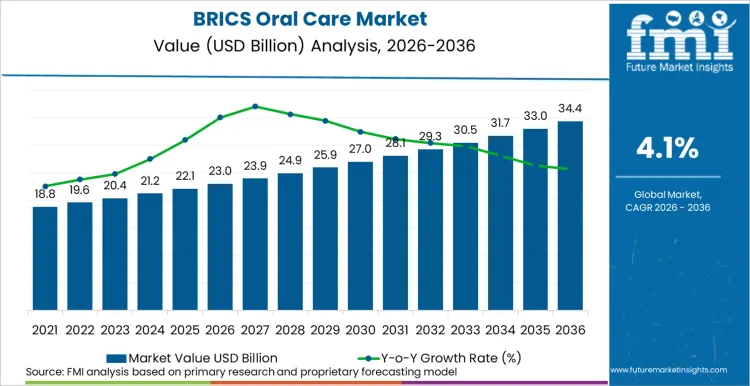
BRICS Oral Care Market Key Takeaways
| Metric | Value |
|---|---|
| Market Size (2026) | USD 23.0 Billion |
| Forecast Value (2036) | USD 34.4 Billion |
| CAGR (2026 to 2036) | 4.1% |
Summary of the BRICS Oral Care Market
What is Growth Outlook for BRICS Oral Care Market as per Future Market Insights Projection?
Future Market Insights projects the BRICS oral care market to expand from USD 23.0 Billion in 2026 to USD 34.4 Billion by 2036, reflecting a 4.1% CAGR.
FMI Research Approach: Forecast built by mapping primary oral care replenishment frequency to modern retail penetration, pricing ladder shifts in toothpaste and brushes, and brand-led premiumisation intensity by country.
How do FMI Analysts Perceive the BRICS Oral Care Market to Evolve?
FMI expects growth to concentrate in portfolios that combine therapeutic science investment with modern trade execution, as regulators tighten product compliance and leading companies push innovation cycles into sensitive-teeth, gum-health, and power-brush conversion.
FMI Research Approach: Competitive tracking of disclosed R&D investments, portfolio upgrades, and channel expansion signals across BRICS.
Which Country is Expected to be the Fastest Growing in the BRICS Oral Care Market?
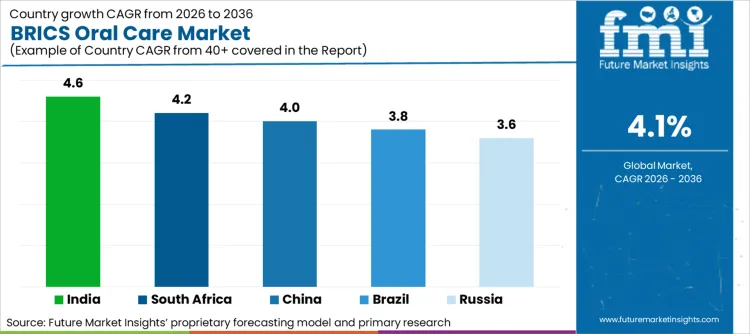
India is expected to grow at a 4.6% CAGR from 2026 to 2036 as toothpaste standardisation, Ayurvedic-to-science repositioning, and modern retail expansion reinforce scale-driven replenishment.
FMI Research Approach: Country model weighted to FMCG route density, toothpaste compliance and standardisation norms, and premiumisation pace.
Which Product Type Leads the BRICS Oral Care Market in 2026?
Primary oral care products lead with a 74.0% share in 2026, reflecting the structural dominance of toothpaste and toothbrush replenishment in household baskets.
FMI Research Approach: Segment share derived from category purchase frequency, household penetration, and portfolio breadth of scaled oral care owners.
Which Distribution Channel Holds the Largest Share in 2026?
Hypermarkets and supermarkets lead with a 32.0% share in 2026, reflecting high-volume replenishment behaviour and shelf-led brand conversion in mass modern trade.
FMI Research Approach: Channel allocation model based on modern trade expansion, price-pack architecture, and retail-led promotion intensity.
Which forces are structurally lifting BRICS oral care consumption?
Demand is being driven by a tightening loop between regulation, premiumisation investment, and modern retail reach. In China, the State Administration for Market Regulation issued the Provisions for Toothpaste Regulation, effective December 1, 2023, formalising supervision requirements that raise the compliance bar and favour scaled manufacturers with dossier and quality systems. In parallel, global leaders are increasing science and innovation spend around oral health outcomes. Haleon’s disclosed £130 million commitment to an oral health innovation centre signals sustained platform funding behind therapeutic claims that trade consumers up inside core toothpaste and adjunct categories. Technology conversion is also expanding value per household.
How is the BRICS Oral Care Market Segmented?
The BRICS oral care market is segmented by product type and distribution channel to reflect how demand is generated through high-frequency household replenishment and converted at scale through retail execution. By product type, the market includes primary oral care products such as toothpaste and toothbrushes, alongside secondary categories including mouthwash, dental floss, and denture care, with primary products forming the structural core of daily oral hygiene routines. By distribution channel, demand spans hypermarkets and supermarkets, specialty stores and pharmacies, convenience stores, direct selling, and other retail routes, highlighting the importance of shelf visibility, price-pack architecture, and route density in driving repeat purchases across mass and premium tiers.
FMI analysis suggests that while innovation in therapeutic claims and device-led upgrades is increasing, the market structure remains heavily anchored in habitual consumption and compliance-safe essentials. This segmentation highlights a dual-track market where primary oral care products deliver scale and frequency through modern retail channels, while secondary formats and emerging channels provide incremental value and premiumisation without displacing the dominance of core hygiene platforms.
Why do primary oral care products keep controlling the value pool in BRICS?
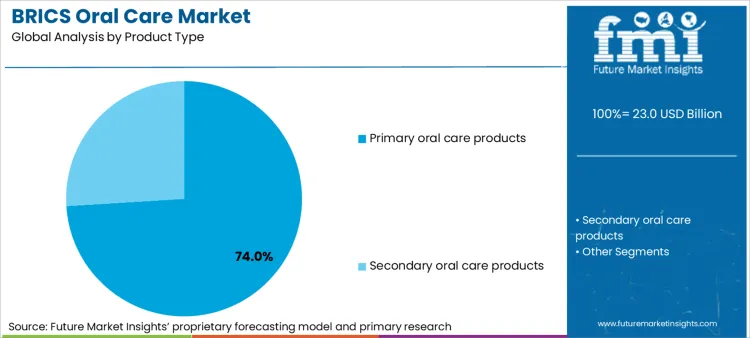
Primary oral care products lead with a 74.0% share in 2026 because procurement of daily essentials is governed by habitual replenishment and regulatory-safe standardisation, which structurally concentrates volumes in toothpaste and toothbrushes rather than episodic secondary formats. The strongest platform owners repeatedly treat toothpaste and brushes as the anchor categories where global leadership and routine-driven consumption compound. Colgate-Palmolive’s Form 10-K states it holds global leadership in toothpaste and manual toothbrush categories by market share, which signals why BRICS consumption stays concentrated in these formats: they are the shelves where incumbents defend scale, pricing ladder control, and frequency economics. Portfolio owners also keep pushing premium conversion inside brushes, lifting the primary basket’s value per household. Tighter toothpaste governance in China raises the advantage of scaled compliance systems, further concentrating primary category share among large operators that can execute filings, quality assurance, and packaging claims at scale across provinces and import pathways.
What makes hypermarkets and supermarkets the most decisive channel for BRICS scale execution?
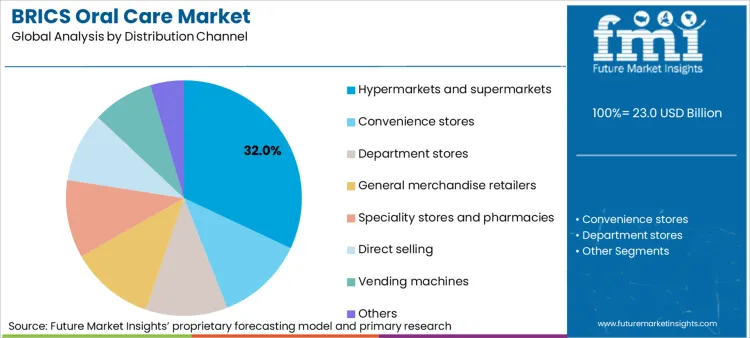
Hypermarkets and supermarkets lead with a 32.0% share in 2026 because they are the channel where mass replenishment, shelf-led switching, and price-pack architecture are operationalised at national scale, making them the most controllable conversion point for primary oral care baskets. The channel advantage is not convenience, it is execution leverage. Large players repeatedly invest behind retail programs and innovation pipelines that depend on high-visibility shelf presence and predictable in-store conversion. Unilever explicitly links its oral care growth to premium product launches and innovation-driven premiumisation, which is commercially amplified when modern trade can carry wider assortments, run promotional mechanics, and deliver high throughput. The channel also becomes more important as product governance tightens, because retailers prefer suppliers that can defend compliance and continuity across regions. China’s Provisions for Toothpaste Regulation, effective December 1, 2023, reinforces that toothpaste is under defined supervision rules, which increases the value of scaled supply chains that can keep compliant SKUs continuously on shelf. This combination of shelf control, assortment breadth, and compliance confidence explains why modern trade remains the decisive channel even as e-commerce expands.
Why Is Science-Led Premiumisation Reshaping BRICS Oral Care Consumption?
Science-led premiumisation is reshaping the BRICS oral care market by shifting value capture from basic hygiene to therapeutically positioned platforms backed by sustained R&D investment. Large oral care owners are funding innovation infrastructure to upgrade everyday routines rather than create entirely new categories. Haleon’s disclosed £130 million investment in a Global Oral Health Innovation Centre illustrates how portfolio owners are embedding science capabilities to accelerate innovation across toothpaste and adjunct segments, driving mix improvement and margin expansion. In parallel, P&G’s reporting that Oral-B iO supported power brush category growth shows that device-led upgrading is pulling incremental value into toothbrush portfolios, particularly as urban BRICS consumers adopt power brushes through modern trade and specialist retail channels.
How Is Device-Led Upgrading Changing Daily Oral Care Behavior?
The BRICS oral care market is pivoting from purely consumable-led growth toward integrated consumable-and-device ecosystems that increase value per household. Power brushes are no longer niche accessories but structured trade-up pathways that anchor premiumisation inside primary oral care baskets. This shift allows brands to monetise habitual routines through higher-priced hardware supported by replacement heads and complementary toothpaste systems, reinforcing repeat purchase economics while maintaining scale.
What Role Does Regulatory Tightening Play as a Market Restraint?
Rising compliance and documentation requirements across BRICS markets are increasing cost-to-serve and slowing SKU experimentation, particularly for smaller or informal players. China’s Provisions for Toothpaste Regulation, effective December 1, 2023, formalise supervision expectations around filing, labeling, and product control, tightening the operating perimeter for brands without scaled regulatory and quality systems. Similar governance pressure elsewhere elevates audit readiness and manufacturing discipline as competitive requirements, pushing the category toward fewer, larger manufacturers capable of funding compliance, documentation, and consistent control across complex BRICS supply chains.
What is the BRICS Oral Care Market Regional Outlook?
Growth across the BRICS oral care market reflects steady expansion rooted in daily-use hygiene rather than rapid volume acceleration. While the overall market advances at a moderate pace, performance varies by country based on regulatory frameworks, retail penetration, and premiumisation intensity. India leads BRICS growth at a 4.6% CAGR, supported by toothpaste standardisation, expanding modern trade, and rising acceptance of science-led oral care claims. South Africa follows at a 4.2% CAGR, driven by prevention-focused public health programs and consistent household replenishment.
China grows at a 4.0% CAGR, shaped by compliance-led consolidation under tighter toothpaste supervision. Brazil records a 3.8% CAGR, as health surveillance governance favours stable, large-scale portfolios. Russia lags at 3.6% CAGR, where conformity regimes stabilise demand but limit experimentation. FMI analysis indicates BRICS growth will remain resilient and regulation-driven.
| Country | CAGR (2026 to 2036) |
|---|---|
| Brazil | 3.8% |
| Russia | 3.6% |
| India | 4.6% |
| China | 4.0% |
| South Africa | 4.2% |
Source: Future Market Insights (FMI) analysis, based on proprietary forecasting model and primary research.
How does Brazil’s health surveillance governance favour scaled oral care portfolios over fragmented supply?
Brazil will grow at a 3.8% CAGR from 2026 to 2036 because regulatory gatekeeping and quality accountability reinforce the advantage of scaled manufacturers that can document safety, labeling, and manufacturing controls across high-frequency personal hygiene categories. ANVISA’s own regulatory overview states that marketing authorisation for personal hygiene products, cosmetics and fragrances is governed by Resolution RDC 907/2024, signalling the continuing role of health surveillance governance in structuring compliant participation. In an oral care context, this raises execution requirements around product substantiation and compliance discipline, which favours large portfolios with established quality systems and local operating depth. The effect is stronger shelf stability in modern trade, where high-throughput stores prioritise predictable supply and lower regulatory disruption risk. As modern retail remains a critical conversion engine for toothpaste and toothbrush replenishment, compliance confidence becomes a commercial advantage that sustains branded leaders while keeping informal or low-capability entrants constrained.
Why does Russia’s EAEU conformity regime concentrate oral care scaling among established brand owners?
Russia will expand at a 3.6% CAGR from 2026 to 2036 because the EAEU technical regulation regime increases conformity requirements for perfumery and cosmetic products, shaping market participation toward manufacturers and importers with documentation and local legal entity capability. The Customs Union technical regulation TR CU 009/2011 on the safety of perfumery and cosmetic products is an effective framework that sets safety and compliance requirements for products placed on the market. In oral care, where toothpaste and mouthwash sit inside regulated daily use products, the compliance load reinforces scale advantages in quality testing, packaging control, and distributor readiness. This structure supports stable national distribution for leading brands and raises friction for rapid entry by smaller importers. The commercial result is slower but more defensible growth, with expansion tied to compliance-ready assortments and channel partners that can manage conformity declarations and consistent product availability across large geographies.
What is making India the fastest-growing BRICS oral care market through standardisation and scaled replenishment?
India is projected to grow at a 4.6% CAGR from 2026 to 2036 because toothpaste quality standardisation and high-frequency replenishment economics reinforce scale-led execution across mass channels. The Bureau of Indian Standards’ IS 6356 specifies requirements and test methods for toothpaste, including composition and sampling, reflecting the role of formal standards in structuring product compliance for high-volume categories. As standards tighten, manufacturers with strong QA and manufacturing discipline gain relative advantage in sustaining broad SKU coverage across price tiers and regions. On the demand side, India’s oral care growth is increasingly driven by portfolio owners expanding premium ladders while keeping mass availability intact, a pattern consistent with large FMCG distribution models. The combination of standard-driven category formalisation and route density across general trade and modern trade sustains faster expansion versus other BRICS markets where demographic or regulatory constraints slow conversion.
How is China’s toothpaste supervision regime accelerating compliance-led consolidation in oral care?
China will grow at a 4.0% CAGR from 2026 to 2036 because toothpaste is now governed by a defined supervision framework that raises compliance expectations and favours scaled operators able to execute filings and maintain regulatory-ready portfolios. The National Medical Products Administration’s English-language publication of the Provisions for Toothpaste Regulation notes it was promulgated by SAMR Decree No. 71 and took effect on December 1, 2023, formalising the operating perimeter for toothpaste products. This type of governance increases the cost of non-compliance and reduces tolerance for informal assortment churn, which structurally benefits incumbents with mature quality systems, local manufacturing depth, and multi-channel distribution control. The commercial outcome is more predictable shelf sets in modern trade and stronger platform advantage for brands that can sustain documentation discipline while executing premiumisation, including sensitive-teeth and gum-health claims that require tighter substantiation and regulatory readiness.
Why is South Africa’s policy refresh pushing prevention-led oral health programs that lift toothpaste relevance?
South Africa will expand at a 4.2% CAGR from 2026 to 2036 because the public health system is explicitly refreshing oral health policy to improve coordination of services and strengthen prevention logic, which structurally supports daily self-care categories such as toothpaste and toothbrushes. The National Department of Health’s National Oral Health Policy and Strategy (published December 2024) is positioned to improve coordination of oral health services and guide stakeholders across the system, reinforcing prevention and structured programming rather than episodic care alone. As policy emphasis increases on coordinated oral health delivery, toothpaste becomes a scalable prevention lever in households and school-linked routines, which supports baseline category expansion even under affordability constraints. The result is demand growth tied to prevention programs and awareness pathways that are specific to South Africa’s health system objectives, rather than a generic premiumisation story.
How is the competitive landscape evolving in the global oral care market?
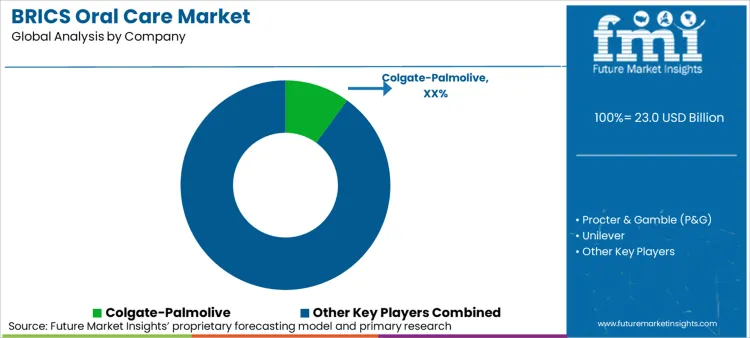
Competition is concentrated among scaled oral care platform owners that control toothpaste, toothbrushes, mouthwash, floss, and denture care portfolios and win through science investment, retail execution, and device-led premiumisation. This scope includes toothpaste, manual and power toothbrushes, mouthwash, dental floss, and denture care products. This scope excludes professional dental equipment, dental implants, orthodontic devices, clinical procedures, and prescription dental therapeutics sold primarily through dental clinics.
Colgate-Palmolive is positioned as the largest global oral care reference player because its SEC filing states it is a leader in Oral Care with global leadership in toothpaste and manual toothbrush categories by market share, reflecting entrenched scale in the two highest-frequency subcategories. Leadership differs by region. In Europe, Haleon’s Oral Health platform is reinforced by disclosed infrastructure investment, including its £130 million Global Oral Health Innovation Centre plan, which signals sustained R&D-backed premiumisation. In Asia, global leadership does not automatically translate into regional dominance, especially in Japan, where Lion’s integrated reporting signals strategic prioritisation by renaming oral care to oral healthcare, reflecting locally anchored platform execution that can outperform global peers in domestic routines and channel influence.
Recent Developments
- In January 2026, Lion Corporation’s “Okuchi Plus You” oral healthcare support service reached more than 200 organizations and 100,000 users under the KENKO Investment for Health initiative, reinforcing the company’s efforts to promote dental and mouth health and improve quality of life.
- In December 2025, Church & Dwight agreed to sell its VitaFusion® and L’il Critters® vitamin brands, along with related manufacturing and distribution facilities, to Piping Rock Health Products, following a strategic review of its VMS business, with the transaction expected to close before year-end.
Key Players
- Colgate-Palmolive
- Procter & Gamble (P&G)
- Unilever
- Haleon
- Kenvue
- Church & Dwight
- Lion Corporation
- Sunstar Group
- Dabur
- Yunnan Baiyao Group
Market Definition
The BRICS oral care market covers consumer oral hygiene products sold for routine cleaning, protection, and maintenance of teeth and gums across Brazil, Russia, India, China, and South Africa. It includes primary replenishment categories such as toothpaste and toothbrushes, and secondary categories such as mouthwash, floss, and denture care. Demand is shaped by daily-use replenishment frequency, modern retail conversion, and increasing regulation of toothpaste and cosmetics-style personal care products. Competitive advantage is driven by quality systems, regulatory compliance capability, retail route density, and the ability to premiumise through science-led claims and device adoption programs.
Market Inclusion
Included revenues cover toothpaste in gel and non-gel formats, manual and power toothbrushes, mouthwash, dental floss, and denture care products sold through hypermarkets and supermarkets, specialty stores and pharmacies, convenience stores, department stores, general merchandise retailers, direct selling, vending, and other retail routes. The market includes mass and premium variants where claims and packaging remain within consumer oral care regulation. Leadership inference relies on disclosed platform scale and repeatable investment signals. For example, Colgate’s SEC filing describes global leadership in toothpaste and manual toothbrushes, while Haleon’s disclosed £130 million oral health innovation centre investment signals sustained R&D funding behind oral health platforms.
Market Exclusion
Excluded are professional dental instruments and equipment, dental chairs and imaging systems, dental implants, orthodontic appliances, prescription dental pharmaceuticals, and clinical services delivered through dental practices. Also excluded are standalone professional training services, clinic management software, and insurance reimbursement flows. Regional leadership is assessed separately because domestic champions can dominate through local channel influence and culturally anchored routines, especially in Japan where Lion’s reporting shows a strategic elevation of oral care to oral healthcare, demonstrating that global category leadership does not always translate into regional leadership in Asia.
Scope of Report
| Items | Values |
|---|---|
| Quantitative Units | USD 23 Billion |
| Product Type Segments | Toothpaste; Toothbrushes (Manual & Power); Mouthwash; Dental Floss; Denture Care Products |
| Category Structure | Primary Oral Care Products; Secondary Oral Care Products |
| Distribution Channels | Hypermarkets & Supermarkets; Specialty Stores & Pharmacies; Convenience Stores; Department Stores; General Merchandise Retailers; Direct Selling; Vending Machines; Others |
| End-Use Context | Daily Household Oral Hygiene and Preventive Care |
| Regions Covered | BRICS |
| Key Countries | Brazil, Russia, India, China, South Africa |
| Key Companies Profiled | Colgate-Palmolive; Procter & Gamble (P&G); Unilever; Haleon; Kenvue; Church & Dwight; Lion Corporation; Sunstar Group; Dabur; Yunnan Baiyao Group |
| Regulatory & Standards Reference | Toothpaste and oral care governance under national safety, quality, and labelling frameworks including China SAMR/NMPA Provisions for Toothpaste Regulation, BIS IS 6356 (India), ANVISA RDC 907/2024 (Brazil), EAEU TR CU 009/2011 (Russia), and national public health oral care policies |
| Additional Attributes | Dollar sales measured for consumer oral hygiene products sold across BRICS; demand driven by high-frequency replenishment of toothpaste and toothbrushes; premiumisation through science-led claims, sensitive-teeth and gum-health positioning, and power-brush adoption; modern trade shelf execution as the primary conversion lever; increasing compliance and documentation requirements shaping supplier selection; competitive advantage determined by platform scale, regulatory readiness, retail route density, and ability to monetise daily oral care routines through therapeutic innovation |
BRICS Oral Care Market by Key Segments
Product Type
- Primary oral care products
- Toothbrush
- Specialised
- Mid-tier
- Kids
- Toothpaste
- Gel toothpaste
- Non-gel toothpaste
- Toothbrush
- Secondary oral care products
- Mouthwash
- Flavoured
- Conventional
- Organic toothpaste
- Dental floss
- Waxed
- Unwaxed
- Flavoured
- Unflavoured
- Thread
- Tape floss
- Denture care
- Denture care products
- Cleanser
- Adhesive
- Paste
- Denture care fixtures
- Complete
- Partial
- Over denture fixtures
- Denture care products
- Others
- Mouthwash
Distribution Channel
- Hypermarkets and supermarkets
- Convenience stores
- Department stores
- General merchandise retailers
- Speciality stores and pharmacies
- Direct selling
- Vending machines
- Others
Bibliography
- Colgate-Palmolive Company. (2025). Form 10-K for the fiscal year ended December 31, 2024. USA Securities and Exchange Commission.
- Haleon. (2024). Haleon to invest £130 million in global oral health innovation centre [Press release].
- Haleon. (2025). Haleon breaks ground on new £130m global oral health innovation centre [Press release].
- National Department of Health, South Africa. (2024). National oral health policy and strategy.
- State Administration for Market Regulation. (2023). Provisions for toothpaste regulation. National Medical Products Administration.
Frequently Asked Questions
How big is the global BRICS oral care market?
The BRICS oral care market is valued at USD 23.0 Billion in 2026 and is projected to reach USD 34.4 Billion by 2036.
What is the growth outlook for the BRICS oral care market over the next 10 years?
The market is forecast to expand at a steady 4.1% CAGR from 2026 to 2036, driven by scale-led replenishment and science-backed premiumisation.
Which product segments or formats drive demand in this market?
Primary oral care products, led by toothpaste and toothbrushes, dominate demand with a 74.0% share due to high-frequency daily use.
How does consumer behavior differ by region?
Consumer behaviour varies by country, with India and South Africa showing faster growth through standardisation and prevention programs, while China and Brazil reflect compliance-led consolidation and stable replenishment patterns.
What are the main risks and constraints affecting this market?
Tightening regulatory and documentation requirements, particularly China’s Provisions for Toothpaste Regulation, increase compliance costs and restrict rapid SKU expansion for smaller players.
Table of Content
- Executive Summary
- Global Market Outlook
- Demand-side Trends
- Supply-side Trends
- Technology Roadmap Analysis
- Analysis and Recommendations
- Market Overview
- Market Coverage / Taxonomy
- Market Definition / Scope / Limitations
- Research Methodology
- Chapter Orientation
- Analytical Lens and Working Hypotheses
- Market Structure, Signals, and Trend Drivers
- Benchmarking and Cross-market Comparability
- Market Sizing, Forecasting, and Opportunity Mapping
- Research Design and Evidence Framework
- Desk Research Programme (Secondary Evidence)
- Company Annual Reports and Integrated Reports
- Peer-reviewed Medical and Clinical Journals
- Corporate Websites and Product Technical Literature
- Investor Presentations and Earnings Communications
- Regulatory Filings and Medical Device Standards
- Clinical Guidelines and Public Health Publications
- Trade Journals and Wound Care Industry Magazines
- Conference Proceedings and Clinical Congress Materials
- Government Health Statistics and Surveillance Data
- Press Releases and Verified Media Coverage
- Specialist Healthcare Newsletters
- Sector Databases and Medical Device Repositories
- FMI Internal Knowledge Base
- Subscription-based Healthcare Databases
- Hospital Procurement and Tendering Inputs
- Additional Desk Sources
- Expert Input and Fieldwork (Primary Evidence)
- Primary Modes
- Qualitative Interviews
- Quantitative Surveys
- Hybrid Validation Approach
- Why Primary Evidence is Used
- Field Techniques
- Hospital and Clinic Interviews
- Procurement and Formulary Surveys
- Wound Care Specialist Workshops
- Care Pathway Observations
- Policy and Payment Reform Consultations
- Stakeholder Universe Engaged
- C-suite Executives
- Hospital Procurement Heads
- Clinical Directors and Wound Care Specialists
- Quality and Infection Control Leads
- Regulatory and Compliance Officers
- Home Care and Post-acute Care Coordinators
- Governance, Ethics, and Data Stewardship
- Research Ethics
- Data Integrity and Handling
- Primary Modes
- Tooling, Models, and Reference Databases
- Desk Research Programme (Secondary Evidence)
- Data Engineering and Model Build
- Data Acquisition and Ingestion
- Cleaning, Normalisation, and Verification
- Synthesis, Triangulation, and Analysis
- Quality Assurance and Audit Trail
- Market Background
- Market Dynamics
- Drivers
- Restraints
- Opportunity
- Trends
- Scenario Forecast
- Demand in Optimistic Scenario
- Demand in Likely Scenario
- Demand in Conservative Scenario
- Opportunity Map Analysis
- Product Life Cycle Analysis
- Supply Chain Analysis
- Investment Feasibility Matrix
- Value Chain Analysis
- PESTLE and Porter’s Analysis
- Regulatory Landscape
- Regional Parent Market Outlook
- Healthcare Utilisation and Treatment Statistics
- Import and Export Statistics
- Market Dynamics
- Global Market Analysis 2021 to 2025 and Forecast, 2026 to 2036
- Historical Market Size Value (USD Billion) Analysis, 2021 to 2025
- Current and Future Market Size Value (USD Billion) Projections, 2026 to 2036
- Y-o-Y Growth Trend Analysis
- Absolute $ Opportunity Analysis
- Global Market Pricing Analysis 2021 to 2025 and Forecast 2026 to 2036
- Global Market Analysis 2021 to 2025 and Forecast 2026 to 2036, By Product Type
- Introduction / Key Findings
- Historical Market Size Value (USD Billion) Analysis By Product Type, 2021 to 2025
- Current and Future Market Size Value (USD Billion) Analysis and Forecast By Product Type, 2026 to 2036
- Y-o-Y Growth Trend Analysis By Product Type, 2021 to 2025
- Absolute $ Opportunity Analysis By Product Type, 2026 to 2036
- Global Market Analysis 2021 to 2025 and Forecast 2026 to 2036, By Distribution Channel
- Y-o-Y Growth Trend Analysis By Distribution Channel
- Absolute $ Opportunity Analysis By Distribution Channel
- Global Market Analysis 2021 to 2025 and Forecast 2026 to 2036, By Region
- Introduction
- Historical Market Size Value (USD Billion) Analysis By Region, 2021 to 2025
- Current Market Size Value (USD Billion) Analysis and Forecast By Region, 2026 to 2036
- BRICS
- Market Attractiveness Analysis By Region
- Key Countries Market Analysis
- Brazil
- Russia
- India
- China
- South Africa
- Market Structure Analysis
- Competition Dashboard
- Competition Benchmarking
- Market Share Analysis of Top Players
- By Product Type
- By Distribution Channel
- By Country
- Competition Analysis
- Competition Deep Dive
- Recent Developments
- Key Players
- Scope Controls
- Market Definition
- Market Inclusion
- Market Exclusion
- Scope of Report
- BRICS Oral Care Market by Key Segments
- Product Type
- Distribution Channel
- Bibliography
- Frequently Asked Questions
- Assumptions & Acronyms Used
List of Tables
- BRICS Oral Care Market Key Takeaways
- BRICS Oral Care Market Analysis by Key Countries
- BRICS Oral Care Market by Product Type
- BRICS Oral Care Market by Distribution Channel
- Scope of Report
List of Figures
- BRICS Oral Care Market Growth Trajectory, 2026 to 2036
- Regulation, Premiumisation, and Modern Trade Flywheel Framework
- Product Type Share Analysis
- Distribution Channel Share Analysis
- BRICS Country CAGR Comparison
- Competitive Landscape Overview


