

- Market Size (2026)
- USD 1.56 Bn
- Forecast (2036)
- USD 2.85 Bn
- CAGR (2026 to 2036)
- 6.2%
Stevia Market Size, Market Forecast and Outlook By FMI
The stevia market was valued at USD 1.47 billion in 2025. The market is set to reach USD 1.56 billion by 2026-end and grow at a CAGR of 6.2% between 2026-2036 to reach USD 2.85 billion by 2036. Conventional will dominate with a 64.8% share, while Powder Extract will lead with a 41.5% share.
Summary of the Stevia Market
- Demand and Growth Drivers
- Demand for stevia market products is shaped by shifting consumer preferences toward performance-validated formulations that meet regulatory requirements across key markets.
- Procurement cycles in organized retail and B2B channels are supporting steady volume growth as distribution networks expand in high-growth economies.
- Regulatory tightening around product claims and ingredient safety is consolidating demand toward compliant suppliers with documented quality systems.
- Product and Segment View
- Conventional is expected to lead the product type segment with a 64.8% share in 2026, reflecting established demand patterns and procurement scale.
- By form, powder extract accounts for 41.5% of demand, supported by its compatibility with high-volume processing requirements.
- Food and Beverages holds 38.7% of the application segment, indicating concentrated demand in cost-effective and widely adopted product formats.
- Geography and Competitive Outlook
- China is expected to lead growth at 8% CAGR, supported by industrial scale, policy alignment, and expanding end-use demand.
- India follows at 7.4% CAGR, reflecting sustained investment in production capacity and infrastructure modernization.
- Companies with broad geographic reach, established distribution networks, and regulatory compliance capability are positioned to capture the largest share of incremental demand through 2036.
- Analyst Opinion
- Nandini Roy, Principal Consultant, Packaging Domain, Future Market Insights says, 'Companies that can improve cost competitiveness while delivering consistent performance across retail and direct-to-consumer channels are likely to strengthen their position over the forecast period. The stevia market is evolving from brand-led differentiation toward a compliance-anchored structure where ingredient documentation, batch consistency, and regulatory alignment shape supplier selection. Demand growth through 2036 is expected to concentrate among companies that can scale validated formulations across geographies while meeting tightening ingredient safety and labeling requirements in both mature and emerging markets.'
- The stevia market is evolving from price-led competition toward a value chain structure where technical capability, supply continuity, and compliance depth determine supplier selection.
- Adoption is being supported by regulatory frameworks that are raising minimum performance and documentation standards across key regions.
- Demand diversification across end-use categories is reducing cyclical risk and supporting more stable growth trajectories through the forecast period.
- China at 8% CAGR represents the strongest country-level growth opportunity, supported by expanding industrial capacity and favorable policy conditions.
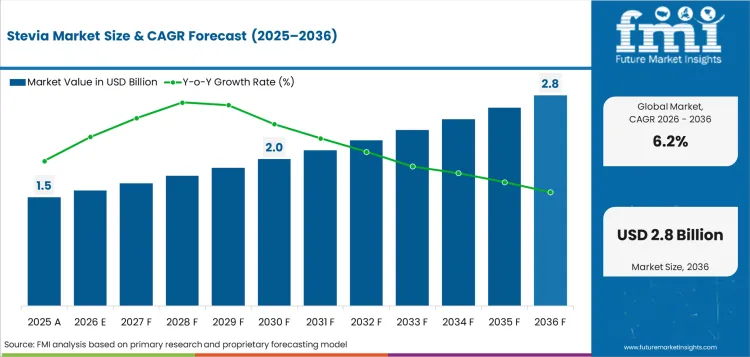
Key Takeaways, Market Size, and Forecast
| Metric | Value |
|---|---|
| Market Size (2025) | USD 1.47 Billion |
| Market Size (2026) | USD 1.56 Billion |
| Market Size (2036) | USD 2.85 Billion |
| CAGR (2026–2036) | 6.2% |
| Incremental Opportunity (2026–2036) | USD 1.29 Billion |
| Leading Product Type (2026) | Conventional |
| Conventional Share (2026) | 64.8% |
| Fastest-Growing Country | China |
| China CAGR | 8% |
| 2nd Fastest-Growing Country | India |
| India CAGR | 7.4% |
Stevia Market Definition
The stevia market encompasses products and solutions categorized by product type, form, application, end use, distribution channel, processing technology, and region. The market covers commercially traded products across established and emerging applications, serving end users through direct supply, distribution networks, and specialized channels. Revenue sizing reflects transaction-level data from 2026 to 2036 across more than 30 countries.
Stevia Market Inclusions
Market scope encompasses all commercially traded products categorized by product type (Conventional, Unconventional); by form (Powder Extract, Liquid, Leaf); by application (Food and Beverages, Pharmaceuticals, Cosmetics and Personal Care, Nutraceuticals); by end use (B2B Manufacturers, Retail Consumers); by distribution channel (Direct Sales, Retail Distribution, Online Channels); by processing technology (Conventional Extraction, Advanced Extraction). The range of revenue sizes is from 2026 to 2036.
Stevia Market Exclusions
The scope does not include raw materials sold without processing or formulation, professional-grade products sold exclusively through medical channels, or products classified under separate regulatory categories not aligned with the defined market taxonomy.
Stevia Market Research Methodology
- Primary Research: FMI analysts conducted structured interviews with manufacturers, distributors, procurement specialists, and end users across key markets to validate demand patterns and competitive positioning.
- Desk Research: Combined data from industry associations, regulatory filings, trade publications, and manufacturer disclosures to establish baseline market metrics.
- Market Sizing and Forecasting: Built through a hybrid bottom-up and top-down methodology starting with verified transaction data, projecting adoption velocity across segments and regions.
- Data Validation: Cross-checked quarterly against global production data, trade statistics, and manufacturer disclosures to ensure consistency.
Why is the Stevia Market Growing?
- Shifting consumer expectations toward validated product performance and regulatory compliance are reshaping procurement and distribution patterns across key markets.
- China leads growth at 8%, supported by expanding retail infrastructure and rising consumer spending on quality-validated products.
The stevia market is growing due to increasing consumer awareness of product quality and safety of ingredients in organized retail and e-commerce channels. Regulatory frameworks around product claims and ingredient disclosures are tightening in North America, Europe and parts of Asia, consolidating demand towards manufacturers that can demonstrate compliance and traceability. Distribution networks in high growth economies are maturing, allowing for greater geographic penetration and more predictable replenishment cycles for branded and private label products.
Pricing dynamics are divided between economy and premium segments, with growth increasingly focused on segments where consumers perceive measurable performance differentiation. In the retail and distributor environment, sourcing decisions are leaning toward suppliers who can demonstrate documentation, batch consistency and regulatory compliance along with competitive pricing. This structural change is limiting the room for undifferentiated supply and increasing the commercial threshold for market entry.
Market Segmentation Analysis
- Conventional leads the product type segment at 64.8%, reflecting established demand patterns and scale advantages in primary applications.
- The Powder Extract segment holds 41.5% share of the form segment due to wide applicability and cost effective performance characteristics.
- Food and Beverages holds 38.7% of application demand, indicating concentrated adoption in standardized commercial formats.
The stevia market is segmented by product type, form, application, end use, distribution channel, processing technology, and region. Each segment reflects distinct procurement patterns, application requirements, and competitive dynamics that shape demand allocation across the forecast period.
Insights into the Conventional Product Type Segment
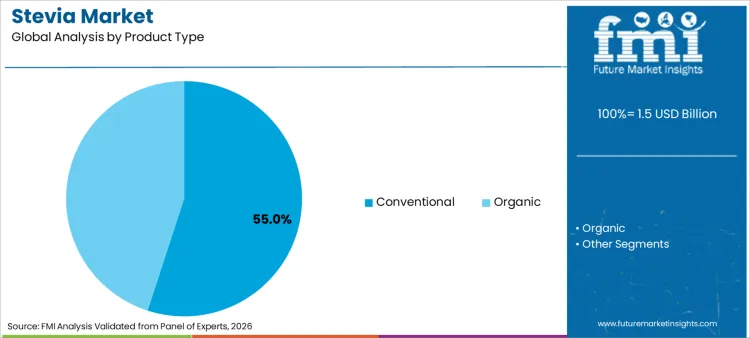
Conventional is expected to dominate the product type segment with 64.8% in 2026. Demand is integrated into established procurement channels, foreseeable price structures that enable sustained procurement volumes and structured supply agreements. The segment has legacy infrastructure with proven performance track record that lowers buyer switching costs.
This segment is expected to see steady growth through 2036 as the end-users are looking for proven solutions that deliver consistent results across production cycles. In areas where compliance requirements are tightening, procurement decisions are increasingly favoring suppliers who can provide scale and documentation capability.
Insights into the Powder Extract Form Segment
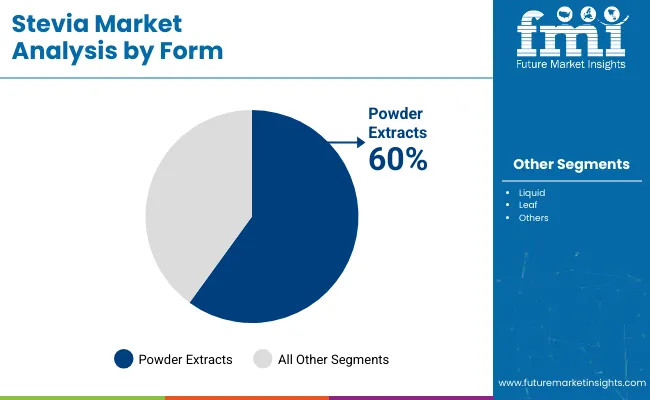
Powder Extract will represent 41.5% of the form segment in 2026. Adoption is a function of how suitable the category is for high-throughput operations, relative to alternatives, and its cost-performance profile. In this segment, buyers usually make decisions based on processing efficiency, maintenance requirements, and long-term supply assurance.
The segment is expected to maintain its position over the forecast period as industrial operations scale and standardize procurement around validated solutions. Regional growth is focused on markets where infrastructure investment and regulatory modernization are expanding the addressable application base.
Stevia Market Drivers, Restraints, and Opportunities
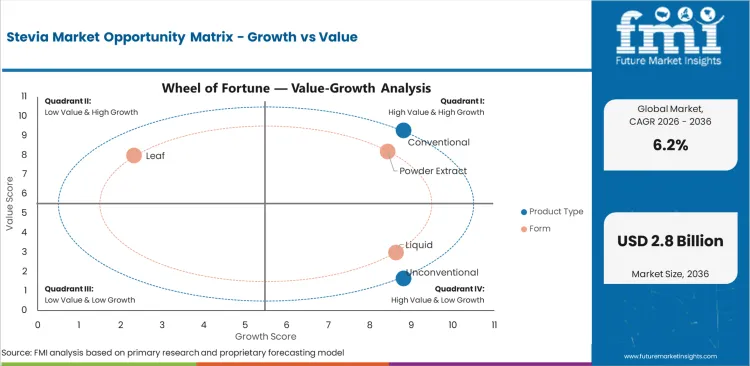
- Consumer demand for performance validated products with documented ingredient safety is reshaping procurement towards compliant suppliers.
- Price sensitivity in economy segments and fragmented distribution in emerging markets are hampering margin expansion for mid-tier manufacturers.
- E-commerce penetration, and direct-to-consumer channels, are opening new routes to market, reducing reliance on traditional retail gatekeepers.
The Stevia market is evolving continuously as the demand side requirements are changing across core applications. Regulatory alignment, end-use diversification and procurement consolidation toward suppliers who can deliver consistent quality and compliance documentation support structural growth. There are still constraints around cost pressures, infrastructure gaps in emerging markets and qualification timelines that slow the adoption of new products.
Ingredient Safety and Regulatory Compliance
With increasing regulations around product claims, ingredient transparency and safety documentation, there is a consolidation of demand towards manufacturers with proven compliance infrastructure.” Emerging markets in Asia are following suit with similar frameworks that raise the bar commercially for market participation, with Europe and North America leading the way.
Distribution Channel Evolution
The growth of e-commerce and direct-to-consumer models are changing the economics of distribution, reducing dependence on traditional retail and allowing smaller brands to compete on visibility and consumer engagement. At the same time that organized retail chains are developing a dual-track distribution structure, they are also raising the bar for suppliers.
Consumer Premiumization and Value Segmentation
Demand is bifurcating into economy and premium tiers, with growth focused on segments where consumers perceive measurable performance differentiation. Efficacy demonstrated through clinical or consumer testing is now driving price premiums and margin compression is occurring on undifferentiated products.
Analysis of Stevia Market by Key Countries
.webp "Top Country Growth Comparison Stevia Market Cagr (2026 2036)")
| Country | CAGR |
|---|---|
| China | 8% |
| India | 7.4% |
| Germany | 6.8% |
| Brazil | 6.2% |
| USA | 5.6% |
| UK | 5% |
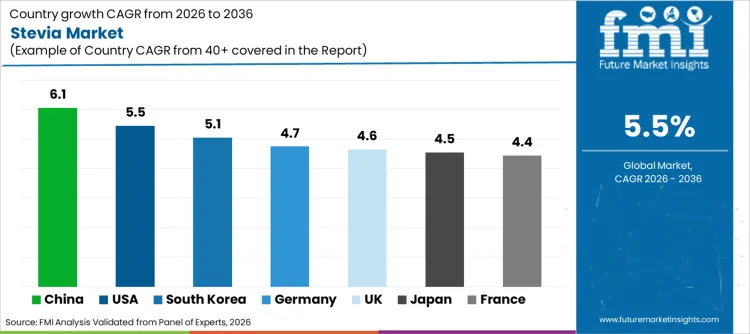
- China to grow at 8% CAGR led by strong industrial capacity and policy-backed demand expansion through 2036.
- India at 7.4% indicates sustained demand driven by production modernization and increasing end-use applications.
- Germany (6.8%) and Brazil (6.2%) remain on growth trajectory supported by regulatory compliance and infrastructure investment cycles.
The global stevia market is projected to grow at a CAGR of 6.2% between 2026 and 2036. The study includes more than 30 countries. The major markets are listed below.
Demand Outlook for Stevia Market in China
Forecast to grow at a CAGR of 8.0% through 2036. China is the top producer of stevia leaf and stevia extract in the world. The processing capacity of stevia extract is mainly concentrated in Shandong and Jiangxi provinces. As a result, domestic demand is rising as major beverage companies reformulate lines of sugar-reduced products to meet the Healthy China 2030 initiative on reduced sugar intake.
- China is the main upstream supplier. Shandong and Jiangxi processing clusters supply more than 80% of global stevia extract.
- Reformulation of domestic beverage and dairy product lines with stevia-based sweetener systems to help meet Healthy China 2030 sugar reduction targets.
- Expansion of Reb M and Reb D high purity steviol glycosides production to meet premium applications requiring taste profile improvement.
Future Outlook for Stevia Market in India
India is expected to grow at a CAGR of 7.4% till 2036. Structured demand growth is created by FSSAI approval of stevia in food and beverages and rising diabetes prevalence among the urban population. Maharashtra, Karnataka and Madhya Pradesh have started domestic stevia cultivation to develop local leaf supply capability to supplement imported extract.
- FSSAI regulatory approval of stevia as a food additive is enabling broad application coverage across packaged food and beverage categories
- Diabetes prevalence impacting over 100 million Indians is creating a consumer demand for sugar free and reduced calorie food products.
- Local leaf supply is being developed through home-grown programs in Maharashtra and Karnataka to reduce dependence on imported Chinese extract.
Opportunity Analysis of Stevia Market in Germany
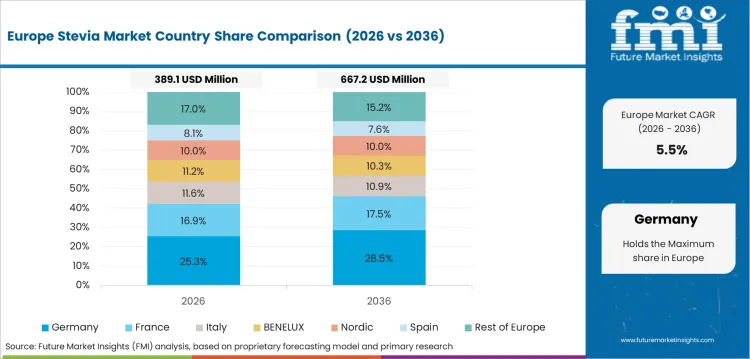
Germany is projected to grow at 6.8% CAGR through 2036. EU novel food regulation approval of steviol glycosides and German consumer preference for natural-origin ingredients are supporting adoption across beverage, dairy, and confectionery reformulation. German food manufacturers are using stevia in combination with other sweeteners to optimize taste profiles in sugar-reduced products.
- EU-approved steviol glycoside usage levels enable reformulation across beverages, dairy, confectionery, and tabletop sweetener categories.
- German consumer preference for natural-origin ingredients gives stevia a positioning advantage over synthetic high-intensity sweeteners.
- Combination sweetener systems using stevia with erythritol or monk fruit are improving taste profiles and expanding application range.
In-depth Analysis of Stevia Market in Brazil
Brazil’s CAGR is forecast to reach 6.2% through 2036. The approval by ANVISA and Brazil’s status as a large sugar producer make for an interesting market dynamic, with stevia competing with low-cost sucrose but also targeting the growing diabetic and health-conscious consumer segment. In the state of Parana, domestic production is being tested in local cultivation trials.
- ANVISA approved Stevia for application in a variety of food and beverage categories, providing for substantial reformulation domestically.
- Sugar-free product alternatives are in demand, driven by a rising diabetic population and health-conscious urban consumers.
- Commercial viability of domestic production of stevia leaf tested in local cultivation trials in Parana and Mato Grosso do Sul.
Sales Analysis of Stevia Market in USA
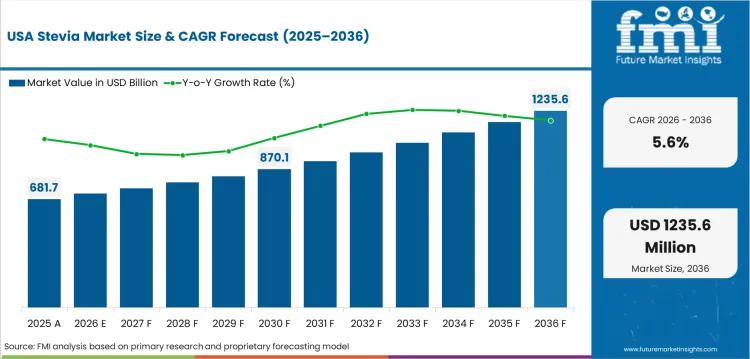
USA is projected to grow at 5.6% CAGR through 2036. The US is a mature stevia market where growth is driven by expanding application coverage beyond beverages into dairy, bakery, and sauces, combined with next-generation Reb M products that deliver improved taste profiles enabling broader reformulation.
- Coca-Cola, PepsiCo, and Keurig Dr Pepper stevia-sweetened product lines sustain high-volume extract procurement.
- Next-generation Reb M and Reb D products with improved taste profiles are expanding reformulation beyond beverages into dairy and bakery.
- FDA GRAS notifications for new steviol glycoside preparations continue to expand the approved application landscape.
Growth Analysis of Stevia Market in UK
UK to grow at 5.0% CAGR through 2036. The UK Soft Drinks Industry Levy has been a structural demand driver for stevia adoption in beverages, and reformulation is now spreading into confectionery and dairy categories. Brand positioning is supported by higher consumer acceptance of stevia as a natural sweetener than synthetic alternatives.
- Soft Drinks Industry Levy continues to inspire reformulation with stevia-based sweetener systems across carbonated and still beverage categories.
- Consumer perception that stevia is a natural-origin sweetener gives it a marketing advantage over aspartame and sucralose in clean-label products.
- Expansion of retail category penetration of own-label product reformulation with stevia by Tesco, Sainsbury's and Marks & Spencer.
Competitive Landscape and Strategic Positioning
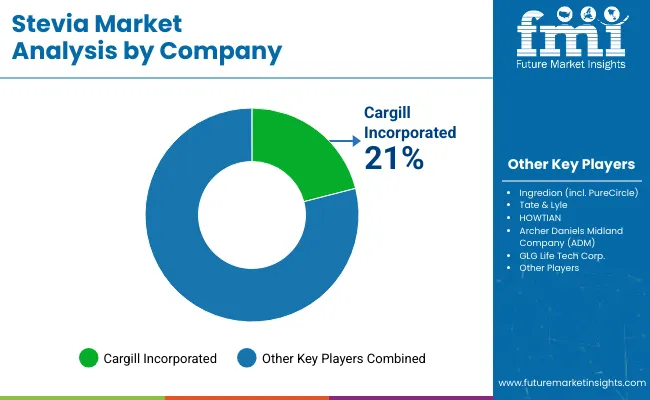
- Cargill, Incorporated is a leader in scale of production, geographic presence and relationships with key end users in major markets.
- Ingredion (including PureCircle), Tate & Lyle and HOWTIAN compete on product breadth, technical capability and regional distribution strength.
- Emerging players are gaining momentum in specialized applications, where technical differentiation and focus on niche markets provide competitive advantages.
The competitive landscape of the stevia market is defined by production scale, technical capability, geographic coverage, and depth of regulatory compliance. Market leadership is recognized by the capacity for consistent quality delivery across multi-region operations, while still being cost competitive and reliable in supply.
Buyers are consolidating their procurement to fewer, larger suppliers who can meet increasing documentation, traceability and performance validation requirements. Competition is intensifying. Cost optimization, capacity expansion in high-growth regions and investments in application-specific solutions to meet evolving end-user requirements are among strategic priorities for market participants.
Barriers to Entry Capital intensive manufacturing infrastructure Regulatory certification requirements Existing customer relationships Validated performance records across target applications. These structural advantages benefit incumbent players, while providing opportunities for technically differentiated entrants in specialized market segments.
Key Companies in the Stevia Market
Key global companies leading the stevia market include:
- Cargill, Incorporated, Ingredion (including PureCircle), Tate & Lyle and HOWTIAN maintain global leadership positions enabled by production scale, broad product portfolios and well-established end-user relationships in multiple regions.
- Archer Daniels Midland Company (ADM), Jianlong Biotechnology Co., Ltd and Morita Kagaku Kogyo Co., Ltd compete through regional supply, formulation support and application-specific portfolios.
- Jianlong Biotechnology Co., Ltd and Morita Kagaku Kogyo Co., Ltd are regional competitors with niche application expertise and manufacturing advantages.
Competitive Benchmarking: Stevia Market
| Company | Brand Portfolio | Distribution Reach | R&D Investment | Geographic Coverage |
|---|---|---|---|---|
| Cargill, Incorporated | High | High | High | Global |
| Ingredion (incl. PureCircle) | High | High | High | Global |
| Tate & Lyle | High | High | High | Global |
| HOWTIAN | Medium | High | Medium | Regional |
| Archer Daniels Midland Company (ADM) | Medium | Medium | Medium | Regional |
| Jianlong Biotechnology Co., Ltd | Medium | Medium | Low | Focused |
| Morita Kagaku Kogyo Co., Ltd | Medium | Medium | Low | Focused |
Source: Future Market Insights competitive analysis, 2026.
Key Developments in Stevia Market
- In 2025, Cargill, Incorporated continued to expand the use of its EverSweet® fermentation-based stevia platform to deliver sugar-reduction solutions with better taste performance and sustainable production capabilities.
- Ingredion furthered its PureCircle™ stevia business in 2025 with sustainability initiatives and advanced clean-label sweetener solutions for food and beverage manufacturers.
- ADM continued to enhance its SweetRight® stevia portfolio in 2025 with improved taste and sugar-reduction functionality for beverage and food applications..
Key Players in the Stevia Market
Major Global Players
- Cargill, Incorporated
- Ingredion (incl. PureCircle)
- Tate & Lyle
- HOWTIAN
- Archer Daniels Midland Company (ADM)
Emerging Players/Startups
- Jianlong Biotechnology Co., Ltd
- Morita Kagaku Kogyo Co., Ltd
Report Scope and Coverage
| Parameter | Details |
|---|---|
| Quantitative Units | USD 1.56 Billion to USD 2.85 Billion, at a CAGR of 6.2% |
| Market Definition | The stevia market encompasses products and solutions across established and emerging applications categorized by product type, form, application, end use, distribution channel, processing technology, and region. |
| Regions Covered | North America, Latin America, Europe, East Asia, South Asia and Pacific, Middle East and Africa |
| Countries Covered | China, India, Germany, Brazil, USA, UK, Japan, 30 plus countries |
| Key Companies Profiled | Cargill, Incorporated, Ingredion (incl. PureCircle), Tate & Lyle, HOWTIAN, Archer Daniels Midland Company (ADM), Jianlong Biotechnology Co., Ltd, Morita Kagaku Kogyo Co., Ltd |
| Forecast Period | 2026 to 2036 |
| Approach | Hybrid bottom-up and top-down methodology starting with verified transaction data, projecting adoption velocity across segments and regions. |
Segmentation
Stevia Market Segmented by Product Type:
- Conventional
- Standard Herbal Extracts
- Bulk Commercial Extracts
- Unconventional
- Organic Extracts
- Wild Harvested Extracts
Stevia Market Segmented by Form:
- Powder Extract
- Spray Dried Powder
- Freeze Dried Powder
- Liquid
- Tinctures
- Fluid Extracts
- Leaf
- Whole Leaf
- Cut and Sifted Leaf
Stevia Market Segmented by Application:
- Food and Beverages
- Functional Drinks
- Herbal Teas
- Pharmaceuticals
- Traditional Medicine
- Modern Herbal Drugs
- Cosmetics and Personal Care
- Skin Care
- Hair Care
- Nutraceuticals
- Dietary Supplements
Stevia Market Segmented by End Use:
- B2B Manufacturers
- Food Processing Companies
- Pharmaceutical Companies
- Retail Consumers
- Direct Consumption
- Home Remedies
Stevia Market Segmented by Distribution Channel:
- Direct Sales
- Bulk Supply Agreements
- Contract Manufacturing Supply
- Retail Distribution
- Pharmacies
- Specialty Stores
- Online Channels
- E-Commerce Platforms
Stevia Market Segmented by Processing Technology:
- Conventional Extraction
- Solvent Extraction
- Steam Distillation
- Advanced Extraction
- Supercritical Fluid Extraction
- Ultrasound Assisted Extraction
Stevia Market by Region:
- North America
- USA
- Canada
- Mexico
- Latin America
- Brazil
- Chile
- Rest of Latin America
- Western Europe
- Germany
- UK
- Italy
- Spain
- France
- Nordic
- BENELUX
- Rest of Western Europe
- Eastern Europe
- Russia
- Poland
- Hungary
- Balkan & Baltic
- Rest of Eastern Europe
- East Asia
- China
- Japan
- South Korea
- South Asia and Pacific
- India
- ASEAN
- Australia & New Zealand
- Rest of South Asia and Pacific
- Middle East & Africa
- Kingdom of Saudi Arabia
- Other GCC Countries
- Turkiye
- South Africa
- Other African Union
- Rest of Middle East & Africa
Research Sources and Bibliography
- U.S. Food and Drug Administration. (2025). Aspartame and Other Sweeteners in Food. FDA.
- European Commission. (2021). Commission Regulation (EU) 2021/1156 on specifications for steviol glycosides (E 960). Official Journal of the European Union.
- Food Safety and Standards Authority of India. (2024). Food Safety and Standards: Chapter 3, Substances Added to Food, steviol glycoside specifications. FSSAI.
- FAO/WHO Joint Expert Committee on Food Additives. (2008). Steviol glycosides specifications. FAO.
- Food Standards Australia New Zealand. (2025). Steviol glycosides (960), intense sweetener. FSANZ.
This bibliography is provided for reader reference.
This Report Answers
- Estimating the size of the stevia market and revenue projections from 2026 to 2036.
- Segmentation analysis by product type, form, application, end use, distribution channel, processing technology, and region.
- Regional and country-level insights across more than 30 markets.
- Technology and application trend analysis across core end-use categories.
- Competitive landscape assessment and company positioning.
- Investment opportunity identification across high-growth segments and regions.
- Supply chain and distribution channel analysis.
- Delivery of data in PDF and Excel formats.
Frequently Asked Questions
What is the global market demand for Stevia Market in 2026?
In 2026, the global stevia market is expected to be worth USD 1.56 billion.
How big will the Stevia Market be in 2036?
By 2036, the stevia market is expected to be worth USD 2.85 billion.
How much is demand for Stevia Market expected to grow between 2026 and 2036?
Between 2026 and 2036, the demand for stevia market is expected to grow at a CAGR of 6.2%.
Which segment is likely to lead globally by 2026?
Conventional is expected to account for 64.8% of the product type segment in 2026, reflecting its dominant position in primary end-use applications.
What is causing demand to rise in China?
China is expected to grow at 8% CAGR through 2036, supported by industrial capacity expansion, regulatory modernization, and increasing adoption across core applications.
What is causing demand to rise in India?
India is expected to grow at 7.4% CAGR through 2036, reflecting sustained investment in production capacity and expanding end-use demand.
What does this report mean by 'Stevia Market definition'?
The stevia market encompasses commercially traded products and solutions categorized by product type, form, application, end use, distribution channel, processing technology, and region, serving end users across established and emerging applications.
How does FMI make the Stevia Market forecast and validate it?
Forecasting models use a hybrid bottom-up and top-down approach, starting with verified transaction data and cross-checking against global production statistics, trade data, and manufacturer disclosures.
Preview the report firsthand - request a free sample
Get SampleGet the brochure for pricing and purchase details.
Get PDFTable of Content
- Executive Summary
- Global Market Outlook
- Demand-side Trends
- Supply-side Trends
- Technology Roadmap Analysis
- Analysis and Recommendations
- Market Overview
- Market Coverage / Taxonomy
- Market Definition / Scope / Limitations
- Research Methodology
- Chapter Orientation
- Analytical Lens and Working Hypotheses
- Market Structure, Signals, and Trend Drivers
- Benchmarking and Cross-market Comparability
- Market Sizing, Forecasting, and Opportunity Mapping
- Research Design and Evidence Framework
- Desk Research Programme (Secondary Evidence)
- Company Annual and Sustainability Reports
- Peer-reviewed Journals and Academic Literature
- Corporate Websites, Product Literature, and Technical Notes
- Earnings Decks and Investor Briefings
- Statutory Filings and Regulatory Disclosures
- Technical White Papers and Standards Notes
- Trade Journals, Industry Magazines, and Analyst Briefs
- Conference Proceedings, Webinars, and Seminar Materials
- Government Statistics Portals and Public Data Releases
- Press Releases and Reputable Media Coverage
- Specialist Newsletters and Curated Briefings
- Sector Databases and Reference Repositories
- FMI Internal Proprietary Databases and Historical Market Datasets
- Subscription Datasets and Paid Sources
- Social Channels, Communities, and Digital Listening Inputs
- Additional Desk Sources
- Expert Input and Fieldwork (Primary Evidence)
- Primary Modes
- Qualitative Interviews and Expert Elicitation
- Quantitative Surveys and Structured Data Capture
- Blended Approach
- Why Primary Evidence is Used
- Field Techniques
- Interviews
- Surveys
- Focus Groups
- Observational and In-context Research
- Social and Community Interactions
- Stakeholder Universe Engaged
- C-suite Leaders
- Board Members
- Presidents and Vice Presidents
- R&D and Innovation Heads
- Technical Specialists
- Domain Subject-matter Experts
- Scientists
- Physicians and Other Healthcare Professionals
- Governance, Ethics, and Data Stewardship
- Research Ethics
- Data Integrity and Handling
- Primary Modes
- Tooling, Models, and Reference Databases
- Desk Research Programme (Secondary Evidence)
- Data Engineering and Model Build
- Data Acquisition and Ingestion
- Cleaning, Normalisation, and Verification
- Synthesis, Triangulation, and Analysis
- Quality Assurance and Audit Trail
- Market Background
- Market Dynamics
- Drivers
- Restraints
- Opportunity
- Trends
- Scenario Forecast
- Demand in Optimistic Scenario
- Demand in Likely Scenario
- Demand in Conservative Scenario
- Opportunity Map Analysis
- Product Life Cycle Analysis
- Supply Chain Analysis
- Investment Feasibility Matrix
- Value Chain Analysis
- PESTLE and Porter’s Analysis
- Regulatory Landscape
- Regional Parent Market Outlook
- Production and Consumption Statistics
- Import and Export Statistics
- Market Dynamics
- Global Market Analysis 2021 to 2025 and Forecast, 2026 to 2036
- Historical Market Size Value (USD Million) Analysis, 2021 to 2025
- Current and Future Market Size Value (USD Million) Projections, 2026 to 2036
- Y-o-Y Growth Trend Analysis
- Absolute $ Opportunity Analysis
- Global Market Pricing Analysis 2021 to 2025 and Forecast 2026 to 2036
- Global Market Analysis 2021 to 2025 and Forecast 2026 to 2036, By Product Type
- Introduction / Key Findings
- Historical Market Size Value (USD Million) Analysis By Product Type, 2021 to 2025
- Current and Future Market Size Value (USD Million) Analysis and Forecast By Product Type, 2026 to 2036
- Conventional
- Standard Herbal Extracts
- Bulk Commercial Extracts
- Unconventional
- Organic Extracts
- Wild Harvested Extracts
- Conventional
- Y-o-Y Growth Trend Analysis By Product Type, 2021 to 2025
- Absolute $ Opportunity Analysis By Product Type, 2026 to 2036
- Global Market Analysis 2021 to 2025 and Forecast 2026 to 2036, By Form
- Introduction / Key Findings
- Historical Market Size Value (USD Million) Analysis By Form, 2021 to 2025
- Current and Future Market Size Value (USD Million) Analysis and Forecast By Form, 2026 to 2036
- Powder Extract
- Spray Dried Powder
- Freeze Dried Powder
- Liquid
- Tinctures
- Fluid Extracts
- Leaf
- Whole Leaf
- Cut and Sifted Leaf
- Powder Extract
- Y-o-Y Growth Trend Analysis By Form, 2021 to 2025
- Absolute $ Opportunity Analysis By Form, 2026 to 2036
- Global Market Analysis 2021 to 2025 and Forecast 2026 to 2036, By Application
- Introduction / Key Findings
- Historical Market Size Value (USD Million) Analysis By Application, 2021 to 2025
- Current and Future Market Size Value (USD Million) Analysis and Forecast By Application, 2026 to 2036
- Food and Beverages
- Functional Drinks
- Herbal Teas
- Pharmaceuticals
- Traditional Medicine
- Modern Herbal Drugs
- Cosmetics and Personal Care
- Skin Care
- Hair Care
- Nutraceuticals
- Dietary Supplements
- Food and Beverages
- Y-o-Y Growth Trend Analysis By Application, 2021 to 2025
- Absolute $ Opportunity Analysis By Application, 2026 to 2036
- Global Market Analysis 2021 to 2025 and Forecast 2026 to 2036, By End Use
- Introduction / Key Findings
- Historical Market Size Value (USD Million) Analysis By End Use, 2021 to 2025
- Current and Future Market Size Value (USD Million) Analysis and Forecast By End Use, 2026 to 2036
- B2B Manufacturers
- Food Processing Companies
- Pharmaceutical Companies
- Retail Consumers
- Direct Consumption
- Home Remedies
- B2B Manufacturers
- Y-o-Y Growth Trend Analysis By End Use, 2021 to 2025
- Absolute $ Opportunity Analysis By End Use, 2026 to 2036
- Global Market Analysis 2021 to 2025 and Forecast 2026 to 2036, By Distribution Channel
- Introduction / Key Findings
- Historical Market Size Value (USD Million) Analysis By Distribution Channel, 2021 to 2025
- Current and Future Market Size Value (USD Million) Analysis and Forecast By Distribution Channel, 2026 to 2036
- Direct Sales
- Bulk Supply Agreements
- Contract Manufacturing Supply
- Retail Distribution
- Pharmacies
- Specialty Stores
- Online Channels
- E-Commerce Platforms
- Direct Sales
- Y-o-Y Growth Trend Analysis By Distribution Channel, 2021 to 2025
- Absolute $ Opportunity Analysis By Distribution Channel, 2026 to 2036
- Global Market Analysis 2021 to 2025 and Forecast 2026 to 2036, By Processing Technology
- Introduction / Key Findings
- Historical Market Size Value (USD Million) Analysis By Processing Technology, 2021 to 2025
- Current and Future Market Size Value (USD Million) Analysis and Forecast By Processing Technology, 2026 to 2036
- Conventional Extraction
- Solvent Extraction
- Steam Distillation
- Advanced Extraction
- Supercritical Fluid Extraction
- Ultrasound Assisted Extraction
- Conventional Extraction
- Y-o-Y Growth Trend Analysis By Processing Technology, 2021 to 2025
- Absolute $ Opportunity Analysis By Processing Technology, 2026 to 2036
- Global Market Analysis 2021 to 2025 and Forecast 2026 to 2036, By Region
- Introduction
- Historical Market Size Value (USD Million) Analysis By Region, 2021 to 2025
- Current Market Size Value (USD Million) Analysis and Forecast By Region, 2026 to 2036
- North America
- Latin America
- Western Europe
- Eastern Europe
- East Asia
- South Asia and Pacific
- Middle East & Africa
- Market Attractiveness Analysis By Region
- North America Market Analysis 2021 to 2025 and Forecast 2026 to 2036, By Country
- Historical Market Size Value (USD Million) Trend Analysis By Market Taxonomy, 2021 to 2025
- Market Size Value (USD Million) Forecast By Market Taxonomy, 2026 to 2036
- By Country
- USA
- Canada
- Mexico
- By Product Type
- By Form
- By Application
- By End Use
- By Distribution Channel
- By Processing Technology
- By Country
- Market Attractiveness Analysis
- By Country
- By Product Type
- By Form
- By Application
- By End Use
- By Distribution Channel
- By Processing Technology
- Key Takeaways
- Latin America Market Analysis 2021 to 2025 and Forecast 2026 to 2036, By Country
- Historical Market Size Value (USD Million) Trend Analysis By Market Taxonomy, 2021 to 2025
- Market Size Value (USD Million) Forecast By Market Taxonomy, 2026 to 2036
- By Country
- Brazil
- Chile
- Rest of Latin America
- By Product Type
- By Form
- By Application
- By End Use
- By Distribution Channel
- By Processing Technology
- By Country
- Market Attractiveness Analysis
- By Country
- By Product Type
- By Form
- By Application
- By End Use
- By Distribution Channel
- By Processing Technology
- Key Takeaways
- Western Europe Market Analysis 2021 to 2025 and Forecast 2026 to 2036, By Country
- Historical Market Size Value (USD Million) Trend Analysis By Market Taxonomy, 2021 to 2025
- Market Size Value (USD Million) Forecast By Market Taxonomy, 2026 to 2036
- By Country
- Germany
- UK
- Italy
- Spain
- France
- Nordic
- BENELUX
- Rest of Western Europe
- By Product Type
- By Form
- By Application
- By End Use
- By Distribution Channel
- By Processing Technology
- By Country
- Market Attractiveness Analysis
- By Country
- By Product Type
- By Form
- By Application
- By End Use
- By Distribution Channel
- By Processing Technology
- Key Takeaways
- Eastern Europe Market Analysis 2021 to 2025 and Forecast 2026 to 2036, By Country
- Historical Market Size Value (USD Million) Trend Analysis By Market Taxonomy, 2021 to 2025
- Market Size Value (USD Million) Forecast By Market Taxonomy, 2026 to 2036
- By Country
- Russia
- Poland
- Hungary
- Balkan & Baltic
- Rest of Eastern Europe
- By Product Type
- By Form
- By Application
- By End Use
- By Distribution Channel
- By Processing Technology
- By Country
- Market Attractiveness Analysis
- By Country
- By Product Type
- By Form
- By Application
- By End Use
- By Distribution Channel
- By Processing Technology
- Key Takeaways
- East Asia Market Analysis 2021 to 2025 and Forecast 2026 to 2036, By Country
- Historical Market Size Value (USD Million) Trend Analysis By Market Taxonomy, 2021 to 2025
- Market Size Value (USD Million) Forecast By Market Taxonomy, 2026 to 2036
- By Country
- China
- Japan
- South Korea
- By Product Type
- By Form
- By Application
- By End Use
- By Distribution Channel
- By Processing Technology
- By Country
- Market Attractiveness Analysis
- By Country
- By Product Type
- By Form
- By Application
- By End Use
- By Distribution Channel
- By Processing Technology
- Key Takeaways
- South Asia and Pacific Market Analysis 2021 to 2025 and Forecast 2026 to 2036, By Country
- Historical Market Size Value (USD Million) Trend Analysis By Market Taxonomy, 2021 to 2025
- Market Size Value (USD Million) Forecast By Market Taxonomy, 2026 to 2036
- By Country
- India
- ASEAN
- Australia & New Zealand
- Rest of South Asia and Pacific
- By Product Type
- By Form
- By Application
- By End Use
- By Distribution Channel
- By Processing Technology
- By Country
- Market Attractiveness Analysis
- By Country
- By Product Type
- By Form
- By Application
- By End Use
- By Distribution Channel
- By Processing Technology
- Key Takeaways
- Middle East & Africa Market Analysis 2021 to 2025 and Forecast 2026 to 2036, By Country
- Historical Market Size Value (USD Million) Trend Analysis By Market Taxonomy, 2021 to 2025
- Market Size Value (USD Million) Forecast By Market Taxonomy, 2026 to 2036
- By Country
- Kingdom of Saudi Arabia
- Other GCC Countries
- Turkiye
- South Africa
- Other African Union
- Rest of Middle East & Africa
- By Product Type
- By Form
- By Application
- By End Use
- By Distribution Channel
- By Processing Technology
- By Country
- Market Attractiveness Analysis
- By Country
- By Product Type
- By Form
- By Application
- By End Use
- By Distribution Channel
- By Processing Technology
- Key Takeaways
- Key Countries Market Analysis
- USA
- Pricing Analysis
- Market Share Analysis, 2025
- By Product Type
- By Form
- By Application
- By End Use
- By Distribution Channel
- By Processing Technology
- Canada
- Pricing Analysis
- Market Share Analysis, 2025
- By Product Type
- By Form
- By Application
- By End Use
- By Distribution Channel
- By Processing Technology
- Mexico
- Pricing Analysis
- Market Share Analysis, 2025
- By Product Type
- By Form
- By Application
- By End Use
- By Distribution Channel
- By Processing Technology
- Brazil
- Pricing Analysis
- Market Share Analysis, 2025
- By Product Type
- By Form
- By Application
- By End Use
- By Distribution Channel
- By Processing Technology
- Chile
- Pricing Analysis
- Market Share Analysis, 2025
- By Product Type
- By Form
- By Application
- By End Use
- By Distribution Channel
- By Processing Technology
- Germany
- Pricing Analysis
- Market Share Analysis, 2025
- By Product Type
- By Form
- By Application
- By End Use
- By Distribution Channel
- By Processing Technology
- UK
- Pricing Analysis
- Market Share Analysis, 2025
- By Product Type
- By Form
- By Application
- By End Use
- By Distribution Channel
- By Processing Technology
- Italy
- Pricing Analysis
- Market Share Analysis, 2025
- By Product Type
- By Form
- By Application
- By End Use
- By Distribution Channel
- By Processing Technology
- Spain
- Pricing Analysis
- Market Share Analysis, 2025
- By Product Type
- By Form
- By Application
- By End Use
- By Distribution Channel
- By Processing Technology
- France
- Pricing Analysis
- Market Share Analysis, 2025
- By Product Type
- By Form
- By Application
- By End Use
- By Distribution Channel
- By Processing Technology
- India
- Pricing Analysis
- Market Share Analysis, 2025
- By Product Type
- By Form
- By Application
- By End Use
- By Distribution Channel
- By Processing Technology
- ASEAN
- Pricing Analysis
- Market Share Analysis, 2025
- By Product Type
- By Form
- By Application
- By End Use
- By Distribution Channel
- By Processing Technology
- Australia & New Zealand
- Pricing Analysis
- Market Share Analysis, 2025
- By Product Type
- By Form
- By Application
- By End Use
- By Distribution Channel
- By Processing Technology
- China
- Pricing Analysis
- Market Share Analysis, 2025
- By Product Type
- By Form
- By Application
- By End Use
- By Distribution Channel
- By Processing Technology
- Japan
- Pricing Analysis
- Market Share Analysis, 2025
- By Product Type
- By Form
- By Application
- By End Use
- By Distribution Channel
- By Processing Technology
- South Korea
- Pricing Analysis
- Market Share Analysis, 2025
- By Product Type
- By Form
- By Application
- By End Use
- By Distribution Channel
- By Processing Technology
- Russia
- Pricing Analysis
- Market Share Analysis, 2025
- By Product Type
- By Form
- By Application
- By End Use
- By Distribution Channel
- By Processing Technology
- Poland
- Pricing Analysis
- Market Share Analysis, 2025
- By Product Type
- By Form
- By Application
- By End Use
- By Distribution Channel
- By Processing Technology
- Hungary
- Pricing Analysis
- Market Share Analysis, 2025
- By Product Type
- By Form
- By Application
- By End Use
- By Distribution Channel
- By Processing Technology
- Kingdom of Saudi Arabia
- Pricing Analysis
- Market Share Analysis, 2025
- By Product Type
- By Form
- By Application
- By End Use
- By Distribution Channel
- By Processing Technology
- Turkiye
- Pricing Analysis
- Market Share Analysis, 2025
- By Product Type
- By Form
- By Application
- By End Use
- By Distribution Channel
- By Processing Technology
- South Africa
- Pricing Analysis
- Market Share Analysis, 2025
- By Product Type
- By Form
- By Application
- By End Use
- By Distribution Channel
- By Processing Technology
- USA
- Market Structure Analysis
- Competition Dashboard
- Competition Benchmarking
- Market Share Analysis of Top Players
- By Regional
- By Product Type
- By Form
- By Application
- By End Use
- By Distribution Channel
- By Processing Technology
- Competition Analysis
- Competition Deep Dive
- Cargill, Incorporated
- Overview
- Product Portfolio
- Profitability by Market Segments (Product Type/Form/Application/Region)
- Sales Footprint
- Strategy Overview
- Marketing Strategy
- Product Strategy
- Channel Strategy
- Ingredion (incl. PureCircle)
- Tate & Lyle
- HOWTIAN
- Archer Daniels Midland Company (ADM)
- Jianlong Biotechnology Co., Ltd
- Morita Kagaku Kogyo Co., Ltd
- Cargill, Incorporated
- Competition Deep Dive
- Assumptions & Acronyms Used


