


- The ambulatory surgical centers market size is valued at USD 110.1 billion in 2026 and is projected to reach USD 171.0 billion by 2036, growing at a CAGR of 4.5% during the forecast period as healthcare systems continue to shift surgical procedures to outpatient settings.
- Purchasing decisions have become more important for ASC operators as they aim to maintain service quality while controlling operating expenses.
- Large ASC networks are assessing whether a single supplier arrangement or a broader supplier base is better suited to their purchasing requirements.
- Working with one supplier can simplify purchasing activities and may provide price advantages through higher order volumes.
- Many centers continue to purchase from multiple vendors when they require access to specialized products or wish to reduce dependence on a single source.
- Contract discussions now extend beyond product pricing. Service support, equipment maintenance, software compatibility, and delivery reliability are receiving greater attention during supplier selection.
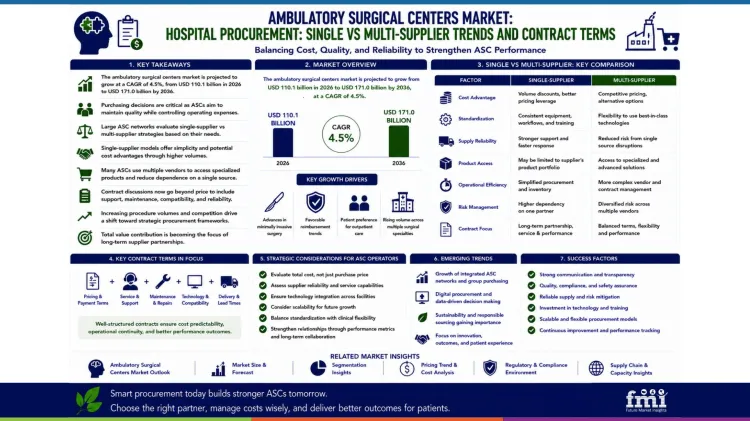
Healthcare providers continue to look for more efficient and cost effective alternatives for inpatient surgical care and the ambulatory surgical centers market continues to grow. The market is expected to grow at a CAGR of 4.5% during the forecast period, from USD 110.1 billion in 2026 to USD 171.0 billion by 2036. Advances in minimally invasive surgery, favorable reimbursement trends for outpatient procedures and growing patient preference for convenient treatment settings are supporting growth.
As the volume of procedures done at ambulatory surgical centers in specialties such as orthopedics, ophthalmology, gastroenterology, cardiovascular care and pain management increases, procurement decisions become more and more critical to operational performance. Device availability, supply reliability, technology compatibility and vendor support now play a key role in determining both clinical outcomes and financial efficiency.
Historically, procurement in many ASCs has been predominantly decentralized. Doctors often selected devices, implants and surgical supplies based on personal preference or longstanding relationships with vendors. As integrated health care networks and multi-site ASC operators grow, more consolidated purchasing approaches are being adopted.
One of the most significant procurement questions facing ASC operators today is whether to partner with one supplier or multiple vendors for key product categories.
There are a number of operational benefits of single-supplier procurement models. ASC operators can combine their buying volumes with one vendor and often can leverage their buying power to negotiate better pricing terms and volume discounts. These cost savings may be especially attractive in an environment of ongoing reimbursement pressures and increased operating costs for facilities.
A big advantage of single supplier arrangements is standardization. Standardization of surgical equipment, implants, imaging technologies and consumables across multiple facilities in a network can facilitate more efficient staff training and unified clinical workflows. Standardized systems can also help with inventory management and reduced administrative complexity.
For high volume ASC operators, consistency across facilities can help improve operational efficiency and support predictable clinical outcomes. Surgeons and clinical staff become familiar with technologies and procedural workflows which leads to reduced variability and improved delivery of care.
Single source contracts tend to be better supported and to receive better service response. Larger partnerships may also include dedicated account management, priority maintenance, equipment financing, and specialized training from vendors. These value added services can help to build long term relationships between suppliers and ASC operators.
But there are operational risks in relying on a single supplier. When alternative sourcing options are limited, supply chain disruptions, manufacturing delays, product recalls, pricing changes or technology limitations can severely impact facility operations.
These risks have come more into focus in recent years with health care providers experiencing supply shortages of surgical instruments, personal protective equipment, implants and other medical consumables. Therefore, many ASC operators still see procurement diversification as an important risk management strategy.
Multi-supplier procurement models allow for more flexibility and the use of specialized technologies. Some vendors are better at orthopedic implants, others at ophthalmic devices, surgical visualization, endoscopy, imaging or disposables. ASCs benefit from relationships with multiple suppliers that allow them to choose technologies best suited to individual clinical needs.
That flexibility is especially helpful as ambulatory surgical centers continue to move into more complex procedures. Facilities are performing more advanced orthopedic surgeries, cardiovascular interventions and minimally invasive procedures that may require specialized equipment from different manufacturers.
The rapid pace of change in medical technology also underpins the case for diversified supplier portfolios. ASC operators are investing in robotic-assisted surgical systems, advanced imaging platforms, artificial intelligence supported workflow tools, digital operating room technologies and next generation minimally invasive surgical equipment. Facilities can more easily assess and adopt new developments when they have the option of multiple vendors.
The contract structures themselves are also evolving to become more sophisticated across the ASC market.
Procurement negotiations now go much further than the simple costs of acquiring product. More and more, healthcare providers are evaluating suppliers on the total value contribution they bring over the entire lifecycle of a contract. Contracts usually involve promises of implementation support, clinician education programs, software upgrades, preventive maintenance services, cybersecurity protections, and equipment replacement.
Digital integration capabilities are becoming more important in procurement evaluations. ASC operators want more technologies that are easy to integrate with electronic health records, scheduling platforms, billing systems, inventory management software and clinical documentation tools. Good integration can increase the efficiency of the workflow and reduce administrative headaches.
Procurement strategies are also being shaped by risk management. The growing volume of procedures and rising expectations of patients make ASC operators increasingly concerned about the reliability of their suppliers. Vendors are typically rated on manufacturing capacity, delivery performance, inventory availability, service response times and business continuity planning capabilities.
Another important factor that affects procurement decisions is the quality assurance requirements. Ambulatory surgical centers have to achieve high levels of patient safety and clinical performance while meeting regulatory and accreditation standards. Suppliers with strong quality documentation, product certifications, performance data and regulatory compliance support are often able to gain an edge in procurement evaluations.
Healthcare providers are focusing on clinical performance metrics and outcome-based decision making is gaining traction. Procurement teams are asking for more proof that products and technology improve patient outcomes, drive efficiency, reduce complication rates and increase patient satisfaction.
Specialty segment also changes procurement priorities. Orthopedic ASCs are typically driven by implant performance, instrument availability and surgeon preference. Eye care centers may also be concerned with imaging systems, surgical precision technology & equipment reliability. Gastroenterology and pain management facilities often emphasize throughput of procedures, uptime of equipment and consistency of consumable supply.
Procurement trends are also being impacted by the emergence of large ASC management organizations. Because of their size and volume of purchases, these organizations have more negotiating power. They usually have preferred supplier programs and standardized purchasing platforms that influence purchasing across multiple facilities.
The geographic scope of expansion adds another layer of complexity in sourcing decisions. ASC operators in multiple states face challenges of operational uniformity and dissimilar regulatory requirements, reimbursement schemes and supplier networks. Increasingly, procurement leaders are weighing the efficiencies of centralized purchasing against local market considerations.
The notion that price is the sole determinant of who wins procurement business is fast becoming a thing of the past. Cost management is still important, but ASC operators look at suppliers on a number of dimensions, clinical performance, technological advancements, operational reliability, service quality, scalability, digital compatibility and long-term partnership potential.
As the ambulatory surgical centers market matures, procurement sophistication is expected to increase substantially. Strategic sourcing decisions will be more and more important in determining operational efficiency, clinical quality, financial results and competitive position.
Bottom Line
Procurement strategies are increasingly a key differentiator in the ambulatory surgical centers market. Single-supplier partnerships bring standardization benefits, administrative simplicity and purchasing efficiencies. But multi-supplier models offer flexibility, access to new ideas, and supply chain resilience. The ASC operators most likely to succeed will be those that combine procurement frameworks with long-term growth strategies, clinical quality goals and changing needs in healthcare delivery, while balancing cost control with operational reliability.

