


- Probiotic ingredients must be selected by application, not by generic strain popularity or headline CFU count.
- Dietary supplements remain the leading application in FMI’s Probiotic Ingredients Market, but dairy, beverages, functional foods, gummies, and animal nutrition require different survival logic.
- Application fit depends on pH tolerance, heat exposure, water activity, oxygen sensitivity, packaging, storage condition, and target benefit.
- Lactobacillus leadership reflects broad use, but Bifidobacterium, Bacillus, yeast-based, and multistrain systems can be better suited for specific formats.
- Suppliers with application labs and stability data can guide customers toward viable formulas rather than one-size-fits-all probiotic positioning.
- The misconception to avoid is that a strong probiotic strain works everywhere. In reality, the best ingredient is the one that survives the chosen product system and supports the intended benefit.
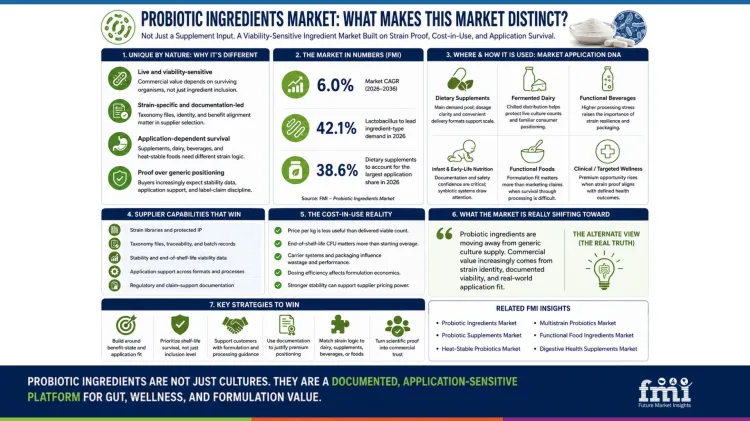
Probiotic ingredient selection is often reduced to strain name and CFU count. That approach is too narrow. The real formulation question is whether the ingredient survives the specific product system and supports the intended benefit. A capsule, yogurt, acidic beverage, gummy, sachet, baked product, or animal feed application each creates a different stress environment. This makes application survival architecture a critical angle for the Probiotic Ingredients Market.
FMI’s Probiotic Ingredients Market identifies dietary supplements as the leading application, which is logical because supplements allow more controlled delivery formats. Capsules, tablets, powders, sachets, and stick packs can be designed around moisture control, packaging barriers, desiccants, and defined serving sizes. Still, even within supplements, strain logic varies. A daily digestive capsule, a baby probiotic sachet, a women’s health blend, and a sports nutrition gut-health powder do not need the same strain system.
The first design step is defining the benefit state. Digestive comfort, immune support, antibiotic-associated balance, women’s health, metabolic support, baby care, oral health, and animal nutrition each require different evidence and strain selection. A supplier cannot assume that one popular Lactobacillus strain is appropriate for every benefit. The Probiotic Strains Market reinforces this point because probiotic value is strain-specific. The benefit must be linked to the strain or strain combination, not only the genus.
The second design step is understanding the matrix. In a capsule or sachet, the matrix may be relatively dry, but excipients can still affect viability. In gummies, water activity, sugars, acids, gelatin or pectin systems, and processing temperature can reduce survival. In functional beverages, acidity, oxygen, preservatives, and shelf-life expectations are critical. In dairy, the probiotic may need to coexist with fermentation cultures, survive refrigeration, and maintain sensory quality. In baked or hot-filled products, processing heat becomes the main barrier.
This is why heat-stable strains have become important. The Heat-Stable Probiotics Market shows demand for probiotic systems that can enter applications where conventional cultures struggle. Spore-forming strains such as selected Bacillus systems are attractive because they can tolerate harsher processing and shelf-stable formats. However, heat-stable is not automatically better for every product. The right choice depends on intended benefit, consumer expectation, regulatory context, and finished-product positioning.
Dairy applications require a different logic. Probiotic yogurts, fermented drinks, cultured milk, and dairy-based functional foods need cultures that survive fermentation and storage without damaging taste, texture, or acidity. The Probiotic Drink Market is a useful adjacent reference because beverage systems require stability and consumer acceptability at the same time. In dairy beverages, the probiotic must support the health promise while fitting the sensory profile. A strain that performs scientifically but creates off-notes or weak texture may fail commercially.
Non-dairy and plant-based applications add further complexity. Plant-based dairy alternatives, fermented plant beverages, nutrition shakes, and functional foods may have different protein systems, fats, fibers, pH values, and processing conditions. Probiotic ingredients must be tested in those matrices rather than assumed to behave like they do in dairy. This creates demand for suppliers with stronger application capabilities and better cross-format data.
Acidity is one of the most common formulation barriers. Many beverage and fruit-based systems operate at low pH, which can reduce viability for sensitive strains. Some brands try to compensate with higher overage, but that can increase cost and still fail if the strain is poorly suited to the matrix. A better approach is to select strains, protective technologies, and packaging systems based on the acid exposure profile from the start.
Oxygen and moisture create another practical decision point. Many probiotic cultures are sensitive to oxygen, while gummies, chewables, and some powders may expose cells to water activity that accelerates decline. This is where delivery technology becomes part of the ingredient architecture. Encapsulation, barrier packaging, low-moisture carriers, and controlled processing conditions can be as important as strain choice.
Gummies and chewable supplements are another high-growth but technically challenging format. Consumers like them for convenience and taste, but probiotics do not always like the format. Moisture, heat during processing, acidity, and storage conditions can reduce viability. Ingredient suppliers need to guide brands on strain choice, processing sequence, encapsulation, packaging, and target overage. Without this support, the finished product may carry an attractive label but underperform at the end of shelf life.
Powders and sachets can be more forgiving but still require careful design. They are often used for children, clinical nutrition, digestive support, and travel-friendly formats. The challenge is maintaining stability after opening, mixing with liquids, and consumer handling. A probiotic powder intended to be mixed into hot beverages needs different strain logic from one intended for cold water, yogurt, or infant-style nutrition.
Functional food integration expands the opportunity but raises the technical bar. The Functional Food Ingredients Market shows how probiotics sit within broader nutrition and wellness formulation. When probiotics are added to bars, cereals, beverages, snacks, or meal replacements, they must coexist with proteins, fibers, minerals, sweeteners, acids, and processing steps. Ingredient suppliers that understand interactions across ingredient systems can help brands avoid failures.
Animal nutrition creates an additional application route for probiotic ingredients. Probiotics used in feed must survive premix handling, storage, pelleting pressure, and species-specific digestive conditions. The end buyer is not judging the ingredient by consumer wellness language but by animal performance, gut health, survivability, and economics. This makes animal feed probiotic applications a separate technical environment rather than a simple extension of human supplements.
Regulatory and label context must also be considered at the application-design stage. Some countries allow more explicit probiotic terminology and benefit language than others. Some end uses require stronger safety documentation or claims discipline. A formulation that is technically viable may still be commercially limited if the brand cannot communicate the benefit responsibly. Ingredient suppliers that understand these boundaries can help customers avoid claim and compliance issues before launch.
Multistrain architecture also requires application discipline. A multistrain formula can be valuable when strains are chosen for complementary roles. But more strains also create more compatibility questions. Some strains may have different moisture tolerance, oxygen sensitivity, or growth behavior. The Multistrain Probiotics Market supports the demand opportunity, but formulation teams still need to validate that the combination survives the chosen format and supports a coherent benefit message.
Postbiotic and paraprobiotic ingredients create a related but distinct design route. They may offer stability advantages because viability is not the same requirement, but they should not be presented as interchangeable with probiotics unless the positioning is clear. The Postbiotic Ingredients Market is therefore an adjacent reference, not a substitute for live probiotic ingredient strategy. Brands need to decide whether the finished product promise depends on live microorganisms or on inanimate microbial components and metabolites.
For ingredient suppliers, the practical opportunity is to move from selling cultures to selling application systems. This means providing strain selection guidance, stability data, processing recommendations, overage models, packaging input, regulatory documentation, and finished-product troubleshooting. The buyer increasingly wants an ingredient partner, not a catalog entry.
A useful supplier checklist starts with five questions. What benefit state is the product targeting? What process conditions will the strain face? What shelf-life and storage conditions are required? What packaging system will protect viability? What documentation is needed for the claims and region? If any of these questions are ignored, the finished probiotic product may underperform even if the ingredient itself is high quality.
The misconception to avoid is that a strong probiotic strain works everywhere. Even well-documented strains can fail if the application environment is wrong. The right probiotic ingredient is not the one with the highest generic potency; it is the one that survives the matrix, fits the process, supports the benefit, and remains credible through shelf life.
Bottom line: probiotic ingredient growth will be increasingly application-led. Suppliers that understand the survival architecture of supplements, dairy, beverages, gummies, heat-stable foods, and functional nutrition will be better positioned than suppliers offering one-size-fits-all culture solutions.
Related FMI Reports
- Probiotic Ingredients Market: Primary interlink for market scope, Lactobacillus leadership, and application demand
- Probiotic Strains Market: Use when discussing strain identity, clinical proof, and supplier differentiation
- Multistrain Probiotics Market: Use when discussing strain combinations and compatibility
- Heat-Stable Probiotics Market: Use when discussing processing tolerance and survivability
- Probiotic Supplements Market: Use when discussing supplement buyer demand and finished-product formats
- Functional Food Ingredients Market: Use when discussing functional food applications and broader ingredient demand

