


- The black maca extract market is projected to reach USD 126.3 million by 2036 from USD 70.5 million in 2026, at a CAGR of 6.0% during the forecast period. The growth of the black maca extract market is driven by the increasing demand for plant-based health ingredients in nutraceutical, pharmaceutical and functional food applications.
- China remains a major producer of botanical extracts due to its large-scale processing infrastructure, established export networks and competitive production economics.
- India is gaining traction as an attractive sourcing destination as global buyers seek supply chain diversification, better procurement resilience, and alternative supplier ecosystems.
- Procurement teams are assessing suppliers based on a wider range of factors, including quality consistency, traceability, regulatory compliance and long-term supply reliability, not just acquisition costs.
- Buyers are increasingly looking to strategic sourcing agreements to reduce exposure to geopolitical risks, logistics disruptions and raw material supply volatility.
- Competitive advantage is slowly shifting from low cost manufacturing to a combination of quality assurance, documentation standards, sustainability practices and reliable delivery performance.
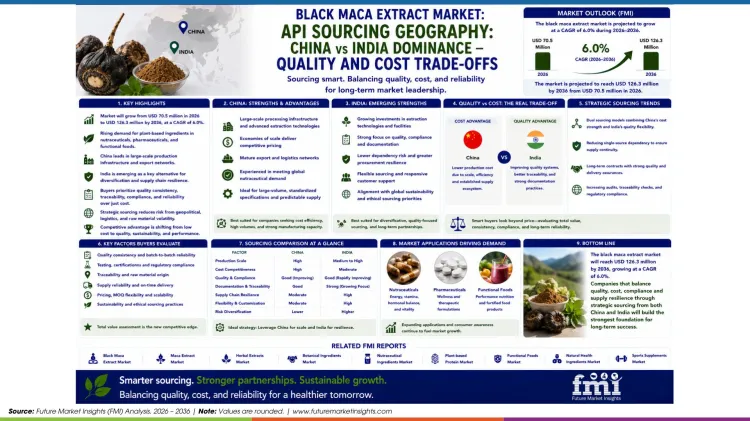
The black maca extract market is witnessing steady growth, owing to increasing demand for natural health ingredients in dietary supplements, functional foods, sports nutrition products, and herbal wellness formulations. The market size is expected to grow from USD 70.5 million in 2026 to USD 126.3 million in 2036, at a CAGR of 6.0% during the forecast period. Manufacturers are focusing on increasing the use of black maca extract in several product categories due to growing consumer preference for energy boosting, hormonal balance, fertility support and plant-based wellness solutions.
As market demand grows, sourcing strategies are becoming an increasingly important determinant of supplier competitiveness.
Previously the choice of botanical extract was mainly based on the cost and availability of the product. But as black maca extract enters the premium nutraceutical space, sourcing departments are adopting more sophisticated supplier evaluation frameworks.
The biggest strategic question for buyers today is whether China or India is the stronger long-term sourcing proposition.
China remains the world’s largest producer of botanical extracts, with large production infrastructure and mature processing capabilities.
Large-scale extraction facilities provide Chinese suppliers with economies of scale, enabling them to sell at competitive prices with high volume output. The country also boasts of mature export logistics networks, advanced extraction technologies and extensive experience in serving international nutraceutical manufacturers.
These factors often result in lower procurement costs and greater availability of supply for buyers in very competitive supplement markets.
Chinese suppliers are particularly attractive for organizations seeking large volume procurement contracts, standardized extract specifications and predictable manufacturing timelines.
But procurement priorities are shifting beyond simple cost comparisons.
Many buyers are more concerned about things like traceability, contaminant testing, regulatory documentation and batch-to-batch consistency. The quality of the product can directly affect the brand reputation and consumer trust, with black maca extract being included in premium formulations.
Therefore, the decision of sourcing is evaluated increasingly on total value rather than only on initial cost.
This shift is benefitting India.
The country's botanical ingredient industry has seen significant development in recent years with increasing investments in extraction technologies, export-oriented manufacturing facilities, and quality management systems.
For many procurement teams, India represents a strong diversification opportunity.
The pandemic-related supply chain disruptions exposed the dangers of a heavy reliance on a single sourcing geography. Since then, many ingredient buyers have been actively pursuing multi-country sourcing strategies to enhance procurement resilience and reduce operational risk.
Increasingly, Indian suppliers are positioning themselves as alternative sourcing partners that can help meet these diversification objectives.
India’s rise is also attributed to the focus on standards of compliance and documentation.
More and more supplier audits, Certificates of Analysis, heavy metal testing reports, microbial testing reports and traceability records are being demanded by global buyers. Manufacturers that can consistently provide this documentation are becoming more attractive procurement partners, no matter the geography.
Many Indian extract producers have invested heavily in meeting these expectations, helping to improve their competitiveness in global supply chains.
So the quality vs cost debate is becoming more nuanced.
While Chinese suppliers often have advantages in production scale and pricing efficiency, Indian suppliers are increasingly competing by offering flexibility, customer support, and tailored sourcing arrangements.
In practice many buyers are not picking just one country.
Rather, purchasing organizations are developing dual sourcing strategies which leverage the strengths of both regions. Large scale manufacturers may be awarded primary supply agreements as they can provide cost efficiencies. Secondary suppliers are retained to provide security of supply and reduce dependency risks.
Larger nutraceutical manufacturers that operate in multiple geographic markets are especially seeing this trend.
Procurement teams are also broadening their supplier evaluation criteria.
Traditionally, suppliers may have been chosen based largely on price and delivery times. Today, assessments are more and more likely to contain:
- Quality management systems,
- Supply chain visibility
- Sustainability efforts
- Regulatory preparedness
- Traceability of product
- Record keeping capacity
- Technical support services.
- Long-term production reliability
Still, the lowest cost supplier is not always the winner of the procurement contracts in these contexts.
Instead, buyers are seeking balanced value propositions that can support long-term product quality goals and business continuity requirements.
Trends at segment level give a better understanding of sourcing priorities.
The black maca extract is still very much in demand for nutraceutical and dietary supplement applications. Producers in these categories often face high standards of quality as consumers become more and more educated about where ingredients come from and how well things work.
Especially premium supplement brands tend to focus on consistency and traceability rather than marginal cost savings.
As acceptance of black maca extract in functional foods and wellness products increases, procurement scrutiny is expected to increase further.
Geographically, regional regulatory developments are also influencing sourcing strategies.
Companies selling products into North America, Europe and developed Asia-Pacific markets are facing increasingly complex ingredient documentation requirements. Suppliers able to meet these regulatory expectations may have a more competitive advantage in procurement evaluations.
The misconception to avoid is that manufacturing costs are the only factor in black maca extract sourcing decisions.
In reality, buyers are increasingly judging suppliers on a broader mix of quality performance, supply security, regulatory preparedness and operational reliability.
As the market matures, we anticipate a corresponding increase in procurement sophistication.
The bottom line: Sourcing geography decisions are playing an increasing role in competitive dynamics in the black maca extract market. China continues to provide cost benefits driven by scale, while India is becoming a strategic diversification destination for buyers looking for more resilient supply chains. ‘Procurement frameworks are becoming more sophisticated and suppliers who can demonstrate a balance of quality, compliance, transparency and cost efficiency will be best placed to take advantage of future market opportunities’.

