


- Citrus ingredient capacity depends on more than citrus fruit availability. It depends on peel recovery, extraction quality, by-product valorization, standardization, and food-grade processing.
- Citrus oils rely heavily on peel-based extraction, where cold pressing, folding, aroma stability, and source control shape commercial quality.
- Citrus fiber scale depends on orange peel availability, food-grade processing, water-binding performance, and consistent particle functionality.
- Citrus pectin scale depends on peel supply, pectin extraction, methoxyl level control, gelling performance, and application-specific specifications.
- Suppliers with integrated juice-processing links can capture more value by converting citrus by-products into oil, fiber, pectin, and flavor systems.
- The biggest misconception is that citrus ingredient capacity is only a crop-volume issue. In reality, processing discipline and specification control decide commercial scale.
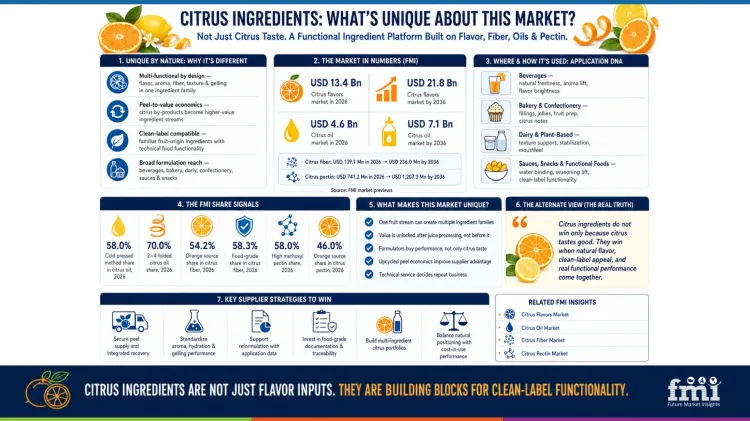
The capacity to produce citrus ingredients is not fully comprehended. Most consumers believe that fruit availability poses the biggest threat. Fruit availability is crucial; however, the capacity to produce citrus ingredients involves post-juicing operations such as peel management, oil extraction, fiber separation, pectin extraction, standardization, concentration, quality assurance, and applications assistance.
FMI’s Citrus Flavors Market highlights that citrus by-products are becoming higher-value assets because they can yield pectin, essential oils, and functional solutions. This is the real capacity story. Citrus ingredients are not only harvested; they are recovered, processed, concentrated, standardized, and converted into technical food inputs.
The Citrus Oil Market is central to this discussion. FMI identifies cold pressed method as the leading extraction method and 2–4 folded citrus oil as the leading fold type. This matters because citrus oil buyers need aroma consistency, controlled concentration, and predictable performance. A citrus oil supplier must manage peel freshness, extraction conditions, terpene balance, oxidation risk, and storage stability.
Cold pressing is significant in ensuring that the natural aroma characteristics are preserved. Cold pressing does, however, need careful handling of the peels. Bad peels, contamination, delay in processing, or oxidation may adversely affect the quality of the essential oils. To flavor manufacturers and beverage producers, aroma drift can lead to serious formulation issues.
Citrus oils which have been folded is one more issue when considering capacity. The folding of citrus oils is achieved through the stripping off of certain volatile parts, thus making it easier for the formulators to maximize their performance and efficiency. The prevalence of 2–4 folded citrus oils is a result of practical compromise between concentration, affordability, and efficiency.
Citrus fiber capacity works differently. The Citrus Fiber Market shows that orange leads the source segment and food grade dominates demand. This is logical because orange processing generates major peel streams that can be converted into functional fiber. But peel availability alone does not create high-quality citrus fiber. Producers must control drying, milling, particle size, hydration behavior, water-binding capacity, microbial quality, and sensory neutrality.
The consistency factor is particularly important in the case of citrus fiber. When a manufacturer in the bakery industry uses citrus fiber in his products to help retain moisture, he must ensure a consistent ability to bind water. Similarly, when a company dealing in plant-based meat products uses citrus fiber, it requires consistent texture and juiciness.
Citrus pectin requires another processing pathway. The Citrus Pectin Market shows high methoxyl pectin as the leading product and oranges as the leading source. Pectin extraction depends on peel chemistry, extraction conditions, purification, drying, and methoxyl control. Food manufacturers do not simply buy “pectin.” They buy specific pectin functionality for jams, jellies, fruit preparations, beverages, confectionery, and dairy systems.
High methoxyl pectin is very popular as it facilitates well-known gelling systems, specifically high sugar and acidic products. But, the purchasers require pectin which sets up according to pre-defined criteria. Any minor change in the pectin characteristics may alter the set-up time, gel structure, clarity, consistency or even product stability.
The Pectin Market is relevant for the broader gelling and stabilization landscape. Citrus pectin competes through source reliability, application fit, and functional performance. Suppliers with strong technical service can help manufacturers choose the right grade for the right formulation.
Integrated citrus processors will have a built-in edge, since they are able to connect the streams of juice, peel, oil, fiber, and pectin. If processors focus solely on processing juice, they are leaving money on the table. Processors who transform peel into various ingredient streams will benefit economically, and at the same time minimize waste.
The processing capacity is also subject to agricultural challenges. Diseases such as citrus greening disease, weather interference, crop volatility, and regional supply changes can influence the amount of available peels and the composition of the oils. This is why companies are focusing on diversifying their sources of supply, managing their inventories, and exploring other technological means.
The Food Ingredients Market provides broader context because industrial food buyers increasingly require not only ingredients but also specification control, documentation, and application support. Citrus ingredient suppliers that can provide technical data, regulatory documentation, allergen statements, origin traceability, and application guidance will gain buyer confidence.
The misconception to avoid is that citrus ingredient scale is simply a matter of growing more oranges, lemons, limes, or grapefruit. Scale is built through recovery systems, extraction quality, standardized processing, and application-specific ingredient design.
Bottom line: Citrus ingredient capacity is won after the fruit is processed. Suppliers that can convert peel and by-products into consistent citrus oils, fibers, pectin, and flavor systems will capture more value than suppliers selling basic citrus inputs.
FMI Related Links
- Citrus Flavors Market: Primary link for natural citrus taste, beverage use, and flavor demand
- Citrus Oil Market: Use when discussing peel-derived aroma and natural citrus oil inputs
- Citrus Fiber Market: Use when discussing clean-label texture, water binding, and stabilizer replacement
- Citrus Pectin Market: Use when discussing gelling, fruit preparations, jams, confectionery, and stabilization
- Natural Food Flavors Market: Use when discussing natural flavor demand and reformulation
- Clean Label Ingredients Market: Use when discussing broader clean-label ingredient substitution

