


- Clean-label claims can support premium pricing in animal feed antioxidants, but only when oxidation control, dosage stability, feed compatibility, and documentation are already strong.
- Buyers are willing to pay more for natural, botanical, tocopherol-based, rosemary-based, vitamin-derived, non-synthetic, and residue-sensitive antioxidant systems, but verified public data does not show one universal animal feed antioxidant clean-label premium.
- The strongest premium opportunity sits in poultry feed, aquafeed, pet-linked feed systems, premium compound feed, export-oriented feed, antibiotic-reduction nutrition programs, and brands selling into residue-conscious animal protein chains.
- Clean label is more valuable in animal feed antioxidants when it reduces buyer risk: rancidity, nutrient loss, fat oxidation, synthetic additive concerns, regulatory uncertainty, residue sensitivity, and label-positioning pressure from meat, egg, dairy, and aquaculture buyers.
- The biggest risk is treating natural antioxidants as a simple replacement for synthetic antioxidants. In animal feed antioxidants, buyers pay for proven protection, not just a cleaner ingredient name.
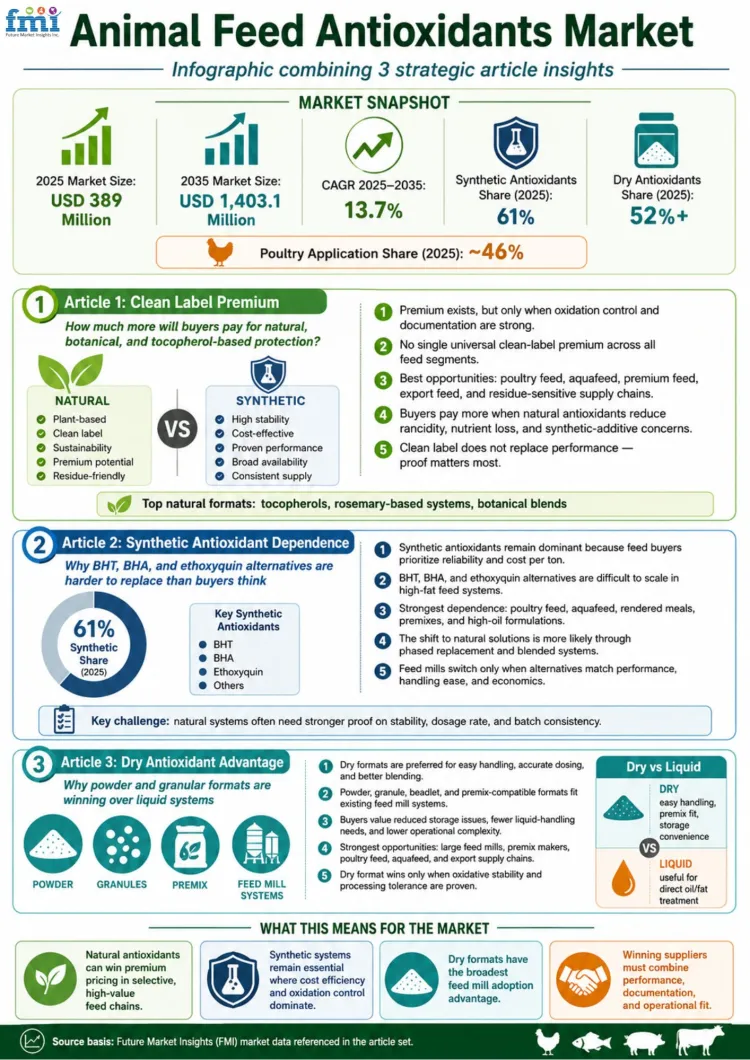
Clean label is becoming a more important pricing lever in the animal feed antioxidants market, but it is not yet strong enough to overturn the practical economics of feed preservation. Feed manufacturers buy antioxidants to protect fats, oils, vitamins, pigments, and other oxidation-sensitive nutrients during processing, storage, transport, and farm-level use. If an antioxidant cannot prevent rancidity, preserve nutritional value, support shelf life, and work at practical inclusion levels, a natural or botanical claim alone will not justify a premium. This makes the clean-label premium in animal feed antioxidants real, but highly conditional.
The market context is important. Animal feed antioxidants are not a lifestyle ingredient category where buyers pay more simply because a product sounds natural. They are technical additives used in high-volume feed systems where cost per ton, oxidative stability, blending performance, supply reliability, and species-specific efficacy matter. Synthetic antioxidants still dominate because they are familiar, cost-efficient, and effective at low dosages. That dominance shows that the market has not shifted fully toward natural antioxidants. Instead, the premium opportunity is developing in specific segments where buyers face stronger pressure from downstream food brands, export markets, pet food standards, aquaculture buyers, and livestock producers seeking cleaner nutrition programs.
The clean-label premium is strongest when natural antioxidants solve both a technical problem and a commercial problem. Technically, buyers want protection against oxidation in high-fat feed ingredients, oils, rendered meals, fishmeal, premixes, and vitamin-rich feed systems. Commercially, they want fewer concerns around synthetic additive perception, cleaner documentation for customers, better alignment with premium animal protein claims, and easier acceptance in sensitive supply chains. This is why tocopherol-based antioxidants, botanical extracts, rosemary-derived systems, carotenoid-supporting blends, and vitamin-based antioxidant solutions can command better pricing in selected feed categories.
However, the premium is not universal. A large commercial feed mill producing standard poultry or swine feed for price-sensitive customers may resist paying significantly more for natural antioxidants if synthetic systems deliver longer shelf life at a lower inclusion cost. In these channels, buyers compare antioxidants through total cost-in-use rather than label appeal. They ask whether the product protects fat quality, survives feed processing, blends well in premixes, remains stable in storage, and avoids reformulation risk. A natural antioxidant that requires a higher dose, has inconsistent botanical potency, or creates handling issues may lose the premium quickly.
Poultry feed is one of the clearest opportunity areas for clean-label antioxidants. Poultry is a large demand center for feed antioxidants because poultry diets often include energy-dense ingredients and oils that require oxidative protection. The opportunity is stronger in premium poultry, branded eggs, antibiotic-reduction programs, export-linked production, and producers selling to retailers or foodservice buyers that care about cleaner input narratives. In these cases, feed antioxidant selection becomes part of the broader quality story around animal health, feed efficiency, and end-product consistency.
Aquafeed is another attractive opportunity because fishmeal, fish oil, and other lipid-rich ingredients are vulnerable to oxidation. Aquaculture buyers are especially sensitive to feed freshness, nutrient preservation, and product quality because oxidative deterioration can affect performance and final product perception. Natural antioxidant systems may gain traction where aquafeed brands want to reduce reliance on controversial synthetic additives, support premium seafood positioning, or meet customer expectations around cleaner feed inputs. Still, the bar is high because aquafeed oxidation risk is significant, and buyers will not accept weaker performance simply for a natural claim.
Ruminant, swine, and dairy feed applications create a more selective premium opportunity. These segments may use antioxidants to protect feed quality and support animal productivity, but willingness to pay more depends heavily on production economics. Dairy producers selling into premium milk programs, organic-linked systems, or high-value branded supply chains may be more open to cleaner antioxidant solutions. Swine and ruminant feed buyers may consider natural antioxidant blends where they improve formulation confidence, reduce synthetic dependency, or align with broader natural feed additive strategies. In conventional high-volume systems, the premium remains harder to defend unless performance is clearly demonstrated.
The clean-label premium also depends on the form of the antioxidant. Dry antioxidants are important because feed mills usually prefer products that are easy to handle, dose, blend, store, and transport. A natural antioxidant in dry powder, granule, or beadlet form may be easier to adopt than a liquid system that requires equipment changes or creates dosing complexity. This matters because feed mills do not buy clean label in isolation. They buy operational fit. If a natural antioxidant works within existing premix and compound feed systems, the buyer has fewer switching barriers and the premium becomes easier to defend.
Documentation is one of the biggest premium drivers. Buyers are more willing to pay extra when suppliers provide clear proof of active content, oxidative stability, recommended dosage, species suitability, ingredient origin, regulatory status, heavy metal checks for botanical inputs, allergen status, non-GMO support where relevant, and batch-to-batch consistency. In animal feed antioxidants, the word "natural" is not enough. Feed producers need evidence that the antioxidant will protect feed quality under real storage temperatures, ingredient variability, and processing conditions.
The strongest premium does not come from replacing synthetic antioxidants one-to-one. It comes from building blended antioxidant systems that combine natural positioning with reliable performance. For example, tocopherols may be positioned with botanical extracts, rosemary-derived compounds, carotenoid-supporting ingredients, or vitamin-based systems to improve oxidation control while supporting cleaner label claims. These combinations allow suppliers to sell a system rather than a single ingredient. That system-level approach is more defensible because it addresses performance, claim support, and formulation risk at the same time.
Clean-label pricing is also linked to downstream pressure from animal protein markets. Meat, eggs, dairy, seafood, and pet-linked supply chains are increasingly shaped by consumer-facing claims around quality, safety, naturalness, sustainability, and responsible nutrition. Feed mills may not market directly to consumers, but they supply producers who do. When downstream customers ask for cleaner production systems, the feed additive supplier can capture value by helping feed manufacturers meet those requirements. This is where natural feed antioxidants become more than preservatives; they become risk-management tools.
The premium weakens where feed is sold as a commodity. In price-sensitive regions or bulk livestock systems, antioxidant buyers often focus on the lowest reliable cost per protected ton of feed. In those settings, synthetic antioxidants remain difficult to displace because they are established, efficient, and widely understood. Natural antioxidants must either demonstrate comparable cost-in-use or offer a clear commercial benefit, such as access to premium buyers, easier compliance with customer requirements, reduced synthetic exposure concerns, or improved brand differentiation.
Supplier strategy should therefore be precise. Companies should not market natural animal feed antioxidants only as "clean label." They should position them as oxidation-control systems for premium feed, export feed, aquafeed, poultry nutrition, natural feed additive programs, and downstream protein quality assurance. The message should be that natural antioxidants help preserve feed quality while supporting cleaner formulation goals. That is more credible than claiming that all buyers are ready to pay a broad premium for natural alternatives.
The biggest commercial mistake is overestimating the clean-label premium. Buyers may like natural antioxidants, but they will still test them against synthetic benchmarks. They will compare oxidative stability, dosage rate, shelf life, feed matrix compatibility, heat and pelleting tolerance, active ingredient consistency, and supplier reliability. If natural antioxidants underperform, the clean-label claim becomes a cost burden. If they perform well and reduce buyer risk, the premium becomes easier to justify.
For the animal feed antioxidants market, the clean-label premium is best understood as a segmented opportunity. It is strongest in premium, technical, and customer-facing supply chains. It is weaker in commodity feed where cost control dominates. Natural, botanical, and tocopherol-based antioxidants can win premium pricing, but only when they are supported by proof, formulation convenience, and a clear buyer benefit. The future of clean-label antioxidants in animal feed will not be decided by the word "natural" alone. It will be decided by whether suppliers can make natural protection perform like a technical additive while helping feed producers meet cleaner nutrition expectations.
Related Markets
- Animal Feed Additives Market: Animal feed antioxidants sit within the wider feed additives ecosystem where feed mills evaluate stability, safety, performance, and cost control.
- Natural Feed Additives Market: Natural feed antioxidants benefit from the broader shift toward chemical-free, sustainable, and cleaner livestock nutrition programs.
- Compound Feed Market: Compound feed manufacturers are key buyers because antioxidants help protect mixed feed formulations during storage, transport, and feeding.
- Pet Food Antioxidants Market: Pet food has stronger clean-label pressure, making it an important adjacent market for natural antioxidant positioning and premium claims.
- Poultry Feed Market: Poultry feed is a major application area because high-volume production, feed efficiency, and oil-rich diets increase the need for oxidation control.

