


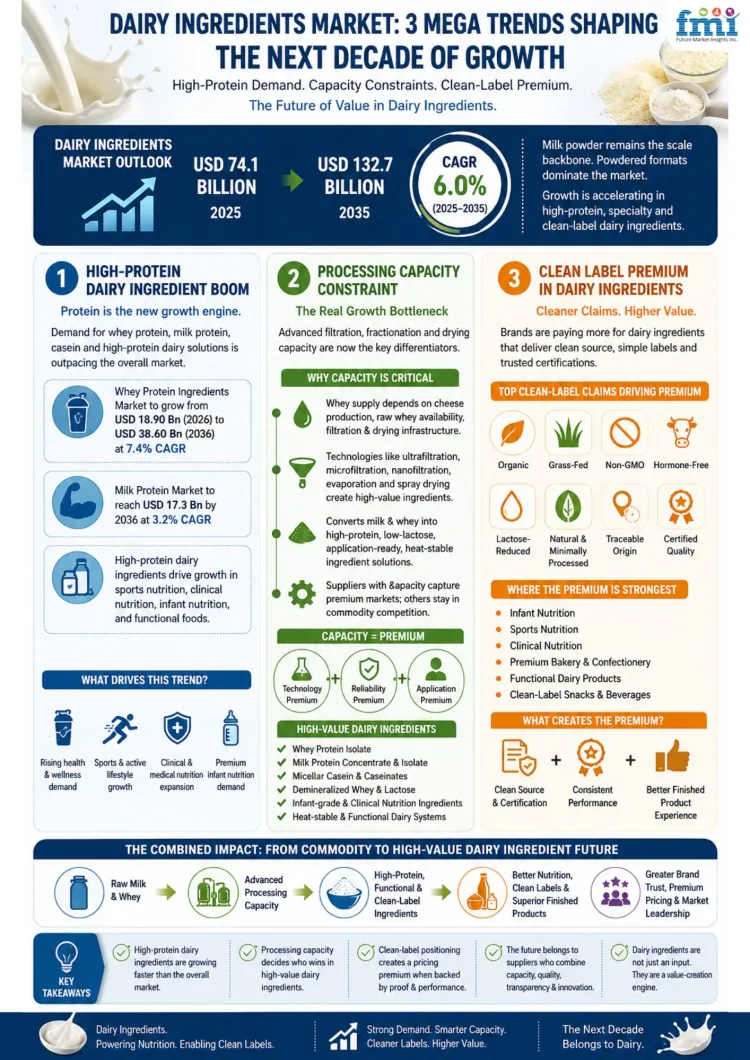
- Clean-label dairy ingredients are gaining pricing power because buyers are no longer evaluating only dairy solids, protein content, or cost; they are evaluating source transparency, processing perception, certification, and label simplicity.
- Milk powder, whey protein, milk protein, lactose, casein, butter powders, and specialty dairy fractions can support premium positioning when they help brands make organic, grass-fed, non-GMO, hormone-free, lactose-reduced, natural, or traceable claims.
- The clean-label premium is strongest in infant nutrition, sports nutrition, clinical nutrition, premium bakery, functional dairy products, clean-label snacks, and natural food formulations where consumers actively check ingredient quality.
- Cleaner claims alone do not create a premium. Dairy ingredients must still deliver solubility, taste neutrality, heat stability, shelf life, nutrition, and processing consistency in the finished product.
- The biggest risk is treating clean label as a marketing phrase. In dairy ingredients, clean label must be supported by certification, origin control, residue management, allergen documentation, quality systems, and application performance.
Dairy ingredients are entering a more selective phase of value creation. The market is no longer driven only by basic dairy solids, protein fortification, milk powder usage, or bulk food manufacturing demand. The sharper question is now: which dairy ingredients can justify a premium because they deliver both cleaner label positioning and reliable formulation performance?
This is an important shift. In earlier dairy ingredient purchasing cycles, buyers often focused on price, availability, fat content, protein level, shelf life, and functionality. Today, food, beverage, supplement, and nutrition brands are becoming more demanding. They want dairy ingredients that support simpler ingredient lists, recognizable sourcing, organic certification, non-GMO positioning, grass-fed claims, hormone-free messaging, lactose-reduced formats, and better consumer trust. This is why clean-label premium is becoming one of the most important pricing questions in the dairy ingredients market.
FMI’s Dairy Ingredients Market shows that the category is already moving at significant scale, with the market valued at USD 74.1 billion in 2025 and projected to reach USD 132.7 billion by 2035, expanding at a CAGR of 6.0%. FMI also identifies milk powder as a leading product segment and powdered formats as the dominant form. That matters because the clean-label opportunity is not limited to niche ingredients. It sits inside the largest and most established dairy ingredient formats, especially where powder-based ingredients are used in infant nutrition, dietary supplements, bakery, confectionery, beverages, and functional foods.
Milk powder remains central to the dairy ingredients market because it offers scale, shelf stability, cost efficiency, and broad formulation use. However, clean-label positioning changes how buyers evaluate milk powder. A standard milk powder may compete mainly on price and specification, while organic milk powder, grass-fed milk powder, non-GMO milk powder, or traceable-origin milk powder can support premium brand positioning. The value is not only in the powder itself. The value is in what the ingredient allows the finished product to claim.
This is where organic dairy ingredients become strategically important. FMI’s Organic Milk Powder Market is projected to grow at a CAGR of 4.6% from 2026 to 2036. This growth supports the idea that organic dairy ingredient demand is not only a retail dairy trend. It is also an ingredient-side opportunity for brands that want cleaner, more transparent, and certification-backed dairy inputs. Organic milk powder can be used in infant nutrition, premium bakery, nutrition powders, confectionery, dairy beverages, and natural food products where certification can justify a higher finished-product price.
The clean-label premium is also linked to the broader clean-label ingredients market. FMI’s Clean-label Ingredients Market was valued at USD 57.3 billion in 2025 and is projected to reach USD 279.6 billion by 2036, growing at a CAGR of 15.5% between 2026 and 2036. This wider clean-label momentum is directly relevant to dairy ingredients. As food manufacturers reformulate away from artificial additives, synthetic ingredients, complex labels, and unclear sourcing, dairy ingredients can benefit when they are positioned as familiar, functional, and trusted food inputs.
However, clean label in dairy ingredients is different from clean label in plant-based or additive markets. Dairy already has a strong naturalness advantage because consumers recognize milk, cream, whey, casein, lactose, and butter-derived ingredients. But that advantage is not automatic. The premium depends on whether the ingredient is perceived as clean, minimally altered, traceable, safe, and aligned with the finished brand’s promise. A dairy ingredient with complicated processing perception, poor documentation, or inconsistent quality may not command a premium even if it comes from milk.
The strongest clean-label dairy ingredient opportunity sits in ingredients that combine claim value with application value. Organic skimmed milk powder, organic whole milk powder, grass-fed milk powder, non-GMO whey protein, milk protein concentrate, milk protein isolate, lactose-reduced dairy systems, casein, caseinate, butter powder, buttermilk powder, and traceable dairy blends can all support premium positioning. But the premium is strongest when the ingredient helps the brand solve both label and performance needs.
Infant nutrition is one of the most important examples. Brands in infant formula and toddler nutrition need dairy ingredients that meet strict quality, safety, traceability, and compositional requirements. In this category, buyers are less likely to treat dairy ingredients as interchangeable commodities. Organic certification, controlled sourcing, low contaminant risk, reliable protein quality, and consistent mineral profile can support premium procurement decisions because the finished product is highly sensitive to trust and regulatory scrutiny.
Sports nutrition is another strong area. High-protein powders, RTD shakes, bars, and recovery products often use whey protein, milk protein, casein, or dairy blends. Clean-label positioning matters when brands want to differentiate beyond protein grams. A whey protein ingredient may gain pricing power if it supports non-GMO, grass-fed, hormone-free, low-lactose, natural flavor compatibility, or transparent-origin claims. However, the ingredient must still deliver solubility, neutral taste, digestibility, and consistent protein quality. A clean claim cannot compensate for chalkiness, bitterness, poor mixability, or unstable performance.
Clinical nutrition also supports clean-label value, but in a different way. Here, the premium is less about lifestyle storytelling and more about safety, tolerance, quality assurance, and controlled composition. Dairy ingredients used in medical nutrition must be reliable, digestible, and suitable for sensitive users. Cleaner positioning can help, but the stronger value comes from specification discipline, batch consistency, and documentation.
Premium bakery and confectionery are also important demand areas. Dairy ingredients such as milk powder, butter powder, whey powder, lactose, and buttermilk powder are used for flavor, browning, texture, mouthfeel, and nutritional value. In premium bakery, clean-label dairy ingredients can help brands replace artificial flavor systems or simplify ingredient decks. A natural dairy powder may support better flavor and label appeal at the same time, especially in cookies, cakes, pastries, fillings, chocolates, desserts, and dry mixes.
Functional dairy products create another strong use case. High-protein yogurts, fortified milk drinks, dairy-based smoothies, meal replacement beverages, and probiotic dairy products need ingredients that support nutrition and sensory quality. Clean-label dairy ingredients are valuable in these formats because consumers often associate dairy with health, protein, calcium, and natural nutrition. However, if the ingredient causes sedimentation, off-notes, poor texture, or instability, the clean-label advantage can quickly disappear.
This is why the clean-label premium in dairy ingredients should be measured through three lenses: source premium, claim premium, and performance premium. Source premium comes from organic, grass-fed, pasture-raised, regional, traceable, or controlled-origin sourcing. Claim premium comes from non-GMO, hormone-free, lactose-reduced, natural, minimally processed, or certification-backed positioning. Performance premium comes from solubility, heat stability, mouthfeel, taste neutrality, emulsification, browning, protein quality, and shelf-life contribution.
Price premium versus baseline should therefore be calculated carefully. The baseline is usually conventional milk powder, whey powder, lactose, casein, or standard dairy solids because these ingredients are scalable, familiar, and cost-efficient. A clean-label dairy ingredient should be evaluated against that baseline not only by price per kilogram but also by finished product economics. If a higher-priced organic or traceable dairy ingredient helps the brand justify a premium retail price, reduce label complexity, improve consumer trust, or strengthen claim credibility, the real value may be higher than the raw ingredient premium suggests.
For brands, this creates a clear segmentation strategy. Mass-market and value products may continue to rely on conventional dairy ingredients because cost, supply, and functional dependability remain critical. Premium and better-for-you products may use organic milk powder, grass-fed dairy proteins, non-GMO whey, lactose-reduced dairy systems, or traceable dairy ingredients to support a stronger label story. Hybrid products may use a balanced approach, combining conventional dairy solids with cleaner specialty ingredients where claims or sensory benefits justify the added cost.
For suppliers, the opportunity is to avoid selling clean label as a vague promise. Buyers need proof. They need certificates, sourcing documentation, allergen statements, non-GMO support where applicable, organic certification where applicable, residue testing, quality specifications, application guidance, and batch-level consistency. The winning suppliers will not simply say their dairy ingredient is clean label. They will show how it performs in infant formula, protein powders, RTD beverages, yogurts, bakery products, confectionery, desserts, sauces, and functional foods.
For processors, clean-label demand creates a different type of manufacturing challenge. Organic or grass-fed dairy ingredient production requires controlled sourcing and segregation. Non-GMO positioning requires supply chain documentation. Lactose-reduced systems require processing control. Clean-label dairy proteins require careful management of heat treatment, filtration, drying, flavor, microbiology, and solubility. This means clean label is not only a marketing decision. It is also a supply chain and manufacturing capability decision.
For food manufacturers, the key question is whether the clean-label premium can be passed through to the customer. In infant nutrition, premium supplements, natural food retail, high-protein dairy, clean-label bakery, and premium confectionery, the premium may be easier to justify. In value dairy products, institutional foodservice, or price-sensitive processed foods, the premium may be harder to recover unless the ingredient also improves yield, reduces reformulation complexity, strengthens shelf life, or supports broader brand positioning.
The regional angle also matters. Europe and North America are likely to remain important clean-label positioning regions because consumers and brands are more sensitive to organic certification, non-GMO claims, animal welfare, natural positioning, and ingredient transparency. Oceania can benefit from strong dairy export reputation and grass-fed dairy positioning. Asia-Pacific may offer fast growth in premium infant nutrition, protein supplements, and functional dairy products, but price sensitivity and local regulatory requirements can influence how much premium buyers will accept.
Clean-label dairy ingredients also intersect with clean-labelled food additives and clean-label preservatives. FMI’s Clean Labelled Food Additives Market is projected to grow from USD 47.9 billion in 2025 to USD 84.2 billion by 2035, while clean-label preservatives are gaining share in the wider food preservatives market. This supports a broader interpretation: food manufacturers are not only changing one ingredient. They are rethinking whole formulation systems. Dairy ingredients can benefit when they help simplify labels, improve taste, and reduce dependence on artificial or unfamiliar inputs.
The misconception to avoid is that clean label automatically means less processed. Dairy ingredients such as whey protein isolate, milk protein concentrate, casein, lactose, and demineralized whey often require advanced processing. The real clean-label question is not whether processing exists. The question is whether the ingredient source, label declaration, certification, functionality, and finished-product experience feel acceptable to the target buyer. Clean label in dairy ingredients is about trusted processing, not the absence of processing.
Another misconception is that organic always wins. Organic dairy ingredients can command a premium in the right application, but conventional dairy ingredients will continue to dominate where cost, scale, and functional reliability matter most. The clean-label shift should therefore be seen as portfolio expansion, not full replacement. The market is likely to move toward a layered structure: conventional dairy ingredients as the scalable base, organic and grass-fed ingredients as premium options, and specialized dairy proteins or lactose-managed systems as application-specific clean-label solutions.
For suppliers, this creates a strong commercial message. Clean-label dairy ingredients should not be sold only as “natural” or “better.” They should be sold as claim-enabled, quality-controlled, application-ready ingredients that help brands improve finished-product positioning. Buyers need to understand where the premium comes from: source, certification, technical performance, and consumer-facing value.
For brands, the decision must be disciplined. A clean-label dairy ingredient is worth paying more for when it helps the finished product win on trust, taste, nutrition, claims, and repeat purchase. It is not worth paying more for when the claim is weak, the consumer does not notice it, the application does not need it, or the ingredient creates formulation problems. The premium must be earned at the finished-product level.
Bottom line: the clean-label premium in dairy ingredients will not be captured by every supplier that offers organic, grass-fed, non-GMO, or traceable dairy inputs. It will be captured by suppliers that combine clean source positioning with certification, quality assurance, sensory performance, formulation support, and reliable supply. In dairy ingredients, the premium is not paid for the claim alone. It is paid when the claim helps the brand sell a better finished product.
FMI Report Links
- Dairy Ingredients Market: Primary interlink in the introduction and conclusion
- Clean-label Ingredients Market: Use when discussing clean-label demand as a broader formulation trend
- Organic Milk Powder Market: Use when discussing organic dairy ingredients and certification-backed dairy powder premiums
- Milk Powder Market: Use when comparing conventional milk powder with organic, grass-fed, and traceable powder formats
- Whey Protein Ingredients Market: Use when discussing clean-label whey protein, sports nutrition, and grass-fed/non-GMO positioning
- Milk Protein Market: Use when discussing milk protein concentrates, isolates, and dairy protein functionality
- Clean Labelled Food Additives Market: Use when linking dairy ingredient reformulation to wider clean-label food additive trends
- Clean-label Preservatives Market: Use when discussing broader clean-label reformulation across processed foods
- Infant Formula Ingredients Market: Use when discussing high-trust clean-label dairy ingredient demand in infant nutrition
- Functional Dairy Products Market: Use when linking clean-label dairy ingredients to high-protein yogurts, beverages, and functional dairy formats

