


- Clean-label premium in fish protein isolate is driven by marine-sourced nutrition, high protein density, digestibility, and formulation functionality.
- Food & Beverages leads end-use demand because brands are using fish protein isolate to support high-protein, functional, and alternative protein formulations.
- Powder dominance shows that convenience, shelf stability, and application flexibility are central to commercial adoption.
- Sustainability can support premium positioning, but it is not enough unless the ingredient also performs on taste, odor, solubility, and nutrition.
- Fish protein isolate can serve sports nutrition, nutraceutical, clinical nutrition, fortified foods, and protein-enriched beverage applications.
- The biggest misconception is that marine origin alone creates premium value. Buyers pay more when marine protein is clean, functional, standardized, and easy to formulate.
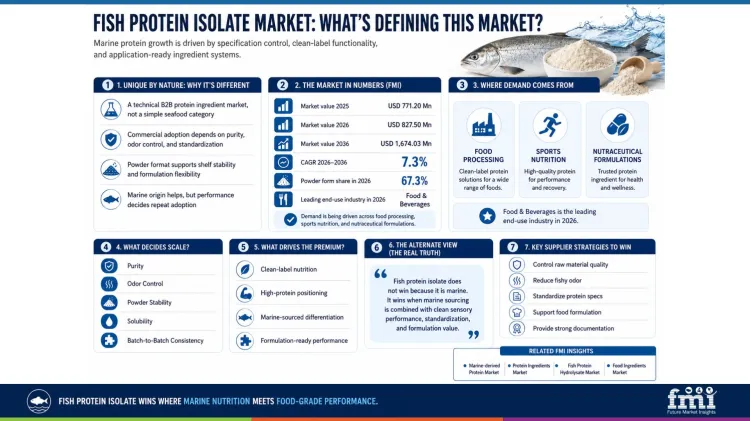
The Fish Protein Isolate Market is increasingly part of the clean-label and functional protein conversation. However, clean label in this market does not simply mean “natural” or “sustainable.” It means a protein ingredient that can help brands deliver recognizable nutrition, high protein content, marine origin, digestibility, and formulation performance without unnecessary complexity.
FMI states that the Fish Protein Isolate Market is projected to grow from USD 827.50 Mn in 2026 to USD 1,674.03 Mn by 2036 at a 7.3% CAGR. FMI also highlights rising demand for marine-sourced protein ingredients across food processing, sports nutrition, and nutraceutical formulations. This makes fish protein isolate a functional ingredient story, not only a seafood by-product story.
It is predicted that the Food & Beverages end-use industry will dominate in 2026. This is significant considering that for the food and beverages formulators, protein alone is not enough. In addition to providing nutrition, they need good sensory attributes, water solubility, dispersion ability, compatibility with other ingredients, and stable shelf-life characteristics. An isolate that fails in the end product is as good as waste.
The Protein Ingredients Market is relevant because consumers and brands are diversifying beyond traditional dairy and plant protein sources. Whey, casein, soy, pea, rice, collagen, egg, and marine proteins all compete for formulation space. Fish protein isolate can stand out when it offers a strong protein profile, marine identity, and clean-label positioning.
The powder dosage forms capture the majority of the market demand with a share of 67.3%. The powder dosage forms are critical since they help to serve numerous clean label as well as functional nutrition applications. Some of the uses of the powder dosage forms include dry mixes, instant beverages, protein powder, meal replacement, soup, snack, bakery, bars, nutraceutical blends, and fortified foods.
The Sports Nutrition Market is relevant because fish protein isolate can be positioned around high protein intake, amino acid delivery, digestibility, and alternative protein sourcing. Sports nutrition consumers often compare protein types based on performance, digestibility, taste, and clean-label cues. Fish protein isolate must compete against well-established whey and plant proteins, so sensory performance is essential.
The marine origin could actually serve as a premium signal, but this will need to be done in the right way. Customers could relate the marine components to nutrition and omega-related wellness benefits and sustainable products. On the other hand, the consumers could fear fish-like flavor, possible allergens, toxins or contamination, and lack of traceability.
The Marine-derived Protein Market supports the broader ingredient trend. Marine proteins are gaining attention because they provide another route to protein diversification. Fish protein isolate can benefit from this trend if it is positioned as a functional, food-grade, formulation-ready protein rather than a low-value seafood derivative.
Sustainability may apply to the issue, but it may not be emphasized as the sole value proposition. Fish protein isolate can add to the circular economy story where it is derived from fish processing wastes. That may help brands eliminate wastage and enhance efficiency. But claims on sustainability cannot help if the product doesn't taste good or perform consistently.
The Sustainable Seafood Market is useful when discussing responsible sourcing and marine resource efficiency. For fish protein isolate, sustainability credibility may come from traceable raw materials, by-product valorization, responsible fisheries, and transparent supply chains. These claims can strengthen premium value, especially in food and nutrition brands.
Nutraceutical formulations also provide a promising avenue for expansion. The fish protein isolate can be marketed as a nutraceutical formulation within protein-enriched products, active aging, health powder drinks, and medical nutrition. This category generally needs reliable documentation, consistent formulations, and suitability to combine with other nutrients, including minerals, vitamins, flavoring agents, etc.
The Nutraceutical Ingredients Market is relevant because ingredient buyers in this space value documentation, consistency, and benefit communication. Fish protein isolate suppliers that can support technical dossiers and product claims will be better positioned than those selling generic protein powder.
Clean label benefit is also linked to product formulation. In case the fish protein concentrate needs many masking agents, stabilizers or complex processing in order to be deemed fit, then the value of clean label will be reduced. The best ingredients enable the brand to make high protein products without complicating the labeling process.
The Food Ingredients Market is relevant because clean-label product development depends on ingredients that can deliver nutrition and functionality without causing processing or sensory problems. Fish protein isolate must integrate into broader food systems, not remain a niche marine ingredient.
The misconception to avoid is that fish protein isolate automatically wins because consumers want more protein. Protein demand is strong, but protein markets are crowded. Fish protein isolate must offer a specific reason to choose it over whey, pea, soy, collagen, or other protein systems.
Bottom line: Clean-label premium in fish protein isolate is earned through functionality, nutrition, standardization, and credible marine sourcing. Sustainability helps, but the ingredient must first deliver neutral taste, reliable protein value, and formulation performance.
FMI Related Links
- Fish Protein Isolate Market: Primary link for market value, CAGR, powder share, Food & Beverages end-use leadership, and protein application trends
- Protein Ingredients Market: Use when discussing protein diversification, formulation competition, and alternative protein ingredients
- Sports Nutrition Market: Use when discussing protein powders, performance nutrition, muscle recovery, and active consumer demand
- Marine-derived Protein Market: Use when discussing marine-sourced proteins, seafood-derived ingredients, and sustainable protein innovation
- Nutraceutical Ingredients Market: Use when discussing wellness products, active aging, dietary supplements, and functional ingredient formulations

