


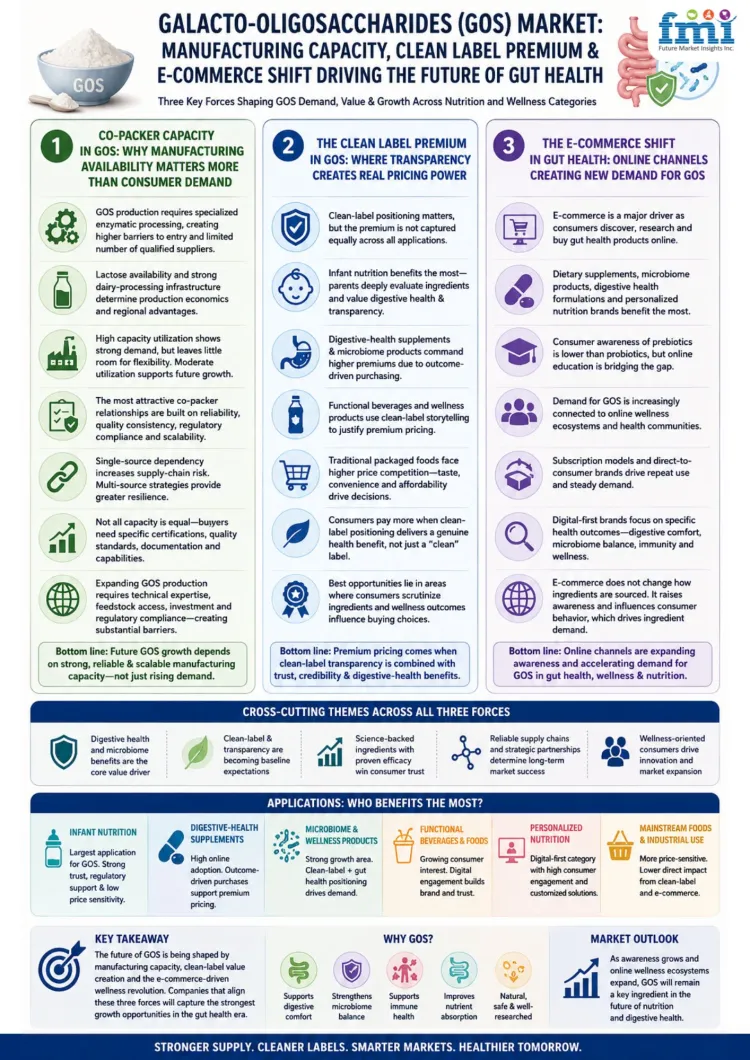
- GOS demand is expanding across infant nutrition, dietary supplements, and functional foods, but manufacturing capacity remains concentrated among a limited number of suppliers.
- Unlike many food ingredients, GOS production requires specialized enzymatic processing capabilities, creating higher barriers to entry for new manufacturers.
- Capacity constraints are not distributed evenly. Regions with strong dairy-processing infrastructure possess significant advantages in GOS production.
- Lactose availability is becoming one of the most important factors influencing long-term production economics and manufacturing scalability.
- The most attractive co-packer relationships are built around reliability, quality consistency, and regulatory compliance rather than simply the lowest production cost.
- Buyers relying on a single production source face greater supply-chain exposure than buyers operating diversified sourcing strategies.
- The biggest misconception is that rising demand automatically creates additional capacity. In reality, expanding GOS production requires technical expertise, feedstock availability, and regulatory compliance.
The conversation around Galacto-Oligosaccharides (GOS) often focuses on consumer demand. Discussions usually highlight products for digestive health, infant nutrition, microbiome wellness, and functional food innovation. While these factors are important, they only represent one side of the equation. The other side is manufacturing capacity.
For GOS producers, meeting future demand relies not just on consumer acceptance but also on the industry’s ability to produce consistently, cost-effectively, and at a commercial scale. This reality makes co-packer capacity and production availability vital considerations.
Unlike many food ingredients, GOS production needs specialized processing. This ingredient is typically made through enzymatic conversion that changes lactose into galacto-oligosaccharides. This process requires technical expertise, specialized equipment, quality control systems, and regulatory compliance, which are not commonly found in all food manufacturing facilities.
As a result, GOS production is concentrated among a small number of established suppliers. This situation presents both opportunities and risks. Established manufacturers typically benefit from technical expertise and economies of scale. Buyers, however, face a more limited selection of qualified production partners compared to conventional food ingredients.
The basis of GOS manufacturing starts with lactose availability. Since lactose is the main feedstock, regions with strong dairy processing industries hold a structural advantage. This infrastructure provides steady access to raw materials, making supply chains simpler and improving production costs.
This connection explains why dairy-rich regions have historically been crucial for GOS manufacturing. Having access to lactose is not just about sourcing-it directly affects production costs, supply reliability, and long-term scalability. Manufacturers located near dairy-processing ecosystems often have more operational flexibility than those relying on imported feedstocks.
The significance of feedstock availability becomes especially clear during supply-chain disruptions. Companies with stable access to lactose usually deal with fewer production issues than those dependent on external sourcing networks. As supply-chain resilience gains importance, secure access to feedstock is becoming a competitive edge.
Capacity utilization is another significant factor. High utilization rates can indicate strong market demand and efficient operations. However, when utilization is too high, it can limit flexibility. Manufacturers nearing full capacity might struggle to handle unexpected demand spikes, product rollouts, or customer growth initiatives.
On the other hand, facilities with moderate utilization rates often have a greater ability to absorb new business. This flexibility is especially valuable for emerging brands in digestive health or functional nutrition. Buyers often prefer suppliers who can support future growth over those who just meet current needs.
This issue is becoming increasingly relevant as GOS use grows beyond traditional categories. Infant nutrition continues to be a major demand area, but dietary supplements, microbiome products, and functional beverages are adding pressure on manufacturing. Each new application intensifies competition for production capacity.
This doesn’t necessarily indicate a global capacity shortage but highlights the importance of the quality of that capacity. Not all production capacity holds equal value. Buyers often need specific regulatory certifications, quality standards, production capabilities, and documentation systems. Consequently, the number of acceptable production partners is often smaller than overall capacity figures suggest.
The dietary supplement industry illustrates this well. Brands in digestive health tend to prioritize ingredient consistency and traceability. A manufacturing partner that can show reliable quality systems might hold more strategic value than a lower-cost option that lacks adequate documentation.
Infant nutrition creates an even more challenging environment. Regulatory demands, quality expectations, and consumer scrutiny are much higher than in many other food sectors. Manufacturers catering to infant nutrition must meet strict standards, making qualified production capacity especially valuable.
This situation results in a tiered landscape for capacity. At the top are facilities that can serve highly regulated applications. In the middle are those that support mainstream functional foods and beverages. The lower tier includes facilities focused mainly on simpler applications. The value of capacity depends not only on volume but also on capability.
The concentration of suppliers also affects market dynamics. Because the number of established GOS manufacturers is relatively small, buyers generally have fewer sourcing options than in larger ingredient categories. This concentration increases the importance of supplier relationships and long-term production planning.
Using a single-source strategy may seem efficient during stable supply periods, but it poses significant risks during disruptions. Manufacturing interruptions, raw material shortages, logistical issues, or regulatory challenges can quickly interrupt supply. As a result, many buyers are now considering multi-source procurement strategies.
Multi-source strategies offer more resilience but add complexity. Companies need to manage various supplier relationships, ensure quality consistency across sources, and coordinate procurement efforts. Still, the benefits of increased supply security often justify this trade-off.
Contract structures are also changing as a result. Buyers increasingly seek agreements that provide insight into future production availability. Long-term supply agreements can help lock in capacity and reduce uncertainty. For manufacturers, these contracts enhance production planning and investment transparency.
Another key factor is vertical integration. Companies that control multiple stages of the value chain often have a better ability to manage risks. Integration can enhance feedstock security, strengthen quality assurance, and improve responsiveness to market changes. As GOS demand grows, vertically integrated operations may gain significant advantages over more fragmented supply chains.
The regional spread of manufacturing capacity also plays a role. Regions with established dairy-processing infrastructure, technical know-how, and regulatory experience generally lay a stronger foundation for GOS production. Emerging regions could offer growth opportunities, but scaling production demands significant investment in both infrastructure and technical skills.
This reality challenges a common belief in the market. Increased demand does not automatically result in new manufacturing capacity. Expanding production requires capital investments, process expertise, qualified personnel, feedstock access, and regulatory compliance. These needs create substantial barriers to quick capacity growth.
For buyers assessing manufacturing partners, important criteria go beyond just price. Reliability, regulatory compliance, quality consistency, technical support, feedstock security, and long-term scalability are often more strategically important than short-term cost savings.
The best co-packer relationships focus on operational stability rather than transaction costs. A supplier that can support product growth, maintain quality standards, and assure supply continuity typically provides more long-term value than suppliers competing primarily on cost.
The applications most reliant on dependable manufacturing capacity include infant nutrition, digestive-health supplements, microbiome products, and premium functional nutrition. These categories require rigorous quality checks and reliable supply.
Conversely, applications that are less reliant on specialized production capabilities include certain mainstream food uses, where regulatory requirements and formulation complexities might be lower.
The practical takeaway is that future GOS growth will depend not just on creating demand but also on readiness in manufacturing. Companies that establish reliable production partnerships today are more likely to succeed in future expansion than those that rely solely on short-term ordering strategies.
In summary, while consumer demand may shape the GOS market’s future, manufacturing capacity will determine how much of that demand can actually be met. As use expands across nutrition and wellness categories, access to dependable production capacity will become an even more critical competitive advantage.
FMI Related Reports
- Galacto-Oligosaccharides (GOS) Market: Primary link for market value, production capacity, application trends, and introduction and conclusion sections
- Pet Prebiotics Market: Use when discussing broader demand expansion, gut health trends, and functional nutrition
- Functional Food Ingredients Market: Use when discussing manufacturing scalability, ingredient innovation, and value-added food formulations
- Dairy Ingredients Market: Use when discussing lactose feedstock, dairy-processing infrastructure, and ingredient manufacturing
- Nutraceutical Ingredients Market: Use when discussing supplement manufacturing, quality standards, and health-focused ingredient applications

