


- Pet milk replacer growth depends not only on demand, but also on the ability of manufacturers and co-packers to produce safe, consistent, fortified, and species-specific formulas.
- FMI estimates the pet milk replacers market at USD 262.4 Mn in 2025, reaching USD 543.5 Mn by 2035 at a 7.7% CAGR.
- Cat milk replacers hold 32.6% share in 2025, making kitten-specific formulation, digestibility, and small-batch quality control important production priorities.
- Dog puppy milk replacers account for 22.5% share in 2025, creating demand for fortified, growth-support, and breeder-trusted formulas.
- The real capacity constraint is not only milk powder supply. It is controlled blending, fortification accuracy, probiotic stability, hygienic packaging, and multi-SKU production discipline.
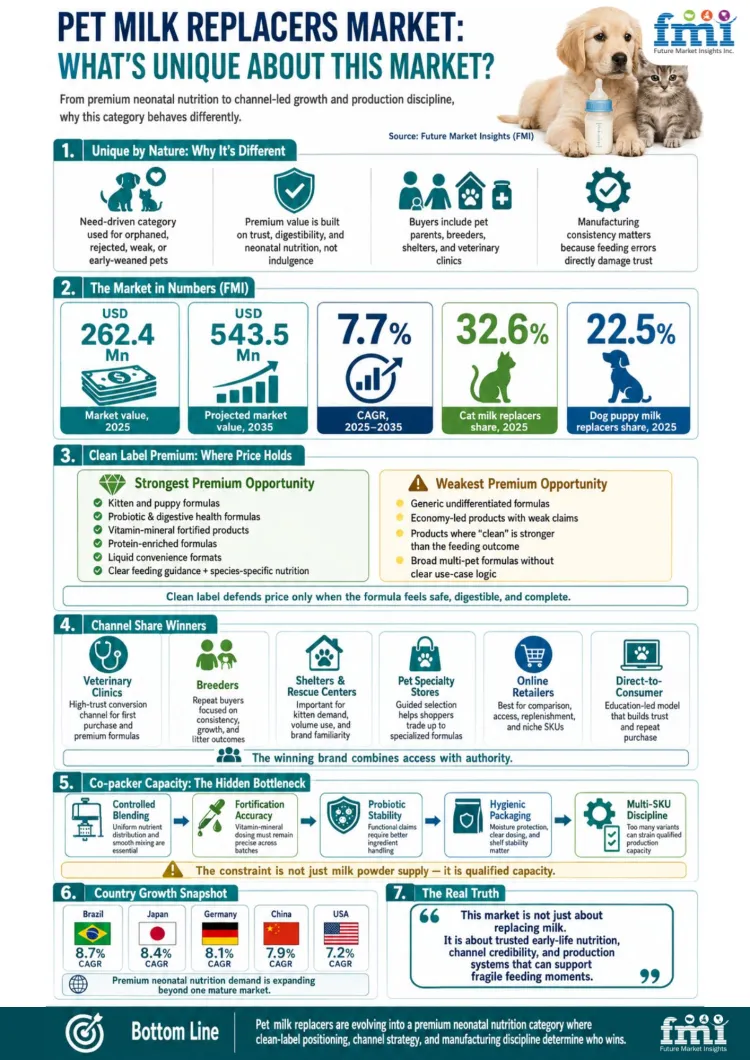
Co-packer capacity is becoming a more important pressure point in the pet milk replacers market, but it is often overlooked. Many brands treat milk replacers as a simple extension of pet food or dairy powder. In reality, this category requires a higher level of formulation control because the product is used for newborn, orphaned, rejected, weak, or early-weaned pets. A milk replacer does not simply need to look nutritious on the label. It has to mix properly, digest easily, deliver consistent nutrition, and build confidence during a sensitive feeding stage.
That distinction matters because pet milk replacers are not ordinary pet care products. The buyer may be a pet parent feeding a rescued kitten, a breeder supporting a weak litter, a shelter managing multiple newborn animals, or a veterinary clinic recommending supplemental nutrition. In each case, product reliability matters more than casual brand preference. If the formula clumps, separates, causes feeding confusion, or delivers inconsistent performance, the brand loses trust quickly.
FMI’s view of the pet milk replacers market shows why production capability will become more important. The market is valued at USD 262.4 Mn in 2025 and is projected to reach USD 543.5 Mn by 2035 at a 7.7% CAGR. This growth is not only a demand story. It is also a manufacturing readiness story. As the market expands, brands will need more reliable capacity for powdered milk replacers, liquid milk replacers, fortified formulas, probiotic and digestive health formulas, medicated products, non-medicated products, and species-specific nutrition.
The processing challenge is strongest in powdered milk replacers because powder is expected to be stable, easy to store, easy to measure, and easy to prepare. However, producing a high-quality powder is not as simple as blending dairy ingredients with vitamins and minerals. The manufacturer must manage ingredient uniformity, particle behavior, moisture exposure, solubility, nutrient dispersion, and packaging protection. A powder that does not mix smoothly can create a poor feeding experience, even if the formulation looks strong on paper.
Liquid milk replacers create a different type of capacity challenge. They can appeal to convenience-driven buyers because they reduce preparation effort, but they require stricter control around filling, packaging integrity, shelf stability, and safe handling. For brands trying to premiumize through ready-to-feed formats, the bottleneck may not be demand. It may be access to suitable processing and packaging partners that can deliver convenience without compromising trust.
The premium shift in the market makes this even more complex. FMI identifies nutritional content segments such as protein-enriched formulas, fortified with vitamins and minerals formulas, and probiotic and digestive health formulas. These segments require more than basic blending capacity. They require accurate dosing, ingredient compatibility, stability management, and quality checks. A probiotic formula, for example, cannot be treated like a standard powder if the brand wants to protect the digestive health promise.
Cat milk replacers show why qualified capacity matters. FMI indicates that cat milk replacers hold 32.6% share in 2025, making them the leading pet type segment. Kitten formulas are often used in rescue, shelter, and early-life care situations where users are highly concerned about survival, growth, and digestion. A kitten milk replacer that claims gentle nutrition must be produced with strong control over formula consistency, mixing quality, and feeding instructions.
Dog puppy milk replacers also require careful production discipline. FMI indicates that dog puppy milk replacers account for 22.5% share in 2025. This segment is strongly connected with breeders, clinics, shelters, and pet parents managing newborn or weak puppies. For breeders especially, consistency across batches matters. If one batch performs differently from another, the brand may lose professional trust even if the price is attractive.
The co-packer issue becomes more serious when brands expand SKUs too quickly. A company may want kitten formulas, puppy formulas, senior pet formulas, medicated formulas, non-medicated formulas, protein-enriched products, probiotic products, powdered products, liquid products, and bulk packs. Each new SKU increases operational complexity. It adds more ingredient handling, more changeovers, more label control, more quality checks, and more inventory pressure.
This is why the real constraint is not factory space alone. It is qualified capacity. A co-packer may have blending equipment, but that does not mean it can reliably produce neonatal pet nutrition products. The right partner must understand dairy-based formulation, functional ingredient handling, premix accuracy, hygienic production, moisture control, packaging protection, and small-batch flexibility. In this market, outsourcing production without technical alignment can weaken the entire brand promise.
B2B channels make the capacity question even more important. FMI includes pet food manufacturers, private label producers, contract manufacturers, and bulk suppliers within the distribution structure. This means the market is not limited to branded retail packs. Demand may also come from private label programs, breeder packs, shelter supply, bulk procurement, and manufacturing partnerships. Each buyer type may require a different cost structure, pack size, formulation level, and supply rhythm.
Private label can add pressure to the system. Retailers may want milk replacers at accessible price points, but neonatal nutrition cannot be treated like a basic value product. Lower price cannot come at the cost of weak formulation control, unclear feeding guidance, or inconsistent quality. A poor private label milk replacer can create risk for both the retailer and the manufacturer because the product is used in a high-trust feeding situation.
Packaging is another hidden capacity constraint. Powdered milk replacers need packaging that protects against moisture, supports shelf life, allows clear dosing, and keeps instructions visible. Liquid milk replacers need packaging that protects product integrity and supports easy feeding. In both cases, packaging is not only a cost item. It is part of the product experience. If the pack is difficult to measure, reseal, store, or understand, the product becomes less trusted.
E-commerce also changes the production and packaging requirement. FMI identifies online retailers and direct-to-consumer channels as part of the market structure. Products sold online must survive shipping, storage variation, and repeat handling. Clear feeding guidance becomes even more important because the buyer may not receive in-store advice. Brands that sell online need packaging, instructions, and content that reduce user error.
The fastest-growing country markets will also test capacity planning. FMI identifies Brazil as the fastest-growing country-level market at 8.7% CAGR through 2035, followed by Japan, Germany, China, and the USA. These markets will not require identical production strategies. Brazil may need affordable and accessible formats. Japan may support premium and convenience-led formulas. Germany may reward quality and transparent formulation. China may depend heavily on online discovery and brand trust. The USA may require broad coverage across breeders, shelters, veterinary clinics, and e-commerce.
For brands, the practical lesson is clear. Capacity planning should come before aggressive premium positioning. A brand can claim probiotic support, clean-label formulation, kitten-specific nutrition, or fortified puppy growth support, but the production system must be able to deliver those claims consistently. The more specialized the claim, the more important the co-packer becomes.
The weaker strategy is to chase too many claims without solving the manufacturing base. A formula that promises digestive health but has poor mixing quality will struggle. A product that targets breeders but has inconsistent batch performance will lose repeat demand. A liquid product that promises convenience but faces packaging or stability issues will not defend premium pricing. In this category, production failures are not minor inconveniences. They directly affect trust.
The strongest opportunity sits with brands that treat manufacturing as a competitive advantage. These brands will build around reliable ingredient sourcing, controlled powder blending, stable fortification, qualified co-packer relationships, and channel-ready packaging. They will not only launch products faster. They will also protect repeat purchase by making the feeding experience more predictable.
The misconception to avoid is that the pet milk replacers market can scale like a basic pet food category. It cannot. Milk replacers sit closer to functional early-life nutrition than routine feeding. The products are used in moments of concern, urgency, and care. That makes quality consistency, feeding clarity, and production control central to growth.
Bottom line: the pet milk replacers market has strong growth potential, but premium growth will depend on qualified production capacity. Brands that secure reliable co-packers, control powder and liquid processing, manage fortification accurately, protect probiotic and digestive health claims, and simplify feeding through better packaging will be better positioned to scale. In this market, manufacturing consistency is not behind the scenes. It is one of the main reasons buyers trust the product.

