


- Pharmaceutical brands should no longer choose high barrier film suppliers only on quoted price or conversion capability.
- The better supplier is the one that can prove barrier performance, validation continuity, raw material security, documentation discipline, and backup capacity.
- Post-supply chain crisis, single-source dependence is the weakest procurement model for sensitive blister, strip, sachet, and pouch films.
- China-based suppliers may win on cost and scale, but US and EU suppliers often win on audit readiness, change-control discipline, regulatory comfort, and shorter response loops.
- The better supplier-selection question is: who can keep the drug protected and supplied when resin, foil, coating, freight, or regulatory conditions change:
- Brands should treat co-packers and converters as risk-control partners.
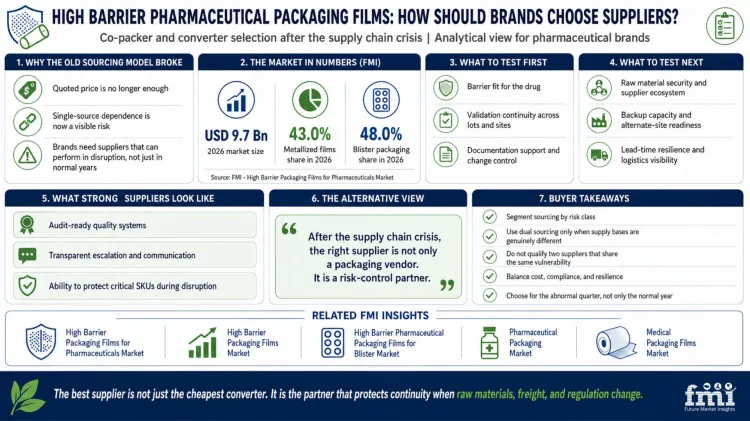
The supplier-selection conversation in the high barrier packaging films for pharmaceuticals market has changed. Before the supply chain crisis, many brands could justify choosing a converter or co-packer through a familiar procurement lens: price, capacity, technical compliance, lead time, and incumbent relationship. That logic is no longer enough.
High barrier pharmaceutical packaging films are not ordinary flexible packaging. They protect dosage stability, shelf life, moisture-sensitive formulations, oxygen-sensitive products, and unit-dose integrity. When supply chains break, the risk is more than late packaging. The risk is delayed product release, revalidation burden, emergency sourcing, short supply, regulatory documentation gaps, and loss of confidence from commercial teams.
FMI values the high barrier packaging films for pharmaceuticals market at USD 9.7 billion in 2026. Metallized films are expected to account for 43.0% of material demand, while blister packaging is expected to hold 48.0% of application demand. These figures matter because the highest-volume segments are also the ones where brands are most tempted to use price-led sourcing. That is where supplier-selection mistakes often begin.
Post-crisis sourcing has a simple test: choose the supplier that can perform in a bad quarter, not the one that looks cheapest in a normal year.
For standard metallized films, mid-barrier pouch films, sachet films, and some strip-pack materials, brands can still use cost competition. China-based converters often have scale advantages, broad material ecosystems, and competitive pricing. They are important options where specifications are standardized and the drug product does not carry extreme stability sensitivity. Pharmaceutical brands still need to test low price against landed-cost risk, tariff exposure, lead-time volatility, audit transparency, documentation quality, and alternate-site availability.
The high barrier pharmaceutical packaging films for blister market shows why blister applications require stricter supplier selection. FMI estimates the blister-specific high barrier pharmaceutical films market at USD 6.24 billion in 2026 and identifies stability requirements for moisture-sensitive and photosensitive drugs as a core demand driver. In practical terms, a blister film supplier must be evaluated on material quality and on whether that material can remain consistent across batches, sites, and regulatory documentation cycles. high barrier pharmaceutical packaging films for blister market
US suppliers are often clearest when proximity and response time matter. A US-based pharmaceutical brand may pay more for a domestic or regional supplier if that supplier reduces the risk of shipment disruption, documentation delay, emergency revalidation, or quality investigation lag. The pharmaceutical packaging market is increasingly shaped by patient safety, product protection, traceability, and regulatory confidence. These are not soft benefits. They are real procurement economics when a late or inconsistent packaging film threatens a product launch. pharmaceutical packaging market
EU suppliers are often better where the brand needs technical depth, sustainability alignment, PVDC-free development, recyclable barrier structures, and clear change-control processes. The broader high barrier packaging films market shows the shift toward multilayer films, EVOH, coated films, and engineered barrier structures. These materials are not plug-and-play commodities. They require technical support, trial discipline, and evidence that performance can be maintained after downgauging, material change, or sustainability-driven redesign. high barrier packaging films market
A useful co-packer or converter scorecard should start with four filters.
The first filter is barrier fit. The supplier must prove that the selected structure fits the drug’s moisture, oxygen, light, and shelf-life requirements. A lower-cost film that forces added stability work may not be cheaper.
Then check validation continuity. Brands should ask whether the supplier can hold specifications across lots, lines, and backup sites. Change notices, retained samples, batch traceability, and documentation support need to be visible before award.
Next comes resilience. The brand should know where the supplier sources resin, aluminum foil, coatings, adhesives, and specialty layers. One excellent plant with no raw material flexibility is still a fragile partner.
Last, test commercial alignment. A supplier can have good technical capability and still respond too slowly. Brands need partners that escalate shortages early, protect critical SKUs, support emergency allocation, and communicate before constraints hit production.
Sharper read: the best supplier is not always the one with the broadest capacity. It is the one with the clearest risk map. A mid-sized supplier with clean documentation, backup sourcing, rapid technical response, and transparent change control can be more valuable than a larger low-cost supplier that becomes opaque when disruption starts.
This also changes how brands should use dual sourcing. Dual sourcing should not mean qualifying two suppliers that depend on the same resin, foil, coating chemistry, or geography. True resilience requires diversity at the material, plant, geography, logistics, and documentation levels. Otherwise, the second supplier may fail at the same time as the first.
The blister packaging market is a useful reminder of why supplier choice matters. Pharmaceuticals represent a major share of blister packaging demand, and blister packs are deeply connected to patient adherence, product protection, and regulated packaging operations. A brand cannot treat blister film sourcing as a simple commodity exercise when the format is tied to drug stability and patient-facing performance.
Common misread: post-crisis supplier selection means bringing everything closer or paying more for every material. That is too blunt. The smarter approach is segmentation. Use cost-efficient suppliers for standardized, lower-risk formats. Use technically embedded suppliers for validated, high-risk, stability-sensitive formats. Use regional redundancy where service continuity matters. Use global sourcing only when documentation and supply transparency can survive disruption.
Bottom line: after the supply chain crisis, pharmaceutical brands should choose high barrier film suppliers by risk performance, more than price performance.

