

- Market Size (2026)
- USD 832.5 Mn
- Forecast (2036)
- USD 1860.0 Mn
- CAGR (2026 to 2036)
- 8.4%
How big is the Aluminum-Free Retort Pouches Market in 2026?
USD 832.5 million in 2026 and USD 1860.0 million by 2036 at an 8.4% CAGR.
Sales of aluminum-free retort pouches are estimated to rise at 8.4% CAGR through 2036, increasing valuation from USD 832.5 million in 2026 to USD 1860.0 million by 2036. Film producers are improving high-barrier packaging films that remove foil without weakening oxygen protection or seal reliability. In February 2025, the European Commission confirmed that the Packaging and Packaging Waste Regulation had entered into force on February 11. The regulation increases packaging redesign pressure across barrier packaging and requires recyclability to be assessed alongside verified food-protection performance. Commercial expansion depends on proof that each new structure survives sterilization across repeated filling runs and storage conditions.
India and the United States use different qualification routes for aluminum-free retort programs across their prepared-food sectors. Indian prepared-food manufacturers need retort-capable film supply and local filling support across regional production clusters. American food processors operate within a mature retort pouch landscape shaped by process-filing rules and established thermal-processing services. FDA information current in May 2025 states that commercial processors of shelf-stable acidified foods and low-acid canned foods in hermetically sealed containers must register each establishment and file scheduled processes for each product, product style, container size and type, and processing method. The requirement makes container configuration and processing method part of process validation rather than a material choice alone. Japan places greater weight on local trials and careful specification changes across established retort-food lines. Commercial results improve through local testing access and technical service for flexible plastic packaging tied to each approved recipe and processing method.
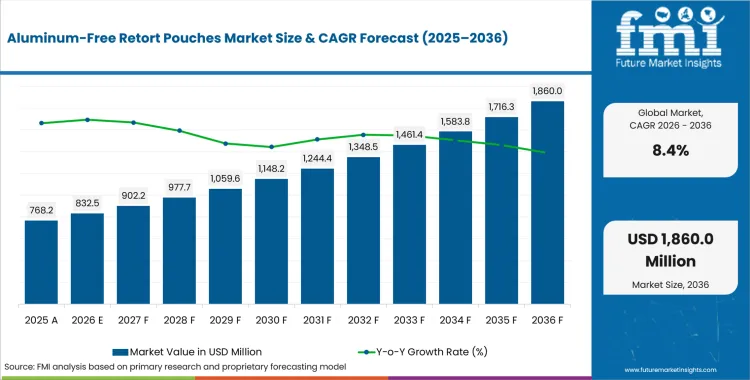
Key Takeaways
- Prepared-food manufacturers are increasing qualification work for foil-free retort structures that preserve shelf life across regulated commercial distribution networks.
- Mono-material PE is expected to represent 35.0% share of material demand in 2026, supported by simpler polymer identification and improving barrier performance.
- Pouches are projected to account for 11.0% share of format demand in 2026, reflecting compact storage and efficient handling across prepared foods.
- Food is estimated to capture 68.0% share of end-use demand in 2026, owing to recurring sterilization and ambient shelf-life requirements.
- Recipe-specific process validation materially slows conversion by requiring seal-integrity and heat-transfer evidence across every affected commercial configuration.
- Amcor; Mondi; Wipak; ProAmpac; Constantia Flexibles; SCGP; TOPPAN; and Coveris compete through barrier development, pouch conversion and technical line support.
Analyst Perspective
“Aluminum-free retort pouches require more than direct foil substitution; every structure must survive heat and long storage without seal failure. The strongest commercial programs pair mono-material design with pilot filling trials and recipe-specific process validation. Pouch manufacturers that provide test access and failure analysis are better positioned to extend one approved food line across a broader portfolio.”
- Nandini Roy Choudhury, Principal Analyst, Future Market Insights
How is the Aluminum-Free Retort Pouches Market segmented?
The aluminum-free retort pouches industry is segmented by material, format, barrier or feature, end use, and region.
Material separates paper, molded fiber, recycled PET, mono-material PE, and bio-based polymer structures according to the main substrate used in each package. Format distinguishes pouches, trays, labels, mailers, and inserts by the package form supplied for filling or distribution. Barrier or feature groups grease resistance, high-barrier protection, tamper evidence, traceability, and freshness indication according to the function added to the package. End use separates food, pharmaceutical, e-commerce, personal care, and cold-chain applications by the operating setting served. Regional analysis compares commercial availability, qualification support, and regulatory conditions across major geographic areas and processing networks. The taxonomy keeps pouch formats tied to verified retort compatibility and excludes unrelated flexible structures that lack thermal-processing evidence.
What supports mono-material PE within the material category?
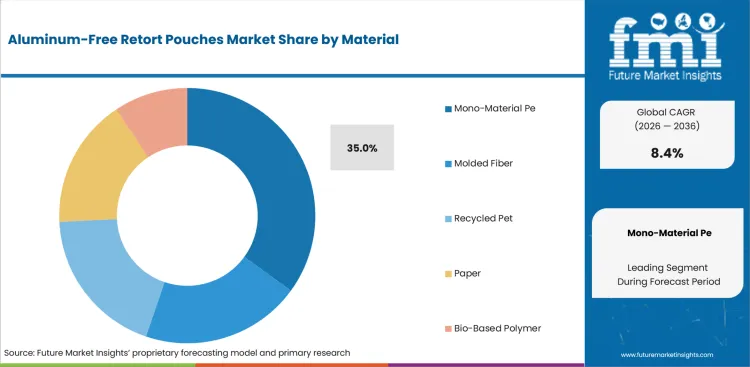
Mono-material PE reduces the number of polymer families that recovery systems must identify across mono-material packaging waste. In March 2025, ProAmpac announced patents covering RT-4000 as an ultra-high-barrier recycle-ready pouch developed for commercial retort processing. The development confirms that a simpler polymer structure must retain heat resistance and barrier performance throughout commercial processing. Package engineers therefore test oxygen protection and seal strength across each recipe instead of treating polymer identity as sufficient commercial qualification. Comparable evidence across recyclable packaging helps teams evaluate recovery compatibility alongside retort performance during material selection.
- By material, mono-material PE is estimated to hold 35.0% in 2026 owing to clearer polymer identification across emerging recovery systems. Barrier coatings and sealing layers can preserve a predominantly polyethylene structure without removing the protection required for shelf-stable foods. Each commercial specification must pass thermal-processing trials across the intended recipe and documented filling-line conditions.
- Prepared-food manufacturers are increasing purchases of mono-material PE through staged trials that compare oxygen protection with seal strength across actual recipes. Repeated commercial production runs show how the film behaves during sterilization and subsequent distribution across established retail networks. Wider portfolio use becomes practical once technical teams document acceptable performance limits for related product families and processing lines.
Why do pouches remain central within the format category?
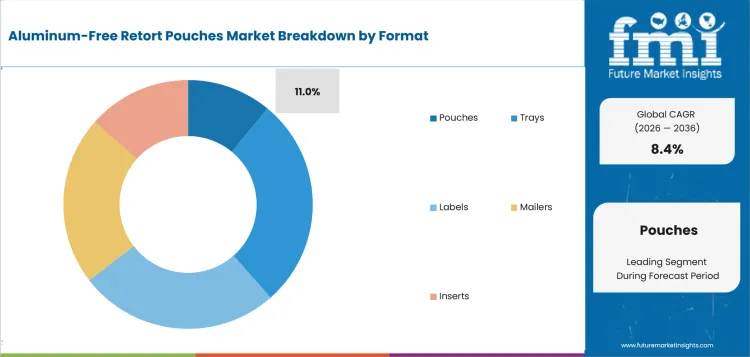
Pouches reduce storage space and shipping weight compared with rigid retort containers across high-volume ready meals packaging programs. Mondi reported in April 2025 that FlexStudios combines pilot filling and sealing lines with a mono-PP upright retort pouch. FlexStudios allows package engineers to test seal windows and package deformation without interrupting normal commercial production schedules. The development ties format selection to operating evidence rather than general claims about flexible-package efficiency.
- Pouches is set to lead the format category with 11.0% share in 2026 due to compact storage and efficient filling across shelf-stable food programs. Flexible pouch walls lower package volume yet require controlled mechanical support during filling and commercial retorting operations. Pilot-line access improves qualification by revealing seal failures or package distortion ahead of a commercial production change.
- Ready-meal producers favor pouches that preserve line speed and reliable coding across commercial filling temperatures. Adoption expands through designs that remain stable during handling and thermal processing without complicated machine changes. Strong programs combine pouch development with process validation so production teams avoid preventable downtime and inconsistent sterilization results across repeated manufacturing runs.
How does grease resistance shape the barrier or feature category?
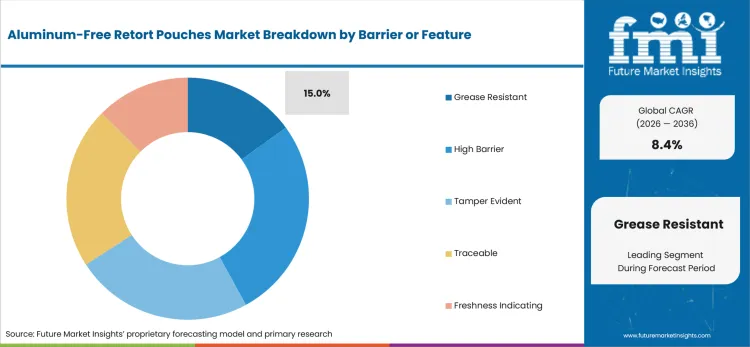
Grease resistance protects printed layers and sealing areas from contact with moist or fatty foods during filling and retorting. ProAmpac reported in April 2026 that its moist and semi-moist food range included RT-4000 mono-material films designed for demanding retort conditions. The update confirms active development for wet formulations but does not establish performance through grease resistance alone. Package engineers therefore assess grease exposure with oxygen protection and print adhesion alongside seal durability.
- Grease resistance is likely to capture 15.0% share in 2026 attributable to oil-rich sauces and prepared meals that expose seals and printed surfaces. Grease resistance protects package appearance and limits contamination around sealing areas during commercial production and later distribution handling. Its commercial role remains linked to total barrier performance rather than a decorative coating choice.
- Sauce manufacturers increase grease-resistant use through coatings and laminate structures matched to product composition and sterilization temperature. Qualification covers prolonged product contact across the intended shelf-life period and repeated package handling during commercial distribution. Technical teams also compare print adhesion with seal cleanliness so packages remain dependable throughout commercial filling and extended retail storage.
What keeps food central within the end use category?
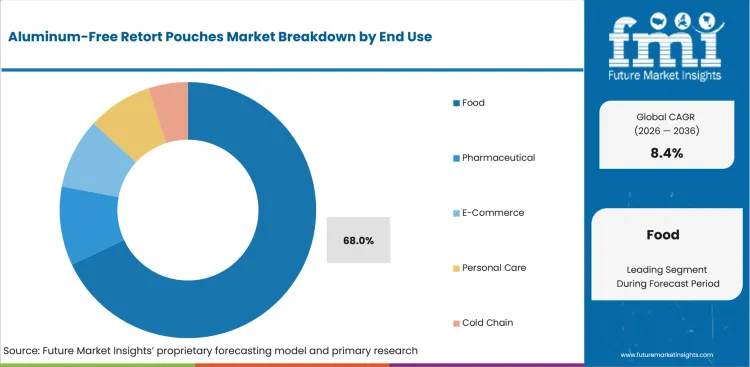
Food applications require thermal stability and barrier protection across recipes with different acidity and storage periods. TOPPAN reported in July 2025 that an ALL-PP mono-material pouch entered commercial use for a retort curry in Japan. TOPPAN completed material suitability checks and commercial filling tests during the package qualification program for prepared-food production. The commercial adoption connects retort demand with direct production evidence instead of general barrier-film claims.
- Based on end use, food is projected to account for 68.0% in 2026 due to recurring sterilization and ambient shelf-life requirements. Sauces and prepared meals create repeat commercial volumes once each structure clears recipe-specific processing and shelf-life trials. Food processors also value packages that extend nationwide distribution without adding refrigeration across established retail networks.
- Food manufacturers expand aluminum-free use through product families that share similar process temperatures and barrier requirements. Successful trials create reusable specifications for related recipes and reduce qualification effort across later launches. Investment becomes more attractive once pouch manufacturers provide dependable filling support and investigate package failures during commercial food production. The same technical service strengthens food packaging programs across related recipes and several commercial production locations.
What are the drivers, restraints, and opportunities in the Aluminum-Free Retort Pouches Market?
Commercial foil-free retort systems expand material choices while process filing slows conversion. Pilot-line support creates a practical route to wider adoption.
- Driver: Commercial foil-free structures give prepared-food manufacturers qualified alternatives that preserve filling efficiency and shelf-stable protection.
- Restraint: Product-specific process filings and package validation increase the time and expense required for every commercial material change.
- Opportunity: Mono-material retort systems reward pouch manufacturers that combine barrier development with line trials and documented application support.
Commercially available foil-free structures give prepared-food manufacturers a practical and testable reason to begin package conversion programs. In September 2025, ProAmpac stated that RT-4000 delivered recycle-ready retort performance without reducing filling-line efficiency. The development gives food-packaging engineering teams a qualified starting point for replacing traditional aluminum-foil laminates across selected recipes. Demand strengthens through programs that convert technical capability into recipe-specific evidence across sterilization and shelf-life tests. Reliable production data lets prepared-food manufacturers screen broader product families with less technical uncertainty and lower trial risk.
Process filing makes a pouch change part of food-safety validation rather than a routine material substitution. Each new structure can alter heat transfer or container behavior across a scheduled thermal process. FDA information current in May 2025 requires commercial processors to file each product and container type with its processing method. Food manufacturers therefore carry additional testing and documentation costs across every affected commercial recipe and container configuration. Smaller product portfolios spread validation costs across fewer commercial units and therefore raise testing expense per product.
Pilot filling programs is a lucrative opportunity for pouch manufacturers that can close remaining performance gaps in mono-material retort structures. Commercial tests must combine seal behavior with shelf life and physical handling across real food products. Drop resistance requires separate commercial evaluation; oxygen and moisture tests cannot reveal package damage during distribution. TNO reported in July 2025 that partners tested more than 2,000 mono-PP soup pouches on commercial filling lines. The project met several functional requirements but retained unresolved drop-impact performance and external recyclability-validation limits for commercial adoption.
Which country CAGRs are profiled in the Aluminum-Free Retort Pouches Market?
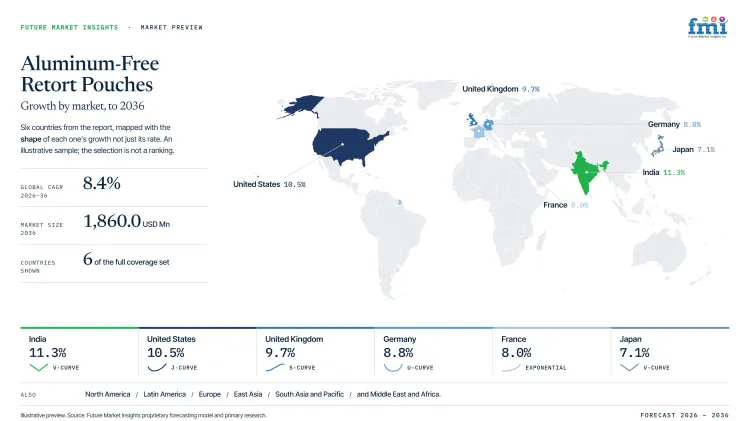
| Country | CAGR |
|---|---|
| India | 11.3% |
| United States | 10.5% |
| Germany | 8.8% |
| United Kingdom | 9.7% |
| France | 8.0% |
| Japan | 7.1% |
How do country-level CAGRs compare in the Aluminum-Free Retort Pouches Market?
The profiled forecasts span 4.2 percentage points and form three practical growth bands across the assessed markets. India and the United States create the upper pair with a difference of 0.8 percentage point. The United Kingdom and Germany occupy the middle band with a measured 0.9-percentage-point difference between their forecasts. France and Japan complete the comparison through another 0.9-point interval shaped by local qualification practices.
- India and the United States combine large processed-food systems with different access to retort film capacity and package-validation services.
- The United Kingdom and Germany face stronger formal packaging assessments that increase the value of documented polymer compatibility and local technical support.
- France and Japan maintain capable food-processing sectors, although conservative specification changes can extend qualification across established commercial lines.
Comparable CAGRs can produce substantially different entry conditions across established national food-processing and flexible-packaging systems. Film availability and process-validation support influence deployment timing more directly than a simple forecast rank. The full report evaluates North America and Latin America alongside Europe and East Asia across established food-processing systems. The regional analysis also covers South Asia and Pacific as well as the Middle East and Africa through country-specific qualification conditions.
Country-wise Analysis
- India combines expanding prepared-food production with limited retort conversion and qualification support outside its major industrial packaging clusters. In India, aluminum-free retort pouch demand is predicted to advance at 11.3% CAGR through 2036, supported by domestic film investment and broader shelf-stable distribution. TOPPAN announced in November 2025 that its Punjab subsidiary began operating a hybrid BOPP and BOPE film line. TOPPAN stated that the line would increase local film capacity by about 40% and widen access to mono-material substrates. Local film output supports material access but does not replace barrier design or recipe-specific sterilization tests. Commercial programs work best through staged trials that include local engineering support and clear responsibility for production failures.
- United States food processors operate within mature thermal-processing rules and a broad flexible-packaging service network. Aluminum-free retort pouch sales in the United States are forecast to expand at 10.5% CAGR by 2036, aided by mature process-authority services and extensive shelf-stable food distribution. FDA stated in October 2025 that entry reviewers verify low-acid or acidified-food FCE and SID identifiers during import checks. Established process authorities give food manufacturers direct access to package validation and recipe-specific scheduled-process support. Each product and container configuration must match its scheduled process, which makes filing accuracy a material friction. Pouch manufacturers gain an advantage through technical records that connect film specifications with approved filling and sterilization conditions.
- Germany combines advanced film conversion capabilities with a formal recyclability assessment used during commercial packaging design and material selection. By 2036, aluminum-free retort pouch demand in Germany is projected to grow at 8.8% CAGR, underpinned by technical conversion capability and formal recyclability assessment. The German Environment Agency issued its 2025 minimum standard for packaging recyclability in August 2025. The standard gives package engineers a defined basis for reviewing polymer structures and compatible barrier components. Strict scoring can penalize packages that require coatings or sealing layers outside the main polymer family. Commercial programs need evidence that links recovery compatibility with food protection across each intended retort process.
- United Kingdom food manufacturers face producer-responsibility charges alongside established retailer requirements for shelf-stable flexible packaging and documented recyclability. Adoption of aluminum-free retort pouches in the United Kingdom is estimated to expand at 9.7% CAGR through 2036, reinforced by packaging-fee exposure and established flexible-format experience. Defra published base fees for the 2025 producer-responsibility year in June 2025 and linked later fees to recyclability assessments. The policy gives package engineers a direct reason to test aluminum-free structures with clearer material classification. Fee uncertainty and limited retort-specific recovery routes remain material frictions during multi-year packaging and investment planning. Strong projects combine package-performance data with an informed view of likely fee treatment across the portfolio.
- France combines a large prepared-food base with national goals for plastic reduction and packaging recovery. France's aluminum-free retort pouches market is estimated to post 8.0% CAGR over the forecast period, shaped by national plastic-reduction goals and established prepared-food production. The ecological-transition ministry released an interim national 3R packaging-strategy review in June 2025 for single-use plastic packaging. The review gives package engineers a local basis for evaluating plastic reduction and recycling claims. Every recipe requires separate thermal-process and seal evidence, which makes food-safety validation a material local friction. Market entry works best through manufacturer partnerships that combine package redesign with measured line performance across commercial production.
- Japan combines concentrated retort-food manufacturing with careful specification changes and advanced domestic barrier-film development across established commercial producers. Aluminum-free retort pouch demand in Japan is forecast to rise at 7.1% CAGR over the forecast period, influenced by advanced barrier-film capability and careful local qualification. The Ministry of the Environment reported in March 2026 that 1,434 municipalities planned plastic-packaging collection for fiscal 2026. The collection footprint gives package engineers a local reason to document polymer composition and sorting compatibility. Food manufacturers expect repeated filling and sterilization tests, which makes conservative material change a persistent commercial friction. Pouch manufacturers gain traction through local trials and technical support that addresses recipe-specific barrier behavior.
Who are the notable companies in the Aluminum-Free Retort Pouches Market?
Amcor, Mondi, Wipak, ProAmpac, Constantia Flexibles, SCGP, TOPPAN, and Coveris are the notable companies assessed in this market.
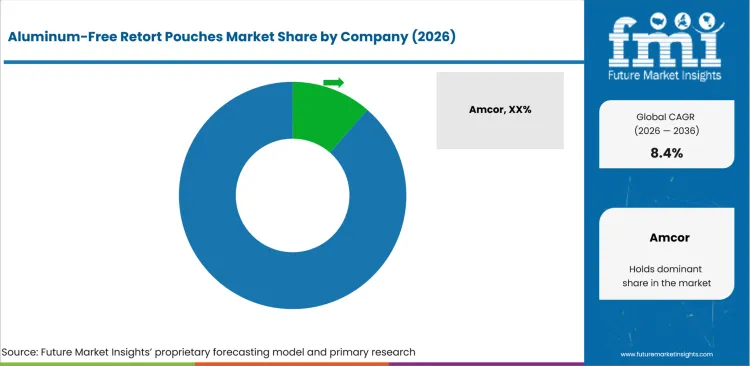
The competitive field combines barrier-film developers with pouch manufacturers that support trials and specification changes. Amcor completed its combination with Berry Global in April 2025, so Berry no longer operates as a separate competitor. Mondi combines pilot filling trials with mono-PP retort formats, while Wipak supports flexible packaging programs through high-barrier aluminum-free pouches designed for retort processing. ProAmpac and Constantia Flexibles document high-barrier mono-material development across demanding food applications, and TOPPAN adds verified Japanese commercial adoption. SCGP adds an all-PP retort option for Asian food programs and Coveris contributes European CPP film capacity for regional pouch conversion. Competitive strength depends on exact application evidence and responsive technical service rather than corporate scale or general packaging reputation.
- Amcor and Mondi combine foil-free retort development with broad manufacturing or pilot-trial capacity across major commercial regions. Wipak adds high-barrier aluminum-free pouches designed for retort and HPP processing across sensitive food applications. Prepared-food manufacturers compare barrier evidence and technical response during recipe qualification before approving larger portfolio conversions.
- ProAmpac and Constantia Flexibles emphasize high-barrier structures with dated retort-food activity, while TOPPAN adds verified Japanese adoption across prepared-food applications. Their competitive test involves dependable material performance and practical filling support across demanding recipes and commercial sterilization conditions. Production teams also compare investigation speed whenever seals or package shape fail during commercial trials.
- SCGP provides an all-PP retort structure for ready meals and wet pet food across Asian programs. Coveris contributes European CPP film capacity through its completed GEFO acquisition and expanded German manufacturing operations. Regional food manufacturers compare local trial support and delivery continuity before extending a qualified structure across additional production locations.
Competitive Benchmarking: Aluminum-Free Retort Pouches Market
| Company | Aluminum-Free Retort Portfolio | Mono-Material Barrier Capability | Pouch Conversion and Line Support | Geographic Reach |
|---|---|---|---|---|
| Amcor | High | High | Medium | Global |
| Mondi | High | High | High | Global |
| Wipak | High | Medium | Medium | Europe |
| ProAmpac | High | High | High | Global |
| Constantia Flexibles | High | High | High | Global |
| SCGP | High | Medium | Medium | Asia |
| TOPPAN | High | High | High | Global |
| Coveris | Medium | Medium | Medium | Europe |
Key Developments in the Aluminum-Free Retort Pouches Market
- In March 2026, Amcor expanded its Italy facility through a dedicated high-barrier line for recyclable structures including AmLite HeatFlex. The investment increases commercial capacity for foil-free packages that require dependable oxygen and moisture protection. Retort programs gain a broader European manufacturing route, although each food application requires seal and thermal-process validation under its intended filling conditions. The dedicated line also improves European capacity planning across several qualified retort formats and customer production schedules.
- In September 2025, Constantia Flexibles introduced EcoVer Retort Pouch and demonstrated mono-material pouch conversion on operating equipment at FACHPACK. The polypropylene structure targets high-barrier commercial retort applications and supports compatibility with established recycling streams. Food manufacturers gain a direct route for production trials, although approval continues to require recipe-specific sterilization and seal testing. The equipment demonstration provides stronger evidence for planning retort qualification across commercial filling and pouch-conversion conditions.
- In June 2026, Coveris acquired the business and assets of GEFO to expand cast-polypropylene film capability in Germany. The completed transaction strengthens access to sealing films used across mono-material flexible structures and retort applications. European manufacturers gain a more integrated conversion route, although verified suitability continues to depend on barrier-layer selection and each thermal-processing specification. The added German capacity shortens coordination between sealing-film production and pouch-conversion teams across European retort programs.
Key Players in the Aluminum-Free Retort Pouches Market
Established Retort Specialists
- Amcor
- Mondi
- Wipak
High-Barrier Pouch Innovators
- ProAmpac
- Constantia Flexibles
- TOPPAN
Regional and Integrated Converters
- SCGP
- Coveris
Aluminum-Free Retort Pouches Market - Report Scope
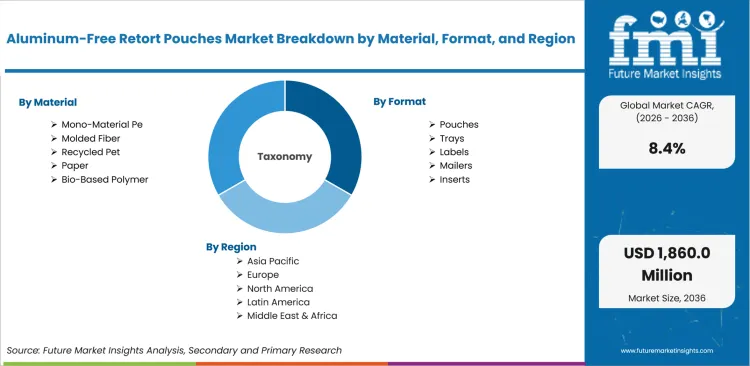
| Coverage field | Report scope |
|---|---|
| Market breakdown | Material, format, barrier or feature, end use, and region. |
| Quantitative Units | Revenue in USD Million, CAGR in %. |
| Market Definition | Commercially tracked demand for aluminum-free retort pouches used across shelf-stable food and other qualified thermal-processing applications. |
| Regions Covered | North America, Latin America, Europe, East Asia, South Asia and Pacific, and Middle East and Africa. |
| Countries Covered | United States, Germany, United Kingdom, France, Japan, India, and 30+ countries. |
| Key Companies Profiled | Amcor, Mondi, Wipak, ProAmpac, Constantia Flexibles, SCGP, TOPPAN, Coveris. |
| Forecast Period | 2026 to 2036. |
| Approach | Hybrid bottom-up and top-down market sizing supported by primary interviews and official desk research. |
Aluminum-Free Retort Pouches Market - Research Methodology
| Method | Approach |
|---|---|
| Primary Research | FMI analysts gathered input from manufacturers, service providers, technology developers, distributors, end users, sourcing teams, and subject-matter experts. Interviews examined purchasing decisions, product or service evaluation, adoption barriers, approval requirements, pricing considerations, and expectations for technical or commercial support. Respondents were also asked what evidence is required before a trial, pilot, or initial order develops into regular purchasing. |
| Desk Research | Desk research covered government statistics, regulatory publications, trade data, industry associations, technical literature, standards, company filings, product information, and official corporate announcements. Sources were reviewed for relevance, publication date, geographic coverage, and consistency with the defined market scope. Claims relating to performance, applications, approvals, capacity, investment, and commercial activity were retained only when supported by credible public evidence. |
| Market Sizing and Forecasting | The market model combined the baseline value with historical performance, segment structure, pricing and volume indicators, adoption levels, company participation, and country-level demand conditions. Forecast assumptions considered economic activity, investment trends, regulatory developments, technology adoption, purchasing cycles, supply availability, and barriers to wider market use. Segment and regional estimates were reconciled before the final market total was calculated. |
| Data Validation | Estimates were checked against multiple independent indicators, including public data, company activity, trade patterns, industry developments, and findings from primary interviews. Validation also tested whether products, services, applications, and company revenues fell within the defined market boundaries. Adjacent categories, unsupported claims, overlapping revenues, and activities without direct market relevance were excluded to reduce double counting and maintain consistency across segments and countries. |
Aluminum-Free Retort Pouches Market by Segments
Aluminum-Free Retort Pouches Market segmented by Material:
- Paper
- Molded Fiber
- Recycled PET
- Mono-material PE
- Bio-based Polymer
Aluminum-Free Retort Pouches Market segmented by Format:
- Pouches
- Trays
- Labels
- Mailers
- Inserts
Aluminum-Free Retort Pouches Market segmented by Barrier or Feature:
- Grease Resistant
- High Barrier
- Tamper Evident
- Traceable
- Freshness Indicating
Aluminum-Free Retort Pouches Market segmented by End Use:
- Food
- Pharmaceutical
- E-commerce
- Personal Care
- Cold Chain
Aluminum-Free Retort Pouches Market by Region:
- North America
- United States
- Canada
- Mexico
- Latin America
- Brazil
- Chile
- Rest of Latin America
- Western Europe
- Germany
- UK
- Italy
- Spain
- France
- Nordic
- BENELUX
- Rest of Western Europe
- Eastern Europe
- Russia
- Poland
- Hungary
- Balkan and Baltic
- Rest of Eastern Europe
- East Asia
- China
- Japan
- South Korea
- South Asia and Pacific
- India
- ASEAN
- Australia and New Zealand
- Rest of South Asia and Pacific
- Middle East and Africa
- Kingdom of Saudi Arabia
- Other GCC Countries
- Turkiye
- South Africa
- Other African Union
- Rest of Middle East and Africa
Research Sources and Bibliography
- Directorate-General for Environment. (2025, February 11). New rules enter into force for a more sustainable and competitive packaging economy.
- USA Food and Drug Administration. (2025, May 29). Acidified & Low-Acid Canned Foods Guidance Documents & Regulatory Information.
- ProAmpac. (2025, March 11). Securing Patents for Sustainable Packaging Innovations.
- Mondi. (2025, April 2). Inside Mondi FlexStudios - and its innovation for circular packaging.
- ProAmpac. (2026, April 7). Fresh Meals, Happy Pets.
- ProAmpac. (2025, September 16). Film, Fibre, and Beyond - ProAmpac Brings Total Packaging Solutions to FACHPACK 2025.
- TOPPAN Holdings Inc. (2025, July 17). TOPPAN’s All-PP Monomaterial Pouch for Retort Foods Adopted for the First Time in Japan.
- USA Food and Drug Administration. (2025, May 29). Acidified & Low-Acid Canned Foods Guidance Documents & Regulatory Information.
- TNO. (2025, July 15). Progress in circular packaging for soups and sauces.
- Wipak. (2026, April 13). Designed for parents, built for brands.
- TOPPAN Holdings Inc. (2025, November 10). TOPPAN Group Launches BOPP/BOPE Film Hybrid Production Line in India for Sustainable Packaging Materials.
- USA Food and Drug Administration. (2025, October 29). Importing Human Foods.
- German Environment Agency. (2025, August 29). Recyclingfähigkeit von Verpackungen: Mindeststandard 2025.
- Department for Environment, Food & Rural Affairs. (2025, June 30). Extended Producer Responsibility for Packaging: 2025 base fees.
- Ministère de la Transition écologique, de la Biodiversité, de la Forêt, de la Mer et de la Pêche. (2025, June). Stratégie nationale pour la réduction, le réemploi et le recyclage des emballages en plastique à usage unique (Stratégie 3R): Présentation du bilan intermédiaire.
- Ministry of the Environment, Japan. (2026, March 31). Compilation Results of Projected Separate Collection Volumes for Fiscal Year 2026 and Beyond under the Containers and Packaging Recycling Act.
- Amcor. (2025, April 30). Amcor completes combination with Berry Global; Positioned to significantly enhance value for customers and shareholders.
- Amcor. (2026, March 9). Amcor’s expanded facility in Italy will meet demand for recyclable packaging.
- Constantia Flexibles. (2025, August 12). FACHPACK 2025: Constantia Flexibles invests over €100 million and expands product portfolio.
- TOPPAN Holdings Inc. (2026, February 6). TOPPAN’s Retort- and Microwave-Compatible Packaging Using Water-Based Flexographic Printing and Solvent-Free Lamination Adopted for the First Time in Japan.
- Coveris. (2026, June 16). Coveris expands CPP film capabilities with acquisition of GEFO in Germany.
- SCG Packaging Public Company Limited. (2025, October 17). Mono retort.
- SCG Packaging Public Company Limited. (2025, October 28). SCGP Announces Q3 Results, Accelerates Consumer Packaging Expansion, Reinforces ASEAN Domestic Market Presence, Maintain Strong Financial Management - Supply Chain to Capture Economic Stimulus Momentum.
This bibliography is provided for reader reference and is not exhaustive. The full report contains the complete reference list and detailed citations.
This Report Answers
- How large is the aluminum-free retort pouches market in 2026 and 2036?
- Which material conditions support mono-material PE adoption across retort food applications?
- Why do pouch formats require separate filling and thermal-processing validation?
- How does grease resistance influence package quality across sauces and prepared meals?
- Why does food account for the largest profiled end-use share in 2026?
- How do country growth conditions differ across India, the United States, Europe, and Japan?
- Which companies provide foil-free retort structures, conversion capacity, or technical line support?
- What qualification requirements limit rapid substitution of aluminum foil across commercial programs?
- Which recent investments and commercial adoptions are changing competitive availability?
Frequently Asked Questions
What is driving growth in the aluminum-free retort pouches market?
Foil-free retort structures now combine commercial barrier performance with clearer material-recovery routes. Recipe-specific qualification converts technical availability into repeat orders across prepared-food portfolios.
Who are the key players in the aluminum-free retort pouches market?
The assessed group includes Amcor, Mondi, Wipak, ProAmpac, Constantia Flexibles, SCGP, TOPPAN, and Coveris. Their roles cover barrier development, pouch conversion, and application support.
What is a notable restraint in the aluminum-free retort pouches market?
Recipe-specific testing raises the cost and duration of every commercial material change. Each structure requires evidence for sealing performance and sterilization behavior under intended production conditions.
Why should executives track the aluminum-free retort pouches market?
Packaging choices affect shelf life and recovery obligations across major prepared-food portfolios. Early qualification protects launch schedules and reduces repeated conversion work across related recipes.
What business problem does the aluminum-free retort pouches market address?
The category reduces reliance on aluminum foil across packages requiring demanding thermal and barrier performance. Qualified alternatives support material recovery without abandoning shelf-stable distribution.
What should packaging teams evaluate in the aluminum-free retort pouches market?
Packaging teams should compare barrier retention and seal strength across actual recipes. They should also assess filling support and sterilization validation for every intended product family.
What limits return on investment in the aluminum-free retort pouches market?
Low production volumes and repeated qualification work weaken project economics across smaller programs. Poor line support increases downtime and delays evidence needed for broader portfolio conversion.
What supports long-term confidence in the aluminum-free retort pouches market?
Commercial food adoptions confirm that foil-free retort structures can reach production under validated conditions. Repeated line evidence supports broader conversion across related prepared-food products.
Preview the report firsthand - request a free sample
Get SampleGet the brochure for pricing and purchase details.
Get PDFTable of Content
- Key Takeaways
- Market Size and CAGR
- Top Growth Driver
- Fastest Growing Segment
- Leading Region
- Key Companies
- Emerging Opportunities
- Executive Summary
- Global Market Outlook
- Demand-side Trends
- Supply-side Trends
- Technology Roadmap Analysis
- Analysis and Recommendations
- Analyst Perspective (What is happening? Why now? What should investors know?)
- Key Questions Answered
- How large is the market?
- What is the CAGR?
- What are key trends?
- Which region dominates?
- Who are the leaders?
- Market Overview
- Market Coverage / Taxonomy
- Market Definition / Scope / Limitations
- Research Methodology
- Chapter Orientation
- Analytical Lens and Working Hypotheses
- Market Structure, Signals, and Trend Drivers
- Benchmarking and Cross-market Comparability
- Market Sizing, Forecasting, and Opportunity Mapping
- Research Design and Evidence Framework
- Desk Research Programme (Secondary Evidence)
- Expert Input and Fieldwork (Primary Evidence)
- Tooling, Models, and Reference Databases
- Data Engineering and Model Build
- Quality Assurance and Audit Trail
- Market Background
- Market Dynamics (Drivers, Restraints, Opportunity, Trends)
- Scenario Forecast (Optimistic, Likely, Conservative)
- Impact Analysis
- AI Impact
- Sustainability Impact
- Regulatory Impact
- Technology Impact
- Consumer / Buyer Analysis
- Purchase Drivers
- Adoption Barriers
- Buyer Journey
- Opportunity Map Analysis
- Product Life Cycle Analysis
- Supply Chain Analysis
- Investment Feasibility Matrix
- Value Chain Analysis
- PESTLE and Porter's Analysis
- Regulatory Landscape
- Regional Parent Market Outlook
- Production and Consumption Statistics
- Import and Export Statistics
- Global Market Analysis and Forecast, 2021 to 2036
- Historical Market Size Value (USD Million) Analysis, 2021 to 2025
- Current and Future Market Size Value (USD Million) Projections, 2026 to 2036
- Y-o-Y Growth Trend Analysis
- Absolute $ Opportunity Analysis
- Global Market Pricing Analysis, 2021 to 2036
- Global Market Analysis and Forecast, By Material, 2021 to 2036
- Introduction / Key Findings
- Historical Market Size Value (USD Million) Analysis By Material, 2021 to 2025
- Current and Future Market Size Value (USD Million) Analysis and Forecast By Material, 2026 to 2036
- Mono-Material Pe
- Molded Fiber
- Recycled Pet
- Paper
- Bio-Based Polymer
- Mono-Material Pe
- Y-o-Y Growth Trend Analysis By Material, 2021 to 2025
- Absolute $ Opportunity Analysis By Material, 2026 to 2036
- Global Market Analysis and Forecast, By Format, 2021 to 2036
- Introduction / Key Findings
- Historical Market Size Value (USD Million) Analysis By Format, 2021 to 2025
- Current and Future Market Size Value (USD Million) Analysis and Forecast By Format, 2026 to 2036
- Pouches
- Trays
- Labels
- Mailers
- Inserts
- Pouches
- Y-o-Y Growth Trend Analysis By Format, 2021 to 2025
- Absolute $ Opportunity Analysis By Format, 2026 to 2036
- Global Market Analysis and Forecast, By Barrier or Feature, 2021 to 2036
- Introduction / Key Findings
- Historical Market Size Value (USD Million) Analysis By Barrier or Feature, 2021 to 2025
- Current and Future Market Size Value (USD Million) Analysis and Forecast By Barrier or Feature, 2026 to 2036
- Grease Resistant
- High Barrier
- Tamper Evident
- Traceable
- Freshness Indicating
- Grease Resistant
- Y-o-Y Growth Trend Analysis By Barrier or Feature, 2021 to 2025
- Absolute $ Opportunity Analysis By Barrier or Feature, 2026 to 2036
- Global Market Analysis and Forecast, By End Use, 2021 to 2036
- Introduction / Key Findings
- Historical Market Size Value (USD Million) Analysis By End Use, 2021 to 2025
- Current and Future Market Size Value (USD Million) Analysis and Forecast By End Use, 2026 to 2036
- Food
- Pharmaceutical
- E-Commerce
- Personal Care
- Cold Chain
- Food
- Y-o-Y Growth Trend Analysis By End Use, 2021 to 2025
- Absolute $ Opportunity Analysis By End Use, 2026 to 2036
- Global Market Analysis and Forecast, By Region, 2021 to 2036
- Introduction
- Historical Market Size Value (USD Million) Analysis By Region, 2021 to 2025
- Current Market Size Value (USD Million) Analysis and Forecast By Region, 2026 to 2036
- North America
- Latin America
- Western Europe
- Eastern Europe
- East Asia
- South Asia and Pacific
- Middle East & Africa
- Market Attractiveness Analysis By Region
- North America Market Analysis and Forecast, By Country, 2021 to 2036
- Historical Market Size Value (USD Million) Trend Analysis By Market Taxonomy, 2021 to 2025
- Market Size Value (USD Million) Forecast By Market Taxonomy, 2026 to 2036
- By Country
- USA
- Canada
- By Material
- By Format
- By Barrier or Feature
- By End Use
- By Country
- Market Attractiveness Analysis
- By Country
- By Material
- By Format
- By Barrier or Feature
- By End Use
- Key Takeaways
- Latin America Market Analysis and Forecast, By Country
- Historical Market Size Value (USD Million) Trend Analysis By Market Taxonomy, 2021 to 2025
- Market Size Value (USD Million) Forecast By Market Taxonomy, 2026 to 2036
- By Country
- Brazil
- Mexico
- Chile
- Rest of Latin America
- By Material
- By Format
- By Barrier or Feature
- By End Use
- By Country
- Market Attractiveness Analysis
- By Country
- By Material
- By Format
- By Barrier or Feature
- By End Use
- Key Takeaways
- Western Europe Market Analysis and Forecast, By Country
- Historical Market Size Value (USD Million) Trend Analysis By Market Taxonomy, 2021 to 2025
- Market Size Value (USD Million) Forecast By Market Taxonomy, 2026 to 2036
- By Country
- Germany
- UK
- Italy
- Spain
- France
- Nordic
- BENELUX
- Rest of Western Europe
- By Material
- By Format
- By Barrier or Feature
- By End Use
- By Country
- Market Attractiveness Analysis
- By Country
- By Material
- By Format
- By Barrier or Feature
- By End Use
- Key Takeaways
- Eastern Europe Market Analysis and Forecast, By Country
- Historical Market Size Value (USD Million) Trend Analysis By Market Taxonomy, 2021 to 2025
- Market Size Value (USD Million) Forecast By Market Taxonomy, 2026 to 2036
- By Country
- Russia
- Poland
- Hungary
- Balkan & Baltic
- Rest of Eastern Europe
- By Material
- By Format
- By Barrier or Feature
- By End Use
- By Country
- Market Attractiveness Analysis
- By Country
- By Material
- By Format
- By Barrier or Feature
- By End Use
- Key Takeaways
- East Asia Market Analysis and Forecast, By Country
- Historical Market Size Value (USD Million) Trend Analysis By Market Taxonomy, 2021 to 2025
- Market Size Value (USD Million) Forecast By Market Taxonomy, 2026 to 2036
- By Country
- China
- Japan
- South Korea
- By Material
- By Format
- By Barrier or Feature
- By End Use
- By Country
- Market Attractiveness Analysis
- By Country
- By Material
- By Format
- By Barrier or Feature
- By End Use
- Key Takeaways
- South Asia and Pacific Market Analysis and Forecast, By Country
- Historical Market Size Value (USD Million) Trend Analysis By Market Taxonomy, 2021 to 2025
- Market Size Value (USD Million) Forecast By Market Taxonomy, 2026 to 2036
- By Country
- India
- ASEAN
- Australia & New Zealand
- Rest of South Asia and Pacific
- By Material
- By Format
- By Barrier or Feature
- By End Use
- By Country
- Market Attractiveness Analysis
- By Country
- By Material
- By Format
- By Barrier or Feature
- By End Use
- Key Takeaways
- Middle East & Africa Market Analysis and Forecast, By Country
- Historical Market Size Value (USD Million) Trend Analysis By Market Taxonomy, 2021 to 2025
- Market Size Value (USD Million) Forecast By Market Taxonomy, 2026 to 2036
- By Country
- Kingdom of Saudi Arabia
- Other GCC Countries
- Türkiye
- South Africa
- Other African Union
- Rest of Middle East & Africa
- By Material
- By Format
- By Barrier or Feature
- By End Use
- By Country
- Market Attractiveness Analysis
- By Country
- By Material
- By Format
- By Barrier or Feature
- By End Use
- Key Takeaways
- Key Countries Market Analysis
- USA
- Pricing Analysis
- Market Share Analysis, 2025
- By Material
- By Format
- By Barrier or Feature
- By End Use
- Canada
- Pricing Analysis
- Market Share Analysis, 2025
- By Material
- By Format
- By Barrier or Feature
- By End Use
- Mexico
- Pricing Analysis
- Market Share Analysis, 2025
- By Material
- By Format
- By Barrier or Feature
- By End Use
- Brazil
- Pricing Analysis
- Market Share Analysis, 2025
- By Material
- By Format
- By Barrier or Feature
- By End Use
- Chile
- Pricing Analysis
- Market Share Analysis, 2025
- By Material
- By Format
- By Barrier or Feature
- By End Use
- Germany
- Pricing Analysis
- Market Share Analysis, 2025
- By Material
- By Format
- By Barrier or Feature
- By End Use
- UK
- Pricing Analysis
- Market Share Analysis, 2025
- By Material
- By Format
- By Barrier or Feature
- By End Use
- Italy
- Pricing Analysis
- Market Share Analysis, 2025
- By Material
- By Format
- By Barrier or Feature
- By End Use
- Spain
- Pricing Analysis
- Market Share Analysis, 2025
- By Material
- By Format
- By Barrier or Feature
- By End Use
- France
- Pricing Analysis
- Market Share Analysis, 2025
- By Material
- By Format
- By Barrier or Feature
- By End Use
- India
- Pricing Analysis
- Market Share Analysis, 2025
- By Material
- By Format
- By Barrier or Feature
- By End Use
- ASEAN
- Pricing Analysis
- Market Share Analysis, 2025
- By Material
- By Format
- By Barrier or Feature
- By End Use
- Australia & New Zealand
- Pricing Analysis
- Market Share Analysis, 2025
- By Material
- By Format
- By Barrier or Feature
- By End Use
- China
- Pricing Analysis
- Market Share Analysis, 2025
- By Material
- By Format
- By Barrier or Feature
- By End Use
- Japan
- Pricing Analysis
- Market Share Analysis, 2025
- By Material
- By Format
- By Barrier or Feature
- By End Use
- South Korea
- Pricing Analysis
- Market Share Analysis, 2025
- By Material
- By Format
- By Barrier or Feature
- By End Use
- Russia
- Pricing Analysis
- Market Share Analysis, 2025
- By Material
- By Format
- By Barrier or Feature
- By End Use
- Poland
- Pricing Analysis
- Market Share Analysis, 2025
- By Material
- By Format
- By Barrier or Feature
- By End Use
- Hungary
- Pricing Analysis
- Market Share Analysis, 2025
- By Material
- By Format
- By Barrier or Feature
- By End Use
- Kingdom of Saudi Arabia
- Pricing Analysis
- Market Share Analysis, 2025
- By Material
- By Format
- By Barrier or Feature
- By End Use
- Türkiye
- Pricing Analysis
- Market Share Analysis, 2025
- By Material
- By Format
- By Barrier or Feature
- By End Use
- South Africa
- Pricing Analysis
- Market Share Analysis, 2025
- By Material
- By Format
- By Barrier or Feature
- By End Use
- USA
- Market Structure Analysis
- Competition Dashboard
- Competition Benchmarking
- Market Share Analysis of Top Players
- By Regional
- By Material
- By Format
- By Barrier or Feature
- By End Use
- Emerging Startups
- Innovation Benchmarking
- Competition Analysis
- Competition Deep Dive
- Amcor
- Overview
- Product Portfolio
- Profitability by Market Segments
- Sales Footprint
- Strategy Overview
- Marketing Strategy
- Product Strategy
- Channel Strategy
- Berry Global
- Mondi
- Huhtamaki
- ProAmpac
- Constantia Flexibles
- UFlex
- Coveris
- Amcor
- Case Studies
- Success Stories
- Recent Developments
- Competition Deep Dive
- Assumptions & Acronyms Used


