


- Commercial heat pump adoption is driven by energy savings, electrification targets, rooftop replacement cycles, refrigerant transition, and building decarbonization plans.
- High upfront cost remains a major barrier when electrical service upgrades, design work, controls integration, and installation complexity are added to equipment price.
- FMI forecasts commercial heat pump demand to grow from USD 20.15 billion in 2026 to USD 69.62 billion by 2036 at a 13.2% CAGR.
- DOE estimates that next-generation high-efficiency rooftop units can cut energy costs by up to 50% versus conventional packaged rooftop units.
- Adoption is strongest when the heat pump can replace an aging HVAC asset during a scheduled capital cycle rather than forcing an unplanned building redesign.
- Buyers increasingly approve projects when suppliers can prove heating output, operating savings, service coverage, and electrical-load feasibility before tender award.
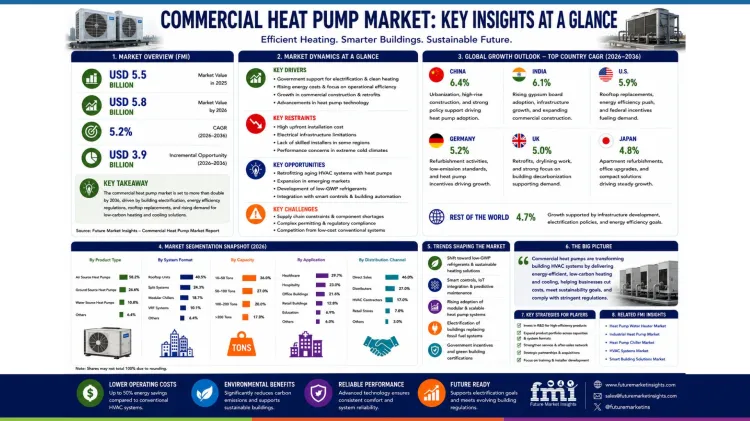
The commercial heat pump adoption decision is rarely a clean comparison between one boiler and one heat pump. A building owner usually has to compare an entire retrofit package that includes equipment cost, installation, electrical upgrades, controls, commissioning, maintenance, tenant disruption, utility tariffs, backup heat, refrigerant rules, and expected energy savings.
That is why the market is growing quickly even while many projects still face approval friction.
FMI forecasts the commercial heat pump market to expand from USD 20.15 billion in 2026 to USD 69.62 billion by 2036. The 13.2% CAGR reflects a strong shift in commercial HVAC planning as buildings move from separate heating and cooling assets toward reversible systems. FMI also states that commercial building owners are replacing boiler-plus-chiller layouts with reversible heating and cooling platforms, while rooftop replacement cycles are pushing packaged heat pump units into schools and retail buildings.
Energy cost savings form the most visible adoption argument. A heat pump moves heat rather than generating heat through combustion, so it can deliver more useful heat per unit of electricity than electric resistance heating and can outperform older inefficient systems under suitable operating conditions. In cooling mode, advanced commercial heat pump rooftop units also compete with conventional packaged air-conditioning equipment.
The DOE Commercial Building HVAC Accelerator states that high-efficiency next-generation rooftop units are estimated to reduce energy costs by up to 50% compared with conventional RTUs. For a facility manager, that kind of number can open the conversation. It does not automatically close the business case, because actual savings depend on climate, load, tariffs, system design, installation quality, and operating hours.
The best adoption cases often begin with aging equipment. If a rooftop unit, boiler, chiller, or packaged HVAC system is near end of life, the owner already expects capital spending. The heat pump is then evaluated against a replacement baseline, not against doing nothing. FMI explicitly identifies rooftop replacement as the main pressure point because building owners are reviewing aging packaged units. This is why retrofit timing matters as much as energy economics.
Upfront cost becomes harder to accept when the heat pump project triggers additional engineering. Older commercial buildings may require electrical panel upgrades, transformer work, wiring, structural roof assessment, controls integration, backup heat decisions, ventilation review, or hydronic redesign. FMI identifies electrical service limitations as a restraint because equipment replacement can trigger wider engineering work. A simple equipment quote can therefore become a broader building electrification project.
This is the point where buyers become cautious. Energy savings may look attractive over ten or fifteen years, and capital approval may be decided over a shorter payback window. Commercial owners may also worry about tenant disruption, heating reliability, contractor capability, and maintenance responsibility. Schools and public buildings may face budget cycles. Retail chains may need standard packages across many locations. Hospitals and hotels may require redundancy before committing.
The IEA heat pump policy work provides the wider building-efficiency context. IEA notes that heat pumps met more than 10% of global heating need in buildings in 2023, while the Net Zero Emissions pathway requires significantly greater deployment by 2030. It also identifies heat pumps as a major building efficiency measure in policy toolkits. That supports the direction of travel, since heat pumps are moving from niche equipment to a mainstream decarbonization tool.
The commercial market still has a project-risk problem. A building owner does not buy the global energy transition. It buys a system that must work on Monday morning in its specific building. A heat pump tender becomes more convincing when the supplier can provide load studies, low-ambient performance data, utility-cost modelling, electrical impact estimates, maintenance plans, and commissioning support.
The FMI direct-sales share of 46.0% reflects this requirement. Large buyers need design responsibility, load studies, and service guarantees. For smaller buildings, HVAC contractors remain important because equipment selection is installer-led. This means adoption is partly controlled by the quality of the local contractor network. Even a good product can stall if contractors are not confident designing, installing, and servicing it.
Refrigerant transition is another adoption driver. FMI states that refrigerant transition is pushing buyers to reconsider older equipment during normal capital cycles. Commercial HVAC buyers already facing equipment replacement may decide to move toward newer heat pump platforms that align better with future refrigerant and efficiency requirements. This can accelerate replacement even when the old system has some remaining life.
Building-policy pressure adds a third layer. In Europe, the Energy Performance of Buildings Directive sets a broad framework for improving building energy performance and reducing fossil fuel dependence. The European Commission zero-emission buildings page states that the 2024 recast directive makes zero-emission the new standard for all new buildings and the gold standard for renovation. Commercial building owners, public bodies, and real estate investors therefore face a stronger long-term signal to electrify heating and improve building performance.
The cost challenge varies by building type. A small office with a packaged rooftop unit may have a relatively straightforward replacement route if the electrical system can support it. A hospital with continuous hot-water and ventilation loads may need modular hydronic heat pumps, redundancy, staged capacity, and careful controls. A hotel may need domestic hot-water stability and guest comfort. A large campus may need central plant redesign, thermal storage, or hybrid systems.
FMI highlights modular hydronic systems as an opportunity in hospitals and hotels because these buildings need staged capacity and continuous service. Modular equipment can reduce project risk by allowing capacity to be added in phases, preserving redundancy, and supporting maintenance access. This is a different adoption driver from simple energy savings. The buyer is paying for operational certainty.
Operating cost savings also depend on electricity and gas prices. A heat pump can be technically efficient and financially less compelling where electricity is expensive relative to gas. The same system can be highly attractive where electricity tariffs, demand-response programmes, renewable procurement, carbon pricing, or gas constraints improve the economics. Commercial buyers increasingly need tariff modelling rather than generic efficiency claims.
Controls matter as well. A heat pump system that is not commissioned correctly can underperform, use backup heat too often, or fail to maintain comfort. This can damage buyer confidence. Suppliers that include commissioning, training, remote monitoring, and service agreements can make adoption more bankable.
The strongest adoption drivers can be grouped into five categories.
Scheduled replacement is the first. Owners are more likely to approve heat pumps when equipment is already due for replacement.
Energy cost reduction is the second. High-efficiency units can reduce operating expense when matched properly to building loads and tariffs.
Decarbonization and compliance is the third. Corporate net-zero goals, public procurement rules, building regulations, and energy-performance standards increase interest.
Operational reliability is the fourth. Hospitals, hotels, schools, and offices need comfort and hot-water stability, not only lower emissions.
Supplier confidence is the fifth. Field data, service coverage, cold-climate performance, and contractor training reduce perceived risk.
The high upfront cost becomes manageable when these drivers combine. A standalone energy-savings argument may struggle. A project linked to equipment end-of-life, energy savings, regulatory pressure, and reliable service has a much stronger chance of approval.
Commercial heat pump adoption is therefore driven by total project economics, not by energy cost savings alone. It is a capital-planning decision shaped by building risk. Buyers move faster when suppliers can prove that the retrofit can be installed, powered, controlled, serviced, and justified within the owner's operating model.

