


- Fish protein isolate supplier winners are those that offer application-ready protein systems, not only bulk ingredient supply.
- Buyers value neutral taste, odor control, protein standardization, solubility, food safety documentation, and reliable raw material sourcing.
- Powder dominance makes supplier capability in drying, particle control, shelf stability, and packaging essential.
- Food & Beverages leads end-use demand, creating opportunities for suppliers that can support formulation in snacks, beverages, powders, fortified foods, and nutrition products.
- Marine protein suppliers can gain if they help brands differentiate from dairy and plant proteins while managing sensory risks.
- The biggest misconception is that fish protein isolate suppliers compete mainly on price. In reality, technical support and specification reliability decide premium supplier status.
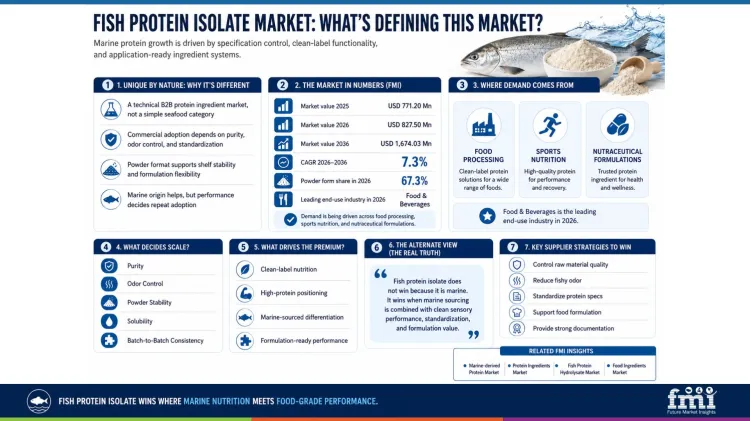
The Fish Protein Isolate Market is becoming more supplier-sensitive as food and nutrition brands look for alternative protein systems. A buyer does not only need fish protein powder. A buyer needs a protein ingredient that is standardized, sensory-controlled, safe, easy to formulate, and supported by documentation.
According to FMI, Fish Protein Isolate market held a valuation of USD 771.20 Mn in 2025 and is projected to have a value of USD 827.50 Mn in 2026 while further reaching USD 1,674.03 Mn by 2036. The compound annual growth rate (CAGR) of 7.3% depicts growing demand for protein ingredients derived from marine sources.
The winning suppliers will be the ones who overcome buyer friction. Fish protein isolate has great nutritional benefits, but there is some risk involved in it. Some of the risks associated with it include fishy smell, flavor transfer, allergic reactions, oxidation, variation in color, inconsistencies in the raw material and in processing.
The Marine-derived Protein Market is relevant because fish protein isolate competes within a wider marine protein ecosystem that includes fish protein, collagen, hydrolysates, peptides, and other marine-derived ingredients. Supplier winners are those that help brands understand which marine protein format fits which application.
Powder form demand is anticipated to hold a 67.3% share in 2026. Thus, the ability to handle powders becomes important for supplier competence. Suppliers who want to be successful need to control the drying process, particle size, bulk density, solubility, flowability, moisture content, shelf life, and packing of the powder.
The Protein Ingredients Market is important because buyers compare protein suppliers across dairy, plant, egg, collagen, and marine categories. Fish protein isolate suppliers must prove why their ingredient deserves formulation space. The answer may be high protein content, marine origin, digestibility, amino acid value, clean-label positioning, or sustainability-linked sourcing.
Food & Beverages is the leading end-user sector demand according to FMI forecast. It sets high standards for suppliers. Applications in food need application development rather than just product description. A drinks company will want solubility and a neutral taste. Snacks company will require heat stability and compatibility of textures. Bars company will need low odour, moisture compatibility, and stability of proteins.
The Food Ingredients Market is useful because fish protein isolate must behave like a professional food ingredient. Buyers need formulation guidance, recommended usage levels, processing compatibility, documentation, allergen information, and quality assurance.
The other category of potential clients is sports nutrition and nutraceutical firms. In most cases, these types of buyers show higher willingness to pay for branded protein products, particularly when such an ingredient is suitable for making clean label, marine-based, and high protein content products.
The Sports Nutrition Market is relevant because protein powders and performance nutrition products are crowded. Fish protein isolate suppliers must help brands create a meaningful point of difference against whey, plant protein, collagen, and blended protein systems.
The Nutraceutical Ingredients Market is relevant because nutraceutical buyers often evaluate ingredients through safety, efficacy, consistency, traceability, and claim support. Fish protein isolate suppliers that provide strong technical dossiers can win premium accounts.
Another difference between suppliers is their ability to control their raw material. Fish species, process flow, freshness, lipid composition, and conditions during processing could influence the quality of the isolate produced. Suppliers who have an integrated or close relationship with fish processing may have better control over the consistency of their product.
The Fish Protein Hydrolysate Market provides a useful comparison because fish-derived protein suppliers may operate across isolates, hydrolysates, and peptide ingredients. Companies with broader fish protein portfolios can offer buyers more application-specific solutions.
Documentation is important. Food and beverage manufacturers might be asked to supply information on protein levels, amino acids, presence of allergens, heavy metals analysis, microbial analysis, traceability of sources, halal or kosher status, non-GMO products, processing techniques, and shelf-life. The companies who are able to provide timely answers will definitely have an edge.
The misconception to avoid is that supplier winners are simply the lowest-cost producers. Price matters, especially in mainstream food applications, but fish protein isolate is not an easy drop-in ingredient. Suppliers that reduce formulation risk can defend better margins.
Bottom line: Fish protein isolate supplier winners will be companies that provide application-ready, sensory-controlled, and documented marine protein systems. The market rewards suppliers that help food and nutrition brands convert marine protein potential into successful finished products.
FMI Related Links
- Fish Protein Isolate Market: Primary link for market value, CAGR, powder share, Food & Beverages end-use leadership, and protein ingredient demand
- Marine-derived Protein Market: Use when discussing marine protein supplier positioning, seafood-derived ingredients, and protein portfolio expansion
- Protein Ingredients Market: Use when discussing supplier competition across dairy, plant-based, and alternative protein systems
- Sports Nutrition Market: Use when discussing sports nutrition applications, protein supplementation, and performance-focused consumers
- Nutraceutical Ingredients Market: Use when discussing nutraceutical buyer requirements, supplement formulations, and wellness ingredients
- Fish Protein Hydrolysate Market: Use when discussing broader fish-derived protein ingredient portfolios, hydrolyzed proteins, and value-added marine ingredients

