


- AMRs (Autonomous Mobile Robot) are expanding quickly because they can move goods without fixed guide paths and can be redeployed as layouts, SKU mixes, and order profiles change.
- Conveyors remain highly relevant in high-speed, stable, repeatable flows such as parcel sorting, baggage handling, bottling, assembly lines, and fixed distribution routes.
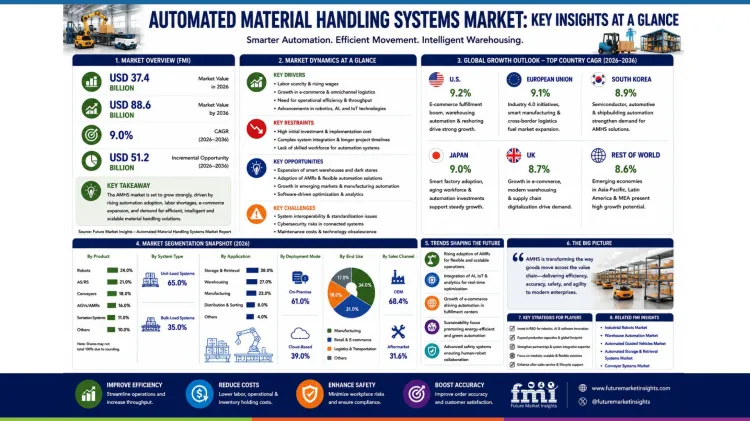
- FMI identifies robots as the leading product category with 24.0% share in 2026, while unit-load systems retain 65.0% of system demand.
- The market is moving toward hybrid designs, where conveyors handle high-volume trunk routes and AMRs manage flexible transport at the edges of the operation.
- Warehouse management and execution software are becoming the connection layer that orchestrates conveyors, ASRS, AGVs, AMRs, robots, and people.
- AMRs are not replacing conveyors everywhere. They are changing the cases in which a facility must commit to fixed infrastructure.
The most visible change in warehouse automation is the rise of mobile robotics. AMRs can navigate around people, racks, workstations, and changing layouts without requiring the permanent guide paths traditionally associated with AGVs or conveyors. Their arrival has led to a common assumption that flexible robotics will replace fixed automation.
The operating reality is more balanced. AMRs are taking work from manual transport, carts, pallet jacks, and some fixed routes. They are not making conveyors obsolete. Conveyors remain one of the more effective tools for moving high volumes through stable, repeatable, speed-sensitive processes.
The more accurate description is a redesign of the automation mix.
FMI expects the automated material handling systems market to grow from USD 37.4 billion in 2026 to USD 88.6 billion by 2036. Robots hold the largest product share at 24.0%, unit-load systems represent 65.0% of system demand, and storage and retrieval accounts for 38.0% of application demand. The report also observes that the market is transitioning from fixed conveyor configurations to flexible robotic systems that can be reconfigured as warehouse layouts and product mixes change.
That transition does not mean every fixed system is being removed. It means buyers are examining the volatility of their operations before committing to long-lived infrastructure.
A conveyor performs best when the route is stable, the flow is continuous, and volume justifies dedicated mechanical movement. Parcel hubs, airport baggage systems, large retail distribution centres, bottling plants, food packaging operations, automotive assembly lines, and high-speed sortation facilities all have these characteristics. Products repeatedly move from point A to point B, often at defined speeds and with limited route variation.
In these settings, conveyors can be hard to beat. They offer predictable throughput, direct routing, continuous movement, and relatively straightforward operational logic once installed. Their limitation is physical commitment. A conveyor line takes space, requires engineering, and can be expensive to modify when the building or process changes.
AMRs solve a different problem. They are designed for variable routes, dynamic work zones, fluctuating order volumes, and environments where a facility does not want to install large amounts of fixed infrastructure. A warehouse may need robots to bring totes from storage to picking stations in the morning, move replenishment stock in the afternoon, and transport returns in the evening. The same AMR fleet can be reassigned through software.
FMI notes that AMRs support warehouse navigation and goods movement without fixed infrastructure. This is particularly relevant for e-commerce fulfilment, micro-fulfilment, third-party logistics, contract warehousing, and mixed-SKU operations. These facilities often face changing inventory profiles and seasonal demand peaks. Their process flow can change faster than a conveyor depreciation schedule.
The cost difference is not always as simple as a claim that AMRs are cheaper. A small AMR deployment can have a lower entry cost because it avoids major building modification. A large AMR fleet still requires charging infrastructure, wireless connectivity, traffic management software, fleet management, safety validation, maintenance, systems integration, and operational redesign. Its economics depend on utilization. Robots parked for most of the day do not create flexibility value.
Conveyors have a similar utilization test. A fixed line operating at low volume can become an expensive underused asset. At high sustained volume, the same line can be extremely efficient. The choice is therefore driven by flow stability and utilization, not only the technology label.
The distinction becomes clearer by use case.
Parcel and Sortation Operations
Conventional conveyors and sorters remain dominant in high-throughput parcel operations. Parcels need to move rapidly through induction, scanning, sorting, diverging, and dispatch routes. The path is repeatable, speed matters, and every second affects capacity. AMRs can support exception handling, indirect transport, or peripheral tasks, and they are unlikely to replace high-speed sortation belts at the core of major hubs.
E-Commerce Fulfilment
E-commerce is more mixed. High-volume, standardized fulfilment centres may still use conveyors for order consolidation, packing, and shipping. AMRs can support goods-to-person picking, replenishment, returns, and movement between dynamic work zones. The hybrid model is becoming common because order profiles are less stable than parcel flow.
FMI identifies retail and e-commerce as the fastest-growing end-use category, supported by micro-fulfilment centres and omnichannel warehousing. This is a natural environment for flexible robotics because product mix, order cut-off times, and fulfilment priorities can change quickly.
Manufacturing and Automotive
Factories also favour hybrid systems. Automotive assembly lines often need fixed conveyors or overhead systems to move parts and bodies through repeatable process steps. Line-side materials, kits, components, and replenishment may be moved by AGVs or AMRs. The fixed automation handles takt-critical flow. Mobile robotics handles flexibility around the line.
FMI identifies automotive as 17.0% of industry demand and manufacturing as 34.0% of end-use demand. EV production, battery handling, parts logistics, and mixed-model assembly are expanding the need for flexible internal movement without removing the need for fixed production flow.
Cold Storage and Food Handling
Cold storage has its own logic. Automation can reduce the amount of labour working in low-temperature environments. ASRS, shuttle systems, pallet conveyors, and automated cranes can be highly effective because storage density and energy management matter. AMRs may be used in selected conditions, and battery performance, floor conditions, charging arrangements, and temperature exposure need careful evaluation.
Food and beverage operations may use conveyors heavily because hygiene, line speed, packaging flow, and repetitive handling are central. Palletizing robots and mobile systems can add flexibility at the edges.
Semiconductor and Cleanroom Logistics
Semiconductor facilities are among the least likely places for a simplistic AMR-versus-conveyor argument. Cleanroom transport requires contamination control, precision, traceability, and specialized inter-bay movement. Automated material handling is often embedded in the factory architecture. Overhead hoist transport, automated stockers, carrier systems, and highly controlled routes remain essential.
FMI specifically highlights semiconductor fabrication as a demand driver because wafer carriers, chemical delivery, and automated inter-bay systems require contamination-free handling. Flexible robotics may have a role in support operations, and core cleanroom movement is usually designed around tightly controlled systems.
The Role of WMS and Warehouse Execution Software
The most important technology may not be the conveyor or the robot. It may be the software layer that decides which one should move the next item.
Warehouse management systems, warehouse execution systems, fleet managers, and orchestration platforms connect stationary and mobile equipment. They allocate work, manage inventory, avoid congestion, prioritize orders, direct replenishment, and balance labour with automation. FMI notes that cloud-based warehouse systems are gaining traction because multi-site operators need real-time inventory control and order optimization.
Without orchestration, a hybrid warehouse can become more complicated than a manual one. AMRs may queue near stations, conveyors may become blocked, storage systems may starve downstream processes, and people may receive unclear work instructions. The software layer is what turns separate equipment assets into a material flow system.
The shift toward AMRs is also changing procurement. Buyers increasingly want modular systems that can be deployed in phases. Instead of approving one large five-year automation project, they may start with a pilot fleet, add software, then expand robots or conveyors as demand becomes clearer. This can reduce upfront risk, and it may create integration complexity if equipment is sourced from too many vendors.
The FMI competitive landscape reflects this direction. Daifuku, KION, Toyota Industries, Honeywell, and SSI SCHAEFER compete through integrated systems that combine conveyors, ASRS, AGVs, robotics, warehouse software, and system design. Emerging players such as Geek+, GreyOrange, AutoStore, and Locus Robotics are gaining traction in AMRs, micro-fulfilment, and flexible automation. The competitive race is therefore not between two isolated product categories. It is between different approaches to integrated material flow.
A facility selecting AMRs should ask several operational questions. How often does the layout change? Is throughput highly variable? Are routes predictable? Does the building have enough wireless reliability? Can charging be managed? Are loads standardized? How will robots interact with people and forklifts? Is software integration ready? What happens during peak periods?
A facility selecting conveyors should ask a different set. Is volume consistently high? Will the route remain stable for several years? Is the building layout fixed? What happens if product sizes or packaging change? Does the maintenance team have the skills to support the system? Can future expansions be built into the design?
The answer may often be both. Conveyors can move high volumes through fixed backbone routes. AMRs can serve variable, lower-volume, or exception-based transport. ASRS can provide density. Robots can palletize or pick. WMS can coordinate the full flow.
The material handling market is therefore moving away from fixed automation as the default answer, and not away from fixed automation as a core tool. AMRs are replacing conventional conveyors only in cases where the main value of the conveyor was moving goods through changing or low-utilization routes. They are not replacing conveyors where speed, repeatability, and sustained volume dominate the operating equation.
The strongest system design is likely to be modular and hybrid. It uses fixed automation where the process is fixed and flexible robotics where the operation is fluid. That is less dramatic than an all-robot warehouse story, and it reflects how most high-performance facilities are likely to be designed.

