


- Format is becoming one of the strongest competitive filters in omega-3 because consumers do not buy EPA and DHA only by science; they buy by convenience, taste, trust, dosage clarity, and repeat-use comfort.
- Softgels remain important because they offer familiar supplement behavior, dose control, and easier oil delivery, but they are under pressure from gummies, powders, liquids, fortified foods, and functional beverages.
- The strongest format opportunities sit in high-concentration softgels, clean-taste gummies, microencapsulated powders, prenatal DHA products, children's formats, heart-health supplements, and omega-3 fortified foods.
- FMI states that the omega-3 market was valued at USD 5,785.1 million in 2025 and is projected to reach USD 13,323.1 million by 2035 at an 8.7% CAGR, showing that format innovation is expanding inside a growing ingredient market.
- The biggest risk is assuming one format can win every consumer. In omega-3, the winning format depends on the buyer's problem: swallowing difficulty, fishy aftertaste, dose strength, clean label, price, food compatibility, or medical credibility.
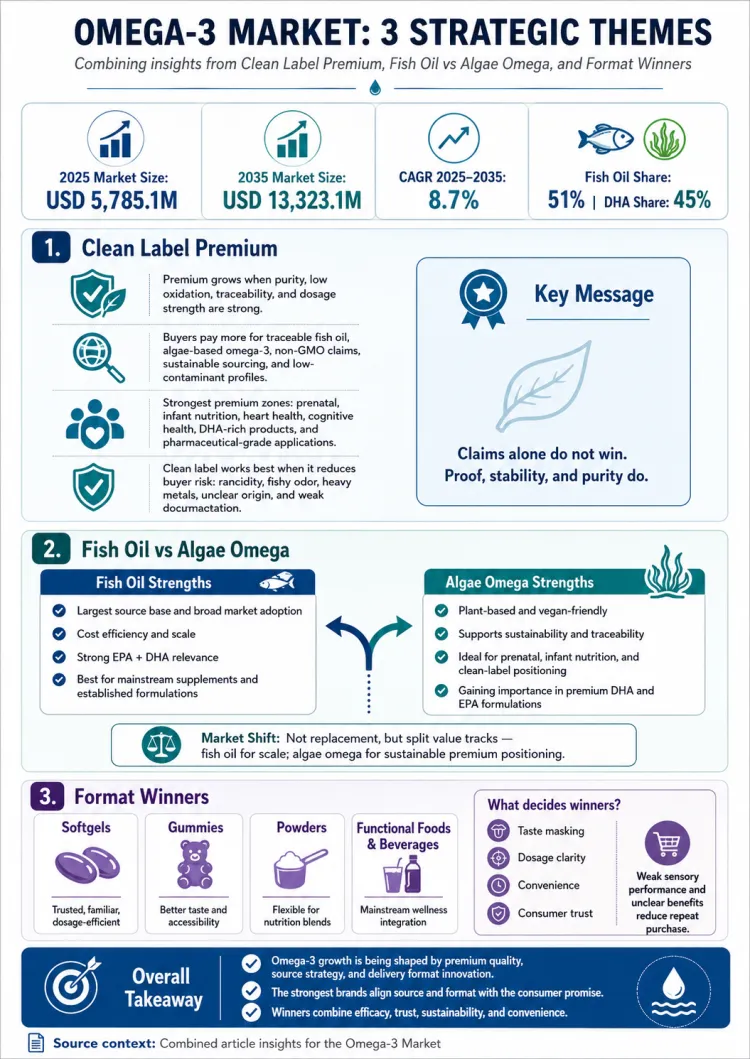
The omega-3 market is increasingly being shaped by format, not only by source. Fish oil, algae omega, krill oil, concentrates, and EPA/DHA blends all matter, but the way omega-3 reaches the consumer is becoming just as important as the ingredient itself. A consumer who refuses large softgels may still accept gummies. A parent may prefer a flavored liquid or chewable format for a child. A food manufacturer may need microencapsulated powder instead of oil. A clinical nutrition buyer may prioritize high-concentration softgels or prescription-style dosage clarity. According to Future Market Insights' Omega-3 Market report, the global omega-3 market was valued at USD 5,785.1 million in 2025 and is projected to reach USD 13,323.1 million by 2035, expanding at an 8.7% CAGR. FMI also states that fish oil accounted for 51% share of the source type segment in 2025, while DHA accounted for 45% share of product-type revenue in 2025.
This means format competition is happening inside a market with strong growth momentum. The format question matters because omega-3 has a trust problem that many other supplement categories do not face. Consumers worry about fishy burps, odor, aftertaste, capsule size, marine contaminants, oxidation, source sustainability, and whether the dose on the label is meaningful. A brand can have strong science behind EPA and DHA, but still lose repeat purchase if the delivery format feels unpleasant, confusing, or inconvenient. This is why format winners are not simply the products with the most omega-3 per serving. They are the products that make daily use easier and more believable.
Softgels remain the default format in many omega-3 supplement shelves because they solve several commercial problems at once. They are familiar to consumers, easy to count, easy to package, and well suited to oil-based ingredients. Softgels also support clear dosage communication when the brand can state EPA, DHA, and total omega-3 per serving. For high-concentration fish oil or EPA/DHA products, softgels can remain a strong format because they preserve the traditional supplement experience and work well for heart-health, adult wellness, and clinical-style positioning.
However, softgels face two important limits. First, many consumers dislike swallowing large capsules, especially when multiple capsules are needed to reach a meaningful daily dose. Second, fishy aftertaste and reflux can weaken repeat usage. This creates space for better softgel technologies, smaller capsule formats, enteric coating, higher concentration oils, improved deodorization, and cleaner sensory performance. In other words, softgels are not losing because they are outdated. They are being forced to become more concentrated, more comfortable, and more premium.
Omega-3 concentrates strengthen the case for premium softgels because they help brands reduce capsule burden and improve dose efficiency. FMI's Omega-3 Concentrates Market report states that the market was valued at USD 2.91 billion in 2025 and is estimated to reach USD 6.33 billion by 2036 at a 6.7% CAGR. Fish source leads the omega-3 concentrates market with approximately 54.8% share, showing that marine-derived high-potency ingredients still have a strong role when brands want clinically relevant EPA and DHA positioning. For format strategy, this means high-concentration softgels can defend premium pricing when they reduce pill count and make the health promise easier to understand.
Gummies are gaining attention because they solve a different consumer problem. They make omega-3 easier to take, especially for children, younger adults, and consumers who dislike capsules. Gummies also fit the broader supplement market shift toward enjoyable daily formats. The challenge is that omega-3 gummies must overcome dosage, taste, odor, sugar content, and stability issues. A gummy that is pleasant but too low in EPA/DHA may win trial but struggle with credibility. A gummy with stronger dosage but poor sensory quality may fail repeat use. The winners will be gummies that balance clean taste, meaningful dose, low fishiness, and transparent labeling.
Powders and microencapsulated omega-3 formats are important because they move the market beyond the supplement bottle. Microencapsulation helps protect omega-3 from oxidation, masks taste and odor, and enables use in foods, beverages, powdered nutrition, dairy, bakery, and family nutrition products. This matters because functional food manufacturers cannot simply add fish oil to a product and expect consumers to accept it. They need ingredient systems that remain stable during processing, storage, and consumption. Format innovation therefore becomes a manufacturing solution as much as a consumer convenience solution.
FMI's Omega-3 Fortified Foods Market report states that the omega-3 fortified foods industry value is anticipated to scale from USD 0.6 billion in 2025 to USD 1.8 billion by 2036 at a 9.9% CAGR as food processors add EPA and ALA to dairy and family nutrition products. FMI also notes that microencapsulated fish oil is forecast to represent 46.8% share in 2026, led by dose control and cleaner sensory performance in food plants, while heart health is expected to secure 44.2% share in 2026. This shows that format innovation is not only happening in supplements. It is also helping omega-3 enter mainstream food occasions.
The Microencapsulated Omega-3 Powders Market also supports this shift. FMI states that the microencapsulated omega-3 powders market was valued at USD 13.3 billion in 2025 and is set to reach USD 31.6 billion by 2036 at an 8.2% CAGR between 2026 and 2036. For brands, microencapsulated powders can make omega-3 easier to use in functional nutrition because they reduce odor, improve handling, and support controlled dosage in non-capsule formats. The premium opportunity is strongest where powder technology protects the finished product from taste failure, rancidity, and consumer rejection.
Liquid omega-3 formats remain relevant in prenatal, pediatric, senior, and high-dose use cases, but they require stronger sensory management. Liquids can be attractive where swallowing is difficult or where caregivers need flexible dosing. The challenge is that liquids expose odor and taste more directly than capsules. This means liquid omega-3 products must invest in flavor systems, packaging, oxidation protection, and clear dosage communication. A weak liquid format can damage trust quickly because rancid smell or unpleasant taste is immediately visible to the consumer.
Functional beverages create another opportunity, but they are also one of the hardest omega-3 formats to execute well. Beverages demand stability, clarity or controlled emulsion, clean taste, and shelf-life confidence. Omega-3 can support heart health, brain health, sports recovery, maternal health, and healthy aging claims, but beverage brands must avoid a medicinal or fishy experience. This makes ingredient technology critical. The winning beverage formats will not be the ones that simply mention omega-3 on the label. They will be the ones that hide the technical difficulty from the consumer while still delivering a meaningful dose.
Prenatal and infant nutrition are among the most format-sensitive omega-3 applications because the consumer stakes are higher. DHA is strongly associated with brain, eye, and developmental nutrition, and FMI notes that DHA held 45% share of omega-3 product-type revenue in 2025. In these applications, the format must communicate safety, purity, dosage, and ease of use. Prenatal consumers may prefer algae-derived DHA softgels, small capsules, liquids, or powders depending on tolerance and brand promise. Infant nutrition manufacturers need omega-3 delivery systems that are stable, safe, and compatible with formula or nutrition products.
Source and format are now closely connected. Fish oil works well in softgels, concentrates, microencapsulated powders, and fortified foods when the supplier can manage oxidation and sensory risks. Algae omega is better positioned for vegan gummies, prenatal DHA softgels, vegetarian capsules, clean-label powders, and plant-based nutrition. FMI's Algae Omega Market outlook states that algae omega demand is supported by dietary supplements, prenatal nutrition, DHA concentrates, and sustainable omega sourcing. This means algae omega can win where the format is tied to a clean-label or plant-based consumer promise.
Krill oil plays a separate premium role because it is often positioned around phospholipid-bound EPA and DHA, bioavailability, and naturally occurring astaxanthin. FMI's Krill Oil Supplements Market report projects growth from USD 1.16 billion in 2026 to USD 2.78 billion by 2036 at a 9.1% CAGR. Krill oil is less about mass-market format disruption and more about premium supplement positioning. Its winners are likely to remain in softgels and capsules where the brand can explain bioavailability, purity, and marine-source differentiation.
The format winner also changes by channel. In pharmacies and practitioner-led channels, high-concentration softgels, prescription-style omega-3 products, and clinically positioned EPA/DHA formats are more credible. In mass retail, consumers may compare price, capsule count, and claims more quickly. In e-commerce, brands can explain source, dosage, third-party testing, and format benefits in more detail. In grocery and foodservice-style channels, fortified foods, beverages, powders, and family nutrition formats can reach consumers who may never buy a traditional fish oil bottle.
Price sensitivity also differs by format. Standard softgels face direct comparison because consumers can easily compare bottle size, capsule count, and total omega-3 content. Gummies can command a convenience premium, but only if consumers accept the dose and taste. Powders and fortified foods may command value through convenience and application fit, but they must avoid the impression of weak or token omega-3 fortification. High-concentration products can defend higher prices when they clearly reduce serving burden. The premium is strongest when the format solves a problem that the consumer already feels.
For suppliers, the strategic lesson is that ingredient quality alone is no longer enough. A supplier that provides fish oil, algae oil, or concentrates must also help brands win in finished format. This means stability data, sensory support, microencapsulation technology, capsule compatibility, gummy formulation support, beverage application guidance, and documentation that supports clean-label, non-GMO, sustainable, or low-contaminant claims. The more difficult the format, the more valuable technical support becomes.
For brands, the strategic lesson is to stop treating format as packaging. Format is part of the value proposition. A heart-health product may need a high-concentration softgel because the consumer expects clinical seriousness. A children's product may need a gummy or flavored liquid because compliance matters more than traditional supplement form. A prenatal product may need algae DHA because source trust matters. A functional food may need microencapsulation because taste and shelf life determine repeat purchase. Each format should be chosen because it supports the consumer promise, not because it looks trendy.
The biggest mistake in omega-3 format strategy is choosing convenience at the expense of credibility. A low-dose gummy may be easy to take but weak in clinical value. A high-dose softgel may be credible but difficult to swallow. A fortified beverage may sound modern but fail if it tastes off or oxidizes. A powder may look flexible but fail if it does not disperse well or protect the oil. The winning formats will balance science, sensory performance, dosage clarity, and trust.
Overall, the omega-3 market is moving from a capsule-led category into a more format-diverse health platform. Softgels will remain important, especially for high-potency and clinical positioning. Gummies will grow where ease and compliance matter. Powders and microencapsulation will unlock food, beverage, and nutrition applications. Functional foods will expand omega-3 into everyday eating occasions. The market will not have one format winner. It will have format winners by use case, and the strongest brands will match the right omega-3 source with the right delivery experience.

