


- Bakery freshness is not solved by one preservative or one improver; it is created through an ingredient system that manages softness, moisture, mold risk, and distribution stress.
- Bread-led demand makes freshness protection a core commercial requirement because packaged bakery products must remain appealing beyond the oven stage.
- Enzymes, emulsifiers, fats, hydrocolloids, sourdough inputs, sweeteners, and preservation systems increasingly work together as freshness architecture.
- Retail returns, consumer complaints, staling, crumbling, drying, and poor foldability can erase the value of cheaper ingredients.
- Clean-label pressure is changing how bakery producers design freshness, pushing suppliers to prove performance without relying only on legacy additives.
- The misconception to avoid is that freshness is a packaging or preservative issue alone. In bakery, freshness begins inside the dough and batter system.
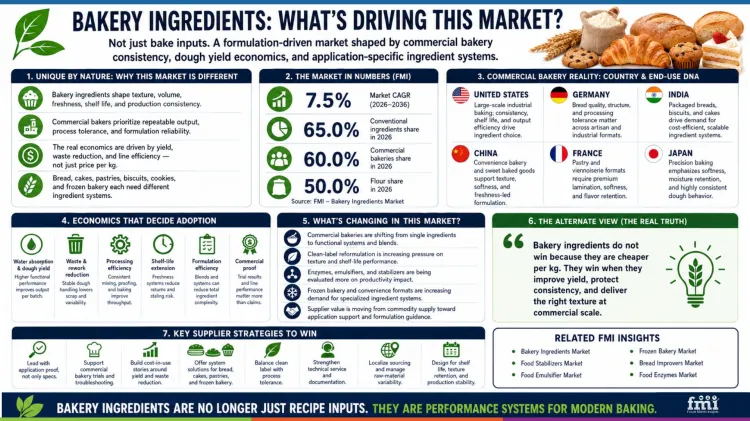
Bakery ingredients are often described by product group: flour, sweeteners, fats and oils, leavening agents, additives, improvers, enzymes, and emulsifiers. That segmentation is useful for sizing the market, but it does not fully explain purchasing behavior. Many bakery manufacturers are now buying freshness systems rather than isolated inputs.
Freshness is one of the strongest commercial performance tests in bakery. A product may leave the oven looking correct, but that is only the first stage. Packaged bread, buns, wraps, cakes, pastries, biscuits, cookies, and frozen bakery items must survive storage, distribution, retail display, and household use. If the product dries, stales, crumbles, loses softness, cracks, molds, or loses eating quality, the consumer sees the brand failure rather than the ingredient choice behind it.
This is why freshness system design is a better angle for the bakery ingredients market than another generic clean-label or cost story. Bakery freshness depends on a combination of flour quality, starch behavior, enzyme activity, emulsifier selection, fat systems, sugar and humectant balance, moisture migration, pH, yeast performance, fermentation profile, preservative strategy, and packaging interaction. One ingredient can improve one problem while creating another. The supplier must understand the whole system.
In bread, staling is a central challenge. Crumb firmness, loss of resilience, dryness, slicing performance, and foldability all affect product acceptance. Enzyme systems can help slow starch retrogradation and improve softness over shelf life. Emulsifiers can support crumb structure and gas retention. Fats and oils influence tenderness and mouthfeel. Sourdough or fermentation inputs can support flavor, acidity, and preservation positioning. The point is not that one technology solves the problem; the point is that freshness is engineered across multiple ingredient layers.
FMI's bakery ingredients analysis highlights bread as the leading application and commercial bakeries as the largest end-use segment. That combination makes freshness economically important. A small improvement in shelf-life performance can reduce returns, improve distribution radius, and protect brand repeat purchase. For a high-volume bakery, freshness is not only a sensory objective; it is a margin and logistics objective.
Freshness design also differs by application. Cakes need moisture retention, aeration stability, and crumb tenderness. Pastries need crispness or flakiness, depending on the format. Biscuits and cookies need controlled break, bite, spread, and moisture balance. Frozen bakery products must handle freeze-thaw stress and still finish with acceptable texture. A system designed for sandwich bread cannot be copied into muffins, cookies, or laminated pastry without adjustment.
This is where adjacent markets such as bakery enzymes, bread emulsifiers, food enzymes, frozen bakery, and food stabilizers become relevant. Bakery ingredients increasingly overlap with texture systems and shelf-life technologies. The supplier that can combine these tools into a practical formulation recommendation has a stronger role than a supplier offering only commodity flour or sugar.
Clean-label expectations complicate freshness design. Consumers may prefer shorter ingredient lists, but bakery producers still need mold control, softness, and distribution stability. Removing a legacy preservative or emulsifier can create rapid quality deterioration if the replacement system is not tested properly. Clean label is not a simple subtraction exercise. It requires performance replacement, process adjustment, and shelf-life validation.
The strongest suppliers therefore focus on proof. They show softness curves, mold-free shelf-life comparisons, crumb firmness data, sensory retention, distribution trials, and application-specific results. They can demonstrate how a system performs in the customer's product and under the customer's storage conditions. For commercial bakeries, that evidence is more persuasive than broad claims about freshness or naturalness.
Retailers and foodservice customers also influence freshness requirements. Supermarkets want reliable shelf life and fewer returns. Convenience stores want consistent texture in high-turnover formats. QSRs need buns and breads that remain soft, resilient, and easy to handle. Foodservice distributors need products that tolerate storage and transport without quality collapse. These channel needs push ingredient suppliers toward more complete freshness architecture.
The decision point for bakery manufacturers is to define freshness by the real failure mode. Is the issue crumb firming, mold, surface dryness, cracking, loss of volume, poor sliceability, freezer burn, or weak reheating performance? Each problem points to a different ingredient system. A supplier that diagnoses the problem correctly can create value faster than one offering a standard improver package.
Bottom line: bakery ingredient growth is increasingly tied to freshness system design. The winning suppliers will be those that help bakeries protect softness, structure, moisture, flavor, and shelf-life performance through validated ingredient systems rather than isolated product claims.
Related FMI reports
- Bakery Ingredients Market: Primary link for market value, ingredient segmentation, functionality trends, end-use applications, and industry benchmarks
- Bakery Mixes Market: Use when discussing pre-blended formulations, dosing simplification, convenience, and commercial baking systems
- Bakery Enzymes Market: Use when discussing freshness extension, dough conditioning, softness, and enzyme-based baking performance
- Food Enzymes Market: Use when discussing enzyme technologies, food processing innovations, and broader enzyme applications
- Bread Emulsifier Market: Use when discussing crumb structure, dough stability, loaf volume, and bread softness
- Frozen Bakery Market: Use when discussing frozen dough, freeze-thaw stability, and foodservice bakery products
- Food Stabilizers Market: Use when discussing texture enhancement, moisture retention, shelf-life improvement, and product stability

