


- HMOs can support premium positioning, but not because they behave like a typical clean-label ingredient. Their premium depends on bio-identical positioning, clinical trust, microbiome relevance, and regulatory confidence.
- In infant formula, HMOs strengthen the bridge between scientific nutrition and breast-milk-inspired formulation, but they do not replace the need for safety, suitability, and parent trust.
- The strongest premium opportunity sits in infant formula, growing-up milk, pediatric nutrition, gut-health supplements, women’s health, immune support, and microbiome-led functional nutrition.
- The premium weakens when brands use vague claims such as "advanced prebiotic" or "closer to breast milk" without explaining the HMO type, purpose, dose logic, or evidence base.
- HMO premiumization is strongest when the ingredient is linked to a clear health platform: gut microbiome, immune development, digestive comfort, or targeted functional nutrition.
- The biggest misconception is that HMOs automatically justify a premium because they sound scientific. Consumers and formulators pay more only when the science is credible, explainable, and relevant to the product occasion.
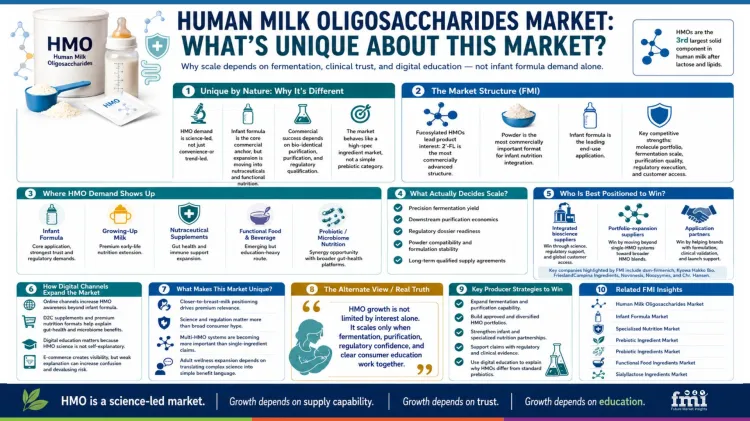
HMOs don't necessarily adhere to the standard clean-label premium model. Food and beverages become premium through naturalness, recognizability, minimal processing, organic quality, or absence of artificial additions. However, HMOs don't have this type of premium. The reason why HMOs are premium does not lie in simplicity but in their biological significance and advanced nutritional quality.
This becomes important as HMOs are science-based ingredients. Naturally, they occur in human breast milk; however, commercial HMOs are created using biotechnological processes. This might be unappealing to certain individuals who would want something cleaner from the conventional point of view. However, within the domain of infant nutrition and functional health, the merit of HMOs does not arise from how clean the ingredient is, but from its effectiveness towards a credible nutritional purpose.
FMI’s Human Milk Oligosaccharides Market helps frame this premium correctly. The market is segmented by HMO type, form, end-use application, and distribution channel. Infant formula remains the central end-use pathway, while nutraceutical supplements and functional food and beverage applications show how HMOs are moving beyond early-life nutrition. This makes HMO premiumization different from conventional clean-label reformulation. The claim is not "less processed." The claim is "more biologically intelligent."
For infant formula, HMOs provide opportunities for a premium position because both mothers and pediatric nutrition brands want to find products that can replicate more functions of breast milk. Nonetheless, this should be done delicately. There is no magic ingredient in creating breast milk. Although formula enriched with 2'FL or other HMO structure could benefit from a compelling scientific story, it should also pass the safety, suitability, and digestibility tests. Any exaggerations could do harm to the brand image.
Premiumization comes where HMOs can be associated with an extensive nutrition system. This means that HMO-enriched infant formulas could be positioned together with other elements like DHA, probiotics, prebiotics, nucleotides, protein systems, and other special ingredients. On the other hand, HMO-enriched growing-up milks can be used for gut and immunity positioning. At the same time, adult nutrition products can be connected to microbiome health, digestive ease, women's health, healthy aging, or immune system health.
FMI’s Infant Formula Market is relevant because infant formula is one of the most trust-sensitive food categories. Parents do not only buy nutrition claims. They buy reassurance, safety, brand credibility, pediatric relevance, and consistency. HMO inclusion can strengthen a formula’s premium story, but it must sit within a trusted product platform.
FMI’s Specialized Nutrition Market also matters because HMOs are aligned with the broader shift toward more targeted nutrition. Specialized nutrition is not only about calories or basic nutrients. It is about suitability for specific life stages, needs, and health outcomes. HMOs fit this direction because they are connected to gut microbiome and immune-related positioning.
However, in the case of adult products, beyond just infant formula, there is an added layer to the premium messaging. Consumers are unlikely to recognize what a human milk oligosaccharide is or why that matters. The very wording itself is likely to evoke a curious response, but not necessarily a fully informed one. The brand must be able to convey scientific information without compromising believability.
This is where FMI’s Prebiotic Ingredient Market and Probiotic Ingredients Market become useful reference points. HMOs are entering a crowded gut-health space where consumers already see prebiotics, probiotics, postbiotics, fibers, fermented ingredients, and digestive wellness claims. HMOs must prove why they deserve a premium in this competitive environment.
The value proposition will be greatest if brands can distinguish themselves by explaining why the HMO works differently from other prebiotics available on the market. Basic generic claims won’t do. Brands need to explain if the HMO is 2’-FL, LNnT, 3-FL, 3’-SL, 6’-SL, or a combination. They also need to link the unique HMO structure to a specific positioning path like gut development in infants, immune health, or microbiome manipulation.
This becomes more challenging when brand names use too much scientific terminology. Terms like "advanced nutrition," "immune support," or "breast-milk inspired" might sound intriguing, but they won’t provide enough value for repeat purchase. If we consider infant formula, parents will want safety and appropriateness. In the case of adult supplements, consumers will wonder why it’s worth paying extra for something besides regular probiotics or prebiotics. And for functional beverages and foods, there must be some justification for its inclusion during formulation, taste, shelf life, and regulatory claims.
The premium also depends on format. Powdered infant formula is a natural fit because HMOs can be integrated into dry nutrition systems. Capsules, sachets, stick packs, and powders can work for adult supplements. Functional beverages and dairy applications may be more challenging because heat, pH, stability, taste, and claim communication can affect adoption. The stronger the format fit, the stronger the premium case.
The biggest danger lies in regarding HMOs as a "magic word" claim. HMOs can be highly beneficial for being an innovative, scientifically-driven ingredient platform, but their use does not guarantee value for every food/beverage application they are used in. HMOs require a proper application, proper consumer education, and proper evidentiary support to deliver on their promise.
The most dangerous misunderstanding is viewing HMOs as an advanced ingredient category that justifies premium pricing. This is true only if HMOs give your product a better feeling of safety, intelligence, targeting, and credibility.
Bottom line: HMOs can command a premium, but not through a normal clean-label story. Their value comes from clinical trust, bio-identical positioning, microbiome relevance, and the ability to translate complex science into a clear nutrition benefit.
Reference
- Human Milk Oligosaccharides Market
- Infant Formula Market
- Specialized Nutrition Market
- Prebiotic Ingredient Market
- Probiotic Ingredients Market
- Functional Food Ingredients Market
- Sialyllactose Ingredients Market

