


- ICE coolants remain the aftermarket volume base because the global vehicle parc is still dominated by combustion and hybrid vehicles.
- EV thermal fluids are creating a new growth layer tied to battery thermal management, power electronics, traction motors, fast charging, and safety-critical temperature control.
- FMI states that EV penetration is changing the coolant product mix because battery thermal management systems require specialized cooling fluids.
- IEA reports that electric car sales exceeded 20 million globally in 2025, representing one in four new cars sold worldwide.
- The shift does not eliminate coolant demand. It changes the technical specification, service interval, fluid function, and channel capability required.
- The strongest aftermarket suppliers will support both legacy ICE coolant replacement and emerging EV thermal-management fluid requirements.
Electrification is often described as a threat to traditional automotive fluids. That is partly true for engine oils in battery-electric vehicles, and the coolant aftermarket has a more complex future. Electric vehicles still need thermal management. Batteries, power electronics, inverters, onboard chargers, and electric motors must operate within controlled temperature ranges. Fast charging increases thermal stress. Battery safety and durability depend on heat management. The product mix changes, and the need for heat-transfer fluids does not disappear.
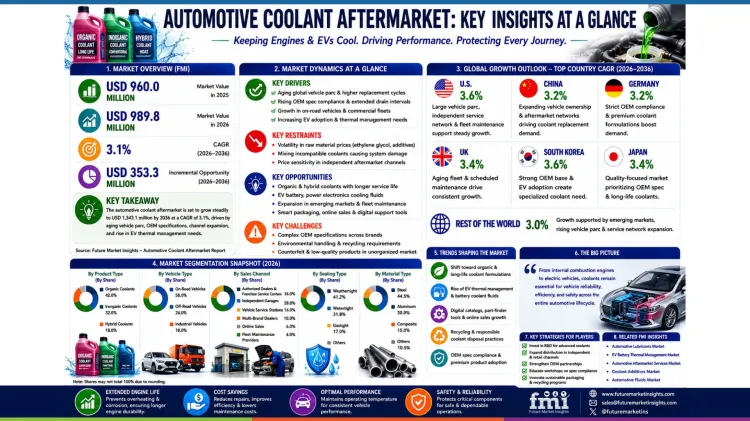
ICE coolant remains the core aftermarket volume today. The global vehicle parc contains hundreds of millions of combustion-engine vehicles and hybrids that need coolant replacement, top-up, flushing, and system maintenance. FMI states that on-road vehicles account for 58.0% of vehicle demand in the automotive coolant aftermarket and that expanding vehicle parc and fleet aging sustain replacement volumes independent of new vehicle sales trends.
That installed base gives ICE coolants a long commercial tail. A battery-electric vehicle sold today reduces future ICE coolant demand for that unit, and vehicles already on the road continue to require maintenance. ACEA 2026 report states that EU cars average 12.7 years of age and trucks 14 years. Such fleet age supports ongoing replacement demand for traditional coolants even as new vehicle sales become more electrified.
The FMI market forecast supports this gradual transition view. The automotive coolant aftermarket is expected to grow from USD 989.8 million in 2026 to USD 1,343.1 million by 2036 at 3.1% CAGR. If electrification were simply destroying coolant demand, the forecast would look different. The more realistic interpretation is that combustion-engine maintenance, hybrid systems, off-road vehicles, commercial fleets, and emerging EV thermal fluids are reshaping the mix.
EV adoption is large enough to matter. The IEA Global EV Outlook 2026 states that electric car sales exceeded 20 million globally in 2025, representing one in four new cars sold worldwide. China sold more than 13 million electric cars in 2025 and accounted for six out of ten electric cars sold globally. Europe reached 4.2 million electric car sales, equal to 28% of all new cars sold in the region. This scale is creating a substantial installed base of vehicles with battery thermal systems.
The fluid requirement is different. ICE coolant is primarily associated with engine heat rejection, radiator circulation, heater core operation, freeze and boil protection, corrosion inhibition, and sometimes turbocharger or exhaust gas recirculation cooling. EV thermal fluids may support battery packs, cold plates, power electronics, traction motors, onboard chargers, and cabin heat pump integration. Some systems use water-glycol fluids in indirect cooling loops. Others may explore dielectric fluids for immersion or direct-contact thermal management, and these remain more specialized.
FMI directly identifies electric vehicle transition as a demand factor, stating that battery thermal management systems require specialized cooling fluids that differ from traditional internal combustion engine coolants. It also notes that South Korea EV adoption is creating emerging demand for specialized battery thermal management fluids, while the UK EV transition is beginning to reshape coolant product specifications.
This means electrification is not only a volume story. It is a specification story. EV cooling systems may have stricter requirements for electrical conductivity, corrosion control, material compatibility, thermal stability, low-temperature performance, pumpability, and long-term degradation. A fluid used near high-voltage components must be selected carefully. The wrong formulation can create performance and safety concerns.
The aftermarket challenge is service knowledge. Many independent garages are comfortable flushing an ICE cooling system. EV thermal systems may require specific diagnostic procedures, safety protocols, OEM-approved fluids, air-bleeding methods, battery system precautions, and technician training. Authorized dealers currently have an advantage because they receive OEM service procedures and approved fluids earlier. Independent garages will need tools, training, and product-selection support to compete as EVs age out of warranty.
The timing of EV aftermarket demand will not mirror new EV sales immediately. New EVs are typically serviced through authorized channels in the early years. The independent aftermarket opportunity grows as these vehicles age, warranties expire, and second-hand EV ownership expands. This creates a delayed but important growth path for EV thermal fluids.
Hybrids create a bridge market. They retain combustion engines and also include electrified components requiring thermal control. A hybrid vehicle may use more than one thermal loop or more complex cooling strategies than a conventional ICE vehicle. This supports demand for both traditional coolant knowledge and electrified-system service capability. The coolant aftermarket should not treat electrification as a binary shift from ICE to BEV. Hybrids and plug-in hybrids extend the relevance of both.
Regional differences will be important. South Korea and the USA lead the FMI country growth outlook at 3.6% CAGR, followed by the EU at 3.5%, Japan at 3.4%, and the UK at 3.4%. South Korea has strong domestic vehicle manufacturing and EV adoption, making specialized thermal fluids an emerging opportunity. The USA has a large aging vehicle base and extensive independent service infrastructure, so ICE coolant remains strong while EV fluids begin to grow. The EU combines older vehicle parc, premium OEM coolant specifications, and rising EV penetration.
The competitive implications are significant. A coolant supplier serving only traditional ICE formulations may maintain volume for years and risk missing higher-specification EV opportunities. A supplier focused only on EV thermal fluids may struggle because the aftermarket installed base still depends heavily on ICE and hybrid coolant replacement. The strongest portfolio is likely to include organic coolants, hybrid coolants, OEM-specific products, fleet formats, and EV thermal-management fluids.
Packaging and channel strategy will also change. ICE coolant sells through bottles, drums, cans, dealers, garages, service stations, auto parts retailers, and online channels. EV thermal fluids may initially move through authorized dealers and specialist service networks because specifications are tighter and service procedures are more controlled. Over time, independent garages and fleet operators will need access as EV fleets age.
Fleet operators are an important bridge. Electric buses, delivery vans, taxis, and commercial vehicles may require structured thermal-fluid maintenance. These vehicles operate at higher utilization than private cars, making temperature control and downtime more important. Drums and bulk packs may become more relevant for fleets maintaining several EVs.
Thermal management also connects to fast charging. Higher charging rates generate more heat and increase the importance of stable battery temperature. The IEA EV outlook shows continued global EV sales growth and expanding EV production. As charging speeds and battery capacities rise, fluid performance can become more visible in vehicle durability and warranty outcomes.
The aftermarket will need clearer language. Calling every product coolant can be misleading when ICE engine coolant, hybrid cooling-system fluid, battery thermal fluid, dielectric coolant, and heat pump loop fluid may have different specifications. Suppliers should educate service providers on application, compatibility, and approved use.
Environmental handling remains relevant across both ICE and EV fluids. Used coolant can be recycled when properly segregated and not contaminated. The EPA coolant recycling evaluation described automotive and heavy-duty coolant recycling as a waste-reduction option, while EPA procurement guidance cautions against commingling incompatible coolant types. EV thermal fluids may introduce additional segregation requirements as chemistries diversify.
The strongest market finding is that electrification is reshaping rather than erasing the coolant aftermarket. ICE coolants remain the volume base because the installed vehicle parc is large and old enough to support recurring service. EV thermal fluids create a specification-led growth layer that will become more important as EVs age and enter broader aftermarket channels.
The suppliers best positioned for the next decade will not frame the market as ICE versus EV. They will support cooling-system maintenance across combustion engines, hybrids, EV battery packs, power electronics, and fleet applications. The coolant aftermarket is moving from engine protection toward whole-vehicle thermal management.

