


- Replacement demand in the engine-driven endodontic file market is becoming more associated with the shift from manual files and first-generation rotary systems to higher-end nickel-titanium (NiTi) engine-driven solutions.
- Dental hospitals and clinics are focusing on the newer file systems which can reduce the procedural time and improve navigation through complex root canal anatomy.
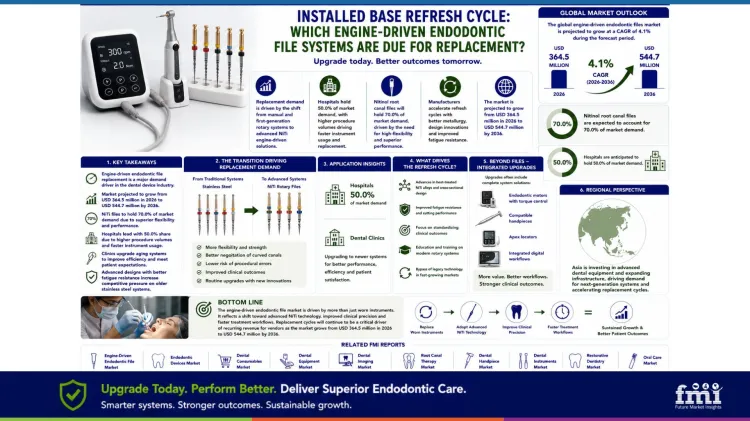
- Nitinol root canal files will hold 70.0% of market demand with the ongoing trend towards high-flexibility instruments.
- The global engine-driven endodontic files market is expected to reach USD 544.7 million by 2036, up from USD 364.5 million in 2026, offering consistent replacement opportunities for manufacturers.
- Clinicians adopting newer generation designs with better fatigue resistance may impose competitive pressure on practices that continue to use older stainless steel rotary systems.
Engine driven endodontic file replacement cycle is now one of the most important demand drivers in the entire dental device industry. Endodontic instruments, unlike capital-intensive imaging systems that can function for years, wear during repeated clinical use and are often upgraded as manufacturers develop improved metallurgy and design features.
The Engine-Driven Endodontic File Market is projected to increase from USD 364.5 million in 2026 to USD 544.7 million by 2036, driven by the increasing use of advanced endodontic technologies in dental practices.
The most significant transition is from traditional stainless steel systems to nickel-titanium rotary files. Newer NiTi instruments are more flexible, and hence permit clinicians to negotiate curved canals with less chance of procedural problems. As practices update treatment protocols, replacement purchases become an expected part of routine procurement rather than one-off capital expenditures.
Hospitals continue to be the leading application segment, accounting for 50.0% of market demand. Large institutional settings typically experience higher volumes of procedures, resulting in faster instrument usage and more frequent purchasing cycles. Migration to premium engine-driven systems is also driven by focus on standard clinical outcomes.
Smaller dental clinics are taking a similar approach. As patient expectations rise and treatment efficiency becomes a competitive advantage, clinics are upgrading their aging rotary platforms to systems offering improved cutting performance and smoother canal preparation.
Manufacturers are also accelerating refresh cycles through ongoing product development. Improvements in heat-treated NiTi alloys, cross-sectional geometry and fatigue resistance are forcing clinicians to upgrade before existing inventories are depleted. The purchasing decision is thus more and more influenced by clinical performance, rather than simple replacement when failure occurs.
This is supported by regional trends. More investment in advanced dental equipment and expansion of dental infrastructure in Asia creates more demand for next generation engine driven files. In fast growing markets, legacy technology is often bypassed in favor of newer technology.
Education is another factor that favors replacement demand. Increasingly, modern rotary systems are being used to train practitioners in dental schools and continuing education programs. Clinical practitioners entering the workforce often prefer technologies aligned with their training, prompting clinics to swap out older inventories.
It’s not just about files that the transition is about. Upgrades often include compatible motors, torque-controlled hand pieces and integrated endodontic systems, providing more opportunities for manufacturers that offer complete procedural solutions.
Bottom Line
But the engine-driven endodontic file market is driven not only by replacement demand for worn instruments. It is a reflection of a change in the industry toward advanced NiTi technology, improved clinical precision, and faster treatment workflows. Replacement cycles are expected to continue to be a critical driver of recurring revenue for vendors, as the market grows from USD 364.5 million in 2026 to USD 544.7 million by 2036.

