


- As companies are looking for greater supply security and regulatory flexibility, manufacturing regionalization is a strategy that is gaining importance in the Bone Morphogenetic Protein Market.
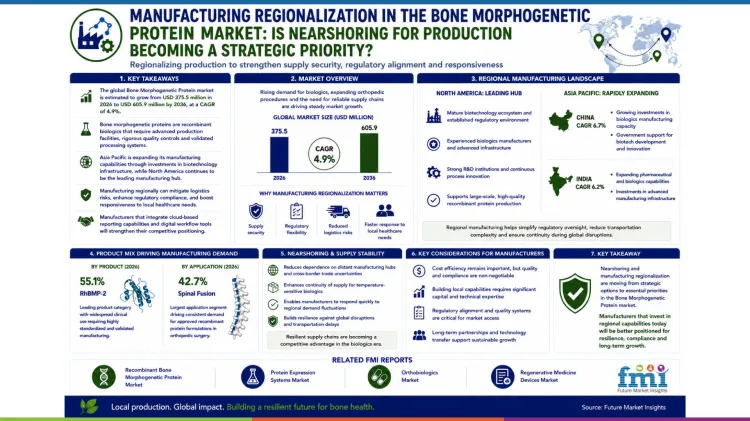
- The global Bone Morphogenetic Protein Market is estimated to grow from USD 375.5 million in 2026 to USD 605.9 million by 2036, at a CAGR of 4.9%.
- Bone morphogenetic proteins are recombinant biologics that require advanced production facilities, rigorous quality controls and validated processing systems.
- Asia Pacific is expanding its manufacturing capabilities through investments in biotechnology infrastructure, while North America continues to be the leading manufacturing hub.
- Manufacturing regionally can mitigate logistics risks, improve regulatory compliance, and boost responsiveness to local healthcare needs.
Introduction
The Bone Morphogenetic Protein Market has historically relied on highly specialized manufacturing facilities that can produce recombinant proteins in tightly controlled conditions. Bone morphogenetic proteins are not commodity pharmaceuticals. They are the products of complex biologic manufacturing processes. Regulatory approval requires documentation of consistency, purity and quality.
Manufacturing location has thus become an important strategic decision, not just a cost consideration.
Future Market Insights anticipates the Bone Morphogenetic Protein Market to be worth USD 605.9 million by 2036, creating fresh motivations for manufacturers to build production networks that aid regional demand while minimizing supply disruptions.
Biologic Manufacturing Requires Specialized Infrastructure
Conventional pharmaceutical manufacturing processes cannot produce recombinant bone morphogenetic proteins. Production requires state-of-the-art biotechnology facilities, validated cell culture systems, purification technologies, sterile processing environments and comprehensive quality management systems.
At each step in manufacturing, regulatory expectations for product consistency and patient safety must be satisfied.
The complexity means that moving production is much harder than moving standard pharmaceutical manufacturing operations.
North America Continues to Lead Production
Due to the mature biotechnology ecosystem and well-developed regulatory environment, North America continues to be the key manufacturing hub for commercially approved bone morphogenetic protein products.
The region boasts experienced biologics manufacturers, advanced research institutions and mature quality systems, creating an environment that can support large scale recombinant protein production.
The concentration of manufacturing expertise also facilitates product innovation and ongoing process improvement.
Asia Pacific Is Expanding Regional Manufacturing Capabilities
North America remains dominant, but Asia Pacific is strengthening its biotechnology manufacturing infrastructure.
China is predicted to grow at a CAGR of 6.7% in the forecast period ending 2036 due to increasing investments in biologics manufacturing capacity, healthcare infrastructure and local innovation. The government's support for the development of biotech is encouraging local manufacturing and international partnerships.
India is expected to grow at a CAGR of 6.2%, propelled by increasing pharmaceutical capabilities and increasing investment in advanced biologic manufacturing. The country’s expanding experience in regulated pharmaceutical manufacturing provides a foundation for future recombinant protein production efforts.
Regulatory Requirements Support Regional Production
Regional manufacturing has other benefits besides logistics.
Making bone morphogenetic proteins closer to target markets can simplify regulatory inspections, reduce transportation complexity and improve oversight of quality management systems.
Many health systems also prize domestic or regional production, because it helps to ensure continuity of supply in times of global disruption.
Those manufacturers that can align production facilities with regional regulatory expectations may find the path to commercialization smoother.
Product Mix Influences Manufacturing Strategy
RhBMP-2 is projected to constitute 55.1% of the global market in 2026, representing the leading product category, according to Future Market Insights.
Its widespread clinical application entails the need for highly standardized manufacturing processes, validated manufacturing systems and extensive documentation.
Concurrently, spinal fusion applications are expected to represent 42.7% of the market demand in 2026, translating into a steady production demand for approved recombinant protein formulations for orthopedic surgery.
The concentration of demand in these mature applications underscores the need for reliable manufacturing capacity.
Nearshoring Improves Supply Stability
The dangers of highly centralized production models have been revealed in recent disruptions to healthcare supply chains.
Manufacturers are increasingly considering regional production networks that are able to sustain continuity in the event of disruption to international transport or cross-border trade.
Nearshoring also helps companies be more responsive to local demand changes and avoid the long-distance distribution challenges that are associated with temperature sensitive biologic products.
Building duplicate manufacturing facilities is a big investment, but the resilience it provides can improve long-term commercial performance.
Cost Is Only One Part of the Equation
Bone Morphogenetic Protein Market Manufacturing Cost Analysis The Bone Morphogenetic Protein Market covers the analysis of the raw material costs.
Delays in approvals, disruption of supply contracts and increased regulatory scrutiny can result from failures in biologic production.
For this reason, minimum production cost is often a secondary consideration to manufacturers who are more concerned with technical capability and validated quality systems.
As healthcare providers use more advanced regenerative therapies, reliable manufacturing is a key element in building customer confidence.
Bottom Line
Manufacturing regionalization is a strategic trend in the Bone Morphogenetic Protein Market. While North America is the current leader in biologic manufacturing, fast growing markets such as China and India are investing in advanced biotechnology infrastructure to support future manufacturing growth.
The market size is projected to increase from USD 375.5 million in 2026 to USD 605.9 million by 2036. Organizations that build strong regional manufacturing networks will likely improve supply reliability, improve regulatory compliance, and position for continued global growth

