


- Bovine collagen peptides are winning on scale, cost efficiency, supply reliability, and broad application fit, while marine collagen peptides are gaining trust in premium beauty-from-within and clean wellness formats.
- FMI expects bovine collagen to lead the collagen peptide source type segment with 54.3% share in 2026, showing that the market is still anchored by commercially scalable bovine supply.
- Marine collagen peptides can command stronger premium interest in beauty, skin health, anti-aging, women's wellness, pescatarian-friendly positioning, and differentiated nutraceutical products.
- The trust battle is not only about animal source. Buyers also evaluate traceability, odor control, solubility, hydrolysis consistency, certification, documentation, and finished-product performance.
- The biggest risk is assuming marine collagen is always premium and bovine collagen is always mass-market. Both can win, but they win in different applications, channels, and price tiers.
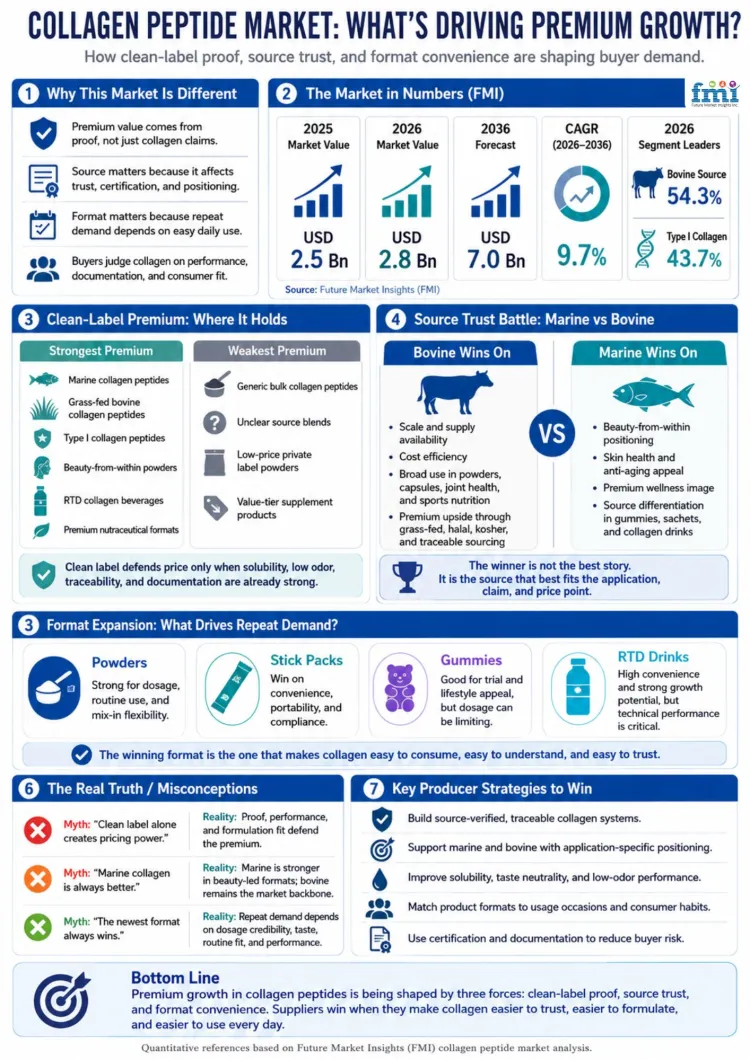
The collagen peptide market is increasingly becoming a source-led market. Earlier, many buyers treated collagen peptides mainly as hydrolyzed protein ingredients. Today, the first commercial question is often about origin. Is the peptide bovine, marine, porcine, chicken, eggshell membrane-derived, or another source? This matters because source identity shapes consumer trust, dietary suitability, certification needs, regional acceptance, product positioning, and pricing power.
FMI's Collagen Peptide Market shows why this source battle matters. FMI indicates that the collagen peptide market was valued at USD 2.5 billion in 2025, is expected to reach USD 2.8 billion in 2026, and is projected to reach USD 7.0 billion by 2036, reflecting a 9.7% CAGR. The market is expanding because collagen peptides are moving deeper into nutraceuticals, medical nutrition, beauty-from-within, sports nutrition, joint health, functional foods, drinks, gummies, powders, and healthy aging products.
Within this growth story, bovine collagen remains the commercial base of the market. FMI expects bovine collagen to lead the source type segment with 54.3% share in 2026. This shows that even as marine collagen receives premium attention, bovine collagen still carries the larger market role. It benefits from wide raw material availability, established processing infrastructure, cost efficiency, and broad compatibility across mainstream supplement and nutrition products.
Bovine collagen peptides are especially strong in powders, capsules, tablets, joint health supplements, sports nutrition blends, healthy aging products, and mass-market wellness formulations. For manufacturers, bovine collagen offers a practical balance of functionality, supply reliability, and price control. It is easier to scale across large product lines and can support both mainstream and premium products depending on the claim structure.
However, bovine collagen is not automatically trusted. The trust premium depends on traceability. Buyers increasingly want clarity on whether the collagen comes from bovine hide or bone, whether it is grass-fed or conventionally sourced, whether it carries halal or kosher certification, and whether the supplier can prove consistent hydrolysis quality. In export-focused products, documentation and certification can become major purchasing filters.
Grass-fed bovine collagen peptides are particularly useful for premium supplement brands because they give bovine collagen a cleaner and more consumer-friendly story. A basic bovine peptide may compete on cost, but a traceable grass-fed bovine peptide can compete on trust. This distinction is critical for brands selling premium powders, beauty blends, active lifestyle products, and direct-to-consumer supplements.
Marine collagen peptides win differently. Their strength is not usually scale. Their strength is perception. Marine collagen often fits better with premium beauty-from-within, skin hydration, hair and nail support, anti-aging, and clean wellness narratives. For many beauty and nutricosmetic brands, marine collagen feels more specialized and more aligned with a premium consumer promise.
Marine collagen also helps brands differentiate in a crowded collagen market. A product that says "marine collagen peptides" may feel more specific than a product that simply says "collagen peptides." This is especially useful in premium sachets, beauty powders, capsules, collagen drinks, and skin health gummies where the buyer wants a more elevated story.
But marine collagen also has limits. It can face higher cost pressure, fish-related allergen concerns, odor challenges, taste-masking requirements, and sourcing scrutiny. A marine collagen peptide that smells fishy, dissolves poorly, or lacks traceability will lose the premium quickly. In premium beauty applications, the product experience must be clean, neutral, and easy to consume.
The strongest marine collagen suppliers are those that can prove low odor, good solubility, controlled peptide profile, responsible sourcing, and reliable documentation. For beauty and wellness brands, marine collagen is attractive only when it makes the finished product feel premium. If it creates formulation problems, the source advantage weakens.
The role of Type I collagen also supports the marine versus bovine discussion. FMI expects Type I collagen peptides to lead the product type segment with 43.7% share in 2026. This matters because Type I collagen is widely linked with skin, bone, tendon, ligament, and connective tissue positioning. Both marine and bovine collagen can be positioned around Type I collagen, but the brand story differs.
Marine Type I collagen usually works well in beauty and skin health products. Bovine Type I collagen can work across beauty, joint health, active nutrition, and general wellness products. Therefore, the trust battle is not only about whether the source is marine or bovine. It is about whether the source, collagen type, application, and consumer promise all fit together.
In beauty-from-within products, marine collagen has a stronger premium image. Consumers buying skin-focused products often respond to source specificity, lighter wellness positioning, and beauty-oriented storytelling. For this reason, marine collagen can defend a higher price in premium beauty powders, capsules, and drink mixes when the formulation is pleasant and the claim is clear.
In joint health and sports nutrition, bovine collagen peptides often have the advantage. These categories are more performance-led and volume-sensitive. Buyers may prioritize protein delivery, amino acid profile, solubility, consistent supply, and cost per serving. Marine collagen can still participate, but bovine collagen is usually more practical for large-format products and daily-use powders.
In functional beverages, the winner depends on technical performance. Marine collagen may offer a premium story, but beverage brands need clean taste, no odor, no sedimentation, and stable dispersion. Bovine collagen may offer better cost control and scale, but it must also meet clarity, solubility, and sensory expectations. In RTD formats, source story matters only after formulation performance is solved.
In gummies, the decision is more brand-positioning led. Marine collagen can support beauty gummy positioning, while bovine collagen may support broader wellness, joint health, and mass-market products. But gummies also create dosage and taste challenges. If the finished gummy cannot deliver an acceptable collagen dose or has poor texture, the source claim will not be enough.
The weaker source premium appears in low-price private label collagen powders, generic capsule products, and bulk ingredient procurement. In these areas, buyers often compare cost, protein content, supply reliability, and minimum documentation. Marine collagen may be viewed as too expensive, while bovine collagen may be selected for commercial practicality.
The stronger source premium appears in premium beauty nutrition, clinically positioned supplements, export-ready products, halal/kosher-certified formulations, clean-label powders, and applications where the source can be clearly communicated on pack. In these formats, the buyer is not only purchasing collagen. They are purchasing a trust story.
The misconception to avoid is that marine collagen is always better than bovine collagen. It is not. Marine collagen is often better for premium beauty positioning, but bovine collagen is stronger in scale, cost structure, and wider application coverage. Similarly, bovine collagen is not automatically a lower-value ingredient. Traceable, grass-fed, certified, low-odor bovine collagen peptides can defend premium pricing when they are matched with the right product format.
For suppliers, the practical lesson is simple. Do not sell source alone. Sell source fit. Marine collagen should be positioned where beauty, premium wellness, pescatarian suitability, and clean sensory performance matter most. Bovine collagen should be positioned where scale, cost efficiency, joint health, sports nutrition, halal/kosher suitability, and broad formulation use matter most.
Bottom line: bovine collagen peptides remain the market backbone, while marine collagen peptides are building premium trust in beauty-led and wellness-led formats. The real winner is not the source with the best story, but the source that best fits the application, claim, price point, and consumer expectation.

