


- Medical-grade polymers command premiums because buyers are purchasing controlled formulation, documentation, traceability, change management, and sterilization compatibility along with the resin.
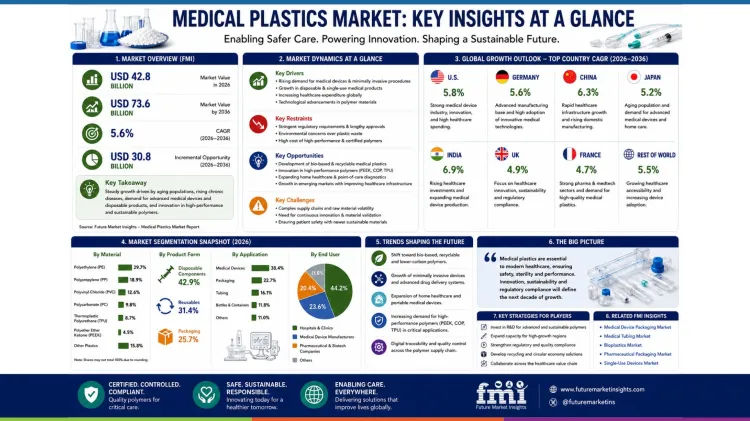
- FMI expects the medical plastics market to increase from USD 42.8 billion in 2026 to USD 73.6 billion by 2036 at a 5.6% CAGR.
- Medical devices account for 38.4% of application demand, making regulatory records and long-term material consistency central to supplier selection.
- A standard polyethylene, polypropylene, polycarbonate, PVC, TPU, or PEEK grade cannot automatically be used in a regulated healthcare product simply because its mechanical properties appear suitable.
- The premium becomes more defensible in patient-contact devices, fluid pathways, diagnostic components, implants, sterile packaging, and long-life device programs.
- Buyers appear to pay most for reduced approval risk and supply continuity rather than for the polymer molecule alone.
Rarely does the medical device manufacturer purchase polymer on the strength of tensile strength, transparency, melt flow, unit price, etc. Those characteristics are important, but the commercial decision is a lot more than just the resin data sheet. The buyer also wants to know the formulation is controlled, the material will survive the selected sterilization method, the supplier will provide regulatory support, and no unannounced change will jeopardize a cleared device.
That combination is the reason for the medical-grade premium.
FMI values the medical plastics market at USD 40.5 billion in 2025 and USD 42.8 billion in 2026. Revenue is forecast to reach USD 73.6 billion by 2036, creating an incremental opportunity of USD 30.8 billion. Medical devices are expected to account for 38.4% of application demand in 2026, while hospitals and clinics represent 44.2% of end-user demand. These figures indicate that a large part of resin consumption is linked to regulated care products where quality records are part of the product value.
The distinction between a general-purpose polymer and a medical-grade polymer is not always evident in the finished part. Two molded housings may look the same. Two tubing materials are similarly flexible. The basic commitment of the supplier can vary a lot.
A supplier of medical-grade may offer detailed composition records, biocompatibility support, extractables and leachables information, sterilization data, lot traceability, regulatory letters, quality agreements and advance change notification. This may result in a grade under a dedicated healthcare quality system or tighter controls on additives, pigments, processing aids and contamination. These controls add cost, but they also reduce uncertainty for the device OEM.
The FDA says that the biocompatibility data manufacturers include in premarket submissions for medical devices are to demonstrate the safety of the materials for use in or on the body. The agency’s guidance follows a risk-based approach in determining what information is needed. The device company gets a more credible starting point from a resin supplier that can support this evaluation than from a commodity supplier that only provides mechanical properties.
The raw polymer per se is not inherently biocompatible. It depends on the finished device, manufacturing process, additives, colorants, surface treatment, sterilization method, period of contact and type of patients exposure. This is one reason medical device companies are reluctant to accept what seem to be minor material changes. A change that looks easy to the procurement team may generate additional work for testing, documentation and submission.
The FMI observes that the rules for device approvals, formulation control and regulatory letters are important. It also calls out a supplier’s need for change notice support. Once you write a resin into a device file, stable supply can be worth more than a small price saving a year.
The USA market illustrates the financial context. FMI estimates USA medical plastics demand at USD 10.6 billion in 2026, rising to USD 18.6 billion by 2036 at 5.8% CAGR. The report references the FDA fiscal year 2026 standard 510(k) application fee of USD 26,067. The fee is only one portion of the approval cost. Testing, engineering time, clinical or performance evidence, documentation, consultant support, and manufacturing validation can raise the burden further.
Changing a polymer after approval may require additional assessment to determine whether the device remains safe and effective. That possibility gives incumbent medical-grade materials unusual commercial stickiness.
Another part of the premium is sterilization compatibility. Medical plastics may be sterilized using ethylene oxide, radiation, steam, electron beam, vaporized hydrogen peroxide or other processes. Not every polymer reacts the same. Radiation can impact, color, brittleness, molecular structure, and long-term performance. Steam can warp materials that do not have sufficient thermal resistance. Chemical sterilants can react with additives and leave residues.
FDA’s sterilization resources recognize standards that consider material compatibility under sterilization. Testing a grade through multiple sterilization routes spares the OEM from having to begin with an unknown material, says a supplier. This benefit can be especially useful in syringes, diagnostic cartridges, respiratory components, connectors, fluid pathways and sterile packaging systems.
The premium also reflects manufacturing consistency. Injection molding is expected to represent 34.6% of processing demand in 2026, according to FMI. Medical components often require tight dimensions, repeatable surface quality, controlled particulate levels, and stable processing over long production runs. A shift in melt flow or additive content can affect cycle time, shrinkage, weld lines, clarity, bonding, and assembly.
Commodity resin markets accept a degree of formulation and production flexibility. Healthcare programs often cannot. Suppliers may need to maintain a grade for many years while supporting the same device platform in several countries.
Polyethylene leads medical plastic material demand with a projected 29.7% share in 2026. Its broad use in tubing, packaging, containers, and disposable products shows that even a comparatively familiar polymer can carry medical value when supplied with healthcare documentation. Polypropylene plays a similar role in syringes, laboratory products, containers, and sterilizable components.
Polycarbonate is often a higher performance material. Its clarity, toughness and dimensional stability are valued in transparent housings, diagnostic components, connectors and durable devices. Medical grade polycarbonate may be more expensive than general purpose resin because the buyer requires controlled composition, sterilization performance and long-term supply.
TPU is used for flexible tubing, catheters, wearable products and parts that need to be elastic. Its premium is based on hardness range, kink resistance, clarity, biocompatibility, chemical resistance and process control. PEEK is at the upper end of the performance scale. Implantable and demanding device applications may value its heat resistance, strength, chemical resistance and sterilization performance. The price is much higher but the acquisition is based on technical suitability, not simply resin cost.
PVC presents a more complex case. It remains widely used in blood bags, tubing, and fluid handling because it is flexible, transparent, processable, and familiar to medical manufacturing. The commercial debate increasingly focuses on plasticizers and substances of concern. Under the EU Medical Device Regulation, manufacturers using certain carcinogenic, mutagenic, reproductive-toxic, or endocrine-disrupting substances above specified thresholds may need to provide justification. That pushes buyers to assess alternative plasticizers, materials, and device designs while considering functionality and benefit-risk.
Medical-grade premiums are also influenced by supply security. The pandemic and later logistics disruptions made healthcare manufacturers more aware of single-source risk. A low-cost grade becomes less attractive if it is unavailable during a production surge. Device OEMs may approve two suppliers, hold strategic inventory, or pay more for regionally secure supply.
FMI observed that competition is shifting to documentation and supply reliability. This looks like a defining commercial trend. Resin companies are no longer just competing on polymer performance. They compete on the quality of their healthcare support infrastructure.
The premium is not equally defensible everywhere. Basic secondary packaging or non-patient-contact components may use grades with lower regulatory burden. Commodity pressure is also strong in high-volume disposables when several qualified suppliers are available. Hospitals and procurement groups can push prices down when the plastic contributes little visible differentiation.
The premium is more durable when material failure could affect patient safety, drug stability, diagnostic accuracy, sterility, or device approval. Fluid-contact tubing, implantable parts, drug-delivery devices, sterile barriers, diagnostic cartridges, and critical housings fit this pattern.
Sometimes procurement teams compare medical grade and general purpose resin as if the price difference is a margin by the supplier. A closer look usually shows that the gap partly compensates for work that the device OEM would otherwise have to do or absorb. Testing, controlled change, traceability, regulatory documentation and dedicated supply are all supported to reduce downstream risk.
This is not to say that all medical grade premiums are justified. Buyers need to consider what the supplier actually delivers. Resin labelled for use in healthcare may have little documentation. Other grades may feature substantial testing, regulatory assistance and long-term management. The useful comparison is not price per kilo. Price per qualified, approved and reliably-supplied device component.
From an analyst perspective, the market appears to reward suppliers that make approval easier and change less likely. The resin’s physical performance earns entry into the design. Documentation and stability keep it there.
Medical-grade polymers therefore command higher prices because they carry a form of regulatory insurance. They reduce uncertainty across design validation, production, sterilization, approval, and long-term supply. For device makers, that assurance can be worth more than the resin itself.

