


- Microencapsulated omega-3 powders are becoming strategically important because they solve the biggest barriers to omega-3 food fortification: fishy taste, odor, oxidation, handling difficulty, and poor compatibility with dry mixes.
- FMI’s Microencapsulated Omega-3 Powders Market shows the category expanding from USD 14.4 billion in 2026 to USD 31.6 billion by 2036, growing at an 8.2% CAGR.
- Dietary supplements remain the largest application base, but food fortification, infant nutrition, sports nutrition, bakery, dairy, beverages, and powdered nutrition formats are creating the next layer of demand.
- The biggest beneficiaries are suppliers that can deliver stable, taste-masked, application-ready omega-3 powders with documented bioavailability, clean sensory performance, and competitive cost per delivered EPA/DHA dose.
- The biggest risk is assuming microencapsulation automatically makes omega-3 easy to use. Success depends on shell system, oil loading, process tolerance, oxidation control, claim support, and finished-product economics.
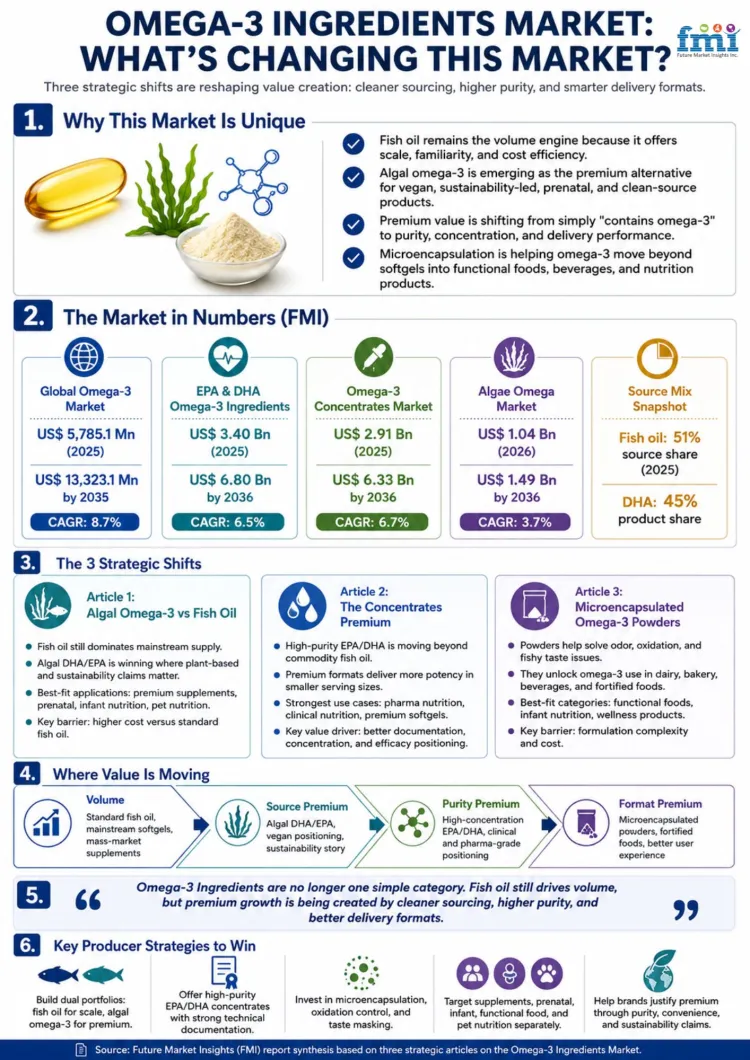
Microencapsulated omega-3 powders are becoming one of the most important delivery-format shifts in the omega-3 ingredients market. The issue is not simply that brands want omega-3 in powder form. The deeper issue is that microencapsulation changes where omega-3 can be used, how it can be positioned, and how ingredient suppliers can move beyond traditional softgel and liquid oil economics.
For years, omega-3 was strongly associated with fish oil capsules, softgels, liquid oils, and pharmaceutical-grade concentrates. These formats remain important, but they create a limitation for food and beverage brands. Oils are difficult to incorporate into many dry, baked, dairy, beverage, powdered, and infant nutrition systems because they can oxidize, create fishy odor, affect taste, interact with processing conditions, and complicate shelf-life management. Microencapsulated powders address these problems by converting sensitive omega-3 oils into protected, more manageable dry ingredients.
FMI’s broader Omega-3 Market shows the strength of the demand base behind this shift. The market was valued at USD 5,785.1 million in 2025 and is projected to reach USD 13,323.1 million by 2035, growing at an 8.7% CAGR. FMI also identifies fish oil as the leading source type with 51% share in 2025, while DHA accounted for 45% of product type revenue. This shows that the market is still anchored in marine omega-3 scale, but value is increasingly moving toward formats that improve usability and product differentiation.
The microencapsulated powder opportunity is more specific. FMI’s Microencapsulated Omega-3 Powders Market is estimated at USD 14.4 billion in 2026 and is projected to reach USD 31.6 billion by 2036, expanding at an 8.2% CAGR. FMI defines the market as commercially produced encapsulated omega-3 fatty acid powders using spray drying, coacervation, fluidized bed coating, and other encapsulation technologies for dietary supplements, food fortification, infant nutrition, pharmaceutical, and animal nutrition applications. The scope excludes liquid omega-3 oils, softgel capsules without powder encapsulation, and omega-3 enriched finished foods.
This distinction matters because microencapsulated omega-3 powder is not just another source of EPA and DHA. It is a delivery platform. It allows omega-3 to move into formats where liquid oil is technically difficult, commercially risky, or sensorially unacceptable. It also allows brands to speak to everyday nutrition rather than only capsule-based supplementation.
FMI’s segmentation shows why the market is gaining momentum. Conventional omega-3 powders hold 72.0% of the nature segment in 2026, reflecting the scale of fish oil-derived encapsulated products. Dietary supplements account for 42.0% of application demand, with powder-filled capsules, sachets, and powdered drink mixes as important formats. DHA represents 46.0% of acid type demand because of its strong role in brain health, infant nutrition, prenatal nutrition, and eye health. Spray drying accounts for 58.0% of encapsulation technology, showing the importance of scalable and cost-efficient processing.
The core value of microencapsulation is simple: it protects the oil and improves usability. Omega-3 fatty acids are sensitive to air, heat, light, moisture, and processing stress. When they oxidize, they can create off-flavors, rancid notes, odor problems, and shortened shelf life. For a supplement softgel, this can be managed through capsules, packaging, antioxidants, and storage. For a bakery mix, dairy drink, infant formula powder, protein powder, or functional beverage premix, the challenge is more complex. The ingredient must survive manufacturing, blending, packaging, storage, and consumer preparation.
This is why microencapsulation is strategically important for functional foods. It creates a protective barrier around the oil, masks taste and odor, improves powder handling, supports dosing accuracy, and enables more uniform distribution in food matrices. Health Canada’s novel food assessment of microencapsulated fish oil describes the process as converting liquid oil into a dry powder for easier formulation and handling, while masking fishy odor and taste. It also notes that the process substantially resolves problems associated with adding fish oils to foods.
Supplier-level product examples show how this works commercially. BASF’s Dry n-3 DHA 11 technical information describes a light-yellow to light-beige, free-flowing dry powder made of spherical particles containing microencapsulated fish oil rich in DHA. This type of ingredient illustrates how a sensitive marine oil can be converted into a more standardized powder input for nutrition applications. dsm-firmenich’s MEG-3 omega-3 powder is positioned for bakery use and is described as easy to add to dry ingredients for bread and bakery products, with minimal impact on dough handling and no adverse effect on taste or texture.
The first major opportunity is fortified bakery and cereal. Bread, rolls, tortillas, bagels, cereals, nutrition bars, and baked snacks are high-frequency eating occasions. They are also technically challenging because omega-3 can be exposed to mixing, heat, oxygen, and long shelf life. Microencapsulated powders give brands a route to add omega-3 without making the finished product taste like fish oil. This matters because functional food fortification only works when the health benefit does not damage the eating experience.
The second opportunity is dairy and dairy alternatives. Yogurts, milk powders, nutritional drinks, smoothies, and plant-based dairy alternatives can carry omega-3 claims, especially when positioned around brain health, children’s nutrition, women’s health, and healthy aging. However, dairy systems are sensitive to flavor, oxidation, emulsion stability, and packaging. Microencapsulated powders can help reduce sensory risk, although formulation testing remains critical.
The third opportunity is powdered nutrition. Protein powders, meal replacement powders, instant breakfast mixes, sports nutrition blends, maternal nutrition powders, and senior nutrition products are natural fits because omega-3 powder can be dry-blended into existing powder systems. FMI notes that US sports nutrition brands incorporate encapsulated omega-3 in protein powder blends and performance supplement formulations. This shows how the format can connect omega-3 with active-lifestyle nutrition beyond traditional softgels.
The fourth opportunity is infant and prenatal nutrition. DHA is already highly relevant in infant formula, baby food, maternal nutrition, and prenatal supplements. In these applications, ingredient buyers require much more than a nutrient claim. They need stability data, regulatory documentation, purity control, contaminant control, consistent particle performance, and supply reliability. Microencapsulated DHA powders can command premium value because they serve high-trust, specification-driven applications.
The fifth opportunity is gummies, sachets, and alternative supplement formats. Consumers increasingly want convenient products that do not feel like traditional pills. Microencapsulated omega-3 powders can support sachets, powdered drink mixes, chewables, stick packs, and certain gummy formats where oil handling is difficult. The more the supplement market moves toward enjoyable formats, the more omega-3 delivery technology matters.
For omega-3 ingredient suppliers, the market shift is clear. The product being sold is no longer only EPA/DHA content. Suppliers must sell application performance. This includes particle size, flowability, dispersibility, encapsulation efficiency, oil loading, sensory masking, oxidation control, process tolerance, allergen profile, carrier system, label impact, and compatibility with the customer’s manufacturing line.
The first pressure point is cost. Microencapsulation adds processing cost over raw fish oil or algal oil. The finished powder can be more expensive per unit of delivered EPA/DHA, especially when carrier materials, antioxidants, encapsulation yield, and quality testing are considered. This means microencapsulated powders are unlikely to replace commodity fish oil in every application. They are most attractive where the format unlocks a higher-value product, stronger claim, better convenience, or access to food categories that oils cannot serve well.
The second pressure point is active loading. A powder is not pure omega-3 oil. It contains oil plus wall materials, stabilizers, carriers, antioxidants, and processing aids. Buyers need to assess cost per gram of delivered EPA/DHA, not only price per kilogram of powder. A powder with lower oil loading may be easy to handle but require more inclusion in the finished product. A higher-loading powder may offer stronger economics but create greater stability and sensory challenges. The right balance depends on the application.
The third pressure point is heat and process stability. Bakery, extruded snacks, powdered drink mixes, gummies, dairy processing, and infant formula all expose ingredients to different stress conditions. A powder that performs in a dry capsule may not perform in a baked product. A product that disperses well in a beverage may not be suitable for high-heat processing. This is why application-specific testing is essential. Microencapsulation is not one technology. It is a family of systems that must be matched to the food matrix.
The fourth pressure point is label impact. The wall material used in encapsulation can affect clean-label positioning. Gelatin, caseinate, starches, gums, proteins, modified starches, or other carriers can influence allergen status, vegetarian suitability, vegan claims, dairy-free claims, and consumer perception. This is especially important as omega-3 brands move into plant-based, kids’ nutrition, clean-label supplements, and premium functional foods. Algal omega-3 powders can support fish-free positioning, but the encapsulation system must also support the intended claim.
The fifth pressure point is shelf-life validation. Omega-3 oxidation is not only an ingredient problem. It is a finished-product problem. Packaging, water activity, oxygen exposure, light exposure, storage temperature, co-ingredients, flavor systems, minerals, and processing steps can all affect stability. Suppliers that provide finished-application stability support will be more valuable than suppliers that only sell powder specifications.
Country growth also supports the functional food opportunity. FMI projects China at 11.1% CAGR through 2036, India at 10.3%, Germany at 9.4%, France at 8.6%, the UK at 7.8%, the USA at 7.0%, and Brazil at 6.2% in the microencapsulated omega-3 powders market. This growth pattern shows that the opportunity is not limited to mature supplement markets. It also reflects nutraceutical manufacturing growth, infant nutrition demand, urban health awareness, e-commerce supplement retail, and food fortification interest across emerging and developed economies.
China and India are particularly important because they combine rising supplement adoption with expanding nutrition manufacturing. Local manufacturers can use microencapsulated omega-3 powders in sachets, capsules, drink mixes, infant nutrition, and fortified food products. Germany, France, the UK, and the USA remain important because they have established supplement channels, stronger regulatory structures, and more developed functional food innovation systems.
The biggest misconception is that microencapsulation automatically makes omega-3 easy to add to any food. That is not true. Microencapsulation reduces barriers, but it does not eliminate formulation work. The powder must be tested for taste, odor, oxidation, dispersibility, process tolerance, label compatibility, and shelf-life performance in the actual product. A bakery application, a dairy beverage, a powdered shake, and an infant formula all require different design choices.
Another misconception is that functional foods will replace supplements. In reality, supplements will remain a major demand base because they allow concentrated dosing, controlled serving size, and direct consumer communication. FMI’s 42.0% application share for dietary supplements in 2026 confirms that supplements remain central to the category. Functional foods represent the next growth wave because they expand the number of daily consumption occasions and allow omega-3 to become part of routine eating.
A third misconception is that all powder formats are premium. Some powders are built for cost-effective fortification, while others are built for high-DHA infant nutrition, vegan algal positioning, high stability, or advanced delivery. The premium depends on specification, source, active loading, encapsulation quality, regulatory support, sensory performance, and the finished application. A powder that enables a successful fortified food launch may create more value than a higher-purity oil that cannot be used outside capsules.
For brand owners, the strategic question is whether omega-3 powder creates a real consumer reason to buy. A label claim alone is not enough. The finished product must deliver an acceptable dose, taste good, remain stable, fit the eating occasion, and justify any price premium. This is especially important in functional foods, where consumers will not repurchase a product that sacrifices taste for nutrition.
For co-manufacturers and food manufacturers, microencapsulated omega-3 powders create operational opportunities but also require tighter ingredient control. Procurement teams must qualify suppliers based on active content, batch consistency, allergen profile, documentation, storage requirements, shelf-life data, and performance during processing. Manufacturing teams must understand when to add the powder, how to mix it, whether it affects texture, and how packaging protects the finished product.
For ingredient suppliers, the best strategy is to move from product selling to application partnership. Suppliers that can provide bakery-ready, dairy-ready, beverage-ready, infant-nutrition-ready, sports-nutrition-ready, and vegan-ready omega-3 powder systems will be better positioned than suppliers offering only generic encapsulated powder. The commercial advantage sits in solving the customer’s formulation problem, not just supplying EPA/DHA.
The best way to analyze this market is through an application-unlock lens. Key metrics include oil loading, EPA/DHA content per gram, wall material, encapsulation efficiency, peroxide value, anisidine value, TOTOX, particle size, flowability, dispersibility, heat tolerance, sensory score, shelf-life performance, allergen profile, claim compatibility, and cost per delivered active dose. These metrics show whether a powder can actually enable functional food growth.
Bottom line: microencapsulated omega-3 powders can unlock the next growth wave in functional foods, but only where they solve real formulation and sensory problems. Supplements will remain the largest and most reliable demand base, but bakery, dairy, beverages, infant nutrition, sports nutrition, powdered nutrition, and alternative supplement formats create a broader set of opportunities. The winners will be suppliers that deliver stable, taste-masked, application-ready powders with strong documentation and competitive active-dose economics. The losers will be brands and suppliers that assume a powder format alone is enough to make omega-3 successful in food.
FMI Related Reports
- Microencapsulated Omega-3 Powders Market: Primary interlink in the introduction, market sizing paragraph, formulation discussion, and conclusion
- Omega-3 Market: Use when discussing the broader omega-3 demand base, fish oil leadership, DHA share, and preventive nutrition growth
- EPA DHA Omega 3 Ingredients Market: Use when linking powder formats to the wider EPA/DHA ingredient ecosystem across marine, algae, oil, powder, and encapsulated forms
- Omega-3 Concentrates Market: Use when explaining how high-purity EPA/DHA concentrates can act as the active base for powder delivery systems
- Algae Omega Market: Use when discussing fish-free, vegan, plant-based, and sustainability-led powder formats
- Functional Food Ingredients Market: Use when discussing omega-3 fortification in bakery, dairy, beverages, bars, cereals, and daily nutrition formats
- Infant Formula Market: Use when discussing DHA powder demand in infant formula, baby food, and maternal nutrition
- Sports Nutrition Market: Use when discussing protein powders, powdered drink mixes, performance nutrition, and active-lifestyle omega-3 formats
- Dietary Supplements Market: Use when explaining powder-filled capsules, sachets, stick packs, gummies, and supplement-led demand

