


- Omega-3 concentrates are turning fish oil from a commodity wellness ingredient into a potency-led ingredient platform for premium supplements, pharmaceutical nutrition, infant nutrition, medical nutrition, and functional health products.
- FMI’s Omega-3 Concentrates Market shows the category expanding from USD 2.91 billion in 2025 to USD 3.31 billion in 2026 and USD 6.33 billion by 2036, growing at a 6.7% CAGR.
- High-purity EPA/DHA helps brands reduce serving size, improve dosage convenience, build stronger cardiovascular, cognitive, prenatal, and clinical positioning, and create premium formats beyond standard fish oil capsules.
- The biggest beneficiaries are suppliers that can offer advanced purification, customized EPA:DHA ratios, triglyceride and ethyl ester options, oxidation control, regulatory documentation, and consistent supply quality.
- The biggest risk is treating all concentrates as the same. Premium value depends on purity, form, active dose, sensory performance, stability, compliance support, and the total cost per gram of delivered EPA/DHA.
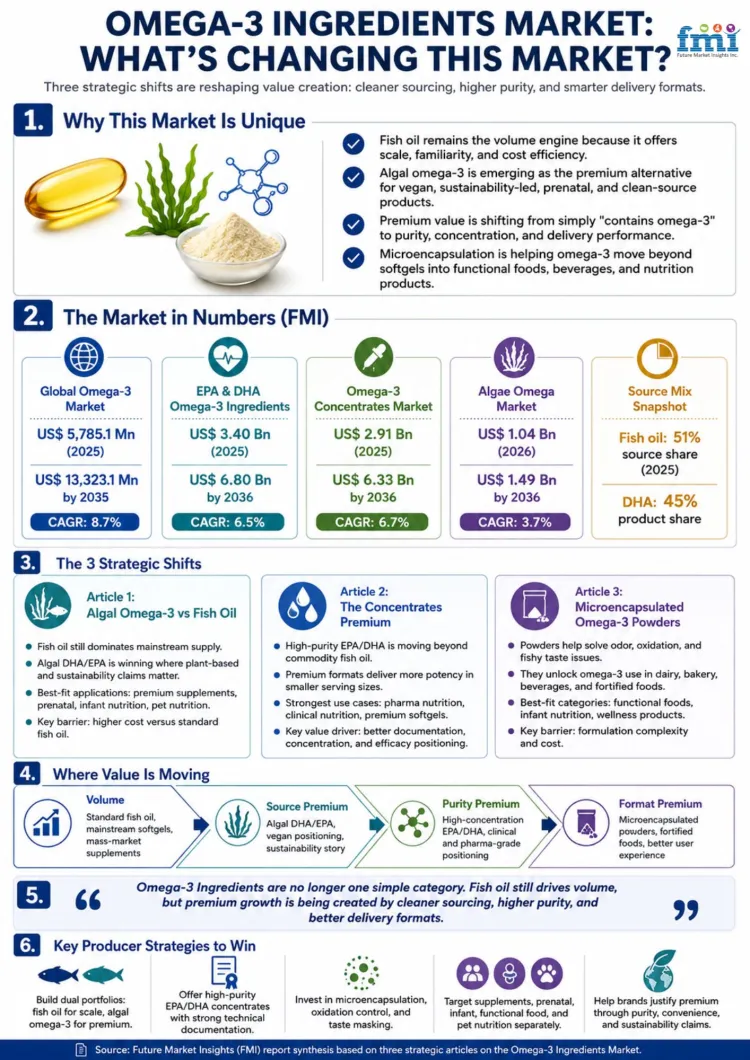
Omega-3 concentrates are becoming one of the most important premium shifts in the omega-3 ingredients market. The issue is not simply that brands want more EPA and DHA per capsule. The deeper issue is that high-purity omega-3 changes the economics of dosage, claims, manufacturing, consumer compliance, and supplier differentiation. It moves the category beyond basic fish oil and into a more specialized ingredient market built around potency, purity, documentation, and application fit.
Standard fish oil remains important because it gives the market scale. It is widely available, familiar to consumers, accepted by supplement manufacturers, and suitable for mainstream softgels. However, standard fish oil can struggle when brands need higher active content, smaller serving sizes, stronger clinical positioning, or premium product architecture. A low-concentration oil may deliver omega-3 benefits, but it often requires more capsules, larger softgels, higher oil loading, and weaker differentiation at shelf level.
FMI’s broader Omega-3 Market shows the strength of the underlying demand base. The market was valued at USD 5,785.1 million in 2025 and is projected to reach USD 13,323.1 million by 2035, growing at an 8.7% CAGR. FMI also identifies fish oil as the leading source type with 51% share in 2025, while DHA held 45% share of product type revenue. This confirms that the market is still anchored in marine omega-3 scale, but it is also moving toward more targeted health-positioned formulations.
The concentrate opportunity is more specific. FMI’s Omega-3 Concentrates Market was valued at USD 2.91 billion in 2025. Demand is estimated to reach USD 3.31 billion in 2026 and USD 6.33 billion by 2036, expanding at a 6.7% CAGR. FMI also notes that oil form is expected to lead with approximately 63.4% share in 2026, fish source with around 54.8% share, triglyceride type with about 46.7% share, high EPA concentration with about 38.9% share, and dietary supplements with approximately 41.6% end-use share.
These shares are important because they show that concentrates are not only a niche pharmaceutical input. They remain strongly linked to supplement manufacturing, bulk oil procurement, and potency-led consumer health formats. The market is moving from “fish oil as a general wellness oil” to “EPA/DHA concentrates as targeted functional ingredients.” That shift changes how suppliers compete.
FMI’s EPA DHA Omega 3 Ingredients Market also reinforces this direction. The EPA DHA omega-3 ingredients market was valued at USD 3.40 billion in 2025 and is expected to reach USD 3.62 billion in 2026 and USD 6.80 billion by 2036 at a 6.5% CAGR. FMI defines the market as EPA and DHA ingredients from marine oil, algae oil, and high-purity concentrate sources in oil, powder, and encapsulated forms for dietary supplements, functional food, pharmaceutical, infant formula, and pet food applications. This makes high-purity concentrates central to the long-chain omega-3 ingredient economy.
The first reason high-purity EPA/DHA is gaining premium relevance is dosage efficiency. A higher concentration allows brands to deliver more active omega-3 in fewer capsules or smaller softgels. This matters because consumer compliance is often affected by pill burden, capsule size, repeat dosing, and aftertaste. A product that requires fewer capsules per day is easier to position as premium, convenient, and clinically serious.
The second reason is claim architecture. Standard fish oil can support broad omega-3 positioning, but high-purity concentrates allow more targeted claims around cardiovascular health, triglyceride management, cognitive function, prenatal DHA, eye health, inflammation support, and healthy aging. The ingredient is no longer valued only as an oil. It is valued as a concentrated active system that can support more precise product claims and better dosage communication.
The third reason is finished-product economics. A high-concentrate oil may cost more per kilogram than standard fish oil, but the relevant metric is not only cost per kilogram. The better metric is cost per gram of delivered EPA and DHA, plus the effect on capsule count, fill weight, packaging, serving size, and consumer value perception. In premium supplements, a higher ingredient cost can be justified if it enables a stronger dose, fewer softgels, cleaner communication, and better shelf differentiation.
The fourth reason is pharmaceutical and clinical credibility. High-purity omega-3 has a stronger fit in prescription omega-3 products, pharma-grade APIs, medical nutrition, and practitioner-recommended supplements. BASF, for example, lists omega-3-acid ethyl esters 90, EPA ethyl ester, omega-3 acid triglycerides, and DHA ethyl ester products in its omega-3 API portfolio, and states that its omega-3-based API is approved for use in drug products in approximately 70 countries worldwide. This shows why documentation, monographs, and regulatory support matter in the high-purity segment.
KD Pharma’s omega-3 API portfolio also shows where the premium boundary sits. The company states that it offers concentrates with EPA up to 99% purity and DHA up to 95% purity, and can custom manufacture APIs in ethyl ester, triglyceride, free fatty acid, or other forms. This type of capability shows that the market is not only about refining fish oil. It is about creating customized fatty acid profiles for specific product, therapeutic, and regulatory needs.
The fifth reason is format flexibility. High-purity omega-3 can be used in softgels, liquids, powders, emulsions, microencapsulated systems, pharmaceutical capsules, and functional nutrition formats. Concentrates can also be paired with antioxidants, flavor masking, encapsulation, and delivery technologies to improve stability and sensory performance. This makes them more adaptable than standard oils in applications where taste, odor, oxidation, or processing exposure are major concerns.
The sixth reason is premium segmentation. Brands can use different omega-3 inputs across different price tiers. Standard fish oil can support value products. Medium concentrates can support mainstream premium softgels. High EPA or high DHA concentrates can support condition-specific supplements. Pharmaceutical-grade concentrates can support prescription or practitioner-oriented positioning. Algal concentrates can support vegan or fish-free premium claims. This creates a price ladder rather than a single commodity oil category.
For ingredient suppliers, this creates a clear shift in competitive advantage. The winning supplier is not simply the one with access to raw fish oil. The winning supplier is the one that can purify, concentrate, stabilize, document, customize, and support the ingredient through formulation and regulatory requirements. In this environment, purification technology becomes a value-creation tool.
KD Nutra’s marine omega-3 positioning illustrates this supplier shift. The company describes multi-step distillation and purification, molecular and fractional distillation, and supercritical CO2 chromatography for separation of EPA and DHA. It also states that it can provide omega-3 EPA/DHA content up to 99% in ingredients, with deodorization and oxidation protection. This is exactly the type of technical language that matters to premium omega-3 buyers because it links purity, sensory quality, and stability.
The first pressure point in the concentrate market is raw material security. Even highly purified omega-3 often begins with marine oil supply. If fish oil availability tightens or prices rise, concentrate producers face margin pressure unless they have diversified sourcing, long-term supply agreements, or algae-based alternatives. Concentration does not remove raw material risk. It makes supply quality and yield management even more important.
The second pressure point is oxidation control. Omega-3 oils are sensitive to oxidation, and higher-value products cannot afford sensory failure, rancidity, or stability problems. Peroxide value, anisidine value, TOTOX, packaging, antioxidants, nitrogen flushing, storage conditions, and cold-chain management all become important. A high-purity oil that oxidizes easily will not sustain premium value. Stability is part of the premium, not an afterthought.
The third pressure point is form selection. Ethyl ester, triglyceride, re-esterified triglyceride, and free fatty acid formats do not carry the same positioning. Some buyers prioritize cost and concentration. Others prioritize bioavailability, regulatory fit, or label communication. Triglyceride formats can support premium nutrition positioning, while ethyl esters are common in concentrated and pharmaceutical contexts. Suppliers that can explain and support the right form for each application will have an advantage.
The fourth pressure point is EPA:DHA ratio. The market is no longer satisfied with generic EPA/DHA blends. Cardiovascular products may favor EPA-led formulations. Prenatal and infant nutrition may favor DHA-led formulations. Brain health, eye health, mood, sports recovery, and healthy aging products may require different profiles. Custom ratios allow brands to build more precise product stories, but they also require stronger technical and procurement discipline.
The fifth pressure point is regulatory and quality documentation. Premium omega-3 buyers increasingly need certificates of analysis, contaminant testing, allergen statements, sustainability documentation, regulatory files, monograph alignment, and market-specific compliance support. This is especially important for pharmaceutical, infant nutrition, medical nutrition, and export-oriented supplement brands. Suppliers with weak documentation may be treated as commodity oil vendors even if their concentration is high.
The sixth pressure point is sustainability. Concentrates can create higher value from marine oil, but they can also face scrutiny if sourcing is not transparent. Buyers may ask for fishery certification, traceability, by-product utilization, responsible harvesting, or algal alternatives. Sustainability will not replace potency as the main value driver in concentrates, but it will increasingly affect supplier qualification and brand communication.
For supplement brands, the premium opportunity is clear. High-purity EPA/DHA allows them to move away from basic “1000 mg fish oil” claims and toward active-content claims. Consumers are becoming more aware that total fish oil weight is not the same as EPA and DHA content. Products that clearly communicate EPA, DHA, form, source, and serving size can stand apart from commodity fish oil softgels.
For pharmaceutical and medical nutrition companies, concentrates offer a different type of value. They support controlled composition, repeatable dosage, documentation, and clinical positioning. The barrier to entry is higher, but so is the value of quality assurance. In these channels, buyers are less interested in broad wellness language and more interested in purity, specification control, pharmacopoeial alignment, and regulatory reliability.
For infant and prenatal nutrition, DHA-led concentrates are particularly important. The buyer is often more sensitive to purity, safety perception, and developmental health positioning. In these applications, the premium is built around trust. The source, concentration, contaminant control, and quality documentation must all support the product promise.
For functional food and beverage manufacturers, high-purity concentrates can support fortification, but technical hurdles remain. Taste, odor, oxidation, solubility, and process stability can limit adoption. This is why microencapsulation, emulsification, and powder conversion are strategically important. Concentrates create the active base, but delivery technology often determines whether the ingredient can succeed in foods and beverages.
For pet nutrition, high-concentrate omega-3 can support skin and coat health, joint support, cognitive health, and senior pet wellness. Pet supplement brands may use potency-led positioning similar to human supplements. However, pet food applications remain cost-sensitive, so concentrates are more likely to appear in premium pet supplements, veterinary products, and high-end functional pet foods than in value-tier mass food formats.
The biggest misconception is that omega-3 concentrates are just expensive fish oil. That view misses the core value shift. Concentrates change the active dose, capsule count, claim strength, product tier, and quality expectations. They also allow suppliers to create custom products rather than selling only bulk commodity oil. The premium is not only in the oil. It is in the performance system built around the oil.
Another misconception is that the highest concentration is always best. In reality, the best concentrate depends on application fit. A very high EPA product may be ideal for a cardiovascular-focused product but less suitable for prenatal DHA positioning. A balanced EPA:DHA concentrate may be better for general wellness. A triglyceride concentrate may work better for a premium consumer supplement, while an ethyl ester format may fit a different cost or regulatory context. The right specification matters more than simply maximizing percentage.
A third misconception is that concentrate premiumization only benefits large pharmaceutical suppliers. Large API producers clearly benefit, but premium supplement brands, contract manufacturers, softgel producers, infant nutrition manufacturers, functional food developers, and pet supplement companies also benefit. The market opportunity sits across a spectrum of applications, from high-end retail wellness to clinical and regulated products.
The private-label and value-tier effect also matters. As basic fish oil becomes more price competitive, branded supplement companies need reasons to defend premium pricing. High-purity EPA/DHA is one of the strongest defenses because it provides a tangible difference in active dose and serving convenience. A value fish oil product can compete on price. A high-concentrate product can compete on potency, quality, and targeted health positioning.
For omega-3 ingredient suppliers, the commercial challenge is to avoid the middle. Standard fish oil competes on scale and price. Ultra-premium concentrates compete on specification and documentation. The difficult zone is a product that is more expensive than standard fish oil but not differentiated enough to justify premium pricing. Suppliers need to define whether they are selling cost-efficient marine oil, high-potency nutrition concentrates, pharma-grade API, algal concentrates, or application-ready delivery systems.
The best way to analyze this market is through an active-dose economics lens. Key metrics include EPA/DHA concentration, EPA:DHA ratio, chemical form, peroxide value, anisidine value, TOTOX, heavy metal levels, capsule count per daily serving, cost per gram of active EPA/DHA, yield from raw oil, certification status, regulatory file depth, and stability performance. These metrics reveal whether a concentrate is truly premium or simply higher priced.
Bottom line: omega-3 concentrates are moving the market beyond commodity fish oil by creating a premium ingredient economy around purity, potency, form, documentation, and application-specific performance. Fish oil will remain the scale base of the omega-3 market, but high-purity EPA/DHA will increasingly define the value pools. The winners will be suppliers that can deliver reliable active content, clean sensory performance, oxidation control, regulatory support, and customized EPA:DHA solutions. The losers will be suppliers and brands that continue to sell omega-3 only as bulk oil weight instead of delivered active benefit.
FMI Related Reports
- Omega-3 Concentrates Market: Primary interlink in the introduction, market sizing paragraph, and conclusion when discussing high-purity EPA/DHA premiumization
- EPA DHA Omega 3 Ingredients Market: Use when linking concentrates to the broader EPA/DHA ingredient ecosystem across marine oil, algae oil, powders, and encapsulated formats
- Omega-3 Market: Use when discussing the broader omega-3 demand base, fish oil leadership, DHA share, and preventive health growth
- Microencapsulated Omega-3 Powders Market: Use when discussing food fortification, powder delivery, taste masking, oxidation control, and functional food applications
- Algae Omega Market: Use when discussing fish-free or vegan high-purity omega-3 alternatives and algae-based concentrate opportunities
- Dietary Supplements Market: Use when explaining supplement-led demand for premium omega-3 softgels, liquids, gummies, and targeted health products
- Infant Formula Market: Use when discussing DHA-led concentrate demand in infant formula, toddler nutrition, and developmental health formulations
- Functional Food Ingredients Market: Use when linking high-purity omega-3 to fortified beverages, dairy, bakery, bars, and daily nutrition formats
- Pet Herbal Supplements Market: Use when discussing premium omega-3 use in pet skin, coat, joint, cognitive, and senior wellness supplements

