


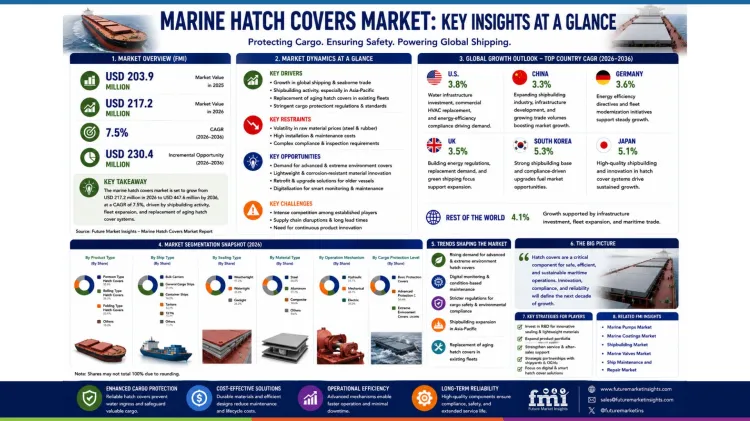
- Pontoon type hatch covers currently show the stronger market position, with FMI projecting a 32.8% product share in 2026.
- Shipowners usually prefer pontoon systems where proven design, structural simplicity, cargo protection, and predictable maintenance economics matter.
- Rolling hatch covers remain important on vessels where fast opening, operational convenience, and repeated cargo access can justify higher mechanical complexity.
- Bulk carriers account for 38.6% of ship-type demand, which supports pontoon adoption because dry bulk cargo protection depends heavily on robust weathertight covers.
- Steel leads material demand with 44.5% share, reflecting shipowner preference for strength, durability, repairability, and classification familiarity.
- The market signal is not that rolling systems are weak. It is that pontoon covers often offer the better cost-performance balance across mainstream dry cargo applications.
A hatch cover is not bought as a simple deck closure. For a shipowner, it is a cargo-protection system, a structural component, a maintenance item, and a source of operational risk if it fails. The cost-performance question therefore has to include much more than the purchase price. It includes cargo type, opening frequency, crew workload, mechanical complexity, maintenance access, gasket life, drainage, corrosion, survey performance, and potential wet cargo claims.
FMI estimates the marine hatch covers market at USD 217.2 million in 2026, rising to USD 447.6 million by 2036 at a 7.5% CAGR. Pontoon type hatch covers are projected to lead with 32.8% product share in 2026, while bulk carriers account for 38.6% of ship-type demand. Weathertight sealing leads with 41.2% share, and steel leads material demand with 44.5%. These figures point to a market where shipowners continue to value proven, structurally robust, classification-friendly systems for dry cargo operations.
Pontoon hatch covers are attractive because they are relatively simple and robust. They are commonly used on bulk carriers and dry cargo vessels where large hatch openings must be closed securely during sea passage. Their strength lies in structural reliability, straightforward panel design, and suitability for vessels carrying coal, grain, ore, fertilizers, minerals, cement, and other bulk or break-bulk cargoes that must be protected from water ingress.
The cost-performance case for pontoon covers is strongest when the shipowner values long service life over operational speed. A pontoon system may not always offer the quickest opening cycle compared with powered rolling systems, and it can be durable, familiar to crews, and easier to assess during maintenance. For many bulk carriers, hatch covers are opened and closed in port during cargo operations, then secured for passage. The number of operating cycles may not be as high as some container or multipurpose cargo applications. In such cases, structural reliability can outweigh speed.
Rolling hatch covers answer a different operating need. They can be attractive where cargo access frequency is higher, where rapid opening and closing improve port efficiency, or where deck layout and cargo handling require a rolling movement rather than lifting or removing pontoon panels. Rolling systems may also be preferred in certain general cargo, container, or specialized cargo configurations where operational convenience has real commercial value.
The trade-off is mechanical complexity. Rolling hatch covers use wheels, tracks, chains, hydraulic or mechanical drive systems, stoppers, cleats, and sealing arrangements that must remain correctly adjusted. These components can be efficient when maintained well, and they create more maintenance points. If tracks deform, wheels wear, seals compress unevenly, or cleats are misadjusted, weathertight integrity can deteriorate.
This is where cost-performance becomes vessel-specific. A rolling hatch cover can outperform a pontoon cover on operational efficiency if the vessel frequently opens and closes hatches and if the owner maintains the operating mechanism properly. A pontoon cover can deliver better lifecycle economics where the owner prioritizes simplicity, lower mechanical burden, and proven cargo protection.
IACS guidance and IMO standards make clear that hatch cover performance is not only a design issue. It depends on inspection and maintenance. IMO Resolution MSC.169(79) defines requirements for owners inspection and maintenance of bulk carrier hatch covers. IMO guidance also notes that manufacturers should provide recommendations for safe operation, inspection, maintenance, repair, spare parts, and periodic renewal of components subject to wear or ageing. That directly affects procurement because shipowners are not only buying steel panels. They are buying a maintenance obligation that follows the vessel through its operating life.
Bulk carriers reinforce the pontoon advantage. They carry cargo that can be highly sensitive to water ingress. Grain can spoil. Cement can set. Ore and coal cargoes can create additional risks if water ingress changes cargo condition. Fertilizers and other bulk commodities can be damaged or contaminated. A hatch cover failure can therefore create cargo claims, off-hire risk, survey findings, and reputational damage.
P&I Club guidance repeatedly emphasizes this risk. Gard has noted that cargo wetting claims due to defective hatch covers remain a recurring issue, and the Nautical Institute has stated that wetting damage from leaking hatch covers still ranks high in dry cargo ship losses. These sources do not rank hatch cover types by market share, and they explain why shipowners are conservative. They prefer systems that crews can inspect, maintain, secure, and test with confidence.
The 44.5% steel share in the FMI material segmentation also supports the pontoon cost-performance case. Steel is heavy, and it is strong, repairable, well understood by shipyards, and familiar to class surveyors. Aluminum or composite alternatives may offer weight and corrosion benefits in selected applications, and hatch covers for bulk carriers and heavy-duty dry cargo vessels often need high structural strength and deformation resistance. For shipowners, a cover that can be repaired by a competent yard may be more valuable than a lighter system with more complex repair requirements.
Cargo protection level also matters. FMI includes basic protection covers, advanced protection covers, and extreme environment covers. A vessel trading in harsh weather routes, carrying high-value moisture-sensitive cargo, or serving regulated charters may justify upgraded sealing, stronger panels, corrosion-resistant components, and more reliable operating mechanisms. In that environment, rolling covers are not necessarily disadvantaged, and their lifecycle case depends on maintenance discipline.
A shipowner evaluating pontoon versus rolling hatch covers should ask practical questions before comparing quotes.
- How often will the hatch be opened?
- What cargoes will be carried?
- How much port time is saved by faster operation?
- Can the crew maintain tracks, wheels, seals, cleats, hydraulics, and drainage properly?
- Are replacement gaskets and spare parts available at likely trading ports?
- How strict are charterer and cargo-owner inspection requirements?
- Will the vessel operate in heavy weather, icy routes, or corrosive cargo environments?
- How costly would one wet cargo claim be compared with the price difference between designs?
This final question is often decisive. A small saving in hatch cover procurement can disappear quickly if poor sealing causes a claim. A highly automated rolling system may also not justify its higher cost if the vessel cargo operations do not require frequent hatch movement.
The 32.8% pontoon share suggests that shipowners still see pontoon covers as a reliable cost-performance choice for mainstream cargo-protection needs. Rolling covers remain commercially important where operating speed and access efficiency matter. The strongest suppliers will not position one design as universally superior. They will match hatch cover type to cargo profile, ship design, crew capability, operating cycle, and inspection burden.
For most industrial dry cargo and bulk carrier buyers, pontoon hatch covers appear to offer the better cost-performance balance because they combine proven structure, predictable maintenance, and strong suitability for weathertight cargo protection. Rolling hatch covers fit better where operational efficiency justifies additional mechanical complexity.

