


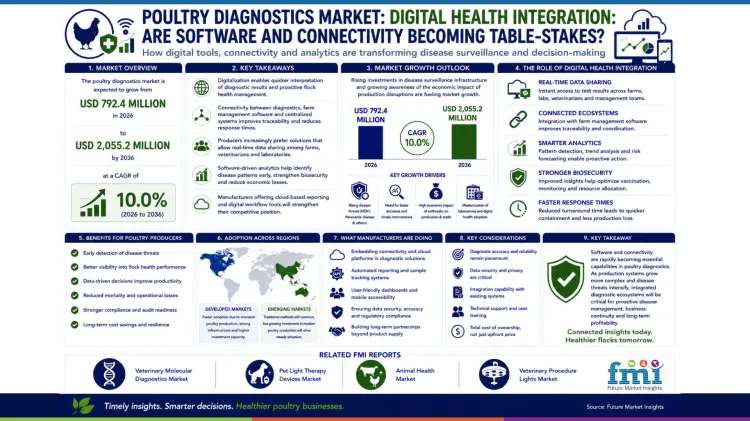
- The poultry diagnostics market is anticipated to grow from USD 792.4 million in 2026 to USD 2,055.2 million by 2036, at a CAGR of 10.0% during the forecast period.
- Digitalization is revolutionizing poultry disease surveillance, enabling quicker interpretation of diagnostic results and more proactive flock health management.
- Connectivity between diagnostic platforms, farm management software and centralized monitoring systems is improving traceability and increasing response times in disease outbreaks.
- Commercial poultry producers are looking increasingly for diagnostic solutions that enable veterinarians, laboratories and production facilities to share data in real time.
- Software-driven analytics are helping producers identify disease patterns sooner, improve biosecurity programs and reduce the financial impact of infectious disease events.
- With the maturation of the market, diagnostic manufacturers that incorporate cloud-based reporting capabilities and digital workflow tools are expected to improve their competitive positioning.
The poultry diagnostics market is rapidly evolving, shifting from traditional lab testing to integrated disease management ecosystems. As poultry production systems become larger and more technologically advanced, producers are looking for diagnostic solutions that provide not only correct results, but also actionable information to guide timely intervention.
The market is expected to grow from USD 792.4 Million in 2026 to USD 2,055.2 Million by the end of 2036 at a CAGR of 10.0% during the forecast period owing to increasing investments in disease surveillance infrastructure and increasing awareness regarding the economic impact of production disruptions.
Historically, poultry diagnostics have been used primarily to confirm the presence of disease following clinical signs. Test results were often processed via unintegrated reporting systems that impeded transparency between the production sites. These methods helped identify disease but often delayed larger containment efforts.
This dynamism is starting to change with digital integration.
In modern poultry production with several production sites, centralization of decision making is becoming increasingly important. In these environments, diagnostic information must be able to move quickly from farms to veterinarians, to laboratories and to operational leadership teams. This exchange is made possible by software-driven reporting systems, which provide immediate access to test results and allow more coordinated responses.
Connectivity is emerging as a key differentiator between diagnostic providers.
Platforms that are able to incorporate test results into larger flock management systems provide better control of disease trends over time to producers. These capacities would allow for more efficient surveillance especially for diseases such as H5N1 and Newcastle disease where timely action is essential to reduce the risk of dissemination.
Digital technologies aid in biosecurity efforts.
By pooling historic diagnostic data, producers can get a better sense of recurring health problems across facilities. By looking at trends we can identify threats when they emerge, allowing us to target our vaccination strategies and resources more efficiently.
But these benefits go beyond disease control for large commercial poultry operations.
Maintaining steady production is a top priority across the poultry value chain. Disease outbreaks can result in substantial economic losses due to mortality, trade bans and interruption of operations. This means faster diagnostic insights to help inform decisions that protect flock productivity and supply stability.
Hence, the integration of software capabilities in the diagnostic workflows can lead to more strong economic outcomes.
Diagnostic laboratories are also evolving to meet these changing expectations.
Digital result portals, automated reporting systems and streamlined sample tracking capabilities improve communication efficiency and reduce administrative burden. Greater transparency builds relationships between labs and producers that encourage long-term collaboration on disease management initiatives.
But adoption is different from place to place.
Poultry markets with a developed intensive commercial production system tend to be faster in the move towards digitally integrated diagnostics. The big producers usually have the technology infrastructure and financial capacity to roll out connected solutions.
Emerging markets are also expanding access to diagnostics using more traditional testing approaches. At the same time, increased investments in modern poultry production practices are expected to steadily increase interest in software-enabled disease surveillance capabilities.
In response to these trends, manufacturers are increasingly positioning connectivity as part of their broader value proposition.
Diagnostic accuracy is still paramount, but producers are starting to assess solutions by their ability to provide better visibility, enable data-driven decisions, and improve overall biosecurity preparedness.
The misconception to avoid is that digital integration is an optional improvement.
Indeed, intensification of production and complexity of diseases are increasing to the point where efficient flow of information becomes critical. Technologies that enable communication and the coordination of intervention strategies may become an increasingly important component of modern poultry health management.
Bottom Line
Software and connectivity are steadily transitioning from value-added features toward expected capabilities within poultry diagnostics. As producers prioritize disease prevention, operational resilience, and data-informed decision-making, digitally integrated diagnostic solutions are expected to play an increasingly influential role across the poultry industry.

