


- Probiotic strain capacity is not only about fermentation volume. It depends on viable cell recovery, freeze-drying quality, shelf stability, packaging, and strain-specific survival.
- Freeze-dried form leads demand because lyophilization supports dosing precision, ambient handling, manufacturing compatibility, and longer shelf-life performance.
- Lactobacillus strains dominate demand, but their commercial value depends on maintaining viability from production through finished product consumption.
- Supplement and functional food manufacturers need strains that survive processing, storage, moisture exposure, compression, blending, and distribution.
- Heat-stable and spore-forming strains are creating new capacity pathways by reducing cold-chain dependence and enabling baked goods, hot beverages, and ambient e-commerce.
- The biggest misconception is that probiotic capacity is measured only by how much culture is produced. Real capacity is measured by how much viable, documented, stable strain reaches the consumer.
There is a difference between probiotic strain production and the production of other ingredients because in the former case, it is the viability of the live microorganisms which determines the commercial value of the probiotic strain. Even though a producer may produce a lot of culture of microorganisms through fermentation, it doesn’t mean that he has produced any probiotic strain capacity.
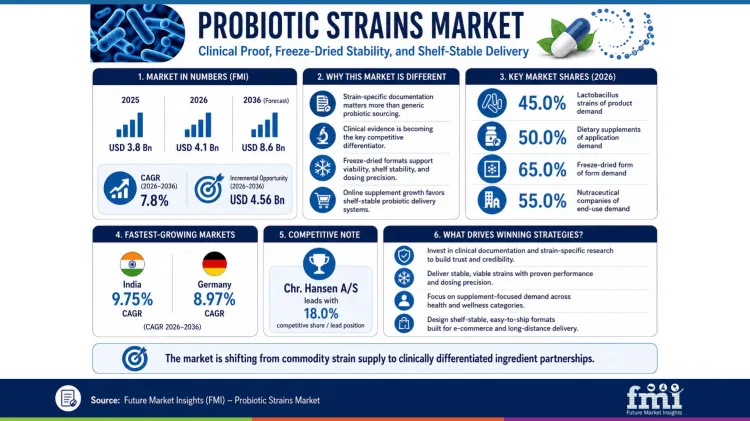
FMI’s Probiotic Strains Market preview shows why stability is central to scale. Freeze-dried form accounts for 65.0% of form demand in 2026 because lyophilization provides shelf stability, dosing precision, and manufacturing compatibility for supplement and food ingredient applications. This makes freeze-drying one of the most important capacity levers in the market.
The lyophilization process is an aid in the preservation of live cultures of probiotics by eliminating water in a controlled manner. But the process needs to be managed properly. Various factors such as freezing rate, protection system, drying temperature, moisture level, exposure to oxygen, and even post drying handling have the potential to affect viability.
The Freeze Drying Equipment Market is relevant because probiotic strain scale depends on specialized equipment and process discipline. Probiotic drying capacity is not only a machinery issue; it is also a formulation science issue. Producers must protect cells before, during, and after drying.
The share of Lactobacillus strains in the product market is largest with 45.0% share in 2026. This is an indication of scale potential, but also of stability challenges. Lactobacillus strains have commercial experience; however, many species are heat sensitive, moisture sensitive, aerobic, and acidic. Viable count maintenance is a critical consideration for buyers.
The Probiotic Ingredients Market supports this view because probiotic strains must fit multiple ingredient applications. A strain used in capsules may face different stress than a strain used in gummies, powders, dairy products, functional beverages, or bars. Each format requires different protection, overage planning, packaging, and validation.
In FMI’s preview of the Probiotic Strains Market, dietary supplements represent 50.0% of total applications demand. The attraction of supplements is that they are capable of offering more protection for viability compared to wet foods. There is better control of dosage and packaging through capsules, tablets, powders, and sachets. But there are technical problems with dietary supplements as well. Cell deformation is likely with tablet compaction. Moisture exposure occurs with gummies. Viability is compromised by poor packaging in powders.
The Dietary Supplements Market is useful because supplement manufacturers increasingly need probiotic ingredients that remain stable in consumer-friendly formats. The supplier must provide not only the strain but also overage guidance, stability data, packaging recommendations, and compatibility information.
Shelf stability is also important for e-commerce. A probiotic product that requires strict refrigeration can face shipping cost, delivery risk, and consumer handling issues. FMI’s Heat-Stable Probiotics Market highlights a structural shift from refrigeration-dependent probiotic delivery toward thermotolerant Bacillus species that enable ambient storage, baked goods, hot beverages, and standard e-commerce shipping. This does not replace traditional Lactobacillus and Bifidobacterium strains, but it expands the category.
Heat-stable probiotics help demonstrate the importance of viability verification. According to FMI, Bacillus coagulans holds dominance among heat-stable probiotic strains because of their GRAS recognition and heat stability verification. For food manufacturers, the issue is not just about determining the probiotic nature of a certain strain. The issue is about the viability of such a strain after heat treatment and consumption.
The Functional Food Ingredients Market is relevant because more food brands want probiotic positioning in everyday foods. But functional foods expose strains to tougher environments than capsules. Bars may have low moisture but high mechanical stress. Beverages may expose strains to acidity and water activity. Baked goods require heat-stable strains. Dairy products may need refrigeration and culture compatibility.
Probiotic potential incorporates the packaging system. Various aspects such as moisture resistance, oxygen protection, desiccant properties, blister packaging, foil packaging, and headspace control can impact survival. A robust strain may become ineffective due to poor packaging. A stable powder form may become useless due to exposure to moisture once packaged.
The Food Packaging Market supports this logic because packaging is not secondary for probiotic products. It is part of the technical system that protects viability and claim integrity. For probiotic strains, packaging helps convert production output into consumer-delivered benefit.
The CAGR of 9.75% for India and 8.97% for Germany showcase two distinct scenarios in terms of capacity development. The growth of India is fueled by the increased production of nutraceuticals, along with increasing awareness of health among consumers. The growth in Germany is due to their extensive probiotics research, coupled with quality-focused regulation.
The best strains will be those that incorporate fermentation, freeze-drying, strain protection, stability analysis, packaging recommendations, and regulatory requirements. The worst strains will be those that produce cultures but do not prove survivability in practice.
It is important to dispel the myth that the capacity of a probiotic strain is determined in the fermenter. For customers, the capacity of a probiotic strain is assessed at the end of its shelf life.
Bottom line: Probiotic strain scale depends on viable stability, not production volume alone. Freeze-drying, strain protection, packaging, and application validation decide which suppliers can serve supplement, functional food, and ambient delivery demand.
FMI Related Links
- Probiotic Strains Market: Primary link for supplement share, freeze-dried form share, Lactobacillus share, and country growth
- Heat-Stable Probiotics Market: Use when discussing ambient shipping, shelf-stable formats, and cold-chain reduction
- Dietary Supplements Market: Use when discussing online supplement purchase and replenishment
- Probiotic Ingredients Market: Use when discussing probiotic formats and ingredient selection
- Functional Food Ingredients Market: Use when discussing probiotic use in bars, beverages, powders, and functional foods
- Prebiotic Ingredients Market: Use when discussing synbiotic positioning and gut-health formulations
- Nutraceutical Ingredients Market: Use when discussing clinically positioned online wellness brands

