


- Probiotic strain competition is shifting from generic species supply toward strain-specific clinical proof, documentation, and formulation partnerships.
- Lactobacillus strains lead product demand because they have broad application history, strong consumer recognition, and extensive documentation across gut health, immunity, and wellness formats.
- Dietary supplements lead application demand because capsules, tablets, powders, and sachets can communicate strain identity and dosage more clearly than many food formats.
- Nutraceutical companies dominate end-use demand because they depend on documented efficacy, regulatory support, and repeatable probiotic ingredient quality.
- Supplier winners are those that own or license clinically supported strains, provide stability data, and help formulators build credible claims.
- The biggest misconception is that probiotic strains compete mainly on CFU count. Premium competition is increasingly based on clinical evidence, strain identity, viability, and regulatory confidence.
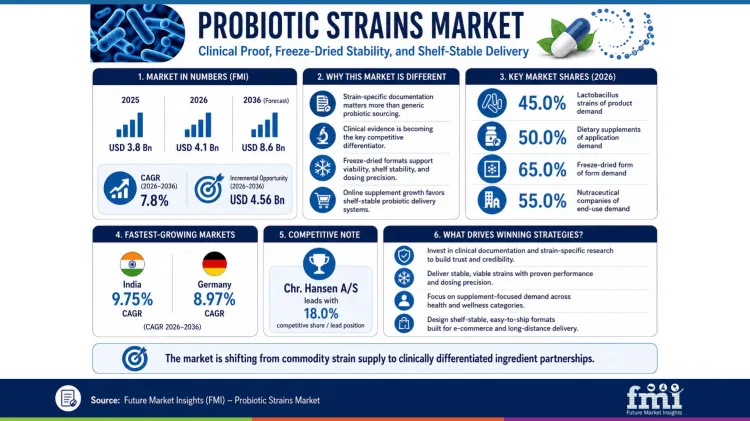
The Probiotics Strains Market is now more than just a market for volumes. It is an ingredient market that is driven by documentation in which the supplier’s competitive edge is determined by strain ownership, scientific backing, viability, regulatory support, and formulator trust. Food and beverage, nutritional supplements, and nutraceutical firms are no longer interested to know if the supplier has the capability to deliver Lactobacillus or Bifidobacterium. They want to know about the exact strain used, its scientific backing, stability, and survival capabilities.
FMI’s Probiotic Strains Market preview shows this clearly. The market was valued at USD 3.8 Bn in 2025 and is expected to reach USD 8.6 Bn by 2036 at a 7.8% CAGR. FMI also states that the market is transitioning from commodity strain supply to clinically differentiated ingredient partnerships where strain-specific documentation drives formulator selection.
Strains belonging to Lactobacillus are anticipated to dominate the market share at 45.0% by 2026. This market leadership owes credit to both familiarity and expertise. Strains like Lactobacillus acidophilus, Lactobacillus rhamnosus, and Lactobacillus plantarum have been extensively used since their application is well known in supplements, functional food, dairy and wellness products. But their value isn’t just due to their familiarity.
The Probiotic Ingredients Market is relevant here because probiotic strain suppliers increasingly compete as ingredient partners, not commodity culture vendors. A finished brand may use a probiotic strain for gut health, immunity, digestive balance, women’s health, oral health, skin health, or general wellness. Each positioning route requires different evidence and formulation support.
The largest segment is dietary supplements with 50.0% market share in 2026. This is due to the fact that there is no better vehicle for conveying the strain identity, CFU, dose, frequency, and positioning of benefits. Dietary supplements, including capsules, tablets, powders, sachets, and sticks, give an opportunity to communicate scientifically about their product.
The Dietary Supplements Market supports this broader consumer behavior. Supplement buyers are increasingly comparing ingredient quality, clinical backing, brand trust, and benefit claims. In this environment, probiotic strain suppliers with documented clinical support become more valuable to finished product companies.
The nutraceutical manufacturers represent a major share of 55.0% of the end-user demand according to FMI’s snapshot. It is crucial because the criteria for evaluating nutraceutical suppliers are different from those for evaluating food processing manufacturers. The buyer requires information about strain traceability, scientific studies on the topic, information on stability, regulations, information on allergy, non-GMO claim, manufacturing, and sometimes specific conditions.
The Nutraceutical Ingredients Market is therefore a strong adjacent reference. Probiotic strains are increasingly part of broader nutraceutical systems that may combine prebiotics, postbiotics, fibers, vitamins, minerals, botanical extracts, and functional claims. Strain suppliers that can work inside multi-ingredient systems may gain more repeat business.
FMI further lists Chr. Hansen A/S as a key player in the market with a market share of 18.0%, owing to its extensive strain library and relationship with supplement and food manufacturers. This indicates that it has a competitive advantage through strain libraries, clinical studies, and long-term associations with the manufacturers. Generic companies can compete in terms of pricing, but they cannot replicate these competitive factors.
Clinical evidence is now more valued than the mere CFU count. A product with a higher CFU number but without sufficient documentation for its strain may not be as appealing as a product with fewer CFUs and good clinical evidence. Formulators are getting more precise. They want to know if the strain has been clinically tested, if the dosage has been proven to be effective, and if the strain is still viable throughout shelf life.
The Prebiotic Ingredients Market is relevant because many brands now use synbiotic concepts, combining probiotics with prebiotics to improve product differentiation. This increases the need for technical support because the interaction between live strains, prebiotic substrates, moisture, packaging, and shelf stability must be controlled.
Supplier winners will also differ by application. Supplement brands may prioritize documented gut health strains. Functional beverage manufacturers may prioritize stability in liquid systems. Dairy brands may prioritize compatibility with fermentation and cold-chain distribution. Animal nutrition companies may prioritize feed stability and antibiotic-reduction programs. Pharmaceutical companies may require stronger clinical and regulatory packages.
The Functional Food Ingredients Market is useful because probiotic strains are part of the wider shift toward food and beverage products with health-positioned functionality. However, functional foods create different strain challenges than supplements. A probiotic yogurt, RTD beverage, bar, gummy, or powder mix must preserve viability while also meeting taste, texture, processing, and shelf-life requirements.
The misconception to avoid is that the strongest probiotic strain suppliers are simply those offering the highest CFU count at the lowest price. The real winners reduce formulator risk. They provide strain identity, clinical data, stability evidence, documentation, and application support.
Bottom line: Probiotic strain winners are those that convert microbial cultures into clinically supported, stable, and formulation-ready ingredient platforms. The supplier advantage belongs to companies that own evidence, not only production capacity.
FMI Related Links
- Probiotic Strains Market: Primary link for supplement share, freeze-dried form share, Lactobacillus share, and country growth
- Heat-Stable Probiotics Market: Use when discussing ambient shipping, shelf-stable formats, and cold-chain reduction
- Dietary Supplements Market: Use when discussing online supplement purchase and replenishment
- Probiotic Ingredients Market: Use when discussing probiotic formats and ingredient selection
- Functional Food Ingredients Market: Use when discussing probiotic use in bars, beverages, powders, and functional foods
- Prebiotic Ingredients Market: Use when discussing synbiotic positioning and gut-health formulations
- Nutraceutical Ingredients Market: Use when discussing clinically positioned online wellness brands

