


- Dairy ingredient growth is becoming a processing-capacity story because buyers are no longer evaluating only milk availability; they are evaluating filtration, fractionation, drying, standardization, and specialty protein capability.
- Milk powder remains the scale backbone of the dairy ingredients market, but higher-value growth is shifting toward whey protein, milk protein concentrate, isolates, casein systems, and specialized functional dairy ingredients.
- Whey protein supply is structurally linked to cheese production, raw whey availability, membrane filtration capacity, evaporation capacity, and spray-drying infrastructure.
- The capacity premium is strongest when suppliers can convert milk and whey streams into high-protein, low-lactose, heat-stable, application-ready ingredients for sports nutrition, clinical nutrition, infant nutrition, and functional foods.
- The biggest risk is treating dairy ingredients as a simple commodity powder market. In specialty dairy proteins, growth depends on processing technology, capital investment, technical know-how, and reliable quality systems.
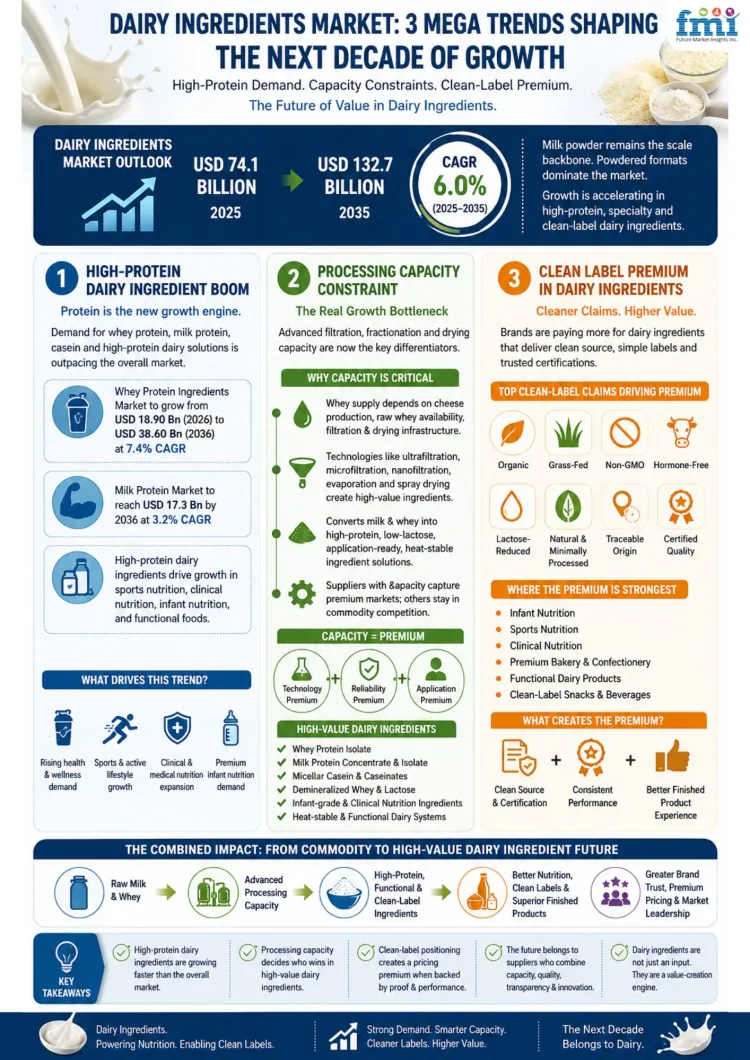
Dairy ingredients are entering a more capacity-sensitive phase of growth. The market is no longer driven only by the availability of raw milk or the demand for basic milk solids. The sharper question is now: which dairy ingredient suppliers have the processing infrastructure required to convert milk and whey streams into higher-value ingredients?
This is an important shift. In traditional dairy ingredient markets, scale was often linked to milk collection, powder production, and bulk supply. Today, buyers are asking for more advanced dairy systems. They need whey protein concentrate, whey protein isolate, milk protein concentrate, milk protein isolate, micellar casein, demineralized whey, lactose-managed ingredients, and application-specific protein systems. These products cannot be produced by milk availability alone. They require filtration, fractionation, evaporation, drying, standardization, and strong process control.
FMI’s Dairy Ingredients Market shows that the category is already moving at scale, with the market valued at USD 74.1 billion in 2025 and projected to reach USD 132.7 billion by 2035, expanding at a CAGR of 6.0%. FMI identifies milk powder as a major product segment and powdered formats as the dominant form, supported by shelf stability, solubility, transport efficiency, and broad use across food and nutrition applications. That matters because powder remains the base of the dairy ingredients market. However, the next layer of value is increasingly being created by suppliers that can move beyond commodity powder and into higher-protein, higher-functionality dairy ingredients.
The processing constraint becomes clearer when whey protein is examined. Whey was once treated mainly as a cheese by-product, but it has become one of the most valuable streams in the dairy ingredients business. FMI’s Whey Protein Ingredients Market is projected to expand from USD 18.90 billion in 2026 to USD 38.60 billion by 2036, growing at a CAGR of 7.4%. This is faster than the broader dairy ingredients market, which confirms that high-protein dairy fractions are gaining value. But whey protein supply cannot be expanded instantly. It depends on cheese production, the volume of liquid whey generated, the ability to collect and stabilize whey streams, and the availability of membrane filtration and spray-drying capacity.
This is where the dairy ingredients market becomes a capacity allocation problem. Every dairy processor with access to whey must decide how to allocate that stream across standard whey powder, whey protein concentrate, whey protein isolate, demineralized whey, lactose, permeate, or other specialty derivatives. The highest-value output is not always the easiest to produce. Whey protein isolate and hydrolyzed whey protein require tighter processing control, higher technical capability, and more capital-intensive production assets than basic whey powder.
The same logic applies to milk protein. FMI’s Milk Protein Market is estimated at USD 12.6 billion in 2026 and projected to reach USD 17.3 billion by 2036, expanding at a CAGR of 3.2%. Milk protein concentrates and isolates are used where brands need protein fortification, texture improvement, emulsification, gelation, and dairy-based nutrition. However, these ingredients also require specialized processing. Milk must be separated, standardized, filtered, concentrated, dried, and tested to meet protein, mineral, lactose, solubility, and functionality specifications.
This means that two dairy companies with similar milk access can have very different market positions. One may remain a supplier of skimmed milk powder, whole milk powder, or basic whey powder. The other may capture higher-margin opportunities in sports nutrition, infant nutrition, clinical nutrition, high-protein beverages, functional dairy products, and premium food applications. The difference is not only raw material. The difference is processing infrastructure.
Membrane filtration is central to this shift. Ultrafiltration is widely used for concentrating proteins in milk and whey. Microfiltration supports bacterial reduction, fat removal, milk protein fractionation, and whey protein isolate production. Nanofiltration and reverse osmosis can support concentration, demineralization, lactose management, and process efficiency. These technologies allow dairy processors to separate and concentrate valuable components instead of selling milk and whey as lower-value bulk streams.
Evaporation and drying capacity are equally important. Once milk or whey proteins are concentrated, they must be dried into stable ingredient formats that can be transported, stored, and used by food and nutrition manufacturers. Spray drying, agglomeration, instantization, and powder handling systems determine whether the final ingredient performs well in beverages, dry mixes, yogurts, bars, bakery applications, and nutritional powders. A high-protein ingredient that clumps, sediments, tastes burnt, or loses functionality during heat processing will struggle to command a premium.
This is why processing capacity is now directly linked to pricing power. Suppliers with advanced filtration and drying assets can produce more specialized ingredients and serve higher-value customers. Suppliers without those assets may remain exposed to commodity pricing cycles. In dairy ingredients, the premium is not only paid for milk solids. It is paid for controlled composition, consistent functionality, technical documentation, and application reliability.
The strongest capacity premium sits in whey protein isolate, milk protein isolate, micellar casein, high-protein concentrates, hydrolyzed proteins, demineralized whey, lactose-reduced dairy systems, and heat-stable protein ingredients. These products are more difficult to produce than standard powders because they require tighter control over protein concentration, mineral balance, fat removal, lactose level, solubility, flavor, and heat stability.
For sports nutrition brands, this matters because protein powders and RTD beverages require high protein density, neutral taste, good solubility, and consistent amino acid quality. For clinical nutrition, the ingredient must support digestibility, safety, tolerance, and reliable formulation performance. For infant nutrition, quality standards are even stricter, with greater emphasis on purity, traceability, controlled mineral composition, and safety assurance. For functional foods, performance in processing and finished-product stability can be just as important as the protein claim.
This creates a clear segmentation strategy for dairy ingredient suppliers. Commodity-focused suppliers may continue to compete in standard milk powder, whey powder, lactose, and bulk dairy solids where price and availability dominate. Technology-led suppliers can compete in higher-value protein ingredients where customers pay for functionality, nutrition, and application support. Integrated dairy processors with both milk access and advanced processing capability are best placed to capture the premium layer of the market.
For brands, supplier selection is becoming more technical. It is no longer enough to ask whether a supplier can provide dairy protein. Buyers need to know whether the supplier can deliver consistent protein content, batch-to-batch stability, microbiological quality, solubility, heat stability, neutral flavor, documentation, allergen control, and application guidance. A low-cost ingredient may become expensive if it creates formulation failures, processing losses, off-notes, sedimentation, or customer complaints.
For co-manufacturers, the capacity constraint is also important. A co-manufacturer producing protein beverages, fortified dairy products, nutrition powders, or meal replacements needs ingredients that behave predictably during processing. High-protein dairy systems can be sensitive to heat, pH, mineral balance, hydration conditions, and shear. If the ingredient supplier does not understand application behavior, the finished product may face instability, chalkiness, gelling, phase separation, or poor mouthfeel.
This is why the processing-capacity premium should be measured through three lenses: technology premium, reliability premium, and application premium. Technology premium comes from membrane filtration, evaporation, drying, instantization, fractionation, hydrolysis, and demineralization assets. Reliability premium comes from quality systems, traceability, supply assurance, and batch consistency. Application premium comes from the ability to help customers make better beverages, powders, bars, yogurts, infant formulas, and clinical nutrition products.
Price premium versus baseline should therefore be calculated carefully. The baseline is usually standard skimmed milk powder, whole milk powder, whey powder, or low-spec dairy solids. A specialty dairy protein may cost more per kilogram, but the real comparison should include protein yield, formulation efficiency, label value, processing performance, waste reduction, and finished-product positioning. If a higher-priced dairy protein allows a brand to make a better high-protein beverage or premium nutrition product, the value may be higher than the raw ingredient premium suggests.
Regional dynamics also matter. North America and Europe have strong dairy processing bases, established cheese industries, and advanced ingredient capabilities, which support whey and milk protein production. Oceania remains important because of large-scale dairy export systems and global ingredient supply. Asia-Pacific is becoming a major demand region, especially for protein-enriched foods, infant nutrition, and supplements. However, countries with faster demand growth may not always have enough domestic cheese production or advanced whey processing capacity, creating reliance on imported specialty dairy ingredients.
India and China are especially important in this context. Demand for protein fortification, dairy beverages, nutritional powders, and functional foods is rising, but specialty dairy ingredient capacity can lag behind consumption growth. This creates opportunities for global suppliers with strong whey protein, milk protein, and specialty dairy processing assets. It also creates a strategic push for local processors to invest in filtration, drying, and ingredient-standardization infrastructure.
The misconception to avoid is that milk availability automatically creates dairy ingredient leadership. Milk access is important, but it is not enough. A processor must be able to convert milk into the right ingredient specification. The highest-value dairy ingredients require controlled processing, not just raw material scale. A region with high milk production but limited filtration and drying infrastructure may still depend on imports for advanced whey protein, milk protein, casein, or infant nutrition ingredients.
Another misconception is that all dairy powders compete in the same way. Standard powders compete mainly on cost, quality, availability, and logistics. Specialty dairy proteins compete on functionality, nutrition, technical performance, and application fit. This difference matters because the buyer base is different. A bakery manufacturer buying milk powder may prioritize cost and supply reliability. A sports nutrition brand buying whey protein isolate may prioritize protein level, solubility, flavor, digestibility, and brand trust.
For suppliers, the opportunity is to avoid selling processing capability as a back-end operational detail. It should be part of the commercial story. Buyers need to know that the supplier has the right filtration assets, drying systems, quality controls, technical support, and application testing. The winning suppliers will not simply say they have dairy ingredients. They will show how their processing capability improves the customer’s finished product.
For investors and strategic planners, capacity planning is becoming one of the most important questions in dairy ingredients. The market opportunity is not only about demand forecasts. It is about whether enough specialized capacity exists to produce the ingredients that brands actually need. New filtration lines, dryers, whey processing plants, demineralization systems, and protein fractionation assets require capital, technical expertise, and time. This creates a supply-side lag that can support premium pricing when demand grows faster than capacity.
Processing constraints also influence product innovation. If whey protein isolate capacity is tight, brands may explore milk protein blends, whey protein concentrate, casein systems, or plant-dairy protein blends. If heat-stable protein systems are limited, RTD beverage innovation may slow or shift toward alternative formulations. If infant-grade dairy ingredient capacity is constrained, manufacturers may prioritize long-term supplier contracts rather than spot purchasing. In this way, capacity does not only influence supply. It shapes the direction of product development.
Bottom line: the processing capacity constraint in dairy ingredients will not affect every supplier equally. It will reward companies that control advanced filtration, fractionation, evaporation, drying, quality assurance, and application-support capabilities. In dairy ingredients, the next phase of growth is not only about who has milk. It is about who can turn milk and whey into higher-value, higher-functionality ingredients that brands can use with confidence.
FMI Report Links
- Dairy Ingredients Market: Primary interlink in the introduction and conclusion
- Whey Protein Ingredients Market: Use when discussing whey protein as the strongest high-protein dairy ingredient growth pocket
- Milk Protein Market: Use when discussing milk protein concentrates, isolates, casein, and dairy protein fortification
- Protein Ingredients Market: Use when positioning dairy proteins within the wider global protein ingredients ecosystem
- Sports Nutrition Market: Use when explaining demand from sports nutrition, active lifestyle, and performance nutrition products
- Protein Powder Market: Use when discussing protein powder demand and whey protein share
- Dietary Supplements Market: Use when discussing supplement demand, active aging, and daily protein intake
- Clinical Nutrition Market: Use when discussing medical nutrition and protein quality requirements
- Infant Formula Ingredients Market: Use when discussing infant nutrition as a high-value dairy protein application

