


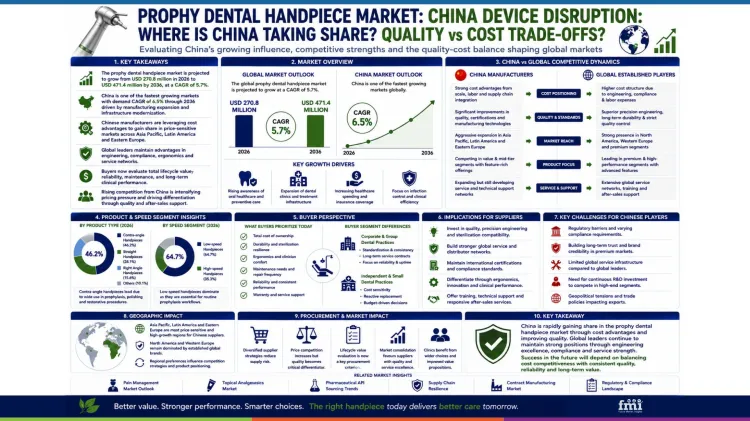
- The prophy dental handpiece market is estimated to reach USD 471.4 million by 2036, growing at a CAGR of 5.7% during the forecast period from USD 270.8 million in 2026.
- China is increasingly becoming one of the fastest growing markets globally, with demand growing at a CAGR of 6.5% through 2036 supported by expansion of domestic manufacturing and modernization of dental infrastructure.
- Chinese manufacturers are increasingly competing in value segments, using their cost advantages to penetrate price-sensitive markets in Asia Pacific, Latin America and parts of Eastern Europe.
- There are still competitive advantages for global established manufacturers in the areas of better engineering, infection control compliance, ergonomic design and extensive service networks.
- Dental products are increasingly being bought on the basis of total lifecycle value rather than acquisition cost alone, considering factors such as reliability, maintenance requirements and long-term clinical performance.
- Increasing competition from Chinese suppliers is fuelling the pricing competition across the industry and pushing towards product differentiation through quality assurance and after sales support.
Chinese manufacturers are expanding their footprint in the dental equipment industry across the globe and the prophy dental handpiece market is witnessing an era of intense competition. The market, which used to be dominated by manufacturers from Japan, Europe and North America, is seeing the emergence of China as a major production center and an important supplier of cost-competitive alternatives.
The market is projected to reach USD 270.8 million in 2026 and reach USD 471.4 million by 2036, suggesting continued demand for prophylaxis equipment used in preventive, restorative, and hygiene procedures. The overall market growth is being supported by increasing awareness of oral healthcare, growing dental practice capacity and focus on infection control.
China’s role in this changing environment is not limited to domestic consumption. The country is forecasted to grow at a CAGR of 6.5% through 2036, making it one of the fastest growing regional markets. China is fortifying its place in the whole dental equipment value chain with the expansion of dental clinic networks, growth in healthcare spending, and the enhancement of its manufacturing capabilities.
Historically, price has been the battleground for Chinese manufacturers.
Low labor costs, large scale production capabilities, and integrated supply chains have allowed domestic manufacturers to offer prophy dental handpieces at a significantly lower price point than many well established international competitors. This value proposition has proved especially appealing in emerging markets, where affordability is a critical factor in purchase decisions.
Yet, procurement decisions in the dental sector are increasingly being made on criteria other than the cost of acquisition.
Handpieces are a must for dental practices as they conduct prophylaxis procedures numerous times a day. Equipment breakdowns can lead to delays, higher maintenance costs and a poor patient experience. Providers thus often evaluate products based on broader economic considerations, such as durability, sterilization efficacy, warranty coverage and availability of technical support.
This makes a big difference between cost leadership and value leadership.
Precision engineering, ergonomic optimisation and strict infection prevention standards are still the key differentiators for premium manufacturers. These characteristics are especially important in mature markets with established quality expectations and mature regulatory environments.
Meanwhile, attitudes toward the quality of Chinese manufacturers are evolving.
Many Chinese suppliers have closed historic performance gaps with investments in advanced manufacturing technologies, quality management systems and international certifications. Some manufacturers are abandoning the race to the bottom and increasingly aiming for the mid-tier, with acceptable quality standards at competitive price points.
Emerging markets are changing the way we think about buying things.
In areas where replacement cycles are shorter and procedure reimbursement is still limited, independent dental practices with tighter budgets may pay more attention to affordability when choosing handpieces. That’s a contrast to the focus of corporate dental networks and specialty clinics, which tend to focus on standardization, service agreements and long-term operational reliability.
The segmentation patterns also show the necessity of balancing quality and cost considerations. The contra-angle dental handpieces segment is expected to account for the largest share of 46.2% in the product type segment in 2026 owing to its wide application in prophylaxis, polishing & restorative procedures. They are incorporated into the routine clinical workflow and improve provider awareness for consistency in performance and maintenance requirements.
Similarly, in 2026, low-speed handpieces are anticipated to account for 64.7% of the speed segment, highlighting the significance of durability and ergonomic efficiency in everyday practice environments.
The implications of competition go further than manufacturers.
As clinics become more sophisticated in their evaluation of equipment investments, distributors are called upon more and more to provide extensive technical support, training resources, and maintenance services. A strong service ecosystem can play a big role in the buying decision, especially when clinical downtime has a big financial impact.
The mistake to steer clear of is that Chinese expansion will inevitably push out existing market players.
In reality, the market will be more segmented. The environment of price sensitivity may increasingly favour competitively priced alternatives, but premium segments will continue to reward manufacturers who can demonstrate better reliability, regulatory compliance and performance over the lifecycle.
In the end, China’s increasing presence is driving the competitive evolution of the prophy dental handpiece market.
Bottom line: That competition is increasing and procurement sector is changing with China’s growth in prophy dental handpiece market. Cost advantages are increasing access across emerging markets but quality, service support and long-term value continue to be decisive factors in purchase decisions across the globe.

