


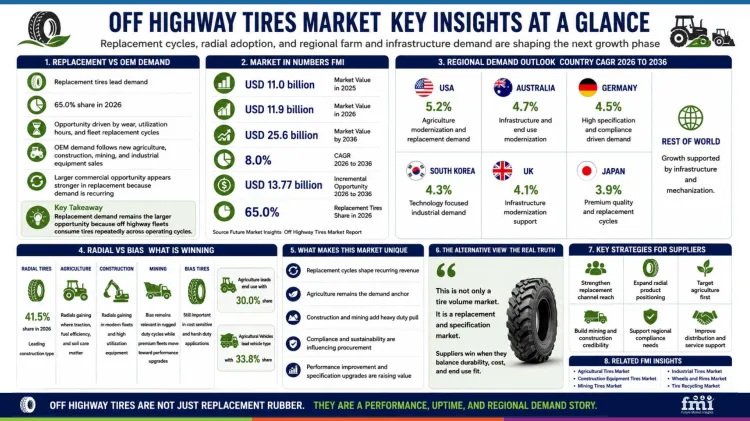
- According to FMI, the USA is expected to record significant growth, with a 5.2% CAGR through 2036, supported by agricultural modernization, replacement demand, and industrial investment.
- Australia follows at 4.7%, with infrastructure projects, mining, regional development, and end-use modernization supporting heavy-duty tire demand.
- Germany grows at 4.5%, where compliance, high-specification procurement, manufacturing, and agricultural investment favor premium tire products.
- South Korea, the UK, and Japan offer lower but structured growth through industrial modernization, automation, replacement cycles, and quality-led procurement.
- Emerging economies also generate significant growth through farm mechanization and infrastructure development, where FMI country-level CAGR breakdowns are not explicitly available.
- The analyst observes that the USA had combination of agriculture and replacement opportunities while, Australia offers a mining and leading infrastructure opportunity, and Germany offers a market shaped specification and compliance.
Regional off-highway tire demand is shaped by more than equipment sales. Agriculture, mining, construction, infrastructure, industrial modernization, fleet replacement, regulation, and distribution all influence tire procurement. A market with a large operational fleet generate frequent replacement demand. A developing market create rapid OEM demand through mechanization and infrastructure investment. A mature market may support premium tires through lifecycle-cost and compliance requirements.
FMI forecasts the global off-highway tire market to expand at 8.0% CAGR from 2026 to 2036. At the country level, the USA leads the listed markets with 5.2% CAGR, followed by Australia at 4.7%, Germany at 4.5%, South Korea at 4.3%, the UK at 4.1%, and Japan at 3.9%.
Although the country's ranking provides a useful basis, it is unable to characterize the kind of opportunity present in each market. The United States has a sizable agricultural base, well-established construction and industrial fleets, a wide dealer network, and ongoing replacement demand. Australia is linked to severe-duty machinery, agriculture, mining, and regional infrastructure. Germany's modern industrial and agricultural operations meet the country's premium, compliance-driven demand.
The USA has significant opportunity in the market. FMI associates its 5.2% CAGR with agriculture modernization, specification upgrades, replacement cycles, and capacity expansion. In USA agriculture is significant sector which operates a substantial fleet of tractors, combines, harvesters, sprayers, and implements. These machines create replacement demand throughout their operating lives.
The USA opportunity is also supported by mature replacement channels. FMI observes that aftermarket services and long-term supply agreements contribute recurring revenue for established suppliers. Farmers, construction fleets, industrial users, and equipment rental companies access regional dealers, service networks, and specialized tire distributors. This makes market entry easier for suppliers with appropriate product coverage, while competition remains strong.
Because larger farms and high-horsepower equipment can justify tires that improve traction, fuel efficiency, ride quality, and soil management, radial adoption may be especially pertinent in the USA agriculture sector. The role of regulated traffic and soil-compaction issues are also noted in USDA precision agriculture research, which supports the larger argument for tire and equipment technology that minimize field damage.
Another dimension is added by construction investment and reshoring. FMI links USA demand to the growth of capacity expansion and new or upgraded industrial facilities. Construction machinery, material-handling equipment, forklifts and industrial vehicles require OEM and replacement tires. This opens the market beyond agriculture.
Australia also offers a significant opportunity. FMI forecasts 4.7% CAGR and associates growth with infrastructure investment, industrial modernization, evolving regulatory requirements, and higher replacement tire specifications. Australia has a large mining industry, significant agricultural operations, long transport distances, and harsh operating environments. These conditions support demand for durable off-highway tires.
Mining plays a significant role in Australia’s tire market. Surface mining equipment operates under high loads, heat, abrasive surfaces, and long duty cycles. Tires are high-value consumables in these fleets. Suppliers that combine premium products with on-site service, monitoring, pressure management, and repair build recurring relationships.
The agricultural industry in Australia utilizes tractors, harvesters, and specialized machinery across large operating areas. Tire durability, traction, heat resistance, and service access matter because equipment may operate far from major distribution centers. Regional inventory and field service can therefore be as important as tire design.
Germany’s 4.5% CAGR appears more specification-led. FMI connects German demand with advanced manufacturing, Industrie 4.0, EU sustainability requirements, energy costs, circular-economy expectations, and high procurement standards. Germany may not be the most cost-effective market, but it can support premium products that demonstrate compliance and lifecycle value.
Agriculture remains relevant in Germany. The European Commission’s German CAP strategy aims to improve farm competitiveness, resilience, environmental performance, investment, innovation, and knowledge transfer. These objectives can support machinery modernization and more efficient agricultural operations, though tire demand will depend on equipment replacement and utilization patterns.
German construction and industrial equipment users also choose tire technologies that support efficiency, digital monitoring, traceability, and longer service life. FMI references digitally enabled replacement tires and real-time monitoring as part of the German outlook. This suggests that the potential for premium radial tires, sensor-ready solutions, retreading, and sustainable materials could be more promising compared to low-cost commodity options.
According to FMI South Korea grows at 4.3% driven by industrial modernization, high-technology manufacturing, compliance, and automation. Off-highway tire demand come from material handling, industrial vehicles, ports, construction equipment, and manufacturing facilities rather than agriculture alone. Buyers prioritize product quality, certification, and technology integration.
FMI projects that the UK has 4.1% CAGR driven infrastructure modernization, regulatory standards, and institutional procurement. Construction and industrial replacement demand appear more important than large-scale farm mechanization. Suppliers may need strong distributor coverage and compliance documentation.
Japan grows at 3.9%. Its mature equipment market, premium quality expectations, labor shortages, automation, and aging facility base supports steady replacement demand. Japan is less attractive for rapid volume expansion but more robust for high-quality, reliable, application-specific tire products.
Emerging economies represent a significant opportunity, even if the country list FMI tends to focus on is developed markets. In some Asian, African and Latin American countries, agriculture mechanization is increasing the fleet of tractors and farm equipment. Investment in infrastructure increases the numbers of loaders, excavators, dump trucks, graders and industrial vehicles. These markets have higher unit growth but also more price sensitivity, fragmented distribution, and diverse service capability.
As a result, regional comparison depends on the type of supplier. Premium agricultural radial tire suppliers prioritize the USA and Germany. Mining tire specialists find Australia highly attractive. Low-cost bias tire producers may target emerging markets and older equipment bases. Industrial tire suppliers may focus on South Korea, Japan, Germany, and port or manufacturing hubs.
Replacement channel strength also differs. The USA has mature dealer and fleet-service networks. Germany and Japan have structured premium channels. Australia requires strong regional and mine-site support. Emerging markets may depend more on importers, local distributors, and price-led procurement.
The most frequent error that should be avoided is the presumption that each supplier's best commercial market is the one with the highest country CAGR. According to FMI, the Australian mining specialist might be more cost-effective for severe-duty applications, even though the USA leads the nation in growth. Compliance and technological requirements could be advantageous to German premium suppliers.
The United States seems to have the most possibility in terms of agriculture, industry, and replacement. High-value mining, infrastructure, and regional service opportunities are available in Australia. Germany provides specification-driven demand linked to premium product performance, efficiency, and compliance. Whether the supplier is designed for building volume, agricultural scale, mining uptime, or premium lifecycle value will determine which market is most appealing.

