


- As manufacturers are looking for faster commercialization of new viscosupplement formulations, the timelines for regulatory approval are becoming an increasingly important competitive factor in the market for knee hyaluronic acid injections.
- Asia-Pacific markets are witnessing strong momentum, as China and India are accelerating market expansion with greater orthopedic access and increasing acceptance for injection-based therapies.
- Product innovation is increasingly focused on single injection formats and next generation steroid combination products which need efficient regulatory pathways to commercialization.
- Countries with a mature orthopedic treatment infrastructure continue to be attractive launch environments, while the emerging markets are improving approval ecosystems and are experiencing a rise in the prevalence of osteoarthritis.
- Over the next decade, companies that can successfully manage regional regulatory requirements and generate strong clinical evidence are projected to improve their competitive positioning.
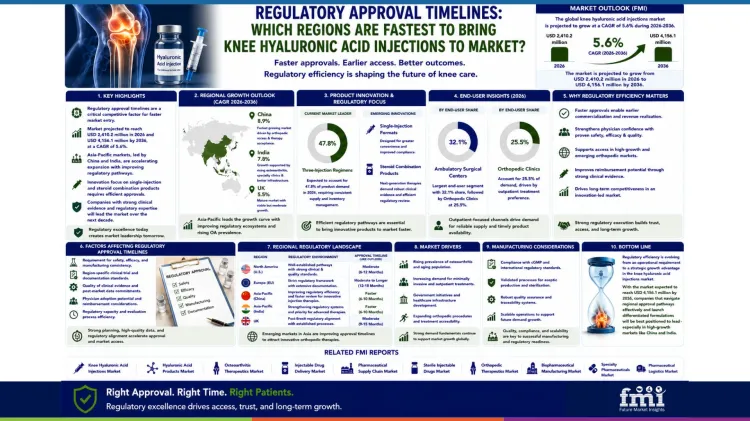
The global knee hyaluronic acid injections market is projected to grow from USD 2,410.2 million in 2026 to USD 4,156.1 million by 2036, registering a CAGR of 5.6% during the forecast period. With competition heating up, regulatory approval timelines are less of an administrative milestone and more of a strategic differentiator.
Knee hyaluronic acid injections, unlike traditional pharmaceutical products, must overcome not only the need for safety, efficacy, and manufacturing consistency, but must also address physician confidence and reimbursement expectations. For better formulations being launched, regulatory efficiency directly affects revenue realization and market penetration.
The US continues to be the largest market due to its mature orthopedic infrastructure, large outpatient footprint and the pervasiveness of physician familiarity with viscosupplementation therapies. But several Asia-Pacific countries are emerging as faster growing commercialization destinations.
As per Future Market Insights, China is expected to manifest the fastest growth at a CAGR of 8.9% in the global market through 2036 owing to increasing orthopedic access, rising diagnosis of degenerative knee disorders, and growing acceptance of viscosupplement therapies. Regulatory strides have expanded commercial opportunities for manufacturers entering the Chinese market.
India is also positioned as a high-growth destination with expected growth of ~7.8% CAGR driven by increasing osteoarthritis incidence, expanding specialty orthopedic clinics and wider adoption of minimally invasive treatment approaches. The country’s improving healthcare infrastructure is continuing to support the commercialization of advanced injection therapies.
Conversely, developed markets including the UK are expected to register relatively moderate growth, with the market expected to grow at around 5.5% CAGR. This is reflective of stable but more mature treatment pathways, where service capacity and clinical pathway selection have an impact on uptake.
Regulatory approvals are becoming more and more important for newer product categories. Despite three-injection regimens accounting for an estimated 47.8% of product demand in 2026, manufacturers continue to invest in single-injection technologies and steroid combination formulations that promise enhanced convenience and patient compliance. The commercialization of each innovation has to go through clinical validation and regulatory review, which must be region-specific.
The competitive environment also emphasizes the importance of regulatory success in physician adoption. Orthopedic specialists looking for predictable outcomes in their treatments are more likely to adopt products with strong clinical evidence and multiple regional approvals.
The commercialization trends also reflect end-user preferences. Outpatient surgery centers are expected to represent 32.1% of market demand in 2026, with orthopedic clinics accounting for 25.5%, underscoring the need for outpatient-centric regulatory pathways to drive widespread clinical adoption.
As regulatory bodies continue to assess not only safety but also long-term clinical effectiveness and treatment value, manufacturers are investing heavily in evidence generation and post-market data collection. This trend can extend development timelines, but it can also boost physician confidence once products are approved.
Technological innovation is also transforming the approval environment. Companies are also investigating cross-linked hyaluronic acid formulations and combination therapies that are designed to provide similar therapeutic benefits with fewer injections, which will require new regulatory assessments but could offer a competitive advantage once approved.
At the end of the day, the launch dates are no longer just dictated by the regulatory approval process but also by regional competitive positioning, the impact on physicians to adopt and the direct impact of the long-term revenue opportunities of a market that is increasingly more innovation driven.
Bottom Line
Regulatory efficiency is emerging as a strategic growth driver for the knee hyaluronic acid injections market. Companies that can successfully navigate regional approval pathways while launching differentiated formulations will be better placed to capitalize on a market projected to reach USD 4,156.1 million by 2036, particularly as high-growth regions like China and India continue to expand access to orthopedic care.
Related FMI Reports
- Knee Hyaluronic Acid Injections Market
- Hyaluronic Acid Products Market
- Osteoarthritis Gene Therapy Market
- Injectable Drug Delivery Market
- Orthopedic Splints Market
- Pain Management Devices Market
- Regenerative Medicine Market
- Biopharmaceuticals Packaging Market
- Specialty Active Pharmaceutical Ingredient Market
- Musculoskeletal Oncology Therapeutics Market

