


- Motor rewinding tends to make the strongest economic sense for medium and high horsepower motors, specialty designs, critical-duty units, and motors with costly installation or long replacement lead times.
- Replacement becomes more attractive for smaller, older, inefficient, repeatedly repaired, or non-critical motors where a new premium-efficiency unit offers better lifecycle economics.
- FMI estimates that repair costs for many larger motors can fall within 30% to 60% of the acquisition cost of a new motor, which keeps rewinding commercially relevant.
- The decision should combine repair price, efficiency retention, annual operating hours, electricity cost, motor loading, downtime risk, spare availability, and expected remaining service life.
- Quality rewinding matters because poor repair practice can reduce efficiency, create repeat failures, and erase the apparent saving from a low-cost rewind.
- The practical outcome is not "repair always wins" or "replace always wins." It is a motor-by-motor asset decision.
A failed motor often creates an urgent maintenance decision. Production may be stopped. A pump may be unavailable. A compressor may be affecting process continuity. A generator auxiliary may be needed immediately. Under those conditions, the cheapest available option can appear attractive. That is not always the most economical option.
The repair-versus-replacement decision is one of the central commercial questions in industrial motor maintenance because the initial service invoice is only one part of the cost. A rewind can restore a large motor at a fraction of new-unit cost. A new premium-efficiency motor can reduce energy use and improve reliability. The right answer depends on the motor's role in the operation.
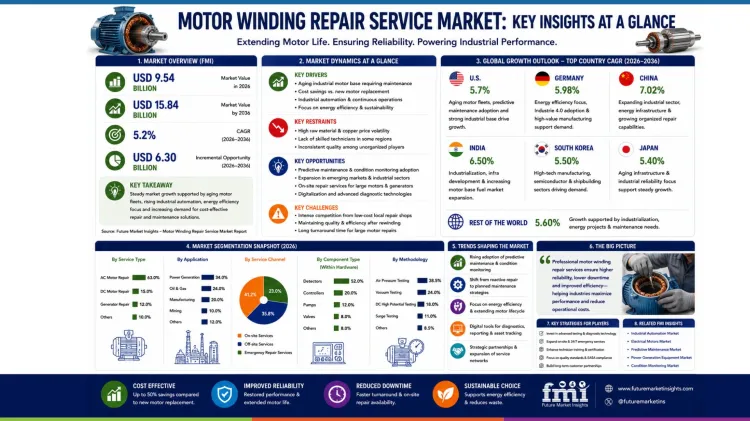
FMI estimates the motor winding repair service market at USD 9.54 billion in 2026 and projects it to reach USD 15.84 billion by 2036, expanding at a 5.2% CAGR. AC motor repair services account for 63.0% of demand, reflecting the large installed base of three-phase induction motors in industrial operations. Power generation represents 34.0% of application demand, while on-site services account for 41.2%, showing the importance of large equipment that cannot easily be transported to a workshop.
These market shares point to an important fact. Motor rewinding is not primarily a low-value service for small failed motors. It is a lifecycle activity for assets that are too expensive, too specialized, too large, or too operationally important to treat as disposable.
A motor used in a continuous cement kiln, mine conveyor, refinery pump, compressor train, turbine-generator support system, water-treatment station, or production line may require a more detailed decision process than a small general-purpose unit. The motor's replacement cost matters, and downtime can matter more. A large motor may carry a long procurement lead time, require custom mounting, have a specific shaft or frame design, or need special hazardous-area, marine, high-voltage, or process-industry characteristics. In these cases, rewinding can restore availability faster than sourcing a new equivalent motor.
The repair case becomes particularly strong when the motor is mechanically sound. If the frame, shaft, laminations, rotor, bearings, terminal box, cooling arrangement, and mounting configuration remain serviceable, replacing damaged windings may preserve a valuable installed asset. The repair provider can perform stator rewinding, insulation replacement, rotor repair, bearing replacement, dynamic balancing, electrical testing, and final run testing.
FMI notes that motors above 50 HP often favour repair economics because rewinding costs can represent 30% to 60% of a new motor acquisition cost. This should not be read as a universal threshold. It is a useful indicator that motor size changes the cost equation. A large medium-voltage process motor may cost far more to replace than to rewind, particularly when installation, commissioning, alignment, controls integration, and lost production are included.
Small motors often produce the opposite outcome. A low-horsepower motor may be inexpensive to buy new, widely available, and more efficient than an older design. The labour and materials involved in rewinding it can approach or exceed the purchase price of a new premium-efficiency motor. In such situations, replacement may provide a better lifecycle outcome even when the rewind quote appears lower at first glance.
The USA Department of Energy's historical motor selection guidance illustrates this economic distinction. It notes that repair-versus-replacement decisions depend on motor size, original efficiency, load, annual operating hours, electricity price, repair cost, and expected rewind losses. It also points out that smaller motors can reach a point where premium-efficiency replacement becomes economically preferable. This remains a useful maintenance principle even when actual pricing and efficiency economics should be recalculated using current motor quotations and electricity tariffs.
Energy use is central to the decision because motors often operate for thousands of hours each year. A small loss in efficiency can become material over the asset's remaining life. This carries particular weight in pumps, fans, compressors, conveyors, mills, crushers, cooling systems, and other continuous-duty equipment.
A lower-quality rewind can create hidden cost. The motor may run hotter, consume more energy, suffer insulation failure earlier, or lose torque performance. The repair may still appear economical on the day it is completed, and the asset can become more expensive over time through energy use, repeated maintenance, and downtime.
Quality-controlled rewinding changes that outcome. EASA states that tests in its rewind studies found that premium-efficiency and IE3 motors can be rewound without degrading efficiency when appropriate repair practices are followed. Its repair guidance emphasizes maintaining or increasing efficiency, reliability, and repair quality through controlled procedures. This shifts the debate away from rewind versus new toward quality rewind versus uncontrolled rewind.
A quality rewind process normally involves more than replacing copper wire. It includes inspection of the core, assessment of insulation condition, controlled burn-out or stripping, core-loss testing where appropriate, proper winding design, insulation-system selection, curing, rotor inspection, bearing work, balancing, electrical testing, and documented final inspection. For larger or high-voltage motors, the process may also involve surge comparison testing, insulation resistance testing, vibration checks, and load or run testing.
The motor's previous repair history should also be considered. A motor that has already been rewound several times may not be a good candidate for another rewind if the core has suffered damage, the lamination stack has degraded, or the repair record shows recurring failures. A repair provider should be able to explain whether the motor can be restored to reliable operating condition or whether replacement is more prudent.
The operating environment changes the economics as well. A motor in a clean, temperature-controlled production area may have a predictable repair profile. A motor in a refinery, mine, cement plant, wastewater facility, marine environment, steel mill, or outdoor pumping station may face contamination, vibration, heat, moisture, voltage imbalance, overload, or bearing-current issues. Rewinding the stator without addressing the root cause can produce another failure.
This is why a reliable repair assessment should ask several questions before approving work:
- Was the failure electrical, mechanical, thermal, environmental, or process-related?
- Is the motor loaded appropriately for its duty cycle?
- Is the driven equipment contributing vibration, misalignment, or overload?
- Is the motor exposed to poor power quality or voltage imbalance?
- Is the insulation system appropriate for the operating temperature and environment?
- Is a spare motor available, or would future downtime create a major production loss?
- Would a new motor improve efficiency, reliability, or maintainability enough to justify its cost?
The answer can vary even within the same plant. A 10 HP general-purpose motor driving a non-critical fan may be replaced. A 250 HP motor driving a process pump may be rewound. A 2,000 HP medium-voltage motor used in a refinery compressor may require specialist repair and a detailed root-cause analysis. A motor supporting a generator auxiliary system may be repaired on-site because removal and transportation are more disruptive than the rewind itself.
The FMI service segmentation reflects this practical diversity. Corrective maintenance serves failed motors. Preventive maintenance supports planned inspections and scheduled service. Predictive maintenance identifies condition deterioration before failure. Emergency repair services address immediate breakdowns. The more economically mature industrial users are shifting away from emergency-only repair toward planned decisions informed by asset condition.
Replacement decisions are becoming more strategic because new motor efficiency standards are increasing buyer awareness. In the USA and Europe, energy-efficiency requirements have encouraged industrial users to evaluate lifecycle energy cost rather than only purchase price. A new premium-efficiency motor may be the right option when the failed motor is small, old, lightly specialized, heavily used, or likely to remain in service for many years.
At the same time, replacement is not automatically superior for a large industrial motor. New equipment may take months to procure. It may require modifications to foundations, couplings, drives, electrical systems, or control panels. It may also introduce integration risk. A quality rewind can preserve the existing mechanical and electrical interface while returning the motor to service more quickly.
The financial calculation should include five cost layers.
Direct repair cost covers rewinding, bearings, rotor work, balancing, testing, transport, installation, and emergency response.
New motor cost covers purchase price, freight, installation, alignment, controls integration, commissioning, and spare-parts implications.
Energy cost reflects expected efficiency after repair compared with a new efficient motor, multiplied by operating hours, load profile, and electricity rate.
Downtime cost reflects lost output, missed production targets, overtime, rental equipment, delayed shipments, and process recovery.
Reliability risk reflects the likelihood of repeat failure, unplanned shutdown, warranty exposure, and future repair frequency.
This is why maintenance managers increasingly use a repair-versus-replace matrix rather than a simple percentage rule. The motor's criticality, size, age, condition, repair history, availability, and energy profile should all be scored.
The current market direction supports quality repair rather than indiscriminate rewinding. FMI points to expanding industrial motor fleets, aging equipment, and energy efficiency awareness as structural growth drivers. The stronger service providers are likely to be those that can demonstrate efficiency preservation, identify root causes, provide documented testing, and advise clients honestly when replacement is the better choice.
Motor rewinding makes the best economic sense when the motor is large, specialized, mechanically recoverable, difficult to replace quickly, and central to operations. Replacement makes more sense when the motor is small, inefficient, obsolete, repeatedly repaired, or inexpensive relative to the repair and energy cost.
The real decision is not whether rewinding is cheaper. It is whether rewinding restores an asset to reliable, efficient, and commercially sensible service.

