


- Replacement demand is strong in developed markets because aging pumps, energy-efficiency rules, and HVAC renovation cycles are pushing upgrades from constant-speed units to efficient and VFD-equipped systems.
- New installation demand is stronger in developing infrastructure markets where water treatment, distribution, boosting, commercial buildings, and industrial facilities are still being built out.
- FMI states that aging infrastructure in developed markets creates replacement demand, while new construction in developing markets creates first-time installation procurement.
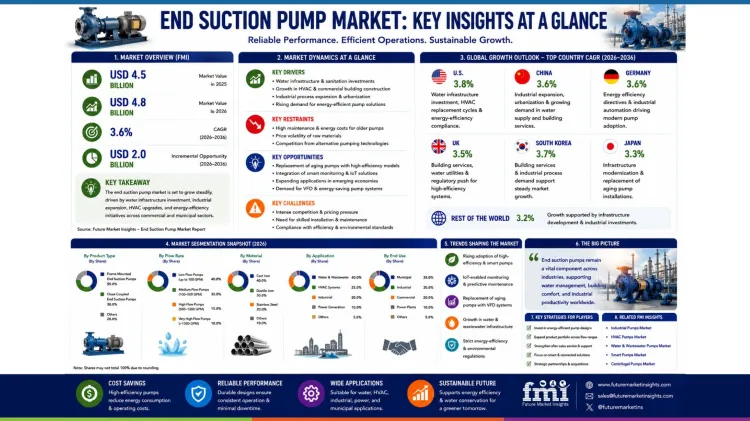
- The USA leads visible country growth at 3.8% CAGR, supported by water infrastructure investment, HVAC replacement cycles, and energy-efficiency compliance.
- EU growth is supported by efficiency directives and building renovation programmes, making replacement and modernization especially important.
- The growth opportunity is balanced. Replacement drives margin-rich upgrades, while new installations drive volume through infrastructure expansion.
End suction pump suppliers are finding growth in two different places. One is the replacement of old pumps in existing buildings, utilities, and industrial systems. The other is new installation in water infrastructure, commercial construction, industrial facilities, and developing urban systems. The best suppliers understand that these demand pools require different sales models.
Replacement demand is not simply a spare-parts business. It is increasingly an efficiency and lifecycle-cost upgrade. A pump installed decades ago may still move water, and it may operate at a poor efficiency point, lack variable speed control, use an outdated motor, or require frequent maintenance. When the owner replaces it, the buyer may specify a more efficient pump, a VFD, a better motor, smart monitoring, or improved materials.
The FMI end suction pump report identifies this directly. It states that demand is supported by an aging installed base in developed markets, which creates replacement procurement cycles as equipment reaches end of service life. It also states that building energy efficiency standards are driving replacement of constant-speed pumps with energy-efficient motor and VFD-equipped alternatives.
The replacement case is especially strong in commercial HVAC. Chilled water, hot water, condenser water, and building circulation systems often rely on centrifugal pumps. In older buildings, pumps may run at constant speed even when load changes. Replacing those pumps with properly selected efficient units and variable speed drives can reduce energy use and improve control. Building owners may approve such projects during renovation, central-plant upgrades, energy-performance programmes, or equipment end-of-life replacement.
The DOE adjustable speed drive guidance supports the operating principle. VFDs adjust motor speed to meet changing process requirements, which is relevant to pump systems with variable flow demand. This helps explain why pump replacement is increasingly tied to controls and energy management rather than only mechanical failure.
The USA is a clear example of replacement plus infrastructure demand. FMI projects the USA market to grow at 3.8% CAGR through 2036, the highest visible country-level rate in the report. The drivers are water infrastructure investment, commercial building HVAC, and energy-efficiency compliance. EPA states that the Infrastructure Investment and Jobs Act delivers more than USD 50 billion to improve drinking water, wastewater, and stormwater infrastructure, the largest federal water investment of its kind. This creates opportunities for pump procurement in treatment, distribution, boosting, and system upgrades.
Replacement demand in the USA also benefits from established distribution. FMI notes that industrial and HVAC wholesale channels provide efficient procurement for contractors and facility operators. This matters because many replacement decisions are made quickly. A contractor replacing a failed or inefficient pump needs availability, selection support, compatible dimensions, and service parts. A supplier with local distributor coverage can capture demand that a slower engineered-sales model may miss.
The EU growth story leans heavily toward modernization. FMI projects the EU at 3.6% CAGR, supported by energy efficiency directives and building renovation programmes. It also notes that EU ecodesign requirements for water pumps mandate minimum efficiency levels and drive adoption of energy-efficient end suction pump systems. In mature markets, the installed building and infrastructure base is large, so pump suppliers often grow by replacing and upgrading existing equipment rather than only adding new assets.
The UK has a similar pattern. FMI projects 3.5% CAGR, supported by building services and water utility investment. Building regulations for energy performance drive high-efficiency pump specification in new construction and major renovation projects, while water utility upgrades support pump procurement for capacity and reliability improvement.
New installation demand has a different profile. It is tied to first-time infrastructure, urbanization, water supply, sanitation, industrial expansion, and new commercial buildings. FMI states that water supply and sanitation infrastructure development in emerging markets creates new pump installations at treatment plants, distribution systems, and building services. Each new facility requires multiple pumps specified for local application requirements.
A new water treatment plant, industrial park, commercial complex, or district cooling system may need several end suction pumps across different duties. These may include transfer pumps, booster pumps, service water pumps, HVAC circulation pumps, cooling water pumps, washdown pumps, and process water pumps. The supplier opportunity is not one pump per project. It is a package of pump applications across the site.
New installations often require engineering support early in the design cycle. Consultants and EPC contractors may specify pump curves, materials, duty points, redundancy, NPSH requirements, motors, controls, and maintenance access. Suppliers that can support design documentation and provide complete pump packages are better positioned in capital projects.
Replacement demand rewards speed and compatibility. New installation rewards specification influence and project support.
The split also affects product configuration. Frame mounted pumps, which FMI identifies as the leading product type with 50.0% share, are attractive in both pools. In replacement, they allow motor upgrades and service access. In new installations, they give engineers flexibility in motor selection and baseframe layout. Close coupled pumps are more likely to win where new buildings or replacement projects need compact equipment in constrained spaces.
Smart pumps are becoming an overlay across both demand pools. FMI identifies integrated monitoring, condition-based maintenance, and building management system connectivity as growing opportunities. In replacement markets, smart features can help justify an upgrade by offering better lifecycle cost and predictive maintenance. In new installations, they can be specified into building automation systems or water utility monitoring networks from the start.
The growth economics differ as well. Replacement can provide higher-value upgrades when the customer is improving efficiency, reliability, or monitoring. It may also include service, installation, spare parts, and maintenance contracts. New installations can provide higher volume if infrastructure spending is strong, and pricing may be competitive through tenders and contractor procurement.
Mature-market pricing pressure remains a restraint. FMI notes that mature market dynamics and moderate growth rates create competitive pricing pressure among established pump manufacturers. This means suppliers cannot rely on replacement demand alone to protect margins. They need differentiation through efficiency, service, smart monitoring, distribution, and lifecycle support.
New installation demand in emerging markets can also be price-sensitive. Water infrastructure buyers and contractors may evaluate pumps based on initial cost, availability, local service, spare parts, and material suitability. A premium efficient pump may need to prove that energy savings justify a higher upfront price. In markets with rising energy costs or formal efficiency standards, that argument becomes easier.
The best commercial strategy is to build different offers for each pool.
For replacement, suppliers should emphasize interchangeability, quick delivery, energy savings, VFD compatibility, drop-in options, retrofit kits, distributor support, and maintenance access.
For new installations, suppliers should emphasize engineering support, pump selection, package breadth, materials, project references, documentation, commissioning, and long-term service.
The country pattern supports this dual approach. The USA, EU, and UK provide replacement-led growth through aging infrastructure and energy efficiency. Developing regions create first-time installation demand through water and sanitation expansion. South Korea provides a mixed profile, with building services and industrial process demand supporting both replacement and new project activity.
End suction pump suppliers are therefore finding growth in both places. Replacement demand is stronger where installed assets are old and efficiency rules are tightening. New installation demand is stronger where water infrastructure, commercial construction, and industrial capacity are expanding. The most resilient suppliers will treat replacement as an upgrade opportunity and new installation as a platform-entry opportunity.

