


- Replacement demand is strong in mature fleets because hatch covers face corrosion, gasket wear, cleat misalignment, drainage issues, panel deformation, and survey-driven maintenance cycles.
- Newbuild demand remains important because shipbuilding activity in East Asia and fleet renewal programs create hatch cover procurement at the vessel-construction stage.
- FMI states that demand is supported by replacement cycles in mature markets and capacity expansion in high-growth regions.
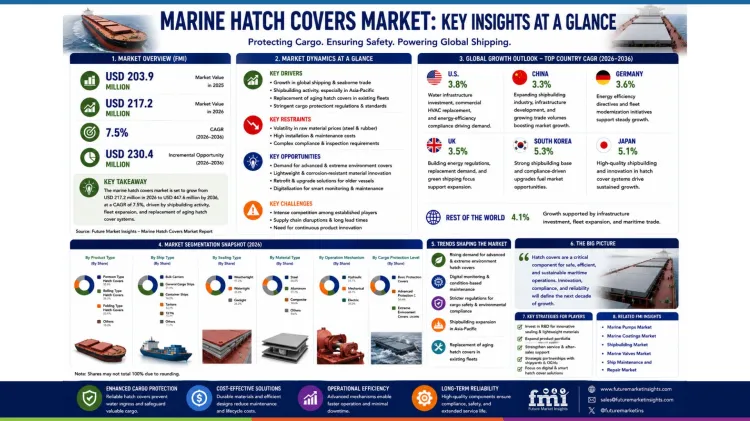
- Bulk carriers hold 38.6% ship-type share in 2026, making dry bulk fleet renewal and maintenance central to supplier opportunity.
- The global fleet continues to age despite new ship deliveries, creating a durable repair, retrofit, and component replacement opportunity.
- Suppliers are finding growth in both pools, and replacement demand is often more service-rich while newbuild demand is more specification and shipyard relationship-driven.
Marine hatch cover suppliers do not depend only on new ships. The installed fleet itself creates a large and recurring opportunity. Hatch covers operate in one of the most hostile parts of a vessel, namely the open deck. They face seawater, cargo impact, corrosion, vibration, hull flexing, heavy weather, crew handling, loading equipment, seal compression, and repeated opening and closing. Even a well-built cover eventually needs inspection, adjustment, repair, component renewal, or replacement.
FMI projects the marine hatch covers market to grow from USD 217.2 million in 2026 to USD 447.6 million by 2036, creating USD 230.4 million of incremental opportunity. The report states that growth is supported by replacement cycles in mature markets, shipbuilding activity in East Asia, and fleet capacity expansion across dry bulk and general cargo segments. That wording is important because it confirms that the market has two engines rather than one.
Newbuild demand is the more visible route. When a bulk carrier, container ship, general cargo ship, Ro-Ro vessel, tanker, or chemical carrier is built, hatch cover systems must be specified, designed, manufactured, fitted, tested, and approved. This creates opportunities for suppliers with shipyard relationships, engineering capabilities, classification familiarity, and the ability to deliver systems on schedule.
East Asia is central to this pool because much of the world shipbuilding capacity is concentrated in China, South Korea, and Japan. FMI identifies South Korea as one of the fastest-growing visible country markets at 5.3% CAGR and Japan at 5.1%, with the EU leading at 5.4%. The report links South Korean demand to compliance requirements, sector modernization, and established procurement infrastructure. For hatch cover suppliers, this indicates that shipyard-linked newbuild demand remains a core sales channel.
Newbuild projects favour suppliers that can support design integration. A hatch cover is not an afterthought. It affects hatch opening geometry, cargo handling, deck layout, coaming design, drainage, sealing, weight, strength, operation mechanism, and maintenance access. On a new vessel, shipowners and shipyards can specify the system around cargo profile and intended trading route. Suppliers can add value through engineering, lightweighting, hydraulic or electric operation, corrosion-resistant materials, and cargo-protection features.
Replacement demand behaves differently. It begins with the operating fleet. A ship may already have hatch covers, and the owner may need new rubber seals, cleats, wheels, chains, hydraulic components, drainage fittings, panel repairs, coaming repairs, track maintenance, corrosion treatment, or full replacement of damaged covers. This creates service and parts opportunities that are less tied to the shipbuilding cycle.
The UNCTAD Review of Maritime Transport 2025 states that maritime trade is projected to slow to 0.5% in 2025 before averaging 2% annually from 2026 to 2030. The same wider reporting notes that the global fleet continues to age despite new deliveries. An ageing fleet matters because older ships usually require more inspection, repair, and replacement work. Hatch covers are directly exposed to this age effect because deterioration is visible through corrosion, deformation, loss of sealing compression, worn wheels, loose cleats, and damaged drainage channels.
IMO and IACS guidance reinforce the replacement case. IMO standards require owners to inspect and maintain bulk carrier hatch covers. IACS guidance emphasizes the care and survey of hatch covers of dry cargo ships and confirms the importance of weathertightness. This creates a maintenance culture around hatch covers. Owners cannot simply wait until water damage occurs. They need planned inspection, documentation, and corrective action.
Replacement growth is especially relevant for bulk carriers. FMI expects bulk carriers to command 38.6% ship-type share in 2026. Dry bulk ships often operate in demanding cargo environments. Cargo handling equipment can damage covers or coamings. Bulk cargo residues can affect drains and seals. Heavy seas can test weathertightness. Surveyors and charterers may pay close attention to hatch cover condition because cargo wetting claims can be costly.
P&I Club material makes the commercial risk visible. Gard notes that wet cargo damage linked to defective hatch covers remains a recurring problem. The Nautical Institute has also described leaking hatch covers as a major source of dry cargo ship claims. These sources support a practical conclusion that replacement and maintenance demand is not optional if the owner wants to preserve cargo-worthiness and reduce claims exposure.
Replacement demand can also be triggered by charterer expectations. A vessel carrying grain, cement, steel products, fertilizers, project cargo, or other moisture-sensitive goods may face stricter pre-loading checks. If hatch covers are poorly maintained, owners may face delays, additional testing, cargo rejection, or claim vulnerability. Suppliers that provide inspection, ultrasonic testing support, replacement seals, and retrofit packages can benefit from this risk environment.
The retrofit opportunity is becoming more attractive because not every owner wants or needs a full hatch cover replacement. A supplier can sell upgrades through sealing systems, drainage improvements, corrosion-resistant materials, improved cleating, hydraulic refurbishment, electrical or monitoring upgrades, and panel strengthening. This can be more affordable than a full new system while still improving cargo protection.
Newbuild and replacement demand also differ in profitability structure. Newbuild contracts may be large and visible, and shipyards often negotiate aggressively on price, delivery, and technical compliance. Replacement and service work may be more fragmented, and it can carry stronger value where speed, spare parts, and technical knowledge prevent cargo delay or survey failure.
Supplier capability requirements differ as well.
For newbuild demand, the supplier needs shipyard integration, engineering documentation, class approval support, production capacity, and delivery reliability.
For replacement demand, the supplier needs field inspection, spare-parts availability, repair knowledge, rapid logistics, service teams, and compatibility with installed hatch cover systems.
The strongest companies are likely to serve both. MacGregor, identified by FMI as a leading player, has a global footprint and broad product coverage. Suppliers such as TTS Group, Baier Marine, Wärtsilä, Hyundai Heavy Industries, Damen, and regional hatch cover specialists occupy different positions across newbuild, retrofit, and service channels. The competitive advantage is not only manufacturing. It is the ability to remain attached to the vessel throughout its life.
Regional patterns add nuance. In East Asia, shipbuilding supports newbuild demand. In Europe and the UK, replacement, regulatory compliance, fleet maintenance, and service networks may be more visible. In Japan and South Korea, quality-first procurement and established shipbuilding relationships sustain both channels. Emerging markets may generate demand through fleet expansion, port-linked cargo activity, and vessel modernization.
The replacement versus newbuild question should also consider fleet strategy. If freight markets are strong and shipowners order new tonnage, newbuild hatch cover demand rises. If freight markets are uncertain, owners may extend the life of existing vessels, increasing repair and retrofit demand. Hatch cover suppliers can remain active in either scenario if they are present in both shipyard and service networks.
The market growth outlook suggests that replacement and newbuild demand are complementary rather than competing pools. Newbuild installations create the future installed base. Replacement demand monetizes that installed base through inspection, spares, repairs, and upgrades. In a marine equipment category exposed to harsh operating conditions, the lifecycle revenue can be just as important as the initial installation.
Marine hatch cover suppliers are finding growth in shipyard procurement, and the more recurring opportunity often sits in replacement and service. The installed fleet ages, cargo damage remains a risk, and inspection requirements keep hatch cover condition under scrutiny. Suppliers that can sell the original cover and support it through its operating life are likely to capture the most resilient demand.

