


- Bakery mixes serve several buyer groups, and each one evaluates the product differently.
- FMI projects B2B direct sales to lead channels with 45.0% share in 2026 because large users need specification support and technical service.
- Industrial bakeries buy mixes for production control, foodservice buyers buy for labor simplification, and retail consumers buy for successful at-home results.
- Distributors remain important where smaller bakeries and regional foodservice operators need flexible access to mixes.
- Online retail supports household baking kits, specialty mixes, and repeat pantry replenishment, but it is not the main route for large industrial accounts.
- The misconception to avoid is assuming one channel strategy fits the entire bakery mixes market.
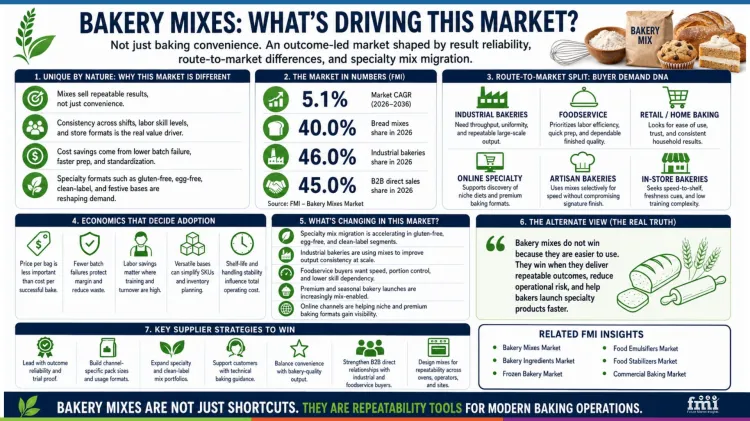
The Bakery Mixes Market is not a single-channel market. It looks simple because the products are often described as bread mixes, cake mixes, and pastry mixes. But the buying logic changes sharply across industrial bakeries, foodservice operators, household retail, distributors, modern trade, and online retail. A mix that succeeds in one route may not automatically succeed in another.
B2B direct sales lead the market because large bakery users need more than a bag of premix. They need specifications, technical guidance, plant trials, documentation, supply assurance, and adjustment support. A high-volume bakery may require a mix to match line speed, dough handling, proofing tolerance, moisture retention, slicing behavior, packaging conditions, and retailer shelf-life targets. This level of support is difficult to provide through a purely transactional channel.
FMI forecasts B2B direct sales to account for 45.0% share in 2026. That number is important because it confirms that bakery mixes are not only retail pantry products. The market is strongly connected to commercial production. Direct selling works best when the buyer is large enough to require tailored formulations, repeat supply contracts, and technical service. It also allows suppliers to protect relationships when formulation performance affects customer operations.
Industrial bakeries are the clearest example. These customers may buy bread mixes, cake bases, muffin mixes, and pastry bases in large volumes. Their priority is not attractive packaging. Their priority is performance under production constraints. They need consistent hydration, mixing tolerance, leavening behavior, crumb texture, color, flavor, shelf life, and waste control. A supplier that can solve those issues may win even if its product is not the lowest priced.
Foodservice buyers behave differently. Restaurants, hotels, cafes, catering companies, quick-service chains, convenience foodservice counters, and institutional kitchens value speed and simplicity. Their challenge is often labor availability and staff training. A foodservice bakery mix must be forgiving, easy to prepare, portion-consistent, and suitable for changing menus. It must help operators serve baked goods without requiring highly skilled bakers in every location.
This is why adjacent FMI references such as the Batter Based Premixes Market are useful. Batter-based premixes often serve breakfast, foodservice, and convenience occasions where preparation speed and consistent texture matter. Bakery mixes overlap with this logic when cake, muffin, pancake, waffle, and dessert bases are used across cafes and foodservice outlets.
Household retail adds another layer. Retail buyers are influenced by brand familiarity, pack design, flavor, price, recipe instructions, seasonal promotions, and perceived success probability. A branded cake mix or bread mix must make home baking feel achievable. In this channel, the buyer may not understand flour strength, leavening chemistry, or emulsifier systems. The pack must translate technical formulation into a simple promise: follow these steps and get a good result.
Modern trade is particularly relevant for mainstream retail mixes. Supermarkets and hypermarkets give brands visibility and support seasonal baking moments. However, shelf competition can be intense. Brands must manage pack architecture, flavor line-up, price points, promotions, and claims such as gluten-free, egg-free, high-fiber, organic, or clean-label. Retail bakery mixes have a stronger consumer-marketing layer than industrial mixes.
Distributors remain important because not every customer buys directly. Small bakeries, regional foodservice operators, hotels, caterers, and local chains may need smaller volumes, quicker access, or a broader mix of products. Distributors can aggregate demand, provide local availability, and carry multiple bakery supply categories. For suppliers, distributors help reach fragmented users, but may reduce direct control over technical communication.
Online retail is growing in visibility but has different economics. It works well for household baking kits, niche mixes, specialty dietary products, gluten-free premixes, and refill purchases. E-commerce can also help consumers compare reviews and discover new flavors. However, online is not usually the main procurement route for industrial bakery accounts because those buyers need specifications, trials, and supply agreements rather than single-pack discovery.
Specialty channels are becoming more important. The Gluten-free Bakery Premix Market illustrates how allergen-aware and specialty bakery systems can create higher-value opportunities. These products often require stronger trust because consumers and foodservice operators depend on formulation accuracy, contamination controls, and clear preparation instructions.
Private-label dynamics also deserve attention. The Private Label Bakery Mix Market is relevant because retailers can use mixes to build own-brand baking ranges. This does not mean all branded mix suppliers are threatened equally. Strong brands may still win on trust, flavor, seasonal innovation, and recipe familiarity. But in routine cake or pancake mixes, private label can be powerful if the product performs reliably at a lower price.
The route-to-market decision therefore shapes the product itself. A B2B direct mix may emphasize technical specifications, batch consistency, and plant performance. A foodservice mix may emphasize simplicity, holding tolerance, and preparation speed. A retail mix may emphasize pack communication, flavor, and success confidence. An online mix may emphasize reviews, repeat purchase, specialty claims, and clear product imagery.
The biggest strategic mistake is using one sales message across all channels. Saying a mix is convenient may work in retail, but it is too weak for industrial buyers. Saying a mix reduces production variation may work for bakeries, but it may not excite home bakers. Each channel has a different buying trigger.
Country-level growth also supports the channel-split logic. FMI points to India and China as faster-growth markets for bakery mixes, reflecting expansion in food processing, bakery chains, packaged bakery, and foodservice formats. In these markets, mixes can help regional operators standardize quality as they scale beyond single-site production. The opportunity is not only consumer convenience; it is the professionalization of bakery output.
In mature markets such as the United States, Germany, the United Kingdom, and Japan, growth is more selective. Buyers already understand bakery systems, so the supplier must prove productivity benefits, claim support, flavor innovation, or operational simplification. In these markets, a bakery mix is less likely to be accepted simply because it saves time. It must defend its role against scratch baking, in-house blending, and private-label alternatives.
The product specification also changes by channel. Industrial buyers may need bulk bags, consistent particle size, allergen controls, certificates, batch traceability, shelf-life data, and technical documentation. Foodservice buyers may prefer smaller packs, easy measurement, simple preparation steps, and reduced training needs. Household retail buyers need brand trust, attractive pack graphics, clear instructions, and strong flavor cues. Online buyers need searchable claims, reviews, comparison-ready descriptions, and repeat-purchase convenience.
This split affects innovation decisions. A supplier launching a premium chocolate cake mix for retail may focus on taste, pack design, and seasonal marketing. The same supplier selling to a hotel chain may focus on yield per pack, speed of preparation, consistency after holding, and compatibility with toppings or fillings. For an industrial bakery, the pitch may be around line efficiency, reduced rework, and finished product specification control.
The strongest suppliers will avoid over-reliance on one route. A balanced strategy can use B2B direct relationships for volume and technical credibility, distributors for regional reach, foodservice packs for professional kitchens, modern trade for household visibility, and online channels for specialty mix discovery. However, each route needs its own product economics and communication logic.
Bottom line: bakery mixes win when the supplier understands the buyer route. B2B direct sales are technical and relationship-led. Foodservice is labor and speed-led. Retail is confidence and brand-led. Distributors are access-led. Online retail is discovery and repeat-replenishment led. A strong market strategy must separate these routes instead of treating bakery mixes as one uniform category.
Related FMI Reports
- Bakery Mixes Market: Primary market reference and channel benchmark source
- Batter Based Premixes Market: Use when discussing foodservice and breakfast-style premix applications
- Private Label Bakery Mix Market: Use when discussing retailer-owned mix programs
- Gluten-free Bakery Premix Market: Use when discussing specialty and allergen-aware channels
- Flour Mixes Market: Use when discussing industrial flour-based mix systems
- Frozen Bakery Market: Use when discussing prepared and foodservice-ready bakery systems

