


- Supply chain resilience is a new strategic priority in the Bone Morphogenetic Protein Market as recombinant biologics demand highly specialized manufacturing and quality-controlled production networks.
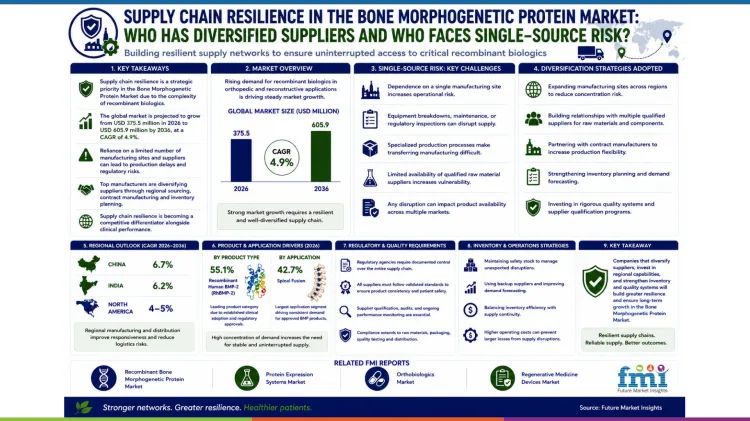
- The global Bone Morphogenetic Protein Market size is projected to reach USD 605.9 million by 2036, exhibiting a CAGR of 4.9% during the forecast period from USD 375.5 million in 2026.
- For companies, reliance on a handful of manufacturing sites and qualified suppliers can lead to production delays and regulatory risk.
- The global top manufacturers are increasing their supplier base with regional sourcing, contract manufacturing relationships and inventory planning.
- As regenerative medicine expands globally, supply chain resilience is becoming a competitive differentiator with clinical performance.
Specialized Biologics Come with Specialized Supply Risks
The Bone Morphogenetic Protein market is unlike many other pharmaceutical segments, in that recombinant proteins require very strict manufacturing processes and are under heavy regulatory scrutiny. Production cannot be easily transferred from one facility to another without validation, updates to documentation and regulatory review.
This creates a supply chain environment where a disruption at a single manufacturing location can impact product availability across multiple markets.
According to Future Market Insights, the Bone Morphogenetic Protein Market is expected to grow from USD 375.5 million in 2026 to USD 605.9 million by 2036. This will make supply continuity increasingly important for both manufacturers and healthcare providers.
Single-Source Dependence Remains a Challenge
Commercial bone morphogenetic protein products are frequently produced using proprietary manufacturing systems that require specialized equipment and validated manufacturing protocols.
Recombinant protein production, unlike most standard pharmaceutical ingredients, which may be available from multiple suppliers, requires qualified facilities with consistent quality standards.
This is even more the case for companies with only one approved production site, which means a higher operational risk in case of unexpected disruptions.
Temporary effects on product availability can be caused by shutdowns of manufacturing, maintenance of equipment, regulatory inspections or lack of raw materials.
Diversification Is Becoming a Strategic Investment
To address these risks, manufacturers are increasingly diversifying their supply strategies.
Rather than one production facility, companies are looking at other manufacturing sites, regional distribution centers and qualified suppliers of critical raw materials.
Capital intensive reproduction of production capacity. Diversification of supply networks increases resilience in times of uncertainty.
This also helps for long term business continuity planning and regulatory readiness.
Regional Expansion Supports Supply Security
China is expected to grow at a CAGR of 6.7% and India at 6.2% through 2036, according to Future Market Insights.
The emergence of these markets spurs manufacturers to develop regional supply capabilities that cut down on transportation complexity and boost responsiveness to local demand.
Regional production and distribution can also support inventory management and strengthen relationships with healthcare providers and regulatory authorities.
Such investments are helping companies to maintain service levels in the face of disruption in international logistics.
Product Concentration Increases the Need for Stable Supply
Future Market Insights expects RhBMP-2 to account for 55.1% of the global market in 2026.
The very large share of demand concentrated within a single product category makes uninterrupted manufacturing essential.
Spinal fusion applications are estimated to contribute 42.7% of the overall market demand in 2026, thus ensuring the availability of reliable products is particularly vital for hospitals and surgeons who perform scheduled orthopedic surgeries.
Unexpected shortages can delay surgeries and cause operational problems for healthcare providers.
Regulatory Compliance Extends Across the Supply Chain
Supply resilience is more than production capacity.
Regulatory agencies expect manufacturers to have documented control over suppliers, quality systems, raw materials, packaging processes and distribution activities.
All participants in the supply chain must follow validated standards to ensure the consistency of the product and the safety of patients.
As a result, supplier qualification programs have become more comprehensive with companies conducting audits and ongoing performance monitoring to mitigate operational risk.
Inventory Planning Is Playing a Larger Role
The COVID-19 pandemic has underscored the importance of more agile healthcare supply chains.
Manufacturers are examining inventory management strategies that balance efficiency and resiliency.
By increasing safety stock, using backup suppliers where possible and improving demand forecasting, companies can respond to unexpected market changes more effectively.
These steps will increase operating costs but can prevent much larger losses from supply disruptions.
Vertical Integration Can Reduce Risk
The vertical integration approach is that some manufacturers are trying to do much more of the production in-house rather than outsource it.
Integrated operations including recombinant protein manufacturing, purification, quality testing and packaging reduce reliance on outside partners and improve control over critical processes.
Integrated operations also promote coordination between manufacturing and regulatory teams so that companies can be more efficient when process updates or inspections occur.
This approach provides significant operational advantages for the biologics markets where maintaining consistency in quality is critical.
Long-Term Growth Depends on Reliable Delivery
TThe regenerative medicine field is growing and health care providers are looking for constant access to approved biologic therapies.
Clinical effectiveness is no longer sufficient to guarantee long-term market leadership.
Manufacturers also need to demonstrate reliable production, capable logistics and consistent product availability on global markets.
For this reason, companies that invest early in diversified, resilient supply chains are likely to build customer confidence while supporting sustainable commercial growth.
Bottom Line
Supply chain resilience is turning out to be a defining competitive factor in the Bone Morphogenetic Protein Market. Specialized manufacturing requirements are naturally single-source risk factors that drive companies to broaden supplier bases, develop regional manufacturing capabilities and tighten inventory planning.
The market is projected to grow from USD 375.5 million in 2026 to USD 605.9 million by 2036, with companies that construct resilient and agile supply networks better positioned to ensure continuity, meet regulatory expectations and support growing global demand.

