


- Supply chain resilience is emerging as a strategic priority for manufacturers in Supply chain resilience is emerging as a strategic priority for manufacturers in the knee HA injection segment to reduce their dependence on single production sites and geographically concentrated suppliers.
- Companies are increasingly diversifying formulation, sterile manufacturing and distribution capabilities to ensure consistent supply of products across key Orthopedic markets.
- Asia-Pacific’s rising demand is leading manufacturers to expand their regional supply networks, while continuing to uphold quality standards for injectable products.
- The largest supply chain advantage belongs to organizations that can strike the right balance between cost efficiency, regulatory compliance, validated manufacturing and reliable logistics.
- The ability to ensure stable product supply across multiple regions, in addition to clinical innovation, will become increasingly important for future competitiveness.
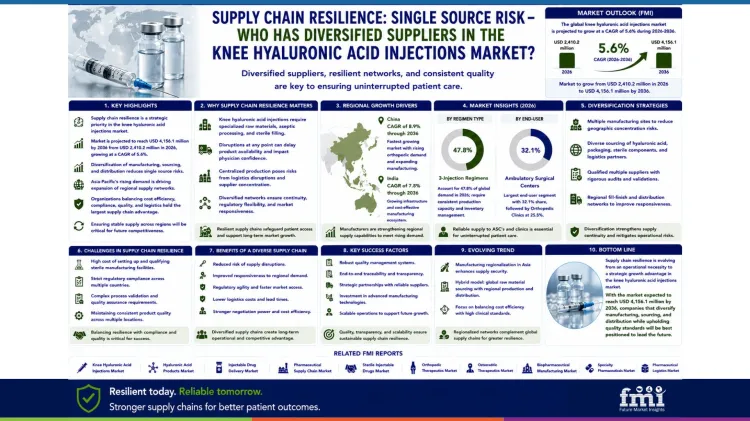
The global knee hyaluronic acid injections market is expected to reach USD 4,156.1 million by 2036 from USD 2,410.2 million in 2026, growing at a CAGR of 5.6%. While product innovation is still key for market expansion, supply chain resilience is becoming another equally important competitive differentiator.
Unlike many traditional drugs, knee hyaluronic acid injections need special raw materials, aseptic processing, sterile filling, rigorous quality testing, and controlled distribution. Disruption at any point can delay product availability and directly impact physician confidence and patient access.
In the past many manufacturers have used central production plants supplying different markets in the world. This model does benefit from economies of scale, but recent global logistics disruptions and growing regional demand have revealed the risks of concentrated manufacturing and limited supplier diversification.
According to Future Market Insights, China will be the fastest growing national market with a CAGR of 8.9% through 2036, and India will grow at 7.8% CAGR during the same period. As demand within the sector grows rapidly, manufacturers are increasing regional supply capabilities to meet rising orthopedic treatment volumes.
Supplier diversity is not just about the manufacturing plant. Companies are also looking at different sourcing strategies for pharmaceutical-grade hyaluronic acid, packaging materials, sterile components and logistics providers to cut reliance on specific vendors and cut operational risk.
Supply planning is also affected by the product composition. Forecasts for the three-injection formulations suggest they will account for 47.8% of global demand in 2026 and will demand ongoing manufacturing capacity and reliable inventory management. We need to keep a constant supply of health care providers who continue to prescribe these proven treatment regimens.
Distribution channels also highlight the need for resilient supply networks. Ambulatory surgical centers are estimated to account for 32.1% share in demand market in 2026, followed by orthopedic clinics (25.5%). In both environments, assurance of inventory availability and timely replenishment is necessary to ensure continuity of patient care.
More diverse suppliers may provide more regulatory flexibility. For regional compliance updates, transportation disruptions, or unforeseen production interruptions, manufacturers have contingency options including multiple validated production sites and qualified vendors.
Diversification has its own problems. Qualification of each manufacturing site or supplier is required. To guarantee consistency in the product, quality audits, process validation, and regulatory oversight are necessary. Ongoing consistency in quality of injectable therapies across multiple facilities remains paramount to physician trust and patient safety.
This trend of regional manufacturing expansion in Asia reinforces such resilience strategies. Companies are building geographically balanced production and distribution systems that can serve local demand and reduce logistics exposure, albeit slowly, rather than relying on exports from one location.
With an aging world and increasing treatment volumes, the prevalence of osteoarthritis will increase and reliable supply chains will be an even more valuable competitive asset. Manufacturers capable of assuring reliable availability of products with consistent clinical performance are likely to reinforce their long-term positioning in the market.
Bottom Line
The Knee HA injection segment is evolving from an operational consideration to a strategic growth advantage through supply chain resilience. With the market anticipated to hit USD 4,156.1 million by 2036, companies that diversify their manufacturing locations, sourcing partners, and regional distribution capabilities, while maintaining stringent quality standards, will be better positioned to compete.
Related FMI Reports
- Knee Hyaluronic Acid Injections Market
- Hyaluronic Acid Products Market
- Injectable Drug Delivery Market
- Pharmaceutical Drug Delivery Market
- Sterile Injectable CDMO Market
- Orthopedic Trauma Device Market
- Osteoarthritis Gene Therapy Market
- Biopharmaceutical Contract Manufacturing Market
- Specialty Active Pharmaceutical Ingredient Market
- Pharmaceutical Logistics Market

