


- PRP market: Supply chain resilience is becoming a strategic priority for healthcare providers who are looking for uninterrupted access to regenerative therapies.
- The use of proprietary kits, centrifuge systems and disposable consumables creates potential single-source vulnerabilities for hospitals and clinics.
- Those manufacturers with the most diversified production capabilities and widest distribution networks are best positioned to support large healthcare systems.
- Closed-system technologies and standardized consumables are gaining in popularity as a means to reduce variability in operations.
- Long-range purchasing strategies are shifting from lowest cost sourcing to supply assurance and consistent clinical performance.
The Platelet Rich Plasma Market is growing rapidly in orthopedic, sports medicine, cosmetic procedures, chronic wound management and dental applications. With adoption increasing, hospitals and specialty clinics are looking beyond platelet concentration and device cost to ensure supply continuity.
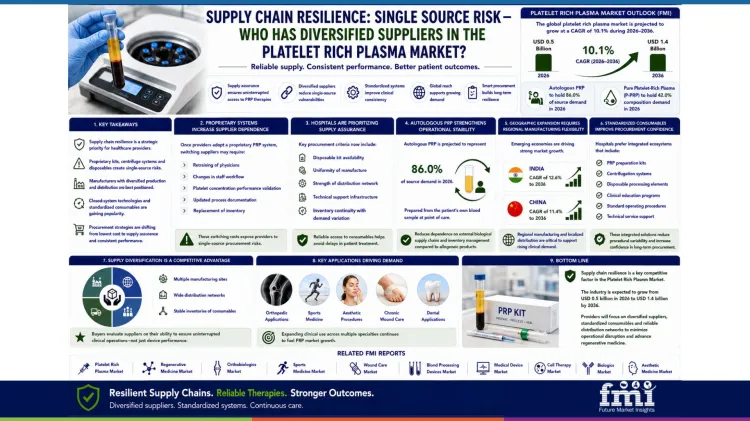
The global platelet rich plasma market is expected to reach USD 0.5 billion in 2026 and is projected to grow at a CAGR of 10.1% during the forecast period of 2026-2036, reaching USD 1.4 billion by the end of 2036, according to Future Market Insights. Autologous PRP is projected to represent 86.0% of source demand in the market. Pure Platelet-Rich Plasma (P-PRP) is estimated to hold 42.0% share of the composition demand in 2026, thus increasing the industry’s reliance on standardized preparation systems and compatible consumables.
Proprietary Systems Increase Supplier Dependence
PRP procedures use proprietary processing kits that are intended for use with specific centrifuge platforms, unlike traditional pharmaceutical products that are often available from multiple manufacturers.
Once a healthcare provider has standardized clinical protocols for a single preparation system, switching suppliers may require:
- Retraining of physicians
- Changes in staff workflow
- Platelet concentration performance validation
- Updated process documentation
- Replacement of inventory
This creates real switching costs that can leave providers exposed to the risks of single-source procurement.
Hospitals Are Prioritizing Supply Assurance
An increasing number of hospital groups are now looking at procurement decisions on their long-term supply reliability and not only on the initial acquisition costs.
Key buying criteria now include:
- Disposable kit availability
- Uniformity of manufacture
- Strength of Distribution Network
- Technical support infrastructure
- Inventory continuity with demand variation
In high volume healthcare systems, reliable access to consumables is critical to avoid delays in treatment.
Autologous PRP Strengthens Operational Stability
FMI expects autologous PRP to represent 86.0% of source demand by 2026, as they prefer blood processing from the same patient, rather than donor blood-derived options.
As treatment is prepared at the point of care from the patient’s own blood sample, providers decrease dependence on external biological supply chains and reduce inventory management relative to allogeneic products.
Geographic Expansion Requires Regional Manufacturing Flexibility
The Platelet Rich Plasma Market is becoming more global. Emerging economies are becoming a larger share of future demand.
FMI states that:
- India is expected to grow at a CAGR of 12.6% to 2036.
- China is projected to witness 11.4% CAGR during the same period.
With fast growth across the Asia-Pacific, regional manufacturing capacity, localized distribution and diversified supplier networks are becoming increasingly important to support rising clinical volumes.
Standardized Consumables Improve Procurement Confidence
Hospitals are increasingly turning to suppliers that can provide full integrated ecosystems that combine:
- PRP preparation kits
- Centrifugation
- Disposable processing elements
- Clinical educational programs
- Standard Operating Procedure
- Support of tech service
These combined solutions reduce procedural variability and increase confidence in procurement over long term purchasing cycles.
Supply Diversification Is Becoming a Competitive Advantage
Institutional buyers are likely to favour manufacturers able to maintain multiple manufacturing sites, wide distribution networks and stable inventories of consumables.
Procurement teams are now looking at more than just device performance, but at the supplier’s ability to keep clinical operations running without interruption.
Bottom Line
Supply chain resilience is becoming a key competitive factor in the Platelet Rich Plasma Market. The industry is expected to grow from USD 0.5 billion in 2026 to USD 1.4 billion by 2036. Hospitals and specialty clinics are likely to focus on diversified suppliers, standardized consumables and reliable distribution networks that minimize operational disruption while supporting the growth of regenerative medicine

