


- Green building requirements are beginning to influence construction polymer selection, particularly in insulation, sealants, coatings, waterproofing, pipes, membranes, and building envelope materials.
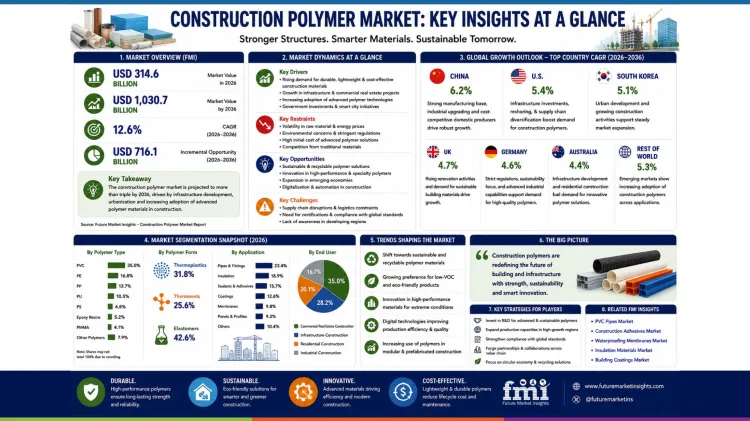
- FMI forecasts construction polymer demand to rise from USD 314.6 billion in 2026 to USD 1,030.7 billion by 2036, creating room for both volume growth and specification change.
- Thermoplastic polymers account for 31.8% of polymer form demand, which makes recyclability, reuse, and recovered-content discussions commercially relevant.
- LEED v5 emphasizes decarbonization across operational, embodied, refrigerants, and transportation emissions, creating stronger attention around material choices.
- EPA sustainable materials guidance prioritizes source reduction because it prevents material use, energy use, and waste before the end-of-life stage.
- The market signal is not a complete shift away from conventional polymers. It is a move toward documented performance, lower-carbon options, recycled content where feasible, and longer service life.
A construction material is rarely selected for sustainability alone. It must insulate, seal, bond, protect, carry load, resist water, survive weathering, meet code, fit installation practices, and stay within budget. Polymers used in construction face that same commercial filter. The sustainability question therefore needs to be framed carefully. Are green building requirements changing material selection, or are they simply adding another layer of documentation to products that already win on performance?
The answer appears to be both.
The FMI Construction Polymer Market indicates that demand is expanding significantly. The market is set to reach USD 314.6 billion in 2026 and USD 1,030.7 billion by 2036, with a 12.6% CAGR. PVC leads polymer type demand with 35.0% share in 2026, commercial real estate construction leads end-user demand with 35.0%, and thermoplastic polymers account for 31.8% of polymer form demand. The scale of the market suggests that even modest shifts in specifications can create significant revenue movement.
Green building requirements are not pushing every buyer toward the same material. Instead, they are changing the questions asked during procurement. Buyers increasingly ask whether a product has an environmental product declaration, recycled content, low-emitting performance, lower embodied carbon, lifecycle durability, chemical compliance, recyclability, or documentation that supports building certification.
USGBC describes LEED as a comprehensive framework for green building design, construction, operations, and maintenance. LEED v5 goes further by emphasizing decarbonization across operational, embodied, refrigerants, and transportation emissions. This does not mean a polymer product must be bio-based or recycled to be accepted. It means the material contribution to building performance, carbon footprint, emissions, durability, and sourcing may be reviewed more closely.
For construction polymers, the strongest sustainability case often comes from use-phase performance. Polyurethane foam, polystyrene insulation, polymer membranes, sealants, coatings, and window profiles can improve energy efficiency by reducing heat loss, air leakage, water intrusion, or maintenance frequency. A polymer product may have fossil-based content and still reduce building energy use or extend service life. This makes sustainability assessment more nuanced than simply replacing conventional polymer with a green alternative.
Insulation materials show this clearly. Polystyrene, polyurethane, polyisocyanurate, and other polymer-based insulation products help improve building thermal performance. In green building projects, insulation can support operational energy reduction. Buyers may also assess blowing agents, fire performance, recyclability, embodied carbon, and installation waste. The preferred material may differ by building type, climate zone, fire code, and cost.
Sealants and adhesives offer another example. A high-performance sealant can reduce air leakage and water ingress, protecting building durability. A low-VOC or low-emitting formulation can support indoor environmental quality. The sustainability value is partly chemical composition and partly performance over time. A poor sealant that fails early can create repair waste, moisture damage, and replacement cost.
The EPA sustainable management guidance for construction and demolition materials gives a useful hierarchy. It states that source reduction reduces lifecycle material use, energy use, and waste generation and receives the highest priority because it prevents waste before it is created. For polymer suppliers, this points to lightweighting, longer-life products, thinner films, better installation efficiency, and packaging reduction as practical sustainability levers.
Recycling and recovered-content products also matter, and application suitability is uneven. EPA notes that buying used and recycled-content products can lower construction and renovation costs while maintaining building function and performance. In polymers, the phrase where performance allows is essential. Recycled-content polymer may be feasible in certain panels, profiles, membranes, drainage products, or non-critical components. It may be harder in products requiring strict fire ratings, weathering performance, chemical resistance, or structural integrity.
Thermoplastic polymers have a sustainability advantage because many can be reprocessed. FMI places thermoplastics at 31.8% of polymer form demand, which indicates a substantial base where circularity discussions are relevant. PVC profiles, polyethylene pipes, polypropylene components, and some PMMA or polycarbonate products can support recycling or reuse pathways when collected and sorted properly.
The weak point is not always the polymer. It is the building waste system. Construction and demolition streams are mixed, contaminated, bulky, and location-specific. A recyclable polymer product may not actually be recycled if recovery infrastructure is poor. That makes take-back schemes, product identification, modular design, and installation waste management important.
Green building requirements also interact with regulation. The European Commission Construction Products Regulation provides a common technical language to assess construction product performance and helps users compare product performance across manufacturers. It also creates a framework in which documented performance becomes central. For polymer suppliers in Europe, sustainability claims are more persuasive when connected to standardized declarations and CE-marked product documentation rather than marketing language.
In the U.S., project-level certification programs, state procurement policies, public infrastructure standards, and corporate real estate commitments can influence material choice. LEED and similar systems are not laws, and they affect specification behavior, particularly in commercial real estate, public buildings, campuses, and multinational projects. That aligns with the FMI finding that commercial real estate construction holds the leading end-user share.
PVC deserves a balanced reading. It leads the construction polymer market because it is cost-effective, durable, versatile, and deeply embedded in pipes, profiles, flooring, cables, and membranes. Sustainability pressure may encourage alternative materials in some applications, and PVC durability and established recycling systems in certain regions can preserve its role. The direction is likely toward better formulations, improved additives, recycled content, and documented lifecycle performance rather than rapid replacement.
Polyurethane and polystyrene insulation also face dual scrutiny. They support energy performance, and customers may examine embodied carbon, fire safety, blowing agents, and end-of-life management. Suppliers that can show lower-carbon production, improved formulation, and credible performance documentation may gain specification preference.
Epoxy resins, coatings, and adhesives may benefit from infrastructure repair and durability-driven sustainability. Extending the life of concrete, steel, floors, bridges, tunnels, and industrial facilities can reduce replacement material demand. In such cases, a polymer product sustainability value lies in asset-life extension rather than recycled content.
Buyers are becoming more sophisticated. A product described as bio-based, recyclable, or green must still meet fire, structural, mechanical, weathering, VOC, and installation requirements. Green building requirements rarely reward sustainability claims that weaken building function. This creates opportunity for suppliers with data, not just alternative chemistry.
A useful market finding emerges here. Green building requirements are changing the decision process faster than they are changing the entire material mix. Specifiers now ask for EPDs, VOC data, recycled content, durability evidence, and compliance records. Material substitution happens only when the alternative performs, prices reasonably, and carries acceptable documentation.
For suppliers, the commercial response should be targeted. In commodity products, reduce material use and improve recycled-content options where safe. In performance materials, demonstrate lifecycle value. In insulation, connect polymer selection to energy performance and embodied carbon. In sealants and coatings, emphasize durability and low emissions. In PVC and polyethylene applications, support traceability, product stewardship, and recycling pathways.
Sustainability is therefore not one product category. It is becoming a qualification layer across many construction polymer applications. The strongest position belongs to materials that can prove both environmental and functional performance. Buyers are unlikely to pay premiums for a greener story alone. They may pay for lower risk, better documentation, improved compliance, and a product that helps the building perform better for longer.

