


Executive Summary: From Container Reuse to Return-Loop Intelligence
Reusable packaging is becoming a control-tower problem. The value is no longer limited to replacing disposable formats with stronger containers. The real test is whether every reusable asset can be found, returned, washed and redeployed before the next shipment cycle starts.
This shift changes the buyer. Operations teams need visibility into asset float and return delays. CIOs need custody records that connect each container to scans, wash events and customer handoffs. CEOs need proof that reuse economics hold after loss, cleaning and reverse freight are included.
This report examines Operations, CIO, CEO and Marketing/Sales journeys in reusable packaging systems. It connects Future Market Insights market data with official PPWR evidence, PR3 washing requirements and provider evidence from Tosca, Rehrig Pacific, Brambles and IFCO. The central theme is the return-loop intelligence gap. Reuse only scales when physical packaging becomes a tracked operating asset.
The Packaging and Packaging Waste Regulation entered into force on February 11, 2025 and generally applies from August 12, 2026. The regulation raises the record burden for packaging operators because reuse and refill options must become more structured across applicable packaging formats. [5]
Market Overview: The Reuse Control Tower Imperative
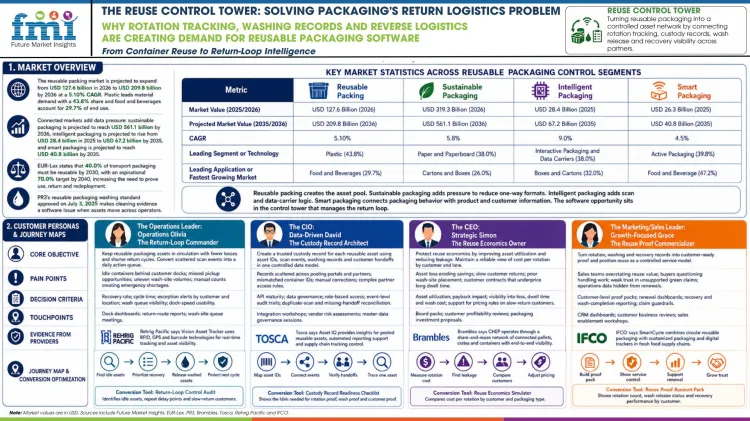
The reusable packing market is projected to expand from USD 127.6 Billion in 2026 to USD 209.8 Billion by 2036. Future Market Insights places the forecast CAGR at 5.10% from 2026 to 2036. Plastic is expected to lead the material segment with a 43.8% share. Food and beverages are projected to account for 29.7% of end-use demand. [1]
Reusable packaging is now part of a wider packaging information market. The sustainable packaging market is expected to reach USD 561.1 Billion by 2036. The intelligent packaging market is projected to rise from USD 28.4 Billion in 2025 to USD 67.2 Billion by 2035. The smart packaging market is forecast to reach USD 40.8 Billion by 2035. [2] [3] [4]
The regulatory signal is stronger than a general circularity claim. EUR-Lex states that 40.0% of transport packaging must be reusable by 2030. The same summary identifies an aspirational 70.0% target by 2040. This creates demand for systems that can prove use, return and redeployment across packaging loops. [6]
PR3’s reusable packaging washing standard was approved on July 3, 2025. The standard provides requirements and recommendations for washing containers, inspecting them and packing them for distribution. This makes cleaning evidence a software problem when reusable assets move across operators. [7]
Key Market Statistics Across Reusable Packaging Control Segments:
| Metric | Reusable Packing | Sustainable Packaging | Intelligent Packaging | Smart Packaging |
|---|---|---|---|---|
| Market Value (2025/2026) | USD 127.6 Billion (2026) | USD 319.3 Billion (2026) | USD 28.4 Billion (2025) | USD 26.3 Billion (2025) |
| Projected Market Value (2035/2036) | USD 209.8 Billion (2036) | USD 561.1 Billion (2036) | USD 67.2 Billion (2035) | USD 40.8 Billion (2035) |
| CAGR | 5.10% | 5.8% | 9.0% | 4.5% |
| Leading Segment or Technology | Plastic (43.8%) | Paper and Paperboard (38.0%) | Interactive Packaging and Data Carriers (38.0%) | Active Packaging (39.8%) |
| Leading Application or Fastest Growing Market | Food and Beverages (29.7%) | Cartons and Boxes (26.0%) | Boxes and Cartons (32.0%) | Food and Beverage (47.2%) |
These figures show that reusable packaging sits between packaging demand and data demand. Reusable packing creates the asset pool. Sustainable packaging creates pressure to reduce one-way formats. Intelligent packaging adds scan and data-carrier logic. Smart packaging connects packaging behavior with product and customer information. The software opportunity sits in the control tower that manages the return loop.
Customer Personas: Running the Reuse Control Tower
The Operations Leader: Operations Olivia - The Return-Loop Commander
Operations Olivia runs packaging movement across plants, retailers, distributors and wash sites. Her problem is asset float. A container that is technically reusable has no value if it is idle behind a customer dock or waiting for wash capacity. She needs a live view of assets by status and next action.
- Core Objective: Olivia must keep reusable packaging assets in circulation with fewer losses and shorter return cycles. She needs to convert scattered scan events into a daily action queue.
- Pain Points: Containers can disappear into customer backrooms after delivery. Return routes can miss assets when pickup and delivery planning are separated. Wash sites can receive uneven asset volumes that delay redeployment. Manual counts can create emergency shortages even when the total asset pool looks large.
- Decision Criteria: Olivia evaluates software by recovery rate and cycle time. She needs exception alerts by customer and location. She also needs wash queue visibility because a returned container is not usable until it is cleaned and released. The system must work at dock speed without adding scanning friction.
- Touchpoints: Olivia reviews dock dashboards, return-route reports and wash-site queue meetings.
Evidence from Providers:
Rehrig Pacific states that its Vision Asset Tracker uses RFID, GPS and barcode technologies for real-time tracking. The company positions the system around status reporting for shipments and asset visibility. This fits Olivia’s need to turn returnable packaging into a traceable operating fleet. [10]
Journey Map & Conversion Optimization:
Olivia’s journey starts with the weekly shortage meeting. She asks why new orders are delayed when assets should already be in the network. She then separates the problem into lost assets, slow returns and wash release delays. A SaaS provider should offer a Return-Loop Control Audit. The audit should identify idle assets, repeat delay points and customers with slow return behavior. Conversion improves when Olivia gets a dispatch-ready recovery list.
The CIO: Data-Driven David - The Custody Record Architect
Data-Driven David owns the evidence layer behind reuse. His issue is not only where the container is located. He must prove who had it, whether it was washed and when it became available again. Reusable packaging becomes difficult when custody records depend on partner spreadsheets and manual uploads.
- Core Objective: David must create a trusted custody record for each reusable asset. He needs asset IDs, scan events, washing records and customer handoffs in one controlled data model.
- Pain Points: Asset records often sit across pooling portals, warehouse systems and transport partners. The container ID used in a wash site may not match the ID used in a customer receipt. Manual corrections can weaken audit confidence. Partner access rules become complex when several companies touch the same asset.
- Decision Criteria: David reviews API maturity and data governance. He needs role-based access and event-level audit trails. He also checks whether the system can reconcile duplicate scans and missing handoffs. Data quality matters because reuse claims fail when the record chain breaks.
- Touchpoints: David reviews integration workshops, vendor risk assessments and master-data governance sessions.
Evidence from Providers:
Tosca’s Asset IQ page states that its traceability solution provides insights for pooled reusable assets and can support automated reporting. The company also states that the solution can identify inefficiencies and help users control supply chain tracking. This evidence supports David’s need for a connected record layer across reusable packaging loops. [9]
Journey Map & Conversion Optimization:
David’s journey starts with a custody-data gap review. He maps where asset IDs, scan records and wash records are created. He then checks whether those records match across systems. A SaaS provider should offer a Custody Record Readiness Checklist. The checklist should show which fields are required for rotation proof, wash proof and customer proof. Conversion improves when David can trace one asset from outbound shipment to wash release.
The CEO: Strategic Simon - The Reuse Economics Owner
Strategic Simon owns the financial case for reusable packaging. He sees reuse as a capital allocation decision. The asset must rotate enough times to justify purchase, pooling or rental cost. If containers are lost or idle, the reuse program becomes another cost center.
- Core Objective: Simon must protect reuse economics by improving asset utilization and reducing leakage. He needs a reliable view of cost per rotation by customer and lane.
- Pain Points: Asset loss can erase the savings from reuse. Slow customer returns can force excess asset purchases. Poor wash-site placement can raise reverse logistics cost. Contract terms can underprice customers that create high asset dwell time.
- Decision Criteria: Simon evaluates software by asset utilization and payback impact. He needs contract-level visibility into loss, dwell time and wash cost. He also checks whether software can support pricing rules for customers that hold assets too long.
- Touchpoints: Simon reviews board packs, customer profitability reviews and packaging investment proposals.
Evidence from Providers:
Brambles states that CHEP operates through a share and reuse network of connected pallets, crates and containers. Brambles also links the model with end-to-end visibility of supply chains. This supports Simon’s need to treat reusable packaging as a managed asset network rather than a one-time packaging expense. [8]
Journey Map & Conversion Optimization:
Simon’s journey begins with a payback question. He asks whether reusable packaging is reducing cost after loss, wash and return freight are included. He then asks which customers weaken the economic case. A SaaS provider should offer a Reuse Economics Simulator. The simulator should compare cost per rotation by customer and packaging type. Conversion improves when Simon sees where pooling terms need a price or process change.
Marketing & Sales: Growth-Focused Grace - The Reuse Proof Commercializer
Growth-Focused Grace must sell reusable packaging without relying on broad circularity language. Buyers want evidence that the program works in daily distribution. They ask whether assets return clean, whether availability is stable and whether the service lowers waste exposure. Grace needs proof that is specific to the customer.
- Core Objective: Grace must turn rotation, washing and recovery records into customer-ready proof. She needs sales materials that show reuse as a controlled service model.
- Pain Points: Sales teams can overstate reuse value when they lack customer-level data. Buyers may question whether reusable assets increase handling work. Green claims can weaken trust when they are not linked to measured rotations. Account renewals become harder when proof sits inside operations systems.
- Decision Criteria: Grace needs customer-level proof packs and renewal dashboards. She values reports that show recovery performance and wash completion. She also needs claim guardrails so sales teams do not use unsupported statements.
- Touchpoints: Grace uses CRM dashboards, customer business reviews and sales enablement workshops.
Evidence from Providers:
IFCO describes SmartCycle as a circular model for reusable packaging in fresh food supply chains. IFCO also says its model uses customized packaging and modern digital trackers. This evidence supports Grace’s need to connect reuse claims with controlled asset movement. [11]
Journey Map & Conversion Optimization:
Grace’s journey starts with a customer asking whether reuse adds work or reduces risk. She needs a simple proof story based on asset rotations and service reliability. A SaaS provider should offer a Reuse Proof Account Pack. The pack should show rotation count, wash release status and recovery performance by customer. Conversion improves when account teams can prove the loop rather than describe it.
Key Market Research Pointers: Future Outlook for B2B SaaS in Reusable Packaging Systems
To provide a specific perspective beyond standard syndicated research, consider these five evidence-based pointers for the future of the Reusable Packaging Systems Market, specifically for B2B SaaS providers:
- Return-Loop Control Towers: Reusable packaging software will move beyond asset tracking screens. The stronger platform will show what action each asset needs next. It will separate assets that are idle, lost, washing, ready or in transit. Operations teams can use this view to protect the next shipment cycle. The value is not location alone. The value is the next decision.
- Custody Ledgers for Shared Packaging Assets: Reusable packaging assets often pass across manufacturers, carriers, retailers and wash partners. SaaS platforms can create custody ledgers that record every handoff. CIOs can use these ledgers to resolve disputes and support audit requests. This matters because reuse evidence weakens when partner records do not match.
- Wash Release Automation: Washing records will become a release gate for reusable packaging. A software layer can connect wash cycle, inspection result and asset status. Operations teams can see which assets are clean enough for redeployment. CIOs can keep a record that supports sanitation and customer proof. This turns washing from a back-office note into an operating control.
- Leakage Pricing for Slow-Return Customers: Reuse economics fail when customers keep assets too long or lose them. SaaS dashboards can calculate dwell time and asset leakage by customer. CEOs can use this view to adjust pooling terms or charge recovery fees. Sales teams can use the same data to explain service expectations during renewals.
- Digital Product Passports for Reusable Packaging: Reusable containers need a digital identity that carries material, owner, rotation count and wash history. This record can support PPWR-style reporting and customer assurance. It can also help asset owners manage repair, retirement and redeployment. The software opportunity is a packaging passport that works across partners.
Uniqueness Explanation: This article does not treat reusable packaging as a material substitution story. It treats reuse as a control-tower problem. The operating shift is from container ownership to return-loop execution. The technology shift is from simple scans to custody records and wash release logic. The buyer shift is from circularity interest to proof that assets return clean and on time.
Conclusion: The Strategic Imperative of Return-Loop Intelligence
Reusable packaging systems are becoming harder to manage with manual records. Each asset must move through use, return, washing and redeployment without breaking the next shipment cycle. The main challenge is not whether the package can survive reuse. The challenge is whether the return loop can be controlled at scale.
B2B SaaS providers must solve this with rotation tracking, custody records and wash release automation. Operations leaders need a daily action queue. CIOs need trusted records across partners. CEOs need reuse economics by customer. Sales teams need proof that the system works. Companies that control the loop will be better positioned to make reusable packaging commercially durable.
Ready to run reusable packaging as a controlled asset network? Request a Demo of our Reuse Control Tower Platform to track rotations, verify wash release and recover assets before the next shipment cycle.
References
- [1] Future Market Insights. "Reusable Packing Market Size, Share & Trends 2026 to 2036." February 24, 2026.
- [2] Future Market Insights. "Sustainable Packaging Market: Global Industry Analysis and Opportunity Assessment 2026 to 2036." May 28, 2026.
- [3] Future Market Insights. "Intelligent Packaging Market | Global Market Analysis Report." May 16, 2026.
- [4] Future Market Insights. "Smart Packaging Market Size, Companies, Share & Trends 2025 to 2035." July 2, 2025.
- [5] European Commission. "Packaging waste."
- [6] EUR-Lex. "Packaging and packaging waste from 2026." September 26, 2025.
- [7] PR3. "RES-002:25/CSA R303:25 Reusable Packaging System Design Standard: Container Washing, Inspection, and Packing for Distribution." July 3, 2025.
- [8] Brambles. "Annual Report 2025." August 21, 2025.
- [9] Tosca. "Supply Chain Tracking & IoT - Tosca Asset IQ."
- [10] Rehrig Pacific. "Tracking Assets with the Vision Technology Platform."
- [11] IFCO. "Redefining the fresh grocery supply chain."

